Key takeaways
- Local GEO is local SEO plus one new question: when someone asks an AI assistant for the best tacos near them, does your specific store get named, or just your brand?
- The fundamentals still feed AI answers: consistent listings, genuinely unique location pages, review volume, and structured data. They are necessary, but not sufficient on their own.
- ChatGPT started using the site: operator at scale on August 8, 2026, so location pages and store locators that are not crawlable and indexed now cost you answers.
- Local tools (SOCi, Yext, Birdeye, Malou) handle listings and reviews. AI visibility platforms handle the prompt tracking. Most chains need one of each.
- Measure per location, not just per brand. Seattle can be visible while Denver is invisible, and a brand-level average hides that.
What local GEO actually means
Multi-location SEO is the work of getting every individual store, not just the brand homepage, to show up for its own city and neighborhood. Local GEO (generative engine optimization) extends that to AI answers. The question changes from "do we rank in the map pack for burgers in Austin?" to "when someone asks ChatGPT where to get a good burger in Austin, is our Austin location in the answer, and does the answer get the hours and address right?"
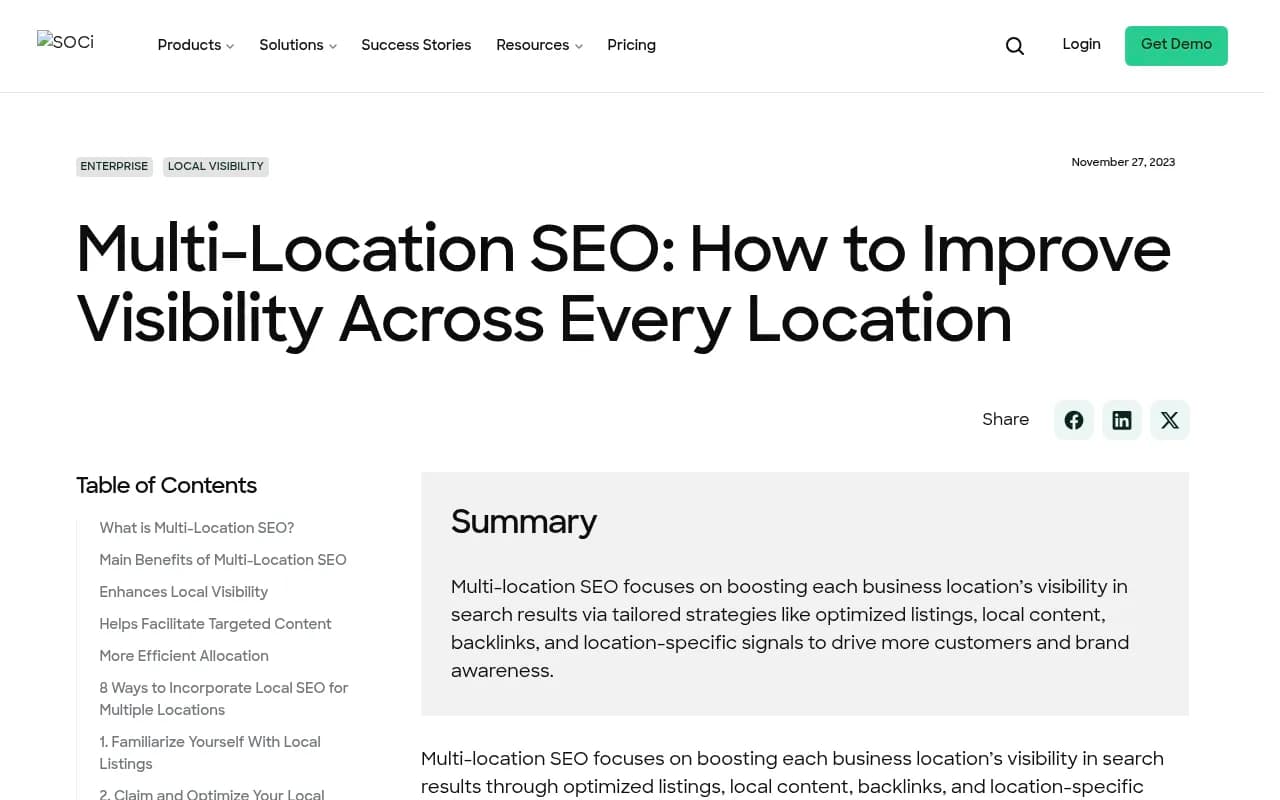
The tactics overlap heavily. SOCi's guide for enterprise brands makes the same point: accurate listings, local pages, reviews and schema markup feed both traditional and AI systems, but they are not enough alone for AI visibility. I agree with that framing. The foundation is the same. What is new is that you now need to check the output, because AI engines synthesize and sometimes get things wrong.
SOCi's own research cites that 83% of U.S. consumers used search engines to find a local business, 55% used social media, and 52% used AI tools. Treat those as SOCi's numbers, but the direction is clear: AI is now one of three places people look, not a fringe channel.
What AI engines are doing differently in late 2026
I could not find a Promptwatch report built specifically on restaurant or retail prompts, so take the following as adjacent evidence, not local-only data. Still, it shapes the tactics.
ChatGPT now searches your domain directly
On August 8, 2026, ChatGPT Search started using the site: operator at scale. Per Promptwatch Data, site: queries jumped from 0.37% to 16.8% of fanout queries, and average fanout queries per response rose from about 1.08 to about 1.83. For a chain, the implication is practical. ChatGPT may run a search restricted to your domain to find the Phoenix location. If your location pages are thin, blocked, unindexed, or buried behind a JavaScript-only store locator, that search comes back empty.
Pages that describe what you sell get cited most
In Promptwatch's ChatGPT citation data by content type (Sep 28 to Oct 4, 2026), product pages were 22.4% of citations and landing pages 16.8%. Commercial prompts skewed higher still: 26.0% product pages and 20.6% landing pages. For chains, my inference is that location pages and menu or product pages are the equivalents. The report does not say that, so verify it on your own prompts. For branded prompts, reviews rose to 5.6% and FAQ pages to 4.8%, which fits what you would expect when someone asks about a specific restaurant.
Social citations differ by engine
Per Promptwatch's social media citations report (Sep 28 to Oct 4, 2026), ChatGPT drew just 0.46% of its citations from social platforms, while Google AI Overviews drew 12.2%. In AI Overviews, YouTube took 4.28%, Facebook 2.38% and Instagram 1.61%. Branch-level content often lives on Facebook and Instagram pages, so keep those complete and active if Google is your main audience. Don't build a local strategy on Reddit for ChatGPT: reddit.com's citation share collapsed on August 14, 2026.
The foundations that still decide everything
One verified Google Business Profile per location
Each physical location needs its own verified profile. Common violations in multi-location setups: keyword stuffing in the business name, virtual office addresses, duplicate listings for one store, and P.O. boxes. Use bulk management or the Business Profile API once you pass roughly ten locations. Standardize naming conventions and categories centrally, then let each store add local details.
NAP consistency
Inconsistent name, address and phone data confuses both Google and AI models about which version is true. Audit the main directories, remove duplicates, and make the GBP data match what is on your site. This is boring work and it is where a lot of chains quietly lose. Moved stores, changed holiday hours, and old franchisee listings are the usual culprits.
Location pages that are not one template with a swapped address
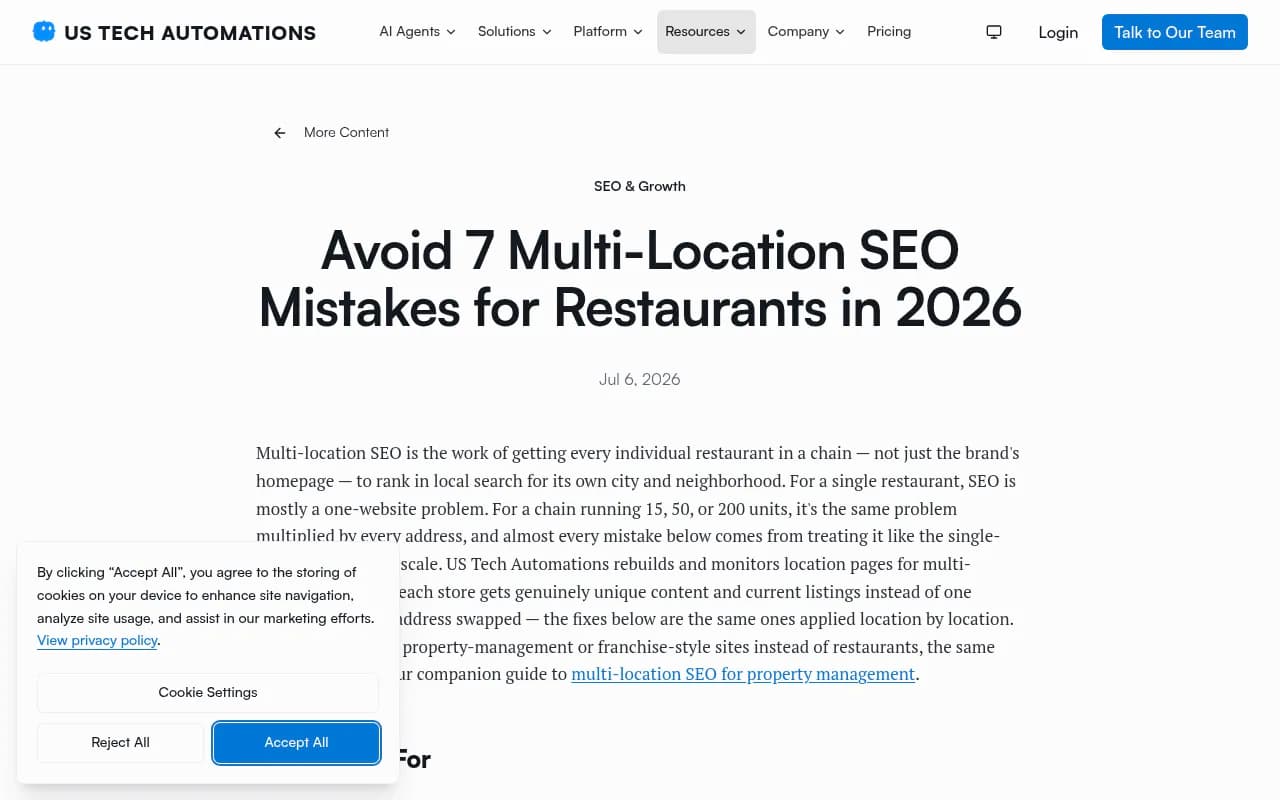
Templated pages are the most common reason chains under-rank across the board, according to US Tech Automations' restaurant guide. Standardize the template, but fill it with real local material: the neighborhood, parking, local staff or manager notes, nearby landmarks, location-specific menu items or services, local events, and photos of the actual store with sensible alt text.
V9 Digital's case study of a major retailer with hundreds of stores followed the same pattern: standardized templates with local differentiation, clarified URL structure, store-specific details, local business schema, and internal links between location pages. Their FAQ answer to whether you need separate pages is blunt: yes, each location gets a dedicated page with at least some unique content.
A crawlable store locator
A store locator that lists every location on one page helps customers and gives crawlers a clean path to each store. Given the site: operator change, check that every location page is reachable through plain HTML links, appears in your sitemap, and is not orphaned. Locators that load stores only through a map widget are a risk.
Reviews, per location
SOCi reports that profiles ranked 1 to 3 carry 21% more reviews on average than those ranked 4 to 10, and that a one-star increase corresponds to a 44% conversion lift. Those are SOCi's claims, so use them as directional, not gospel. What holds up regardless: review volume, recency and your response rate all matter, and AI answers draw on review content. Track them store by store. A franchise-style health score (rating, review count, response rate, hours consistency, category completeness) is a useful way to spot weak locations, as the Bayard Bradford Google Maps guide describes.
Structured data
Deploy Restaurant or LocalBusiness schema on every location page with address, hours, phone, geo coordinates, menu or service links and review markup where eligible. Generate it from one source of truth so that a change to holiday hours propagates everywhere. Tools like InLinks and WordLift automate parts of schema and entity markup.

The GEO layer: content built to be extracted
V9 Digital describes GEO for local business as structuring content so generative systems can confidently extract and reference it, on top of strong foundational SEO. Concretely:
- Put the answer first. A location page should state in the first screen what the store is, where it is, when it is open, and what makes it distinct.
- Add a short FAQ per location: parking, reservations, delivery, dietary options, accessibility. FAQ pages were 4.8% of branded-prompt citations in the Promptwatch content-type data, small but present.
- Keep menus, prices and services complete and factual. Vague marketing copy gives a model nothing to quote.
- Use the phrasing customers use. Prompts look like "best gluten-free pizza near the convention center", not "pizza Denver".
- Maintain public Facebook, Instagram and YouTube presence where they carry branch content.
Content from third parties matters too. Local press, neighborhood blogs and food guides get cited. A digital PR push per market can pay off more than another round of on-page tweaks.
Tools: what to use for what
No single product covers everything. The categories below are separate jobs, and the pricing of most of these tools is quote-based, so confirm current plans directly. I did not verify feature or pricing details for the local-listing platforms beyond what the vendors state about themselves.
Listings, reviews and local SEO platforms
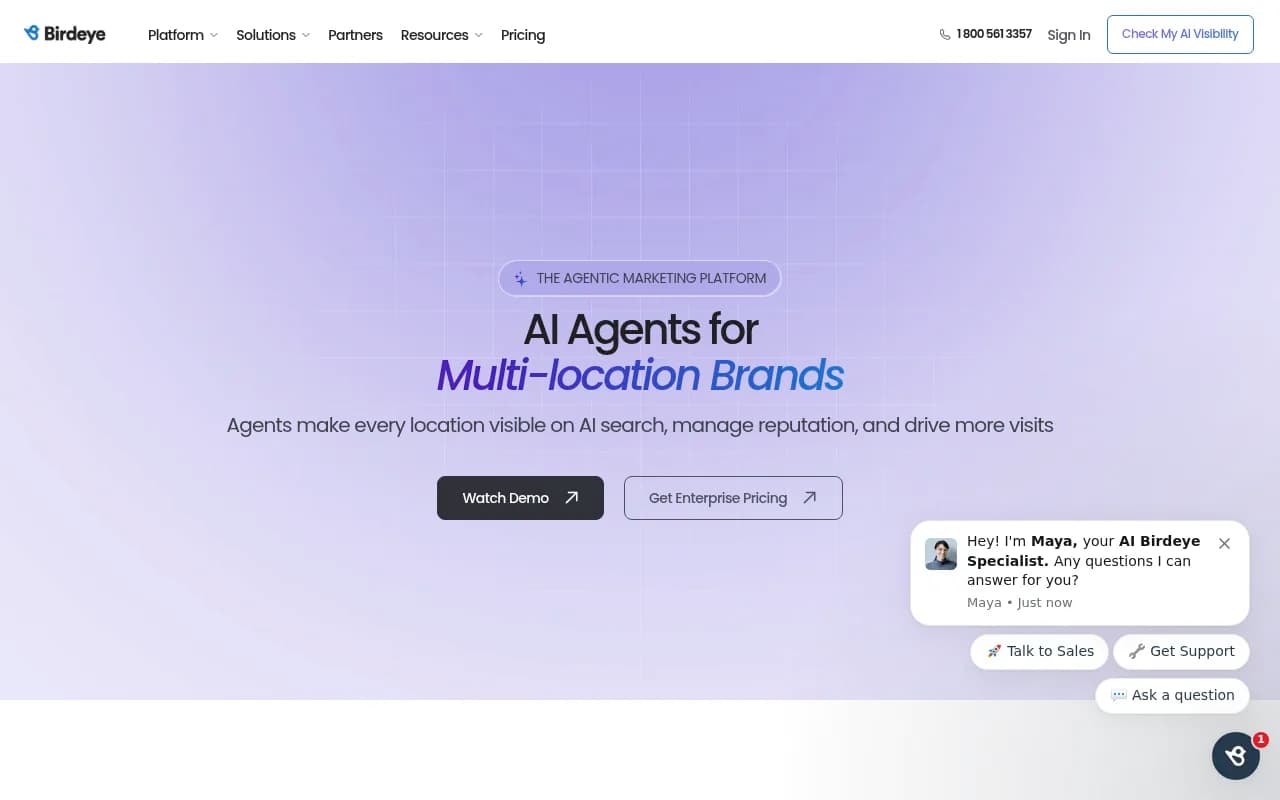
SOCi, Yext, Birdeye, Uberall and Malou are the names that come up most for multi-location work. SOCi positions itself around enterprise brands with a Genius agent suite for search and reputation. Malou targets restaurant groups specifically. Birdeye has a catalog entry for location-level AI visibility, and Yext has Scout for AI search competitive intelligence.
Yext Scout
AI visibility tracking
This is the part local suites typically do not do deeply: running real prompts across ChatGPT, Google AI Overviews, Perplexity and others, and seeing which locations and which sources get named. Promptwatch tracks real user-interface answers by country and, on Business plans, by state and city, which matters when a prompt like "best brunch in Portland" needs to be checked as a local user would see it. Its IP-verified AI crawler logs also help diagnose the post-August-8 question of whether AI crawlers are reaching your location pages, and the Action Board turns gaps into a prioritized to-do list.

Other platforms in the catalog worth a look depending on budget and scale:




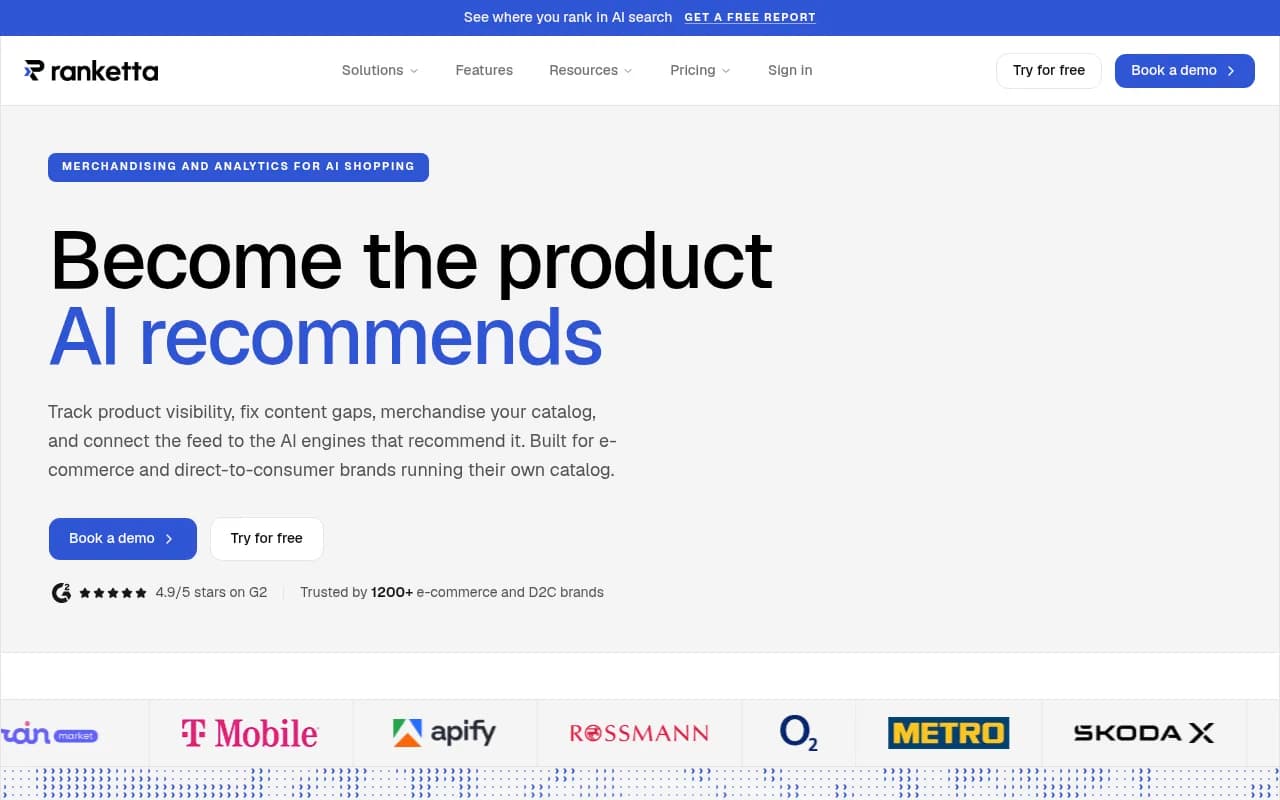
For retail chains with large product catalogs, Yotpo Discover and Ranketta focus on product-level AI visibility.
Yotpo Discover
For technical crawl health across hundreds of location pages, enterprise platforms like Botify and BrightEdge are built for that scale.
More options are listed in the GEO software directory at bestgeosoftware.com.
Comparison by job
| Job | What to look for | Example tools |
|---|---|---|
| Listings and NAP sync | Bulk publishing, duplicate suppression, GBP API | SOCi, Yext, Uberall, Malou |
| Review management | Per-location response tracking, request automation | Birdeye, SOCi, Malou |
| Local rank tracking | Grid-based map pack tracking | Local Falcon, BrightLocal |
| AI prompt tracking | Real-UI answers, city-level tracking, citations | Promptwatch, Profound, Scrunch AI |
| Crawl and indexing health | Crawler logs, site audits, orphan page checks | Promptwatch, Botify |
| Schema and entities | Template-driven structured data | InLinks, WordLift |
A rollout plan that works for 20 or 200 locations
Weeks 1 to 2: audit
Pull every GBP, check for duplicates and unverified profiles, and compare NAP across the top directories. Crawl the site and list every location page with its indexation status. Note which pages are templated clones.
Weeks 3 to 6: fix the foundation
Correct listings, rewrite location pages with real local content, deploy schema, build or repair the store locator, and set a review-response SLA. US Tech Automations suggests responding within 48 hours and tracking it per location. Don't expect dozens of new rankings in month one, since crawl and authority build over time.
Weeks 4 to 8: build the prompt set
Write 30 to 100 prompts per market that mimic real customer questions: category plus neighborhood, "open now", dietary or service constraints, comparison against local competitors. Track them in an AI visibility tool. Because ChatGPT fanouts changed on August 8, rebuild any keyword mapping created before that date.
Ongoing: measure by location
| Metric | Source | Cadence |
|---|---|---|
| GBP views, calls, direction requests | GBP Insights or API | Weekly |
| Map pack position by grid | Local Falcon, BrightLocal | Weekly |
| Reviews, rating, response rate per store | Review platform | Weekly |
| AI mention and citation rate per location | AI visibility tool | Weekly |
| AI crawler hits on location pages | Crawler logs | Weekly |
| Traffic and conversions by location page | GA4 | Weekly |
Local-intent traffic often converts better than broad national traffic, so judge performance on calls, directions and orders rather than raw sessions.
Common mistakes
- Treating GBP as set and forget. Hours drift, categories change, and photos go stale.
- Assuming brand authority transfers evenly. It does not. A strong Seattle store tells you nothing about Denver.
- Letting franchisees edit listings with no governance, which breeds duplicates.
- Reporting a single brand-level AI visibility score. Break it down by market.
- Chasing Reddit for ChatGPT visibility after the August 14 drop.
- Publishing hundreds of near-identical pages at once.
When to bring in help
The operational load is real once you pass about 50 locations: listings governance, page production, review ops and AI monitoring all need an owner. Agencies that combine local SEO with GEO, such as 1001 SEO Media, can set up the reporting and content process, while the tools above do the day-to-day tracking.
Bottom line
Start with the unglamorous work: one clean profile per store, consistent data, genuinely local pages, and reviews you answer. Then add a prompt-tracking tool so you can see which locations AI engines actually recommend, and fix the weak markets first. Check your location pages' indexability this month, given ChatGPT's shift to searching brand domains directly.