Key takeaways
- Aiso's real differentiator is its consent-based panel of real human-AI conversations, but the product is young: only 5 of 12 planned features are live as of September 2026, and third-party review coverage is thin.
- If you want an end-to-end platform that monitors, explains, and fixes your AI visibility, Promptwatch is the strongest alternative, with crawler logs, content agents, and CMS publishing from $95/mo.
- For pure budget monitoring, Otterly.AI starts at $29/mo, though the jump to its Standard tier is steep at $189/mo.
- Peec AI ($95/mo Starter) and AthenaHQ (free Essential tier) sit in the middle, offering solid tracking with some optimization features.
- Enterprise buyers should shortlist Profound and Scrunch AI, both of which have raised significant funding and offer deeper analytics at higher price points.
Why look for Aiso alternatives?
Aiso (getaiso.com) does something genuinely interesting: instead of running synthetic prompts through AI models and watching what comes back, it samples from a consent-based panel of real human-AI conversations, drawing on a database of over 10 million chats. Each prompt gets run roughly ten times to capture answer variance, and the Conversation Explorer lets you browse actual category conversations classified by intent and language. That's a real methodological difference, and for demand-gen teams trying to understand what buyers actually ask AI assistants, it matters.
But there are legitimate reasons to shop around. The product is early in its life. As of September 2026, only five of twelve planned features are live: Conversation Explorer, Fan-outs & GPT Trends, AI Mention Tracker, Crawlability Audit, and Third-Party Source Mapper. The schema generator, content engine, competitive benchmarking, and alerts are all still "coming soon." If you need a complete platform today, that roadmap gap hurts.
Pricing has quirks too. The Starter plan is currently $19/mo on what the site calls a summer sale (list price $89/mo, with no stated end date), but the next tier up, Pro, costs $215/mo. That's a steep cliff. The REST API is gated behind Enterprise or the agency Scale plan at $705/mo, though the hosted MCP server (19 tools) is now included on every plan. And the public review footprint is thin: one Trustpilot review (3.7 rating) as of August 2026, and little presence in the major third-party comparison roundups, which mostly cover Profound, Scrunch, Otterly, Peec, and the SEO suites.
None of this makes Aiso a bad product. It makes it a bet on a young platform with a smart data approach. If that bet doesn't fit your risk tolerance, here are the alternatives worth your time.
The best Aiso alternatives in 2026
Promptwatch

Promptwatch is the closest thing to a complete replacement if your concern is Aiso's missing features. Where Aiso has five live features and seven on the roadmap, Promptwatch ships the full stack today: prompt tracking with volumes and difficulty scores, citation trends, AI crawler logs, visitor analytics, content gap analysis, offsite mention tracking, Reddit and YouTube citation reports, ChatGPT Shopping and Ads Radar, and automated content agents that plan, write, and publish GEO-optimized content straight to Webflow, Framer, or WordPress.
The crawler logs are the piece most competitors lack entirely. You can see exactly when ChatGPTBot, ClaudeBot, PerplexityBot, or any of 400+ other crawlers hit your site, which pages they read, and whether they hit errors. That answers the "why" behind your visibility scores in a way prompt-only trackers can't. Promptwatch monitors the actual user interfaces of ChatGPT, Gemini, Claude, Perplexity, Grok, DeepSeek, Copilot, and Google's AI surfaces, not just API outputs, which can differ from what users actually see.
The company has real traction: 1,840+ customers including Duolingo, Yelp, Typeform, and agencies like Monks and WPP, a 4.7/5 G2 rating, and a dataset of more than 4.5 billion citations, clicks, and prompts analyzed. Pricing runs from a free Explore tier through Essential at $95/mo, Professional at $245/mo, and Business at $579/mo, with agency plans from $199/mo. The free 7-day trial on Essential is worth using before committing.
The honest trade-off: Promptwatch doesn't use Aiso's real-conversation panel approach. Its prompt data comes from its own massive tracking and response dataset rather than sampled human chats. If real buyer conversations are your primary research need, Aiso's Conversation Explorer is still unique. But for everything else, monitoring, explanation, and execution, Promptwatch covers more ground.
Otterly.AI
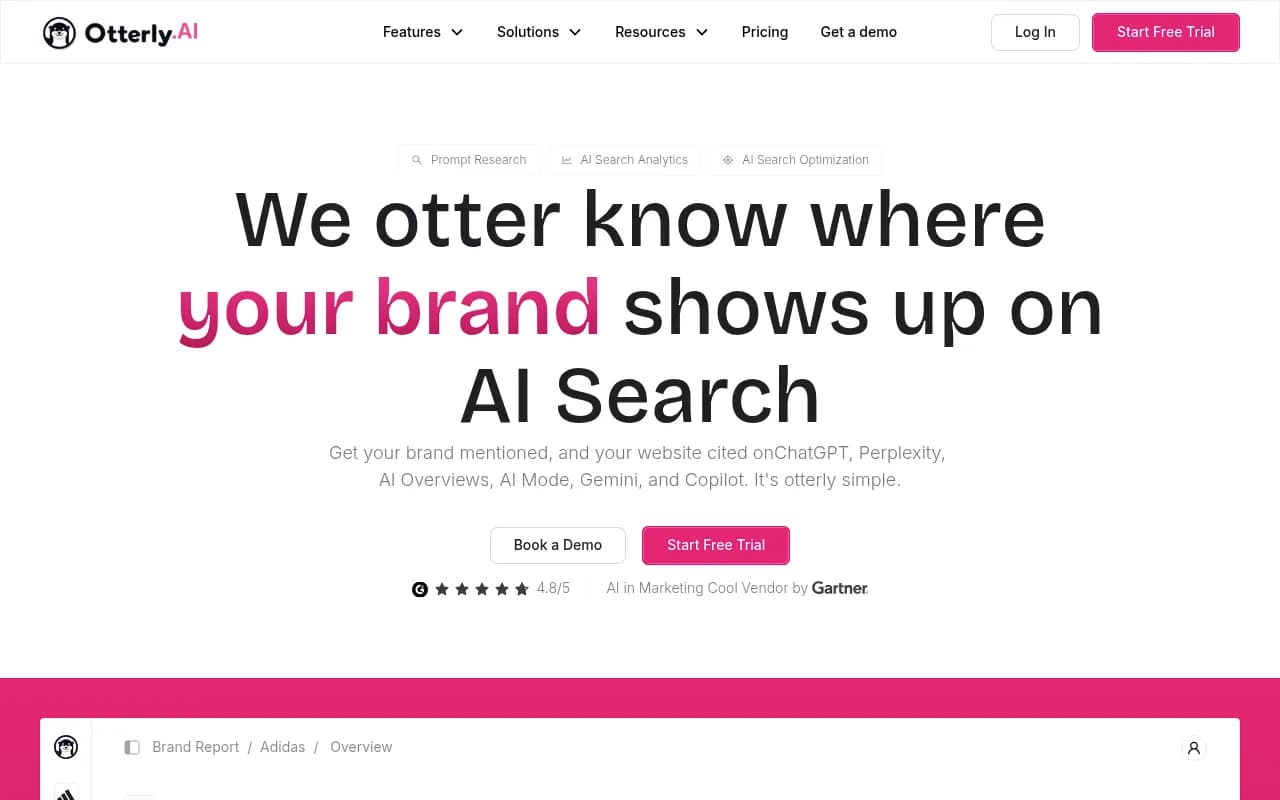
Otterly.AI is the budget entry point of the category and the pick multiple independent roundups agree on for small teams. Lite runs $29/mo ($25/mo annual) with 15 prompts, daily tracking, unlimited team members, multi-country coverage across 50+ countries, ChatGPT Ads tracking, and 1,000 GEO URL audits per month. The 14-day free trial requires no credit card and includes 50 prompts plus 1,000 API and MCP calls.
The catch is the tier cliff. Standard, at $189/mo, is a 6.5x jump from Lite. Multiple reviewers flag this as the single biggest buying decision with Otterly: if 15 prompts won't cut it, you're paying enterprise-adjacent money fast. Add-ons for Google AI Mode and Gemini cost extra ($9 to $149/mo depending on tier), and engine coverage on the core plans is ChatGPT, Google AI Overviews, Perplexity, and Microsoft Copilot, with Gemini as a paid add-on.
Otterly is a monitoring layer, not an execution layer. It gives you GEO content audits and weekly recommendations, but no content generation or CMS publishing. Pair it with a separate content workflow if you go this route. For teams that want to prove the AI visibility category internally before committing real budget, it's the cheapest credible way to do that.
Peec AI
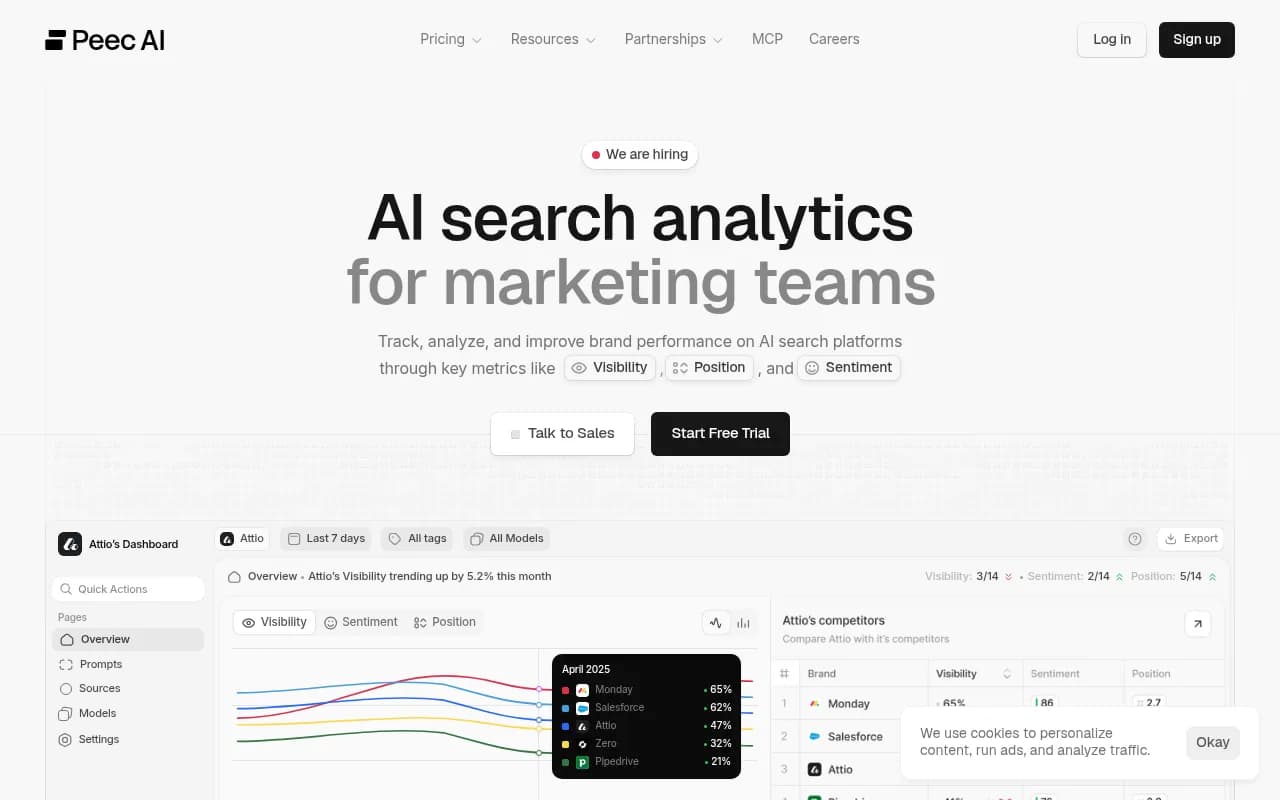
Peec AI splits the difference between Otterly's budget tier and the enterprise platforms. Starter is $95/mo with 50 prompts, 3 models, 1 project, daily tracking, and unlimited users. Pro is $245/mo with 150 prompts and 2 projects, Advanced is $495/mo with 350 prompts and multi-country tracking, and Enterprise adds up to 13 LLMs, API access, and SSO.
The feature set is broader than the price suggests. Peec includes AI Shopping and SKU-level tracking, an ads library for sponsored placement tracking, a source and crawlability audit covering 40+ bots, AI referral analytics, and the Peec agent with pre-built and custom skills. The interface is clean, and the visibility, position, and sentiment metrics are presented in a way that marketing teams can actually use in stakeholder reports.
Where Peec falls short of a full replacement: content optimization is recommendations-only rather than automated generation, and there's no CMS publishing. It's a strong tracker with smart suggestions, not a do-it-for-you system. If your Aiso use case is prompt research plus mention tracking plus competitive benchmarking, Peec covers it well at a fair price. If you want the fixing automated, look at Promptwatch or Writesonic instead.
Profound
Profound is the most established name in AI visibility analytics. Fortune reported in February 2026 that it raised a $96 million Series C at a $1 billion valuation, bringing total funding to $155 million, and its platform processes a self-reported 100M+ AI queries per month. It tracks 10+ engines, offers deep citation analytics, sentiment, competitor benchmarking, and enterprise-grade reporting, and it's SOC 2 Type II certified.
In 2026 Profound added a real action loop: Projects turns findings into ranked tasks, and Aim converts signals into work and measures what moved. That closed loop shipped in late June and early July 2026, which addresses the historical criticism that Profound was analytics-only. The maturity of those newer workflows is still the fair concern, and agent runs draw on monthly credits that cap the work available per plan. Starter tracks ChatGPT only, with broader engines and shopping on higher tiers.
Pricing is demo-gated at the enterprise end, with aggregator-reported entry around $99/mo. Aiso itself positions directly against Profound, arguing that Profound relies on synthetic prompts and simulated conversations while Aiso uses real chat data. Profound's own scale, data volume, and polish are real strengths, and Aiso's comparison page acknowledges as much. For enterprise brands that want the most established analytics product with the strongest customer evidence, Profound is the safe pick.
Scrunch AI
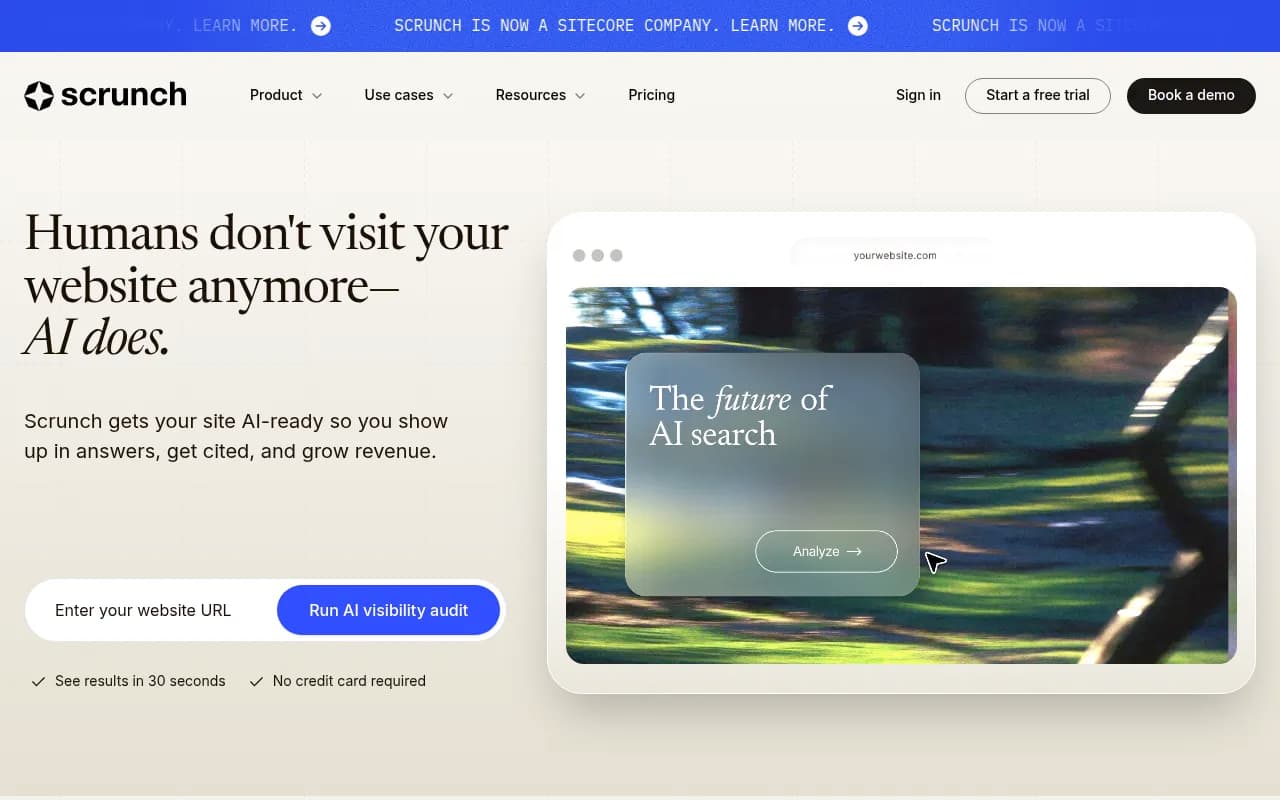
Scrunch has repositioned itself around what it calls the Agent Experience Platform (AXP): the idea that AI agents, not humans, are increasingly the ones visiting your site, and your site needs to serve them. Its product now spans monitoring and citations, agent traffic analytics, site diagnostics for how AI consumes your content, and content delivery that serves optimized experiences directly to AI agents.
Core pricing starts at $250/mo with 125 unique prompts, 4 AI models (ChatGPT, Google AI Overviews, Perplexity, Microsoft Copilot), 1 country, 5 competitors, limited query fan-out, and 1 page optimization per month. Enterprise adds Claude, Gemini, Meta AI, Google AI Mode, and Grok for nine total engines, plus a Query API and CLI, SSO, and the full AXP. There's a 7-day free trial of Core.
At $250/mo, Scrunch is the priciest entry point among the major self-serve tools, against a category median around $89/mo. It's not built for casual experimentation. But for teams whose real problem is that AI agents can't access or interpret their site properly, the diagnostics and content delivery angle is genuinely differentiated, and it's something none of the prompt trackers do.
AthenaHQ
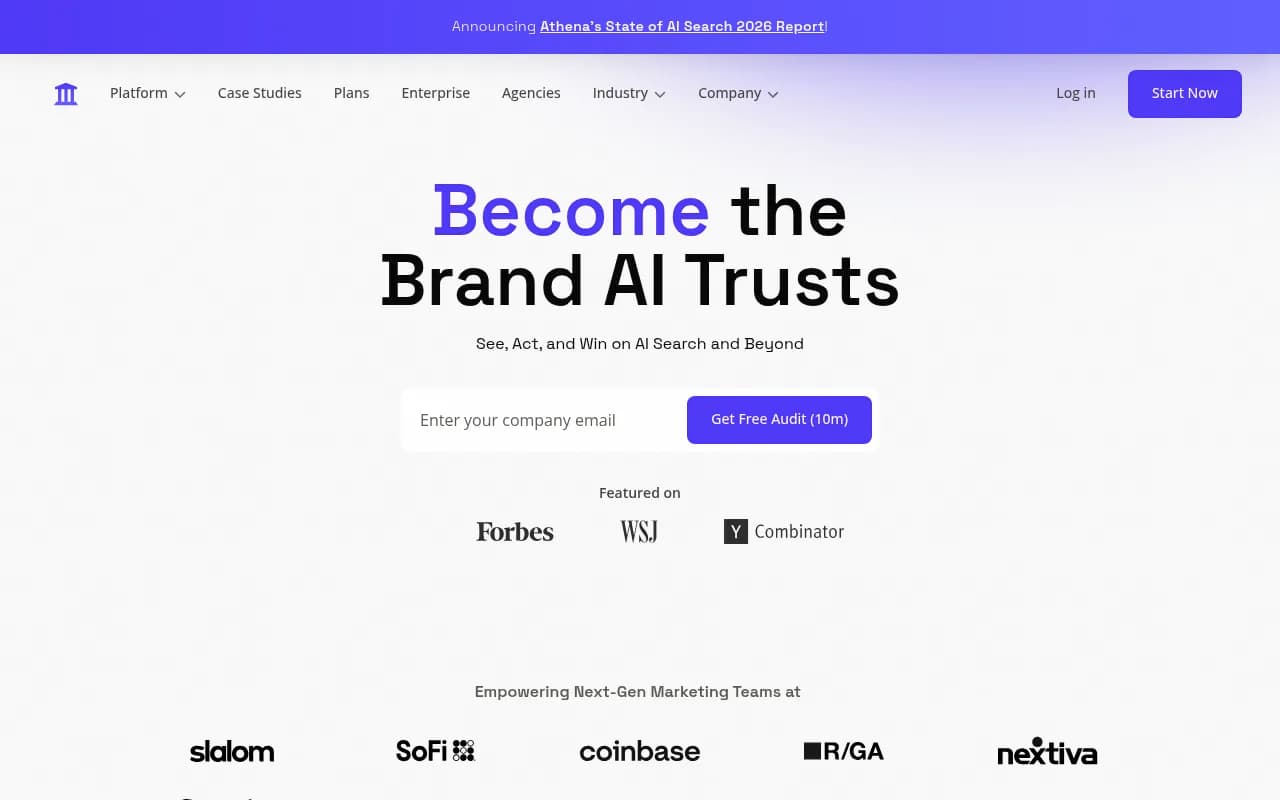
AthenaHQ is the only tool on this list with a genuinely free tier worth having. The Essential plan costs nothing and includes 300 credits per month (1 credit = 1 AI response), tracking across 5 AI models (ChatGPT, Perplexity, Google AI Overviews, Gemini, Claude), unlimited team members, competitor insights, and the Athena AI agent. That's enough to run a serious baseline audit of your AI visibility without spending anything.
Paid plans start at $295/mo for Starter (3,600 credits, 9 models, content optimization agent, CSV export), with Enterprise adding multi-country tracking, the Athena Citation Engine, advanced content agents, and executive BI dashboards for Tableau, Power BI, and Looker. There's no free trial on paid tiers, which is a bit unusual, but the free tier functions as one. AthenaHQ has Y Combinator backing and enterprise clients including Coinbase, Hearst, and SoFi.
The gap between free and $295/mo is stark, with no middle tier on the official pricing page. If the free tier's 300 credits cover your prompt volume, it's the best value in the category. The moment you outgrow it, you're in enterprise pricing territory.
Ahrefs Brand Radar
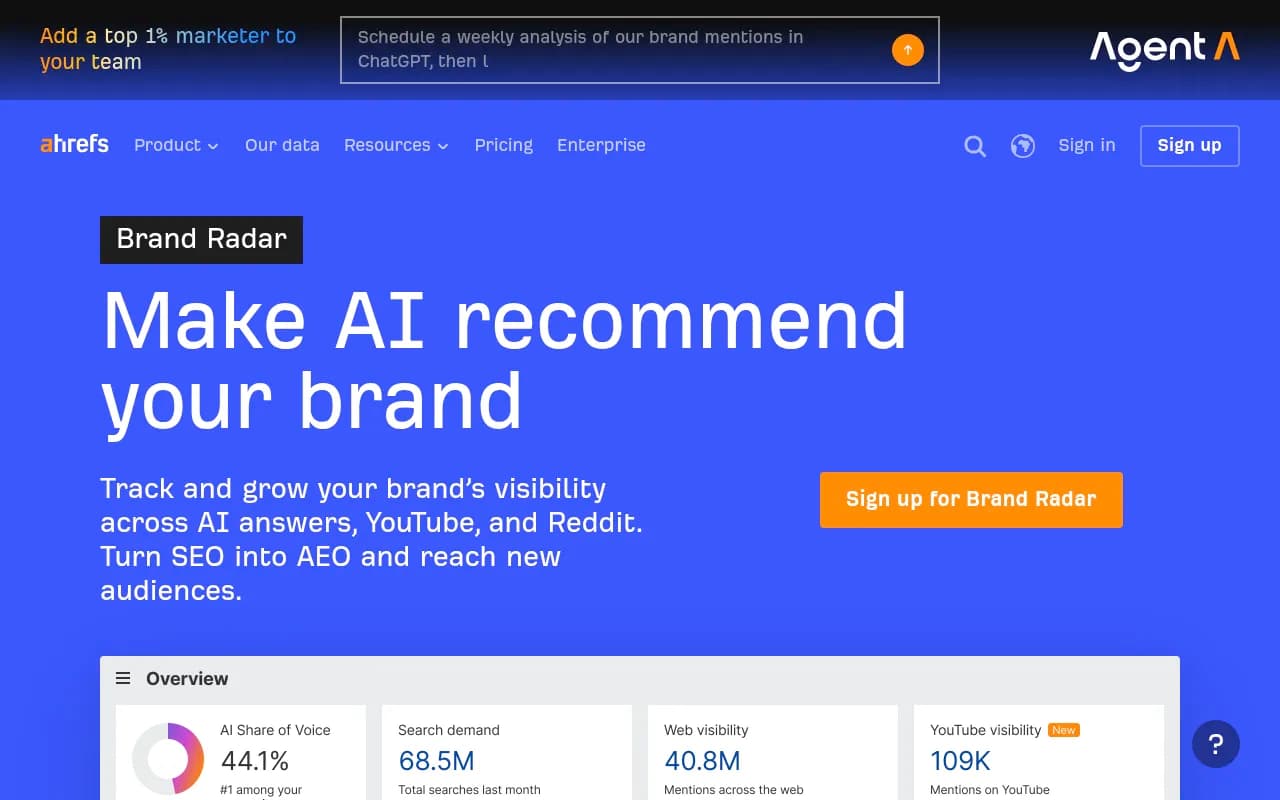
Brand Radar extends Ahrefs' keyword research methodology into AI answers, and its biggest asset is scale: prebuilt indexes covering 475M+ search-backed prompts, letting you research brands, domains, citations, topics, and competitors before committing any prompts to regular tracking. It covers Google AI Overviews, Google AI Mode, ChatGPT, Perplexity, Gemini, Copilot, and Grok, with beta channels for YouTube, Reddit, and TikTok.
Pricing is an add-on to an Ahrefs subscription: $398/mo for select platforms or $699/mo for all platforms, on top of your existing Ahrefs plan. That makes it the most expensive way in if you're not already an Ahrefs customer. It's also research and reporting oriented rather than action oriented. It reports what it finds without acting on it, which reviewers consistently note as its main limitation for daily monitoring programs.
The right use case is a one-off market-mapping exercise: discover which prompts matter in your category, who's being cited, and where the demand is, then build a smaller daily monitoring program elsewhere. If you already pay for Ahrefs and want AI visibility data connected to the web index you already trust, it's a natural extension. If you don't, the total cost is hard to justify.
Semrush
Semrush's AI Visibility Toolkit is the pick if your team already lives in Semrush and wants AI visibility data next to your existing SEO, PPC, and content workflows. The standalone toolkit costs $99/mo per domain (billed annually) and includes 300 daily queries in AI Analysis, 1,000 daily queries in Prompt Research, 25 tracked prompts, and AI search checks in Site Audit for up to 100 pages. Self-serve covers ChatGPT, Google AI Overviews, Google AI Mode, Perplexity, and Gemini; Enterprise adds Claude, Copilot, Grok, and DeepSeek.
The cost compounds quickly. Extra domains are $99/mo each, an extra 50 prompts is $60/mo, and if you're not already a Semrush subscriber, classic SEO plans start at $139.95/mo separately, or you bundle into Semrush One from $199/mo. Profound's own comparison blog calculates that one extra teammate plus 50 prompts puts you at $258/mo. There's no free trial on the standalone toolkit.
Semrush's strength is breadth: keyword research, backlink data, rank tracking, content tools, and now AI visibility in one subscription. Its weakness is depth on the AI-specific side. The prompt sets are more fixed, the AI-specific analytics are shallower than dedicated platforms, and there are no crawler logs or AI traffic attribution. For existing Semrush customers, it's a convenient add-on. For AI-visibility-first buyers, the dedicated tools go deeper.
Writesonic GEO
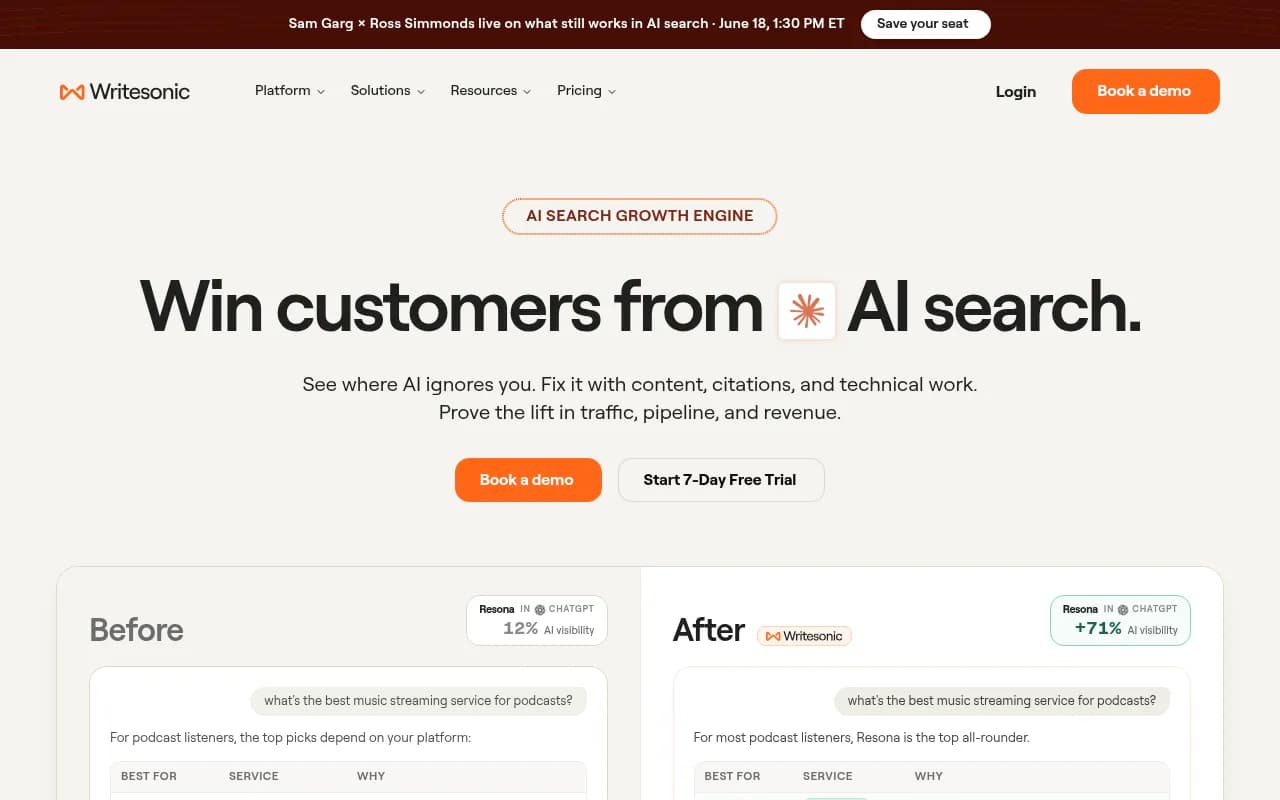
Writesonic approaches the category from the content side rather than the analytics side. Its pitch is execution: autonomous agents that take a detected visibility gap through content creation, outreach, and technical work, then measure what changed. The founder's own comparison piece (with disclosed conflict of interest) scores it highest on execution depth for exactly this reason, and the platform's before/after demos showing a brand going from rarely mentioned to featured in 71 of 100 tracked prompts are compelling.
The pricing structure requires attention. Headline plans show $79/mo and $199/mo billed annually, but GEO prompt tracking only unlocks at the Professional tier with 100 AI prompts per month. Advanced doubles that to 200 prompts and adds sentiment analysis plus AI prompt search volume. One aggregator notes that GEO monitoring effectively sits behind a $249/mo plan, with the cheaper tiers covering AI content creation only. There's a 7-day free trial with no credit card.
If your bottleneck is producing the content that closes visibility gaps, and you want monitoring and generation in one system, Writesonic fits. If you want deep visibility analytics first and content second, the dedicated platforms above give you more data per dollar. The engine coverage on lower tiers is narrower too, with all 10 platforms only at Enterprise.
How to choose between these alternatives
Start with your primary need, because these tools overlap less than their marketing suggests.
If you want one system that finds gaps and fixes them, Promptwatch and Writesonic are the execution-first picks. Promptwatch has the deeper analytics stack (crawler logs, citation trends, Reddit and YouTube tracking, shopping and ads radar); Writesonic leans harder into autonomous content and outreach agents. Both publish to your CMS. Promptwatch starts at $95/mo versus Writesonic's effective $199-249/mo for GEO features, which matters if budget is tight.
If you want pure monitoring at the lowest cost, Otterly.AI at $29/mo is the entry point, with AthenaHQ's free tier as the zero-cost option for a first audit. Peec AI at $95/mo gives you more features per dollar than either once you need 50+ prompts.
If you're an enterprise team buying for scale, Profound and Scrunch are the two to demo. Profound has the most established analytics and the strongest customer evidence; Scrunch has the unique agent-experience angle if your problem is site accessibility to AI agents. Ahrefs Brand Radar earns a spot if you're already in the Ahrefs ecosystem or want a one-off market research exercise.
And if Aiso's real-conversation data panel is what drew you in, hold that thought. It's a genuinely different data source, and nothing on this list replicates it exactly. The question is whether that single differentiator outweighs a feature set that's still being built. For most buyers in 2026, a mature platform with crawler logs, content execution, and multi-engine coverage will deliver more measurable results faster. Run a two-week trial with five revenue-tied prompts on your shortlisted tool, hold engines and locations constant, and judge the winner by what it actually produces, not how the dashboard looks on day one.
If you want to browse the full category beyond these nine, the GEO software directory at bestgeosoftware.com and the AI rank tracking tools directory at ai-rank-tools.com both maintain current listings with pricing and feature breakdowns.