Key takeaways
- Output volume is not a success metric. A scaled program works when pages stay indexed, get cited by AI answers, and drive conversions, not when the publishing calendar is full.
- Google's scaled content abuse policy (introduced March 2024) targets low-value pages regardless of how they were made. One third-party report claims 50-80% traffic drops for hit sites after the March 2026 core update. I couldn't verify that figure, so treat it as directional.
- Promptwatch Data shows content types decay at very different speeds in ChatGPT. News loses half its cited pages in 36 days, while landing pages and docs are still cited at 78% and 76% after 30 days.
- The failures are quiet. Rankings look fine, impressions hold, and meanwhile indexing stalls, bounce rates climb, and nobody is cited.
- Check the ten signs below monthly. If four or more of the failing signs are true, pause publishing and fix the system before adding more pages.
Why scaled programs fail without anyone noticing
I've seen this pattern a lot. A team sets up an AI-assisted pipeline, publishes 50 or 100 pages a month, and the dashboard looks great for a quarter. Pages are live, impressions climb, the cost per article is tiny. Then the plateau arrives, and then the slide.
The slide is quiet because the metrics most teams watch (pages published, words produced, keyword coverage) are inputs. They keep going up while outcomes fall. By the time organic traffic visibly drops, the damage is months old.
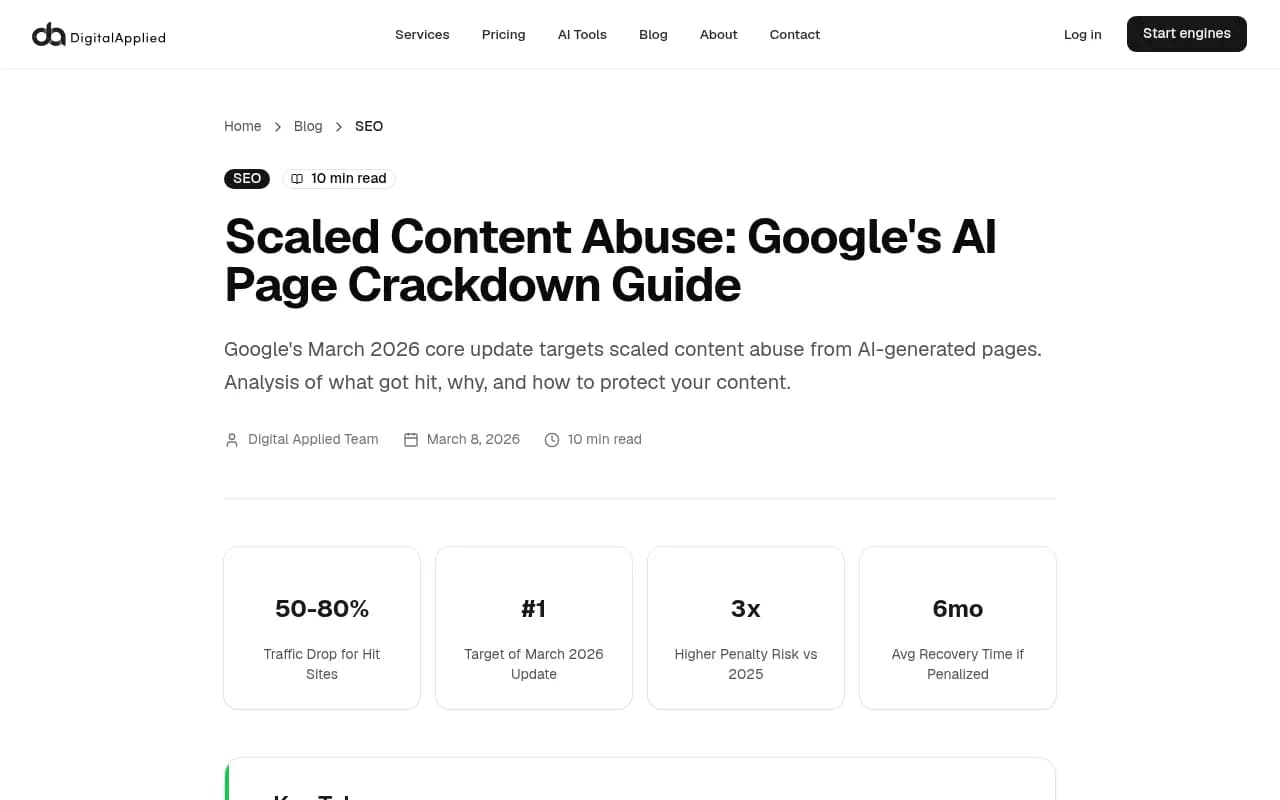
Google's position matters here. Its scaled content abuse policy, dated March 2024, doesn't ban AI content. It targets pages generated primarily to manipulate search rankings rather than help people, however they were produced. A digitalapplied.com analysis argues that the March 2026 core update made this a top enforcement priority and reports 50-80% traffic losses and roughly six months to recover for hit sites. Again, that's a third-party claim. But the recovery advice it gives (consolidate thin pages, redirect, rebuild around fewer stronger resources) matches what I'd expect.
The other half of the story is AI search. Your pages now compete for citations inside ChatGPT, Gemini, Perplexity and Google AI Overviews, and those systems reward different things than a classic rank tracker measures. So the signs below mix traditional SEO health with AI visibility.
10 signs your program is working
1. Indexed pages track published pages
In Search Console, the gap between pages submitted and pages indexed is small and stable. Google choosing to index most of what you ship is the first, cheapest signal of perceived quality. If 90% of new URLs are indexed within a few weeks, the pipeline is producing pages Google considers worth keeping.
2. Pages keep earning impressions 60 to 90 days after publishing
Healthy content has a shape: a ramp, a plateau, slow decay. If your cohorts from three months ago still pull impressions and clicks, the content has staying power. Group pages by publish month and chart each cohort. Flat or rising cohort lines are what you want.
3. Your pages get cited in AI answers, and stay cited
This is the AI-era version of ranking. Promptwatch Data's ChatGPT content half-life report, which tracked every page ChatGPT cited on July 6, 2026 for 90 days, found that after 30 days ChatGPT still cited 78% of landing pages and 76% of docs. A program whose pages sit in that durable group is building something lasting. Tools like Promptwatch can show which of your pages get cited and how that changes over time.

4. The content mix matches how AI actually cites
Promptwatch's content type citation data (Sep 28 to Oct 4, 2026) shows product pages at 22.4% of ChatGPT citations, landing pages at 16.8%, listicles at 13.6%, how-to guides at 8.7% and documentation at 7.5%. If your program covers several of those formats rather than 100% blog posts, you're fishing where the fish are.
5. Different intents get different content
Commercial prompts lean on product pages, landing pages, listicles and comparisons, which together are almost 70% of commercial citations. Informational prompts pull in more how-tos and docs. Branded prompts cite reviews at more than 3x their overall share. A working program maps formats to intent instead of writing one template 500 times.
6. Engagement looks human
Time on page for long-form pieces is reasonable, scroll depth is decent, and people click through to a second page. Nothing proves quality like readers behaving as if they got what they came for. High bounce paired with low time on page is one of the patterns the digitalapplied piece lists as a detection signal.
7. AI-referred visitors convert
Sessions from ChatGPT, Perplexity and others show up in analytics and do something useful: sign up, request a demo, buy. Even small volume with good conversion beats big volume with none. Crisp, for example, reported 2x higher conversion from AI traffic than from traditional channels while publishing 5 to 10 articles a day using Promptwatch.
8. There is a visible human layer
Named authors with real credentials, original data, quotes from your own people, screenshots from your own product. Editors have the authority to kill drafts. Sites that held up in recent updates, per the same digitalapplied analysis, shared demonstrable first-hand experience. You can't mass-produce that, which is exactly why it works as a moat.
9. Evergreen assets get refreshed on a schedule
The program has a refresh queue, not just a publish queue. Promptwatch's half-life data says product pages, reviews and how-to guides each have about 55% still cited at 60 days, hitting their half-life at 74 to 77 days. Listicles sit at 60% at day 60. Teams that refresh before those drop-off points hold their citations.
10. Your crawler and technical basics are clean
AI crawlers can actually reach and read the pages. Server logs show GPTBot, OAI-SearchBot, ClaudeBot and PerplexityBot fetching your content without errors, and the sitemap and internal linking are healthy. A great page nobody can fetch is invisible.
10 signs it's quietly failing
1. Indexing stalls at "Discovered, currently not indexed"
The count of crawled-but-not-indexed or discovered-but-not-crawled URLs keeps growing. Google is telling you it doesn't think the new pages are worth the storage. Publishing more makes this worse, not better.
2. Every page reads like the same page
Open ten random articles. Same intro shape, same H2 pattern, same "in today's fast-paced world" filler, same conclusion. If you can swap the keyword and the article still works, so can a spam classifier.
3. Cohorts decay fast and never recover
Pages peak in week three and are dead by week ten. Some of that is normal for news-style content (Promptwatch Data shows news loses half its cited pages within 36 days, and almost a quarter are never cited again after day 0). But if your whole program behaves like news, you're running a treadmill.
4. Rankings look fine but clicks don't
Neil Patel has been warning that AI answers quietly eat the clicks that used to come with a position, with informational queries hit hardest. If impressions hold while click-through falls, your pages may rank without being the source AI summarizes. Watch clicks and citations, not position alone.
5. Zero or near-zero AI citations
You track 100 relevant prompts and your domain appears in almost none of the source lists. Mentions without self-citations usually point to content or crawlability problems. The content exists, but models don't consider it worth quoting.
6. Heavy investment in low-share formats
If most of your output is reviews, which are 1.7% of ChatGPT citations overall, or generic articles at 6.1%, while landing pages, product pages and listicles are thin, your mix is misaligned with what gets cited. Reviews do matter for branded prompts, so it's about balance.
7. Product and pricing pages are stale
The pages that are most cited (product and landing pages together are 39% of ChatGPT citations) are the ones nobody updates, because the content team only touches the blog. Old pricing, dead features and outdated screenshots drag down exactly the assets AI leans on.
8. Bounce is high and time on page is low
Long-form pages that people leave in eight seconds. This is the clearest behavioral sign the content didn't satisfy the query. Pair it with a sample of search queries from Search Console to see whether the page matches intent at all.
9. Nobody can name the author or the point of view
Bylines are "Staff" or a made-up persona. There's no original data, no first-hand experience, no opinion anyone would disagree with. Consolidation and pruning haven't happened either, so near-duplicate pages compete with each other for the same query.
10. The team reports volume, not outcomes
The monthly report leads with articles published and words generated. Nobody can say how many pages drove a conversion, got cited, or earned a link. This is the most reliable organizational tell. A program measured on output will optimize for output.
Quick diagnostic table
| Metric | Working looks like | Failing looks like |
|---|---|---|
| Indexation | Most new URLs indexed in weeks | Growing "discovered, not indexed" pile |
| Cohort performance | Flat or rising at 90 days | Peak then collapse |
| AI citations | Cited across tracked prompts, durable at 30+ days | Near-zero source-list presence |
| Content mix | Landing, product, comparison, how-to, docs | Almost all generic blog posts |
| Engagement | Reasonable time on page, multi-page sessions | High bounce, short visits |
| Conversions | AI and organic visitors convert | Traffic without outcomes |
| Refresh cadence | Scheduled updates before decay | Publish-only workflow |
| Authorship | Named experts, original data | Anonymous, templated |
How to measure all of this without a spreadsheet nightmare
You need three data layers: search data, AI citation data, and crawler or analytics data. No single free tool covers them well.
For the search layer, Google Search Console is non-negotiable, and a content optimizer like Surfer SEO or Clearscope can help check whether pages cover a topic properly before you publish.


For the AI layer, you want prompt-level tracking, citation analytics and ideally crawler logs. Promptwatch covers real-UI prompt tracking, citation trends, IP-verified crawler logs and visitor analytics in one place, and its Content Agent and Action Board turn gaps into actions, which matters when you're running a program at scale. Several monitoring-focused alternatives exist, including these:



If you're comparing options, the GEO software directory at bestgeosoftware.com lists many more. Most of them stop at monitoring, so check whether the tool tells you what to fix, not just where you're missing.
On the production side, the tool matters less than the guardrails around it. Platforms like AirOps and MarketMuse can structure briefs and workflows, but none of them can supply original experience for you.
What to do if you're seeing the failure signs
Don't respond by publishing faster. Here's the order I'd work in:
- Freeze net-new publishing of the weakest templates for a month.
- Audit by cohort. Sort pages by clicks, citations and conversions. Find the bottom 30%.
- Consolidate. Merge near-duplicate and thin pages into fewer, deeper guides and 301 the old URLs. This is the same pattern the digitalapplied analysis describes for recovery.
- Fix the high-citation formats first: landing pages, product pages, docs, comparisons. These last longest in AI answers.
- Add a human layer: named authors, original data, product screenshots, internal expert quotes.
- Set a refresh calendar tied to decay. Refresh listicles and how-tos before the 55 to 60 day mark.
- Change the report. Lead with indexed share, cited share, AI-referred conversions and cohort retention.
If you'd rather have specialists run the audit and rebuild, an agency that combines technical SEO, content and GEO can do it. 1001 SEO Media, which publishes this site, offers SEO audits and consulting for exactly this situation.
The bottom line
A scaled AI content program is working when pages stay indexed, stay cited, and drive revenue months after they ship. It's failing when the only thing growing is the page count. Run the twenty checks above once a month, be honest about the score, and cut anything that doesn't earn its place. Fewer, stronger pages with a visible human behind them beat a thousand interchangeable ones, in Google and in AI answers.