Key takeaways
- Scaling tools split into two camps: editors that score drafts you write (Surfer, Clearscope, Frase) and autopilot writers that research, write and publish for you (Outrank, Junia, SEO.AI).
- Pricing gaps are huge. Junia starts around $20/mo, Frase at $39-$49/mo, Outrank at $99/mo for 30 articles, and Surfer's AI-search plans at $82-$99/mo billed yearly.
- Volume alone does not match what AI search cites. Promptwatch Data shows product pages and landing pages take about 39% of ChatGPT citations, so a blog-only content machine misses the pages that matter.
- Content decays. Plan refresh into your scaling workflow, not after it.
- Most teams end up with two or three tools: one for research and briefs, one for optimization or autopublishing, and one to measure AI visibility.
What counts as a content scaling tool
The phrase gets used loosely, so let me be specific. A scaling tool should reduce the hours it takes to get a decent, optimized page live. That can mean faster briefs, faster drafts, faster optimization, or removing the publishing step entirely.
The tools below fall into three groups:
- Optimization editors. You (or a writer) write; the tool tells you what the SERP wants. Surfer, Clearscope, NeuronWriter, Frase.
- Autopilot article engines. You pick a site and keywords; the tool writes and publishes on a schedule. Outrank, Junia, SEO Writing AI, Autoblogging.ai.
- Workflow and planning platforms. These coordinate many pages, topics and refreshes. MarketMuse, AirOps, Frase's newer agent features.
No single tool covers everything. Digital Applied's 2026 comparison makes the same point: effective teams combine two to three tools, each doing what it does best.
Quick comparison
| Tool | Type | Starting price | Publishing | Best for |
|---|---|---|---|---|
| Surfer SEO | Optimization editor | $82-$99/mo yearly (AI tiers) | No native autopublish | Document-level optimization with a content score |
| Frase | Research, editor, agent | $39/mo yearly ($49 monthly) | WordPress, Webflow, Sanity, Wix, FraseCMS | Research-to-publish in one workspace |
| Junia AI | Autopilot writer | ~$20/mo yearly | Scheduled AutoBlog | Cheap volume for small sites |
| Outrank | Autopilot writer | $99/mo (30 articles) | 9+ CMS options and webhook | Hands-off publishing plus backlinks |
| Clearscope | Optimization editor | Quote-based | Google Docs workflow | Editorial precision |
| NeuronWriter | Optimization editor | Budget tier | No | Tight budgets |
| MarketMuse | Planning | Quote-based | No | Large sites, portfolio decisions |
Prices come from vendor pages at the time of research. Confirm before buying, because several of these vendors changed their pricing pages this year.
Surfer SEO
Surfer is still the editor most SEO teams reach for. It analyzes the top results for a keyword and scores your draft on terms, headings, length and structure as you type. Surfer AI can draft to the same spec.

The pricing page is now framed around winning AI search. AI Search Analytics runs $82/mo billed yearly (50 prompts refreshed daily across ChatGPT, Perplexity, Google, AI Overviews and Gemini), and the Standard plan, which covers planning, writing and tracking, is $99/mo yearly. I could not verify the higher tiers or article limits, so check those yourself. Some third-party comparison tables still list Surfer at $59/mo, which looks stale.
The honest trade-off: Surfer gives more data and more controls than Clearscope, which means a learning curve. It also does not publish for you. For a team with writers and an editorial process, that is fine. For a team trying to cut headcount, it is not a scaling tool so much as a quality gate.
Frase
Frase has quietly changed what it is. It started as a research and briefing tool and now positions itself as a content operating system for search and AI search, with an agent that can draft and, if you allow it, publish.
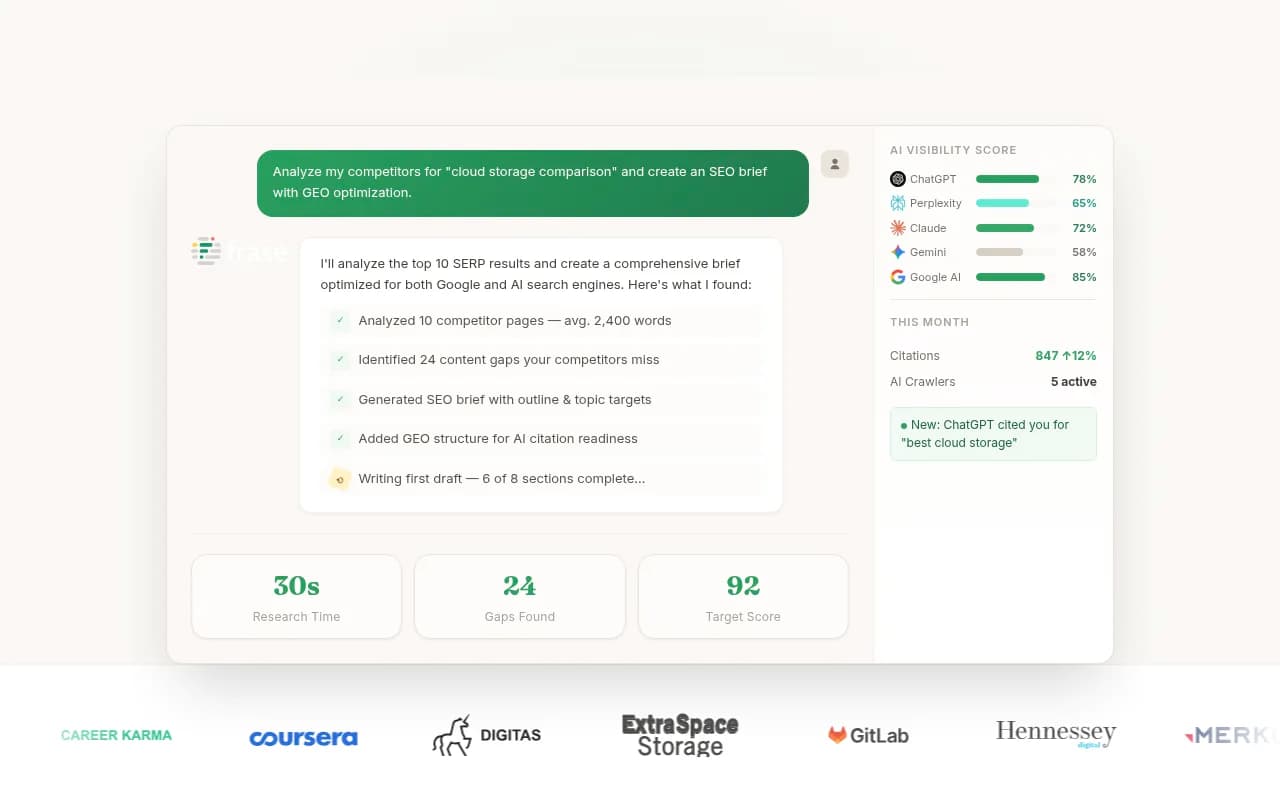
Current pricing from its page:
| Plan | Yearly (monthly) | Articles | Seats / sites | Notable |
|---|---|---|---|---|
| Starter | $39 ($49) | 10 | 1 / 1 | AI visibility on ChatGPT and Google AI |
| Professional | $103 ($129) | 40 | 3 / 5 | Content calendar, internal linking, AI crawler monitoring |
| Scale | $239 ($299) | 100 | 5 / 10 | Client-ready reports, Claude and Gemini tracking |
Two features matter for scaling. First, native publishing to WordPress, Webflow, Sanity and Wix, which most editors lack. Second, Content Guard, which watches 10, 75 or 300 pages (depending on plan) for decay and proposes patches for your approval. There is also an MCP server and CLI on every plan, and a 7-day trial with no card.
Where it falls short: Digital Applied and others describe its scoring as less nuanced than Surfer's. If line-by-line NLP optimization is your main need, Surfer or Clearscope are sharper. If you want fewer tools, Frase is the more complete workspace.
Junia AI
Junia is the budget autopilot option. It pitches itself as an AI SEO agent for competitor gaps and autopublishing.

The Growth plan is about $20/mo billed yearly for 10 SEO articles, with keyword research, internal and external linking, brand voice and 150+ languages. The Scale Starter tier at about $35/mo gives 68 articles a month on autopilot, plus AutoBlog scheduling, bulk generation, a content planner, LLM brand visibility, auto Google indexing and an API. The pricing page shows higher tiers without visible prices, and the headline "$17/mo" looks like a discounted yearly rate, so verify the billing basis.
Junia also sells a done-for-you service from $2,000/mo with a traffic guarantee. That guarantee is a vendor claim, and so are the testimonials on the page. I would treat both as marketing until you have your own data.
The real question with a tool at this price is quality. I did not find independent output tests for Junia, so run a small batch and have a subject-matter expert read it before you scale.
Outrank
Outrank solves a different problem than Surfer. It does not score drafts you write. It finds keywords your site can win, writes the article (title, meta description, headings, internal links, FAQ, images) and publishes about one a day.

Pricing is one plan: $99/mo ($999 a year) for 30 articles, with add-ons of +$85 for 60 and +$160 for 90 articles a month. It publishes to WordPress, Webflow, Shopify, Wix, Framer, Notion, Ghost, Next.js or a webhook, and it includes automated backlink building and AI visibility tracking. There is a $1,399/mo human-curated tier where an editor reviews and fact-checks. Trial articles carry a watermark.
Its own stats (750,000+ articles, 25,000+ backlinks, 10,000+ ChatGPT mentions) are self-reported. Outrank's own ease-of-use ranking puts itself first because there is nothing to edit, with the caveat that it does not optimize pages you write yourself. That caveat is the point: it is a publishing engine, and engines need guardrails.
Other tools worth a look
Clearscope and NeuronWriter
Clearscope gives one grade, few settings and works inside Google Docs. It is the pick when editorial consistency matters more than feature depth. NeuronWriter covers similar NLP-based optimization on a tighter budget.


MarketMuse
Built for content strategists running big sites. It helps decide what to write and where topical gaps sit, rather than helping you write faster.
Scalenut, SEO.AI and AirOps
Scalenut starts around $59/mo and pairs optimization with AI-search articles. SEO.AI is a hands-off agent for content and backlinks. AirOps suits teams building custom content workflows. I have not verified the details of these three here, so evaluate them against a trial.


If you want to browse beyond this list, the software directory at surferstack.com covers a wider set of content and SEO tools.
Scaling volume is not the same as scaling results
Here is the part most comparison posts skip. Pumping out 30 blog posts a month assumes blog posts are what gets cited and ranked. In AI search, that is only partly true.
Promptwatch Data tracked ChatGPT citations from Sep 28 to Oct 4, 2026. Product pages were the most cited type at 22.4%, and landing pages followed at 16.8%, so roughly 39% of citations went to pages describing what a company sells. Listicles were 13.6%, how-to guides 8.7%, and general articles 6.1%. On commercial prompts, product pages, landing pages, listicles and comparisons made up almost 70% of citations. You can see the full breakdown in Promptwatch's ChatGPT citation share by content type report.
So if you point an autopilot tool at informational keywords only, you may fill your site with the formats that ChatGPT cites least. Better to use the tools to produce comparison pages, listicles and supporting content around your product and landing pages, and keep humans on the commercial pages.
Plan for decay
The second finding is about shelf life. Promptwatch Data tracked pages that ChatGPT cited on July 6, 2026 for 90 days. After 60 days ChatGPT still cited 69% of landing pages and 67% of docs, but only about 55% of product pages, reviews and how-tos, and half of news pages were gone after 36 days. Details are in the content half-life report.
The practical read: every article you scale becomes a refresh obligation. Frase's Content Guard is one built-in answer. Otherwise, schedule refreshes in your calendar from the start.
Google's view of scaled content
I could not find independent tests quantifying spam-policy risk for the autopilot tools here, so I will stay in my lane. Publishing large amounts of unreviewed AI text is the pattern most likely to get a site in trouble. Whatever you pick, put an editor between the draft and the publish button for anything that matters, and keep factual claims sourced. Outrank's $1,399 human-curated tier exists for a reason.
Measuring whether it worked
Scaling tools mostly stop at publishing. You still need to know whether those pages get crawled, cited and clicked by AI systems, and which ones decay. Tools like Promptwatch track AI visibility, show which pages get cited, and log AI crawler visits, which closes the loop that autopilot writers leave open.

For more options in that category, the GEO software directory at bestgeosoftware.com is a decent starting point.
Which stack should you pick?
| Situation | Suggested stack |
|---|---|
| Solo or small site, tiny budget | Junia or NeuronWriter, plus manual review |
| Agency with writers and clients | Surfer or Clearscope for scoring, Frase for briefs and reports |
| Lean team wanting hands-off publishing | Outrank or Frase agent with an editor review step |
| Large site, many topics | MarketMuse for planning, Surfer for optimization |
| Webflow-heavy team | Frase or Outrank (Surfer has no native Webflow publishing) |
A few rules I would follow regardless:
- Run a 10-article pilot before committing to a yearly plan. Frase offers a 7-day trial with no card, and Outrank trial articles are watermarked, so test on a staging section.
- Use autopilot tools for supporting content, and write money pages by hand or with heavy review.
- Budget for refresh from day one.
- Add AI visibility measurement, because rankings alone no longer show the full picture.
Bottom line
Surfer is the strongest pure optimizer, Frase is the most complete workspace for the price, Outrank and Junia are the volume engines (Junia cheaper, Outrank broader on publishing and backlinks), and Clearscope or NeuronWriter fill the editorial and budget gaps. None of them replaces judgment about which pages deserve to exist. Pick based on whether your bottleneck is writing, optimizing or publishing, and measure the results at the page level.