Key takeaways
- Most "under $100" AI tracking tools only stay under $100 if you skip engine add-ons. Otterly.AI's $189/mo Standard plan becomes $357/mo once you add Claude and Gemini tracking.
- Otterly.AI Lite ($29/mo), Knowatoa Starter ($59/mo), Peec AI Starter ($95/mo), and Rankscale Pro ($99/mo) are the realistic sub-$100 options once you read the fine print.
- AI answers aren't stable rankings. Promptwatch's data on AI Overviews volatility and citation drift shows you need 2-3 weeks of tracking before trusting any single result.
- Mid-authority sites aren't locked out of AI citations. Promptwatch's domain-rank data shows DR 46-75 sites earned nearly half of all ChatGPT citations in August 2026, so tracking is worth it even if you're not a household name.
- Pair a budget prompt tracker with a free tool like Google Search Console rather than overspending on one all-in-one platform you'll only use 20% of.
Why "under $100/month" is trickier than it sounds
I went looking for a clean list of AI rank trackers under $100 and almost every pricing page I opened had an asterisk somewhere. The headline price gets you a handful of prompts on two or three AI engines. Want Claude or Gemini tracked too? That's a separate line item, and it scales with your plan size, not a flat add-on fee.
Otterly.AI is the clearest example. Its Standard plan lists at $189/month, which already blows past our budget. But even the cheaper Lite plan at $29/month only covers ChatGPT, Google AI Overviews, and Perplexity out of the box. Add Google AI Mode/Gemini for another $9-$149 depending on tier, and Claude for $29-$439, and a plan that looked affordable on the homepage can quietly double or triple in cost. Peec AI does something similar: its Starter tier is priced at $95/month, which fits our budget, but only if you stick to three of its six supported models and skip the add-on fees that start at $35/month per extra engine.
So before I hand you a list, here's the rule I'd apply: read the pricing page for the word "add-on," and multiply by however many AI engines you actually care about. A tool that's $59/month for three engines might be more useful to a small business than a $95/month tool that only covers two once you factor in what you're actually trying to monitor.
What AI rank tracking actually measures (and why it's different from classic SEO)
If you've used a keyword rank tracker before, unlearn some of that intuition here. There's no position #1 through #10 in a ChatGPT answer. The model writes prose, names some brands, links to some sources, and might do all of that differently for the next person who asks the exact same question five minutes later.
A few things worth knowing before you buy anything:
Mentions and citations are not the same win. ChatGPT can say your brand's name in a sentence while linking out to a completely different site, like a review aggregator, as its source. A tool that blends these into one "visibility score" hides which one actually moved. Ask any vendor you're evaluating whether they separate the two.
Answers drift. SE Ranking's own research into AI Mode local queries found only about 35% of domains repeat across runs of the same query. Two-thirds disappear and reappear. If your tracker shows you dropped out of an answer today, that's not necessarily a loss, it might just be normal variance. Treat anything under two to three weeks of data as noise.
Query fan-out complicates prompt selection. LLMs break one prompt into multiple retrieval sub-queries behind the scenes, so there's no simple keyword list to plug in. Picking the right 20-30 buying-intent prompts matters more than picking the most prompts.
Some tools flatten positions in a way that's misleading. At least one competitor reportedly treats every AI Overview citation as a "#1" regardless of where it actually sits in the block. If a tool's reporting feels suspiciously clean, ask how it determines position.
Small businesses aren't locked out just because they're small
This is the part that surprised me. There's a common assumption that only huge, famous domains get cited by AI engines. Promptwatch's citation share by domain rank data for August 2026 says otherwise: domains in the DR 46-60 and DR 61-75 buckets together captured close to 46% of all ChatGPT citations that month, and DR 0-30 sites still picked up around 14%. Meanwhile the very top tier, DR 91-100, shrank from roughly 7% to about 3% of citations by mid-August and stayed there.
That's good news if you run a regional service business or a niche e-commerce shop. You don't need Wikipedia-level authority to show up. You do need to know what you're being compared against, which is exactly what a rank tracker is for.
It also matters what kind of content you're producing. Promptwatch's ChatGPT citation types data for August 2026 shows product pages leading at nearly 29% of citations, but how-to content jumped from about 4% to over 9% share in the last nine days of the month while social posts collapsed from 4.4% to under 1%. If your content plan is built around social posts and hoping they get picked up by AI, the data says that bet is getting worse by the week.
The sub-$100 shortlist
Here's what actually stays under $100/month once you account for add-ons, not just the advertised "starting at" price.
| Tool | Price that stays under $100 | Engines covered at that price | Notable catch |
|---|---|---|---|
| Otterly.AI Lite | $29/mo | ChatGPT, Google AI Overviews, Perplexity | Only 15 prompts, 1 workspace; Claude/Gemini cost extra |
| Knowatoa Starter | $59/mo | 3 of 7 services (ChatGPT, AI Overviews, AI Mode) | Doesn't publish prompt volume limits |
| Peec AI Starter | $95/mo | Choose 3 of 6 models, 50 prompts | Extra models add $35+/mo each |
| Rankscale Essentials / Pro | $20/mo or $99/mo | Credit-based, varies by engine | Claude/Perplexity Pro burn credits 8x faster than ChatGPT |
| Nightwatch Starter | ~$85-105/mo (currency dependent) | Classic rank tracking + 50 AI prompts bundled | USD price fluctuates with EUR billing |



Otterly.AI, the cheapest honest entry point
At $29/month, Otterly Lite is the tool I'd point a solo founder or very small team toward first. You get 15 tracked prompts and 1,000 GEO audits a month across ChatGPT, Google AI Overviews, and Perplexity. It won't scale with you, 15 prompts disappears fast once you're tracking competitors and multiple product lines, but as a way to find out whether AI engines mention you at all, it's hard to beat on price.
Knowatoa, cheap but opaque
Knowatoa's $59/mo Starter plan covers three services (ChatGPT, AI Overviews, AI Mode) and is a reasonable fit if you run several small sites, since the question budget is pooled across unlimited sites on one account. The catch, and it's a real one, is that Knowatoa doesn't publish how many prompts or questions you actually get at that price. Competitors like Otterly and Nightwatch spell this out; Knowatoa makes you ask or find out by hitting a limit.
Peec AI, fine if you only need three models
Peec AI's Starter tier at $95/month gets you 50 prompts and your choice of 3 out of 6 AI models. If ChatGPT, Perplexity, and Google AI Overviews cover your bases, this works. If you also want Claude or Gemini tracked, you're adding $35/month per model and sliding past $100 fast.
Rankscale, credit pricing is a double-edged sword
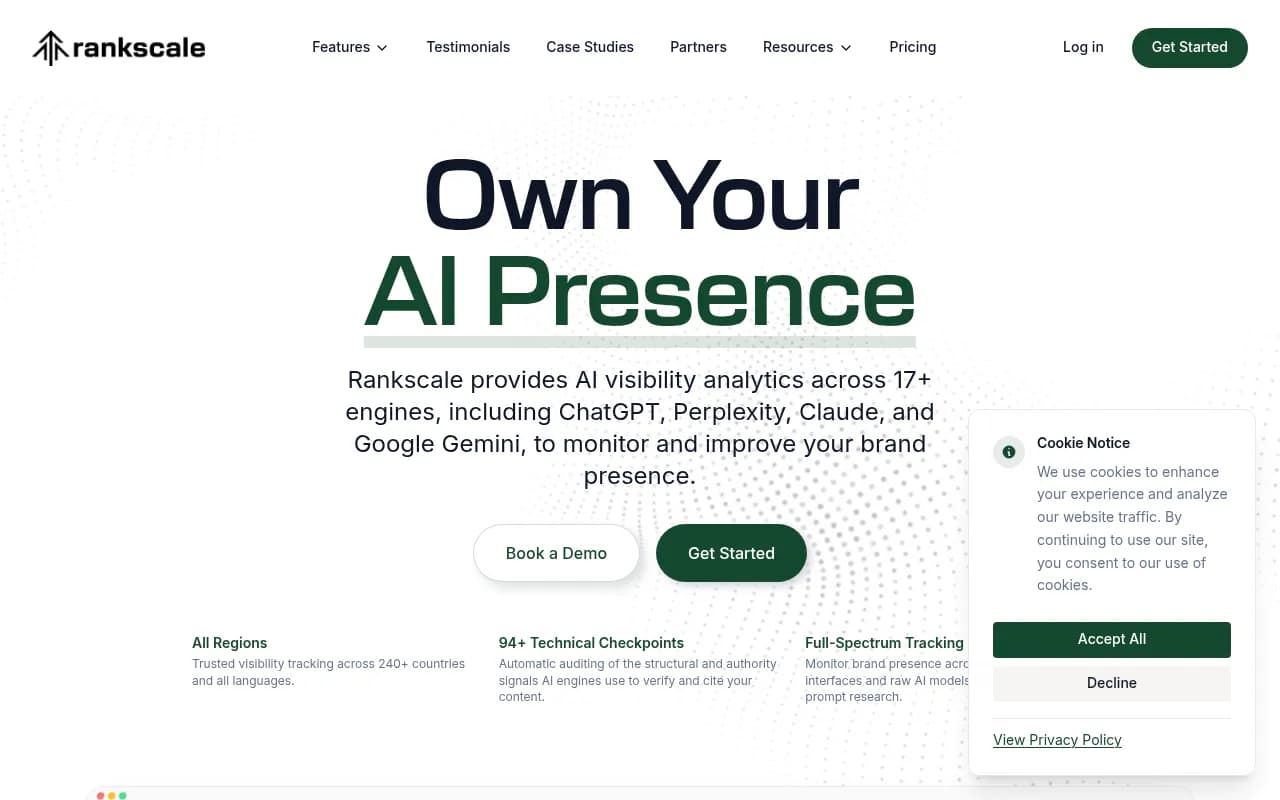
Rankscale doesn't sell prompts, it sells credits, and different AI engines cost different amounts of credit. ChatGPT, Gemini, and Perplexity queries cost 0.25 credits each. Claude and Perplexity Pro cost 2 credits. That means if you care about tracking Claude specifically, your monthly budget disappears roughly eight times faster than it would tracking only ChatGPT. The $99/mo Pro plan gives unlimited team seats, which is genuinely useful for a small team, but do the math on your actual engine mix before committing.
Nightwatch, the classic rank tracker that added AI on top
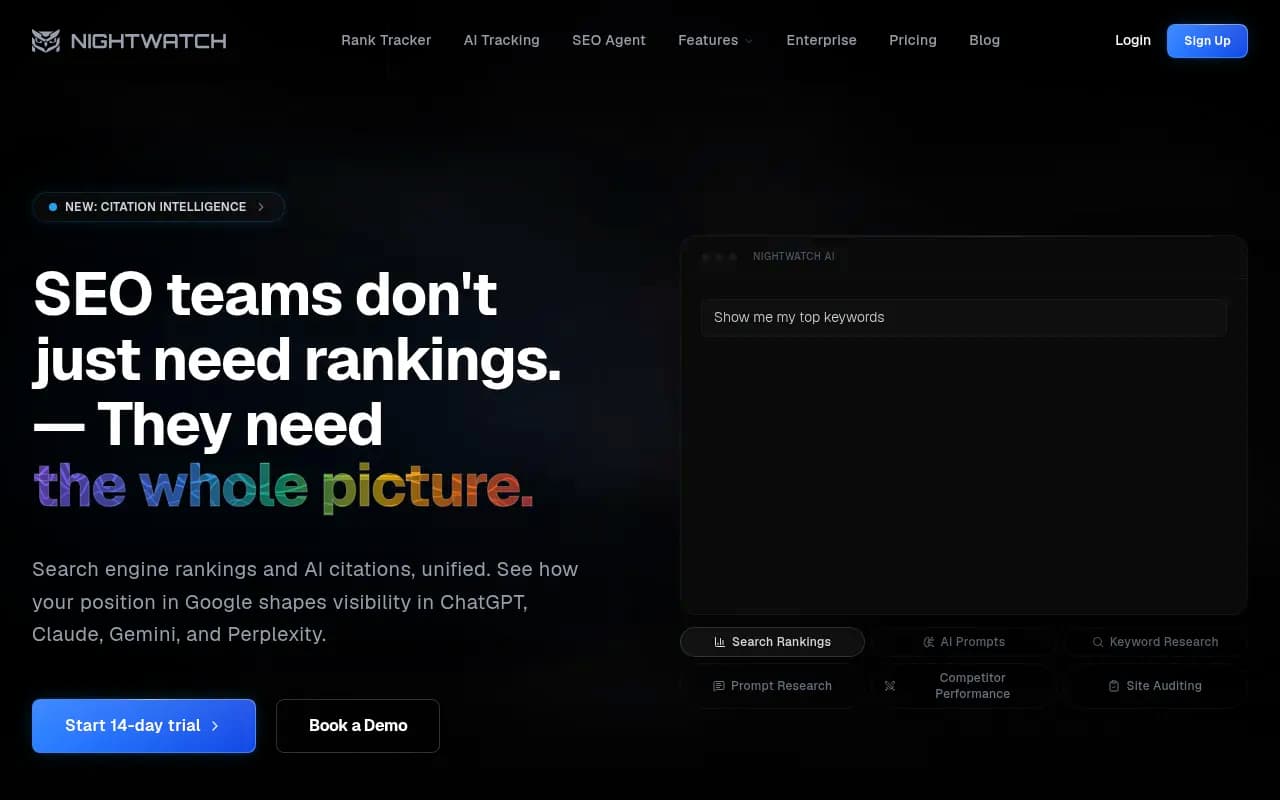
Nightwatch is built as a traditional keyword rank tracker, with 50 AI prompts bundled into its Starter plan. Pricing is listed in euros (€79/mo), which puts it somewhere between $85-105/month depending on exchange rates when you're billed. If you want one tool that handles both Google keyword rankings and basic AI prompt tracking without buying two subscriptions, this is a reasonable middle ground, just watch the FX conversion on your card statement.
What you're giving up at this price tier
The honest answer: multi-engine coverage, content execution, and depth of historical data. Every tool on this list makes you choose between engines or pay more to add them. None of them, at this price, will also write and publish content for you, that's a different category entirely, usually starting well north of $200/month.
This is where it's worth separating "I want to know if AI mentions my brand" from "I want to actually fix my AI visibility." Budget trackers answer the first question reasonably well. If you want a platform that also tells you why you're invisible, via crawler logs showing exactly when ChatGPT or Claude's bots hit your pages, and then does something about it through automated content generation and CMS publishing, that's a different tier of tool. Promptwatch is built for that second job: it tracks prompts across ChatGPT, Gemini, Claude, Perplexity, Grok, and Google AI Overviews/AI Mode, and its Essential plan at $95/month includes 50 prompts, 6,000 responses, and five AEO articles generated for you, not just tracked data.

If you're a true solo operator testing the waters, start with Otterly Lite or Knowatoa and see whether AI search even moves the needle for your category. If you confirm it does and you're ready to act on what you find rather than just watch a dashboard, Promptwatch's Essential tier is the natural next step up, and it's still under $100/month.
A realistic monthly stack for a small business
Given the limits of any single sub-$100 tool, the stack that makes the most sense for most small businesses looks like this:
- A budget AI prompt tracker (Otterly Lite at $29/mo, or Knowatoa at $59/mo) to monitor whether you're mentioned at all.
- Google Search Console, free, to see whether AI Overviews and AI Mode are actually sending you clicks (check the "AI Overviews" filter under Search appearance).
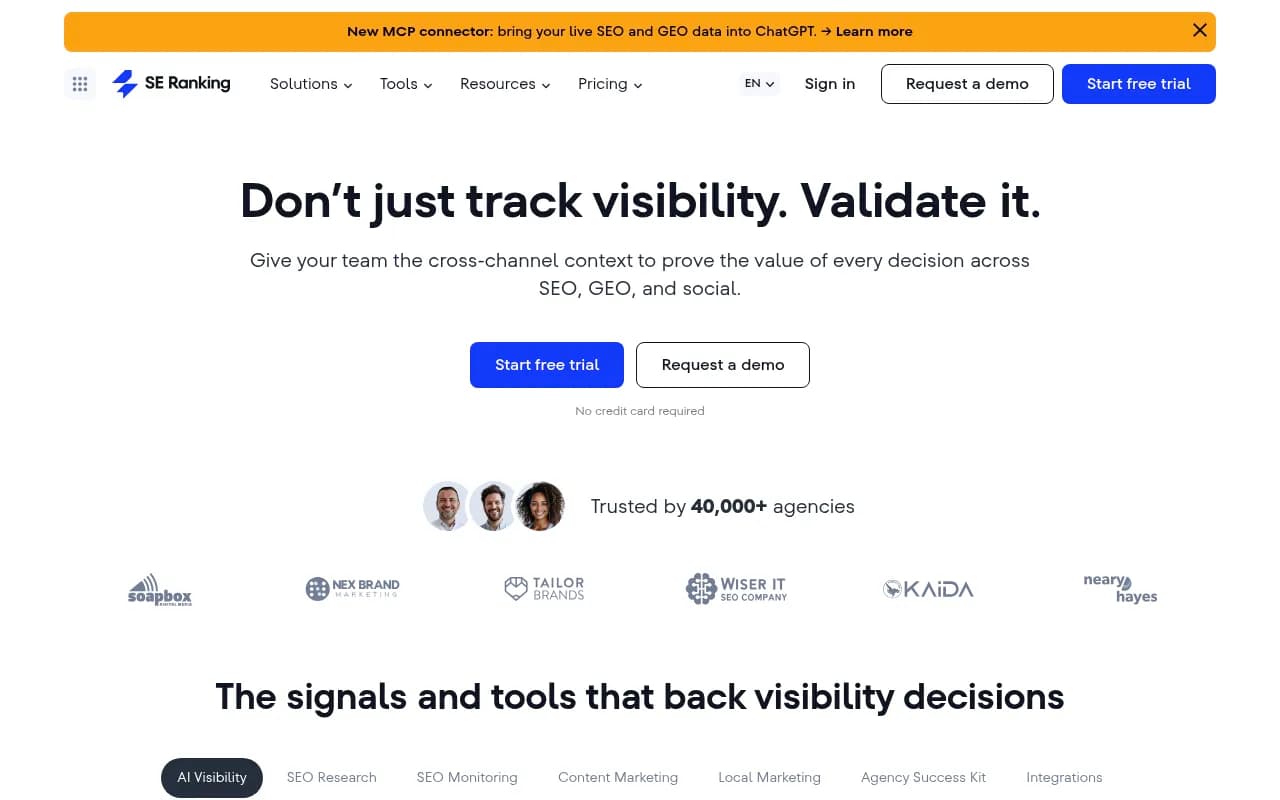
- A classic SEO tool if you don't already have one. SE Ranking starts around $44-52/month and covers keyword tracking plus a basic AI Search add-on starting near $71/month on top.
Running two cheap, focused tools usually beats paying $150+ for one platform that tries to do everything mediocrely. The exception is once your AI visibility work matters enough to act on, at which point consolidating into one platform that both tracks and executes, like Promptwatch, starts to save time instead of costing it.
Practical tips before you commit to any tool
- Pick 20-30 buying-intent prompts, not generic brand-name searches, and give any new tool two to three weeks before judging the results. A single snapshot tells you almost nothing because of answer drift.
- If a tool shows a sudden visibility drop, re-check it three to five times across a few days before assuming you lost ground. Promptwatch's research on Reddit citations dropping in ChatGPT found reddit.com's ChatGPT citation share collapsed from roughly 4% to 0.5% in a single day, August 14, 2026. If your own tracked prompts moved sharply around a date like that, it's probably a platform-wide shift, not something you did.
- Ask every vendor whether they separate "mentions" from "citations" in their reporting. If they don't, you're buying a blended score that hides which lever actually works.
- Don't buy based on the number of prompts alone. Check what counts as one unit of tracking: SE Ranking counts one prompt on one platform as one "check," while Rankscale's credit cost varies 8x by engine. The sticker price means little without this context.
If you want to browse more options beyond this shortlist, the AI rank tracking directory at ai-rank-tools.com covers a wider range of platforms at every price point, and the GEO software directory at bestgeosoftware.com is a good place to compare tools once you're ready to move past tracking and into actual optimization work.