Key takeaways
- Most AI visibility platforms are built for single-brand monitoring. Multi-site management requires features like consolidated dashboards, per-site prompt sets, cross-client reporting, and scalable pricing.
- Agencies and holding companies have different needs: agencies need white-label reporting and client separation; holding companies need cross-brand benchmarking and shared governance.
- Promptwatch is the only platform in 2026 rated as a "Leader" across all evaluation categories, and its Business and Agency tiers are specifically designed for multi-site workflows with content generation built in.
- Monitoring-only tools (Otterly.AI, Peec.ai, AthenaHQ) are fine for single-brand tracking but hit a wall when you need to act on the data across multiple properties.
- The right platform depends on your structure: in-house marketing team, agency, or holding company. Each has different requirements for site limits, reporting, and content workflows.
Managing AI visibility for one website is already a new discipline most teams are still figuring out. Managing it across five, ten, or fifty websites is a different problem entirely.
If you run a digital agency with 30 clients, a holding company with a portfolio of brands, or an in-house team responsible for multiple regional or product sites, you've probably already noticed that most AI visibility tools weren't designed with you in mind. They're built around a single domain, a single prompt set, and a single reporting view.
That's fine for a solo brand. It's a mess for anyone managing at scale.
This guide is for teams that need to track, optimize, and report on AI visibility across multiple websites simultaneously. We'll cover what features actually matter for multi-site management, which platforms support it well, and how to think about the decision depending on your organizational structure.
Why multi-site AI visibility is harder than it looks
The core challenge isn't technical. It's structural.
AI visibility tracking requires you to define prompts (the questions users ask AI engines), monitor how your brand appears in responses across models like ChatGPT, Perplexity, Google AI Overviews, and Claude, and then act on what you find. That workflow is manageable for one site.
When you multiply it across sites, a few problems emerge:
- Prompt sets need to be customized per site (a travel brand and a fintech brand don't share queries)
- Reporting needs to be separated by client or brand, but also aggregated for executive views
- Content gaps need to be fixed at the site level, not just identified at the portfolio level
- Crawler logs and citation data need to be attributed to the right property
- Pricing needs to scale without becoming absurd
Most platforms handle the first point reasonably well. The rest is where things fall apart.
What to look for in a multi-site AI visibility platform
Before comparing specific tools, here's the feature checklist that actually matters for multi-site management:
| Feature | Why it matters for multi-site |
|---|---|
| Site/domain limits per plan | Determines how many properties you can track without paying per-seat or per-domain fees |
| Separate prompt sets per site | Each site needs its own tracked queries; shared prompts create noise |
| Consolidated cross-site dashboard | Executives and account managers need a portfolio view |
| Per-site reporting and exports | Clients or brand managers need isolated reports |
| Content gap analysis per site | Optimization needs to happen at the page/domain level |
| AI content generation | Fixing gaps at scale requires more than identifying them |
| Crawler log access | Understanding how AI engines crawl each site separately |
| White-label or client-facing reports | Essential for agencies billing clients |
| Prompt volume and difficulty data | Helps prioritize which gaps to fix first across a large portfolio |
| Multi-model coverage | More AI engines covered = more complete picture |
The tools that score well on most of these are a short list.
The platforms worth considering
Promptwatch
Promptwatch is the most complete option for multi-site management in 2026. Its Business plan covers 5 sites with 350 prompts and 30 AI-generated articles per month. Agency and Enterprise tiers go further with custom site counts and white-label reporting.
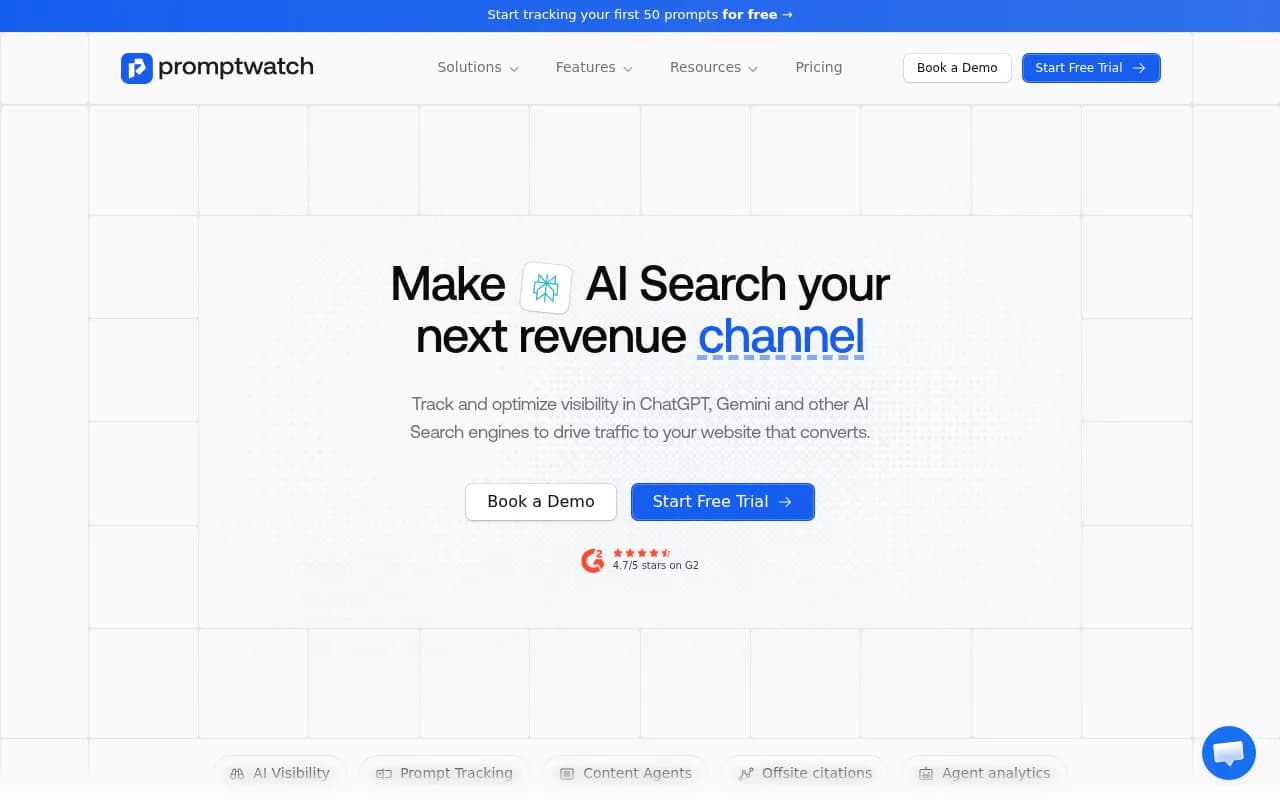
What separates it from the field isn't just the site limits. It's the action loop: Promptwatch shows you which prompts competitors rank for that you don't (Answer Gap Analysis), generates content to close those gaps (Content Agents), and tracks whether that content gets cited by AI models. That cycle works at the site level, meaning you can run it independently for each property in your portfolio.
For agencies, the crawler log feature is particularly useful. You can see exactly which pages on each client's site AI engines are reading, how often they return, and when a crawled page starts generating citations. That's the kind of data that turns a monthly report into a genuine conversation about ROI.
It monitors 10 AI models: ChatGPT, Perplexity, Google AI Overviews, Google AI Mode, Claude, Gemini, Meta/Llama, DeepSeek, Grok, and Copilot. Pricing starts at $99/mo (Essential, 1 site), $249/mo (Professional, 2 sites), and $579/mo (Business, 5 sites). Agency pricing is custom.
Scrunch AI
Scrunch positions itself as a monitoring command center, and it does that well. The dashboard is clean, prompt and competitor tracking is solid, and the reporting is stakeholder-friendly. For agencies that need a consistent visibility narrative week over week, it's a reasonable choice.
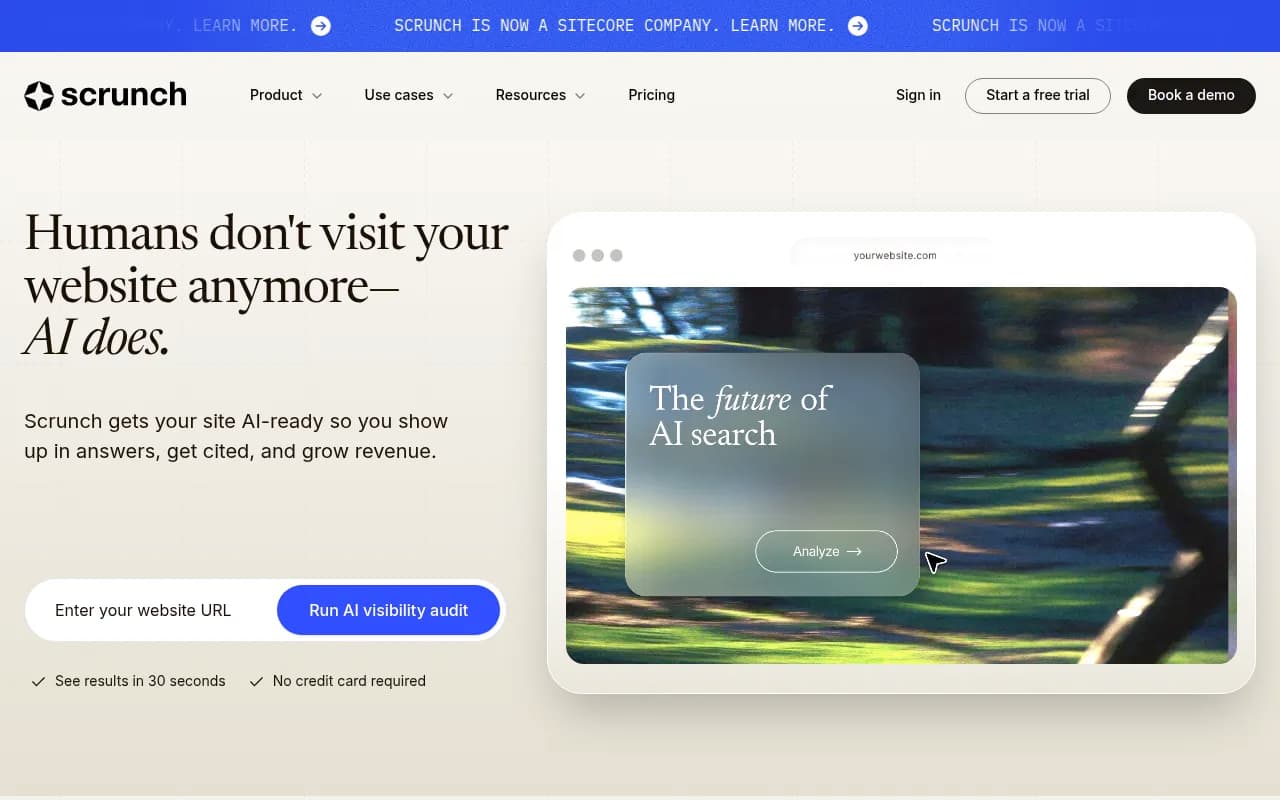
The limitation is that Scrunch leans toward monitoring rather than optimization. It shows you what's happening but doesn't generate content to fix it. For multi-site management, that means you'll need a separate workflow for the "act on it" part. Pricing starts around $300/mo and scales from there.
Profound
Profound is enterprise-grade and genuinely deep. It covers 10+ AI engines, has strong governance features, and its crawler analytics are a real differentiator. For large enterprise teams managing a handful of high-stakes domains, it's a serious option.
The trade-off is price and complexity. Profound is built for enterprise procurement cycles, not agencies spinning up 20 new clients a quarter. If you're a holding company with a small number of major brands and a dedicated analytics team, it fits. If you're an agency with variable client counts, the economics get tricky.
Search Party
Search Party is agency-oriented by design, which makes it worth a look for multi-site use cases. It handles client separation reasonably well and has reporting features aimed at account management workflows.
The gap is on the prompt intelligence side. Search Party doesn't offer the kind of volume estimates and difficulty scoring that help you prioritize which gaps to fix first across a large portfolio. For agencies that need to show clients a clear optimization roadmap, that's a meaningful missing piece.
Semrush AI Visibility Toolkit
If your team is already deep in the Semrush ecosystem, the AI Visibility Toolkit is a natural extension. It tracks brand mentions across 4 to 6 AI engines and integrates with existing Semrush workflows.
The limitation for multi-site management is that Semrush uses fixed prompt sets rather than custom queries, which means you can't tailor the tracking to each site's specific competitive context. It also lacks AI traffic attribution and crawler logs. Fine as a supplement; not ideal as your primary AI visibility layer.
Ahrefs Brand Radar
Ahrefs Brand Radar extends the familiar Ahrefs experience into AI search monitoring. If your team already lives in Ahrefs for traditional SEO, it reduces tool sprawl.
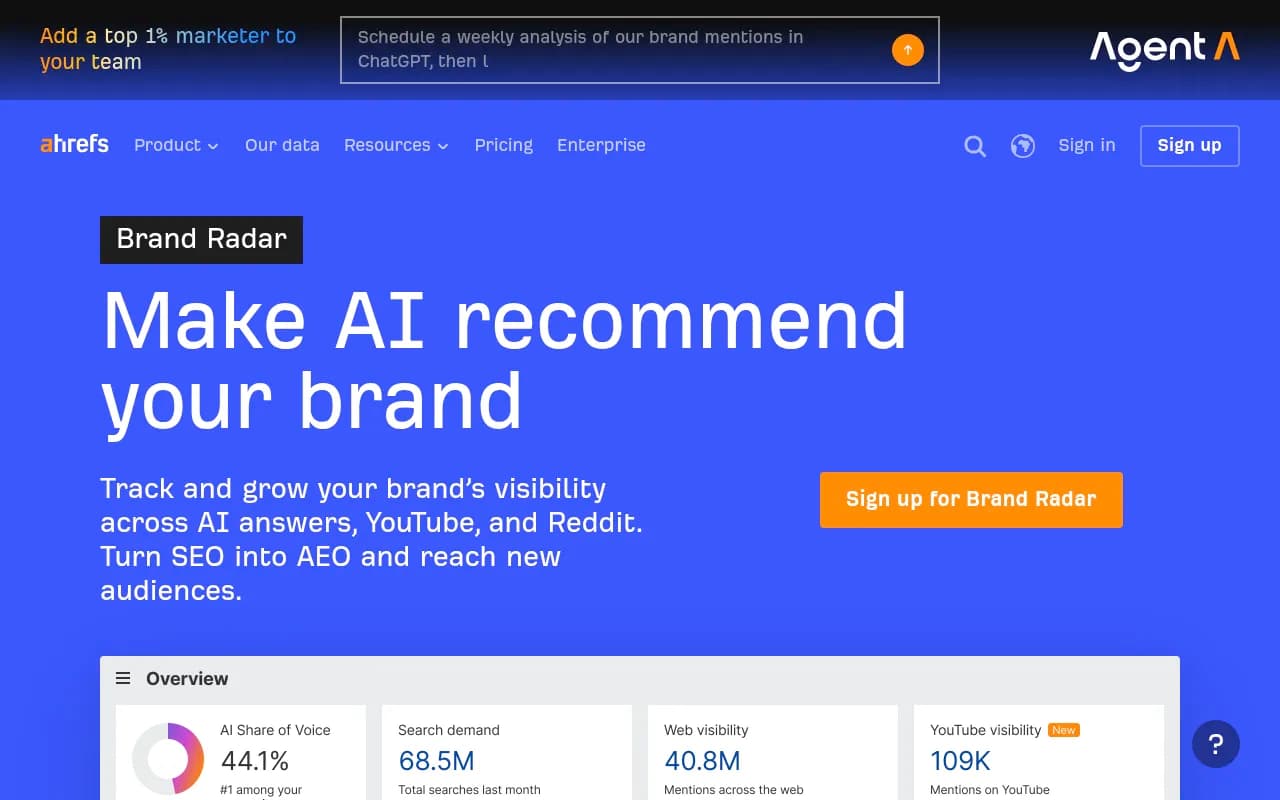
Like Semrush, the prompts are fixed rather than customizable, and there's no AI traffic attribution. For a holding company that wants a quick portfolio-level snapshot, it works. For granular per-site optimization, it falls short.
Otterly.AI
Otterly.AI is the affordable entry point for AI visibility monitoring. It's genuinely useful for small teams or single-brand tracking on a budget.
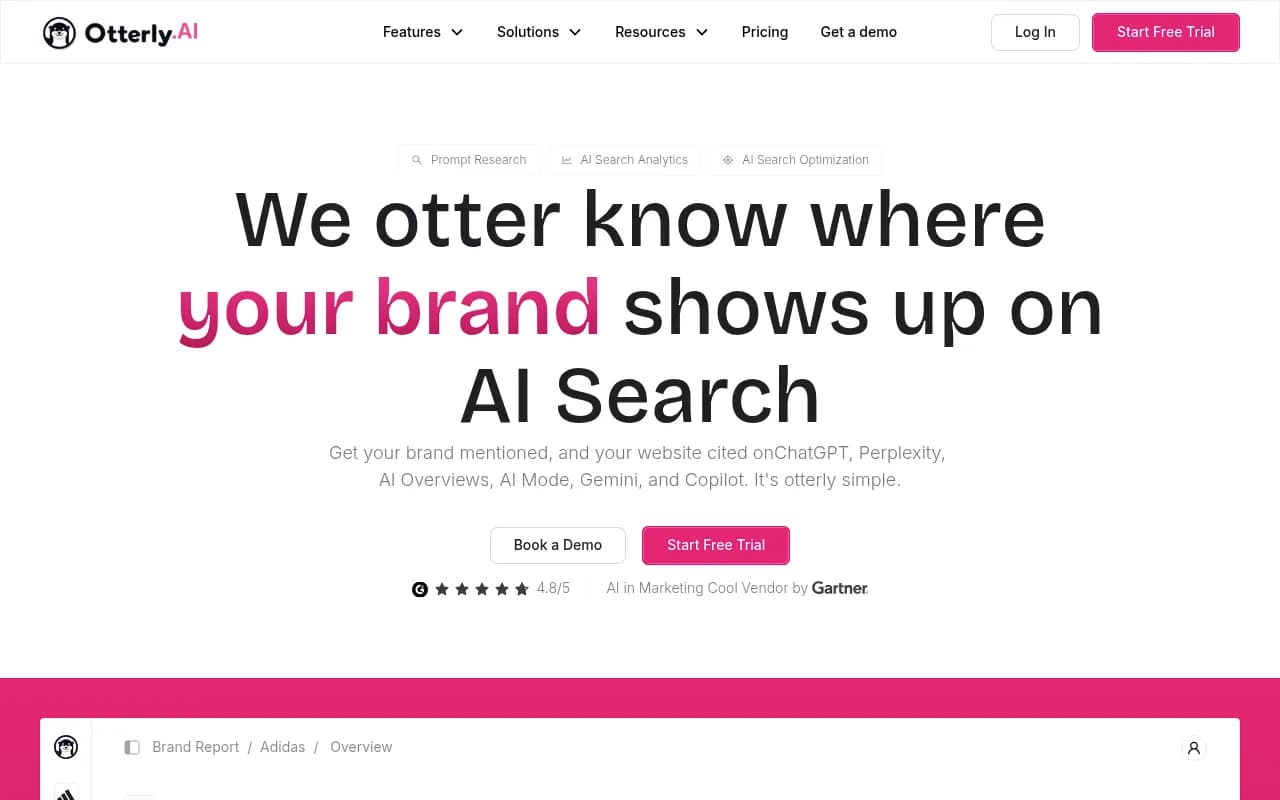
For multi-site management, it's not the right tool. There's no crawler log access, no content generation, and no visitor analytics. You'll hit the ceiling quickly once you're managing more than one or two properties.
Peec AI
Peec AI has a clean interface and some smart suggestions for improving visibility. It's a good starting point for teams new to AI search monitoring.
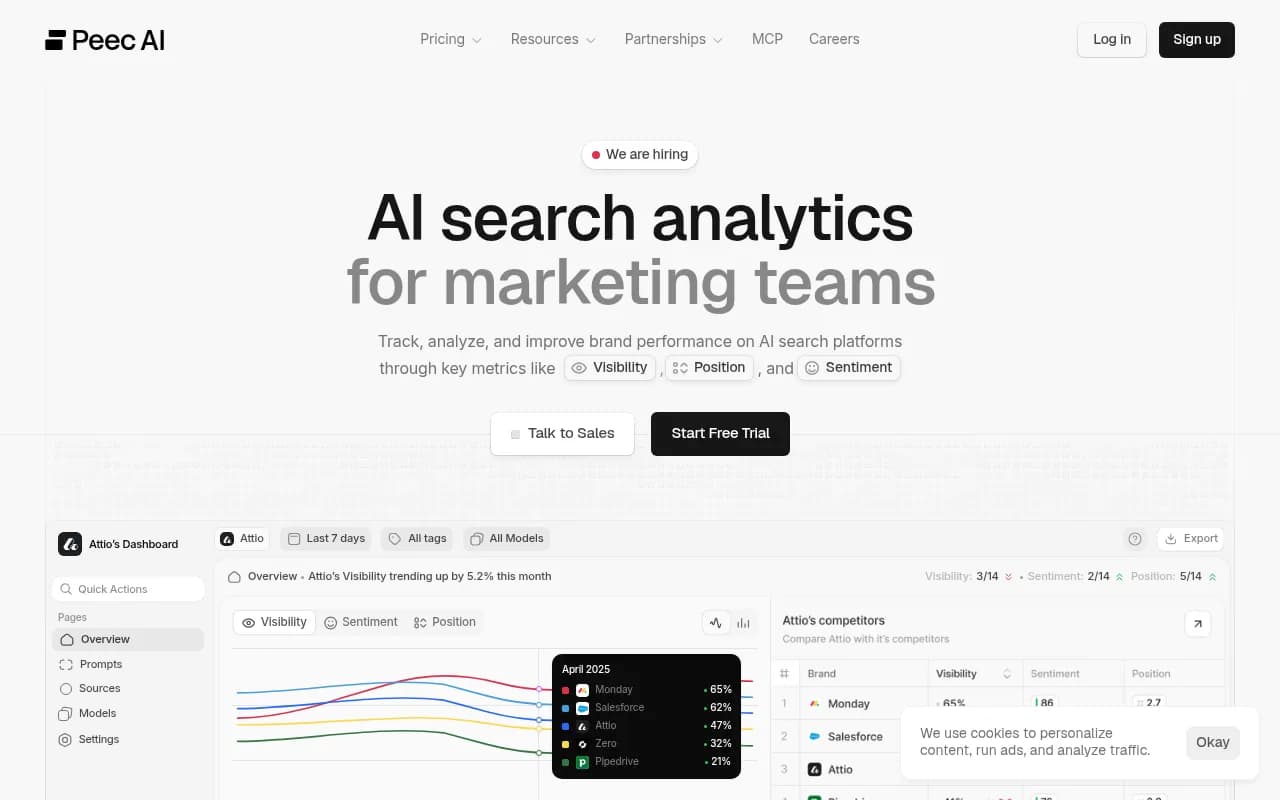
The same caveat applies as with Otterly: it's monitoring-first, and the multi-site workflow isn't really built out. Worth knowing about, but not the anchor of a multi-site stack.
AthenaHQ
AthenaHQ is monitoring-focused with a solid interface. It tracks AI responses and surfaces brand mentions, but like most monitoring-only tools, it stops before the optimization step.

For agencies or holding companies that already have a content production workflow and just need the monitoring layer, AthenaHQ is a reasonable option. Just know you'll need something else to close the gaps it surfaces.
SE Ranking Visible
SE Ranking's AI visibility tracker covers ChatGPT, Gemini, and Perplexity with a clean interface. It's part of the broader SE Ranking ecosystem, which helps if you're already using their traditional rank tracking.
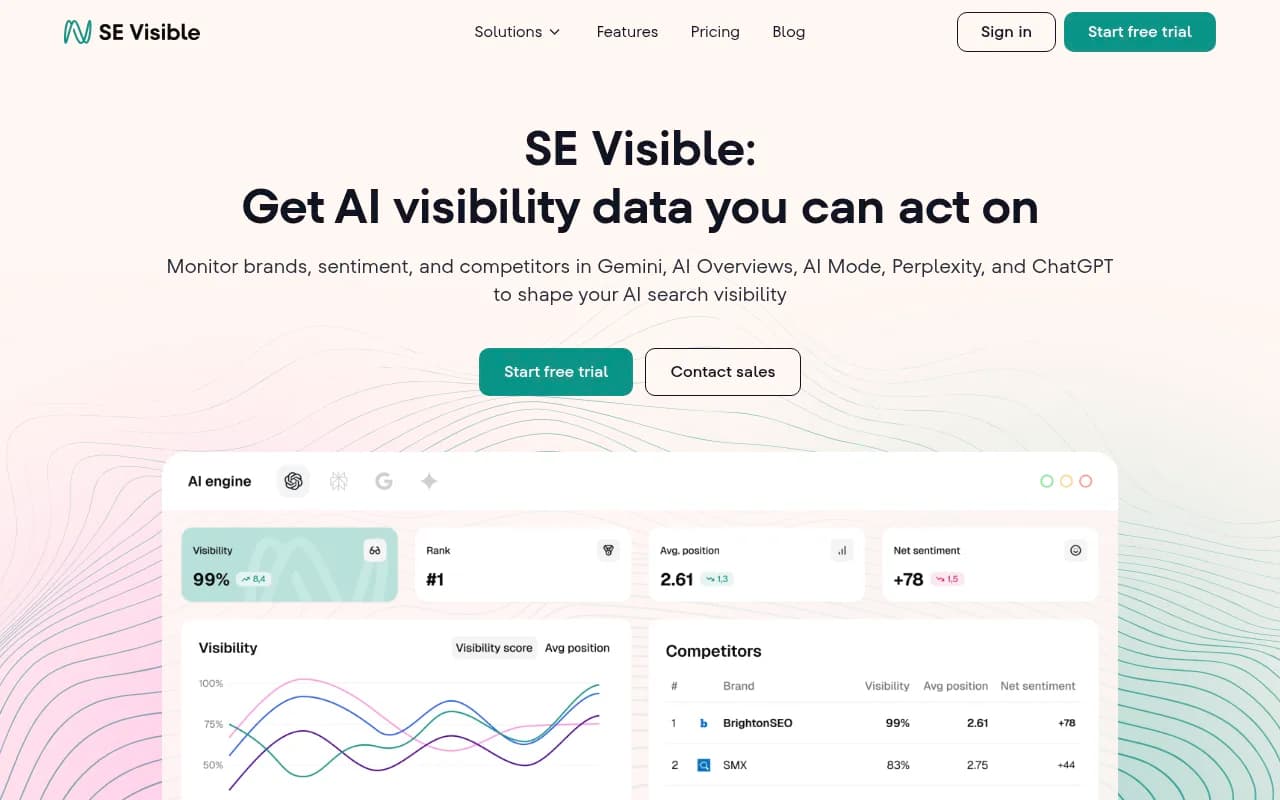
Multi-site support exists but is limited compared to purpose-built platforms. It's a solid mid-market option for agencies that want AI visibility as one module within a larger SEO platform rather than a standalone tool.
Platform comparison: multi-site management features
| Platform | Sites (base plan) | Custom prompts | Content generation | Crawler logs | White-label | Price (entry) |
|---|---|---|---|---|---|---|
| Promptwatch | 1 (up to 5 on Business) | Yes | Yes (Content Agents) | Yes | Yes (Agency) | $99/mo |
| Scrunch AI | Limited | Yes | No | No | Partial | ~$300/mo |
| Profound | 1-2 | Yes | No | Yes | Enterprise | High |
| Search Party | Multiple | Partial | No | No | Yes | Custom |
| Semrush AI | Per domain | Fixed | No | No | No | $99/mo+ |
| Ahrefs Brand Radar | Per domain | Fixed | No | No | No | Included in Ahrefs |
| Otterly.AI | 1-2 | Yes | No | No | No | Low |
| Peec AI | 1-2 | Yes | No | No | No | Low |
| AthenaHQ | Limited | Yes | No | No | No | Mid |
| SE Ranking Visible | Multiple | Partial | No | No | No | Mid |
How to choose based on your organizational structure
If you're an in-house marketing team managing multiple regional or product sites
You need consolidated reporting without the overhead of enterprise procurement. Promptwatch's Business plan (5 sites, 350 prompts, 30 articles/month) covers most multi-brand or multi-regional setups at a predictable price. The Content Agents feature is particularly useful here: instead of briefing a content team separately for each site, you can generate AI-optimized articles directly from the gap analysis.
The crawler logs also matter more than people expect. When you're managing five sites, knowing which pages AI engines are actually reading on each one tells you where to focus technical and content effort.
If you're a digital agency
Client separation and reporting are your primary concerns. You need each client's data isolated, their prompts customized to their competitive context, and their reports exportable in a format you can put in front of them.
Promptwatch's Agency tier handles this. The white-label reporting and per-site tracking mean you're not manually stitching together data from multiple accounts. The content generation also has a practical business case: if you can show clients a direct line from gap analysis to published content to citation growth, that's a service you can charge for.
Search Party is worth evaluating as a secondary option if you want something specifically built around agency account management workflows, though its prompt intelligence is thinner.
If you're a holding company
You need two things that are often in tension: granular per-brand tracking and a portfolio-level view that executives can actually read.
Profound handles the enterprise governance side well. But if you want the optimization layer (content generation, gap analysis, citation tracking) alongside the monitoring, Promptwatch's Enterprise tier gives you both. The competitor heatmaps are useful here: you can see which brands in your portfolio are winning or losing AI visibility relative to competitors, and prioritize accordingly.
The monitoring-only trap
One pattern worth naming directly: a lot of teams buy a monitoring tool, get a dashboard full of visibility scores, and then... don't know what to do next.
This is the most common failure mode in AI visibility programs. The data shows you're invisible for 40 prompts your competitors own. Great. Now what?
Most platforms stop there. They show you the gap but don't help you close it. That means you're back to briefing writers, guessing at content formats, and hoping the AI models eventually notice.
The platforms that break this pattern are the ones with content generation built into the same workflow as the monitoring. When gap analysis feeds directly into content briefs, and content briefs feed into published articles, and published articles feed into citation tracking, the whole thing becomes a loop rather than a one-time audit.
That's the practical reason Promptwatch's architecture matters for multi-site management specifically. Running that loop manually across five or ten sites is a full-time job. Running it through a platform that connects the steps is manageable.
A note on pricing at scale
Multi-site pricing is where a lot of platforms get expensive fast. Per-domain pricing models (common with Semrush and Ahrefs) can compound quickly. A holding company tracking 10 brands at $99/domain/month is looking at $1,000/month before they've done anything with the data.
Platforms with tiered site limits (Promptwatch, Profound, Scrunch) tend to be more predictable for multi-site use. Agency and Enterprise tiers with custom pricing are worth negotiating if you're managing 10+ properties, since most vendors will work with you on volume.
The other pricing consideration is content generation. If you're paying for a monitoring platform and then separately paying for a content team or AI writing tool to act on the findings, your effective cost is higher than it looks. Platforms that include content generation in the same subscription are often cheaper in practice than the sticker price suggests.
Bottom line
Multi-site AI visibility management is a real operational challenge, and most platforms weren't designed for it. The ones that handle it best share a few traits: flexible site limits, per-site prompt customization, consolidated reporting, and some mechanism for acting on the gaps they surface.
For most agencies and multi-brand teams in 2026, Promptwatch is the most complete option. It covers the monitoring, the optimization, and the content generation in one workflow, and its Agency and Business tiers are priced for teams managing multiple properties rather than single brands.
If you're purely enterprise and need deep governance features, Profound is worth evaluating. If budget is the primary constraint and you just need basic monitoring across a few sites, Scrunch or SE Ranking Visible are reasonable starting points.
But if you want a platform that does more than show you a dashboard and leave you to figure out the rest, the action loop matters. Find the gaps, create the content, track the results. That's what multi-site AI visibility management actually looks like when it's working.