Key takeaways
- Most AI visibility platforms track brand mentions at the surface level -- they tell you your name appeared in a ChatGPT response, but not which product, which feature, or in what context.
- Product-level tracking requires tools that can monitor specific SKUs, model names, or feature sets across multiple AI engines simultaneously.
- The gap between monitoring and optimization is where most teams get stuck: seeing the data is step one, but fixing the gaps in your content is what actually moves the needle.
- Promptwatch is one of the few platforms that combines product-level citation tracking with content gap analysis and AI-native content generation -- closing the loop from "we're not being mentioned" to "here's the content that will fix that."
- For e-commerce, SaaS, and multi-product brands, product-level visibility is increasingly a revenue question, not just a brand awareness metric.
Why brand-level monitoring isn't enough anymore
When AI visibility tracking first emerged as a category, the core question was simple: does ChatGPT mention my brand? That was enough to get started. But in 2026, with AI search handling hundreds of millions of queries daily, "brand mentioned: yes/no" is roughly as useful as knowing whether your website exists.
The real questions are more specific. When someone asks Perplexity "what's the best project management tool for remote engineering teams," does your product appear? When someone asks ChatGPT to compare CRM platforms for small businesses, which of your pricing tiers gets mentioned? When Gemini recommends noise-canceling headphones under $200, is your specific model in the list?
These are product-level questions, and they require product-level answers. A tool that only tells you your brand name appeared somewhere in an AI response is leaving most of the useful signal on the table.
The shift matters especially for:
- E-commerce brands with large catalogs, where individual products compete independently in AI recommendations
- SaaS companies with multiple tiers or feature sets that AI engines treat as distinct entities
- Consumer electronics and hardware brands where model numbers and specs drive recommendations
- Agencies managing multiple clients, each with their own product portfolios
For all of these, brand-level monitoring is a starting point, not a strategy.
What "product-level" tracking actually means
Before comparing tools, it's worth being precise about what product-level tracking involves. There are a few distinct layers:
Mention granularity. Does the tool track whether a specific product name (not just the parent brand) appears in AI responses? A mention of "Nike" is different from a mention of "Nike Air Zoom Pegasus 41."
Context and framing. Is the product being recommended, compared unfavorably, or just referenced in passing? Sentiment at the product level matters differently than at the brand level.
Prompt specificity. Are you tracking responses to generic brand queries ("best running shoes") or specific product queries ("Nike Pegasus vs Asics Gel-Nimbus")? The latter requires a much larger and more targeted prompt set.
Citation source tracking. Which pages, reviews, or third-party sources are AI engines citing when they mention your product? Knowing that a competitor's product is being recommended because of a specific Reddit thread or review site is actionable. Knowing your brand score dropped is not.
Cross-model consistency. Does your product get recommended by ChatGPT but not Gemini? Different models have different training data and citation patterns, and product-level gaps often vary significantly across engines.
Most tools handle the first layer reasonably well. Far fewer handle all five.
The platforms worth looking at in 2026
Promptwatch
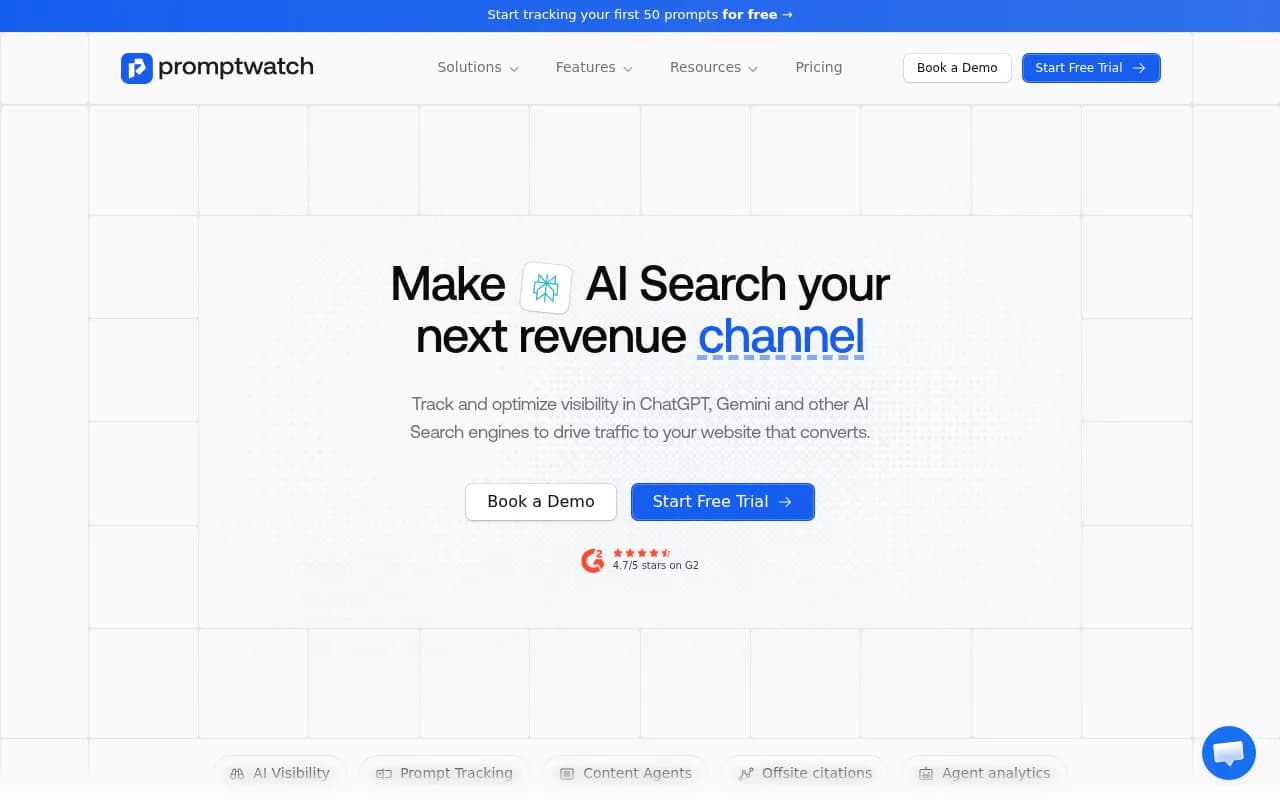
Promptwatch is the platform that comes closest to a full product-level tracking workflow. Its Answer Gap Analysis identifies specific prompts where competitors are being cited but you're not -- and that analysis can be scoped to individual products, not just the brand. You can track which pages on your site are being cited at the page level, which means you can see whether your product detail pages, comparison pages, or feature pages are actually making it into AI responses.
The crawler log feature is particularly useful for product-heavy sites. It shows which pages AI crawlers are actually reading, how often, and whether those pages are making the jump from "crawled" to "cited." For a brand with 50 product pages, that's the difference between knowing your catalog exists and knowing which products AI engines are actually paying attention to.
The content generation side closes the loop: once you know which product-level prompts you're missing, Promptwatch's Content Agents can generate articles, comparisons, and briefs specifically targeting those gaps -- grounded in real citation data, not generic SEO templates.
Profound
Profound is widely considered the strongest dedicated enterprise monitoring platform in the category. Its prompt library is deep, and it handles multi-model tracking well across ChatGPT, Perplexity, Gemini, and others. For product-level tracking, Profound lets you set up custom prompt sets around specific product names and categories, which is genuinely useful for large brands.
Where it falls short is on the action side. Profound is excellent at showing you data -- detailed, well-organized, enterprise-grade data -- but it doesn't help you do much with it. You'll need a separate content workflow to act on what you find. For teams that already have strong content operations and just need the intelligence layer, that's fine. For teams that want a single platform to find gaps and fix them, it's a limitation.
Peec AI
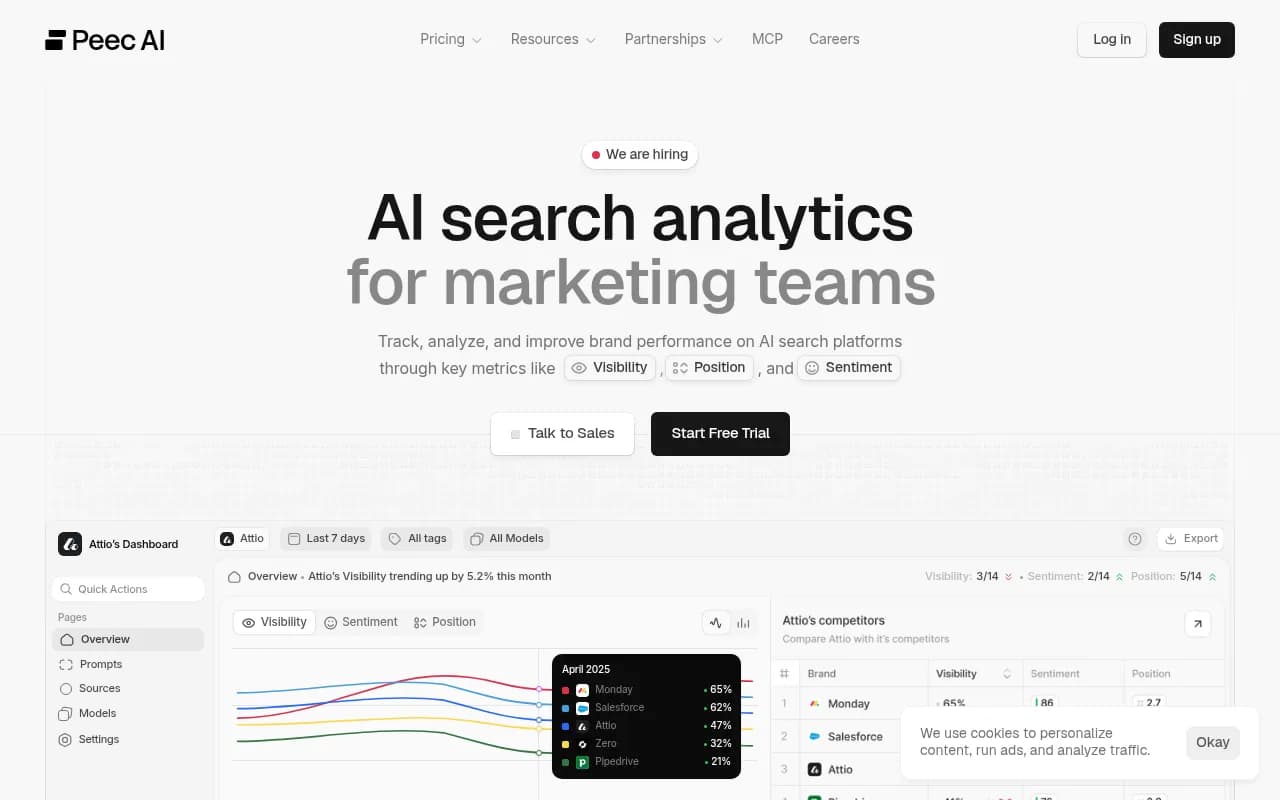
Peec AI is a solid mid-market option that tracks brand and product mentions across the major AI engines. It's more affordable than Profound and easier to get started with. The prompt customization is decent, and it covers the core use case of monitoring specific product names across ChatGPT, Gemini, and Perplexity.
The main limitation is depth. Peec AI doesn't offer crawler logs, doesn't track citation sources at the page level, and doesn't have content generation capabilities. It's a monitoring tool, and a good one, but it stops there.
AthenaHQ
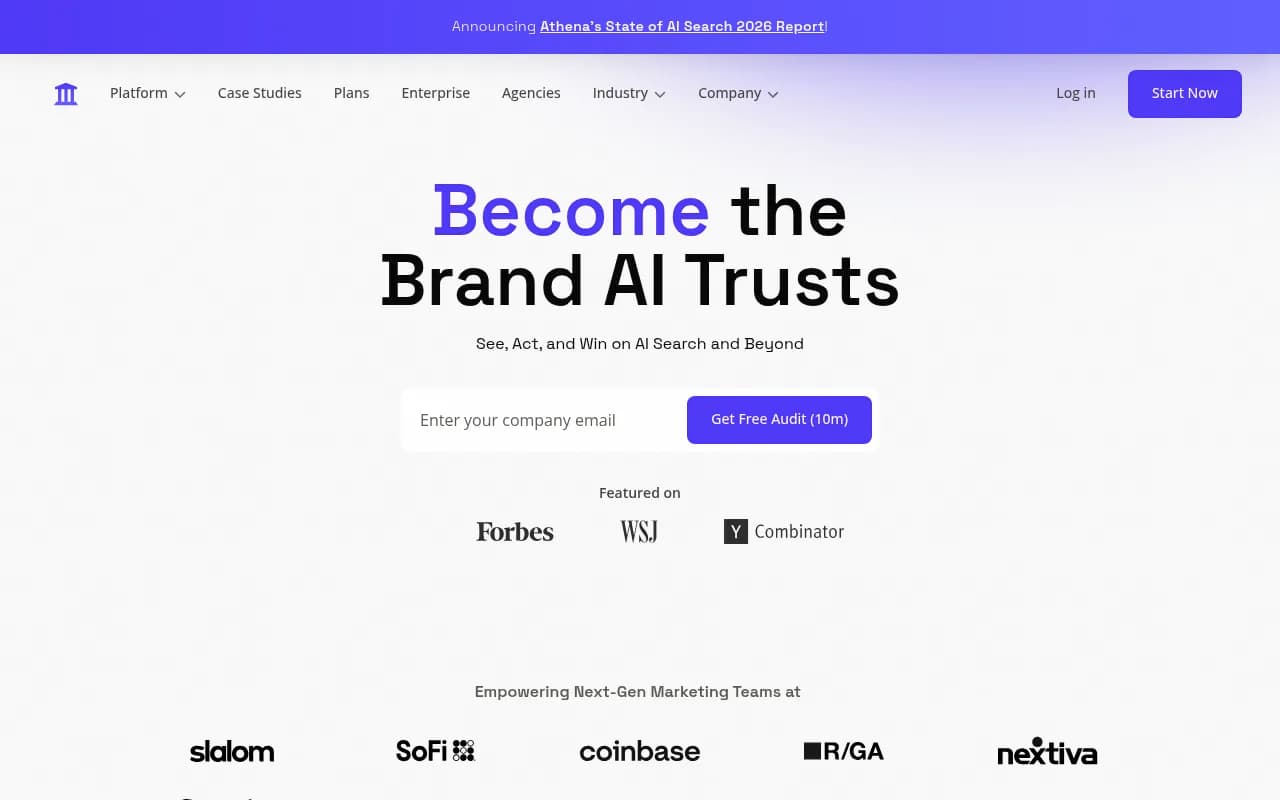
AthenaHQ positions itself as an enterprise-grade AI search monitoring platform with strong analytics. It handles multi-model coverage well and has decent competitor comparison features. For product-level tracking, it supports custom prompt sets, so you can monitor specific product queries rather than just brand queries.
Like Profound, though, AthenaHQ is primarily a monitoring platform. The optimization and content creation side is limited, which means teams using it still need to build a separate workflow to act on what they find.
Otterly.AI
Otterly.AI is one of the more accessible entry points in the category. It's affordable, covers the main AI engines, and is straightforward to set up. For smaller brands or teams just getting started with AI visibility tracking, it's a reasonable choice.
For product-level tracking specifically, Otterly.AI is limited. The prompt customization is basic, there's no page-level citation tracking, and there are no content generation features. It works well for brand-level monitoring but isn't built for the granular product tracking that larger catalogs require.
Scrunch AI
Scrunch AI focuses on AI search monitoring with a particular emphasis on understanding how AI engines use your content. It has some useful features around content analysis and citation tracking. For agencies managing multiple clients with distinct product lines, it's worth evaluating.
Search Party
Search Party is oriented toward agencies and handles multi-client workflows reasonably well. It covers the main AI engines and has decent reporting features. For product-level tracking, it's functional but not specialized -- the prompt metrics are limited, and there's no content gap analysis built in.
Semrush AI Visibility Toolkit
Semrush's AI Visibility Toolkit is the natural choice for teams already standardized on Semrush. It integrates with the broader Semrush platform, which means you can connect AI visibility data to your existing keyword and content workflows. The limitation is that Semrush uses fixed prompt sets rather than fully customizable ones, which makes granular product-level tracking harder to set up. It's a strong option for brand-level monitoring within a familiar platform, less so for deep product tracking.
Ahrefs Brand Radar
Ahrefs Brand Radar tracks brand mentions across AI engines and integrates with the broader Ahrefs toolset. Like Semrush, it uses fixed prompts, which limits how precisely you can target specific products or SKUs. There's also no AI traffic attribution, which means you can see mentions but can't connect them to actual site traffic or revenue. Useful as a supplementary signal, but not a primary product-level tracking solution.
Head-to-head comparison
| Platform | Product-level prompts | Page-level citation tracking | Crawler logs | Content generation | Cross-model coverage | Pricing (starting) |
|---|---|---|---|---|---|---|
| Promptwatch | Yes (custom) | Yes | Yes | Yes (AI Content Agents) | 10 models | $99/mo |
| Profound | Yes (custom) | Partial | No | No | 6+ models | Higher |
| AthenaHQ | Yes (custom) | Limited | No | No | 5+ models | Higher |
| Peec AI | Partial | No | No | No | 4+ models | Mid-range |
| Otterly.AI | Basic | No | No | No | 4+ models | Low |
| Scrunch AI | Partial | Partial | No | No | 4+ models | Mid-range |
| Semrush AI Toolkit | Fixed prompts | No | No | No | 4+ models | Add-on |
| Ahrefs Brand Radar | Fixed prompts | No | No | No | 3+ models | Add-on |
| Search Party | Basic | No | No | No | 4+ models | Mid-range |
The monitoring vs. optimization gap
One thing that stands out when you look at this category honestly: most platforms are dashboards. They show you data. They don't help you act on it.
This matters more for product-level tracking than for brand-level tracking, because the action required is more specific. If your brand visibility score drops, the remediation is vague -- "create more content," "build more backlinks." But if you discover that your product X is being recommended by ChatGPT but not Perplexity, and that Perplexity is citing a competitor's comparison page that you don't have an equivalent for, the action is clear: build that comparison page, targeting the specific angle Perplexity's citations favor.
That kind of specific, prompt-grounded content brief is only possible if your platform connects the monitoring data to the content creation workflow. Most don't. Promptwatch does, which is why it's the platform that makes the most sense for teams that want to actually move their numbers rather than just track them.
What to look for when evaluating these tools for product tracking
A few practical criteria to apply when you're shortlisting:
Custom prompt support. Can you enter your own product names, model numbers, and feature-specific queries? Or are you limited to the platform's fixed prompt library? Fixed prompts work for brand monitoring. Product tracking requires custom prompts.
Page-level citation data. Does the tool tell you which specific pages on your site are being cited, or just that your domain appeared? For product tracking, you need to know whether your product detail pages are being read and cited, not just your homepage.
Competitor product tracking. Can you track which competitor products are being recommended in the same prompts where you're absent? This is the most actionable form of gap analysis.
Source attribution. When AI engines cite your product or a competitor's product, what sources are they drawing from? Review sites, Reddit threads, YouTube videos, your own pages? Knowing the source tells you where to focus your off-site efforts.
Traffic connection. Can the platform connect AI citations to actual site visits? This is still an emerging capability, but it's the difference between "we're being mentioned" and "those mentions are driving revenue."
A note on e-commerce specifically
For e-commerce brands, product-level AI visibility is becoming a direct revenue question. ChatGPT's shopping recommendations, Perplexity's product carousels, and Google's AI-powered shopping results are all surfaces where individual products compete -- not brands.
Promptwatch tracks ChatGPT Shopping specifically, which is one of the few platforms to do so. If you're selling physical products and want to know whether your SKUs are appearing in AI-generated shopping recommendations, that's a capability you need to look for explicitly. Most monitoring tools don't cover it.
The broader point: as AI search becomes more transactional, the gap between "brand mentioned" and "product recommended" will keep widening. Teams that build product-level tracking workflows now will have a significant advantage when that shift fully plays out.
How to get started
If you're moving from brand-level to product-level tracking, a practical starting point:
-
Audit your current prompt set. List the queries where you'd expect your specific products to appear -- comparison queries, "best X for Y" queries, feature-specific questions. These become your custom prompt library.
-
Set up page-level tracking. Connect your site so you can see which product pages AI crawlers are visiting and which are being cited. Crawler logs (available in Promptwatch's Professional plan and above) are the most direct way to do this.
-
Run a competitor product audit. For each of your key products, track which competitor products are appearing in AI responses. The gaps you find are your content priorities.
-
Build the content to fill the gaps. This is where most teams stall -- the monitoring data is there, but the content creation workflow isn't connected. Whether you use Promptwatch's Content Agents or a separate writing workflow, the briefs need to be grounded in the specific prompt data you've collected.
-
Track the results at the page level. As you publish new content, watch for it to appear in crawler logs, then in citations. The timeline from publish to crawl to citation varies by model and by page authority, but it's measurable.
The tools exist to do all of this. The question is whether you're using them to their full depth -- or just watching a brand score number move up and down without knowing why.