Key Takeaways
- Catalog tools differ from generic AI trackers: they report on individual products (SKUs), product cards and feeds, not only whether your brand name appeared.
- Ranketta is strongest on feed enrichment and exports, Yotpo Discover on reviews and off-site activation, and Alhena on rendering analysis (how your product shows up inside an answer).
- Almost every claim about these three tools comes from the vendors themselves. Yotpo's "best of" lists rank Yotpo first. Ranketta's list ranks Ranketta first. Test on your own catalog before buying.
- Product pages are the most cited content type in ChatGPT, so complete product pages and clean feeds matter more than almost any other lever.
- If you also need crawler logs, AI traffic attribution and content execution beyond the catalog, a broader platform like Promptwatch fills that gap.
Why catalogs need their own kind of AI visibility tool
A SaaS company wants to know if ChatGPT mentions its brand. An ecommerce team has a harder question. Which of our 4,000 products does AI recommend, at what price, with what rating, and who is sitting above us?
Generic trackers answer the first question well. They tend to be weak on the second, because they treat your site as a handful of pages rather than a catalog with hero SKUs, variants, feeds and marketplace listings.
There's also the matter of how often shopping UI shows up at all. Promptwatch's ChatGPT shopping usage data shows product cards and price comparisons appear in only a low single-digit percentage of ChatGPT web-search responses. The rate moves in steps. It roughly doubled overnight in late May, then fell back weeks later, which looks like OpenAI tuning when cards appear. So a catalog tool has to be useful when no card shows too, which means citations, mentions and product page quality still carry most of the weight.
What the data says about product pages
According to Promptwatch Data's ChatGPT citation share by content type report (Sep 28 to Oct 4, 2026), product pages are the most cited type at 22.4% of classified citations, with landing pages next at 16.8%. Together that's 39% of citations going to pages that describe what a company sells.
For commercial prompts the skew is stronger. Product pages hit 26.0%, landing pages 20.6%, listicles 15.0% and comparisons 7.9%. Those four are almost 70% of commercial citations. Two takeaways for a catalog owner:
- Your own product pages are the main citation surface. Specs, price and positioning need to be complete.
- Third-party listicles and comparisons still matter, because they take a real slice of the commercial answer.
The content half-life report adds a useful detail: landing pages and docs keep most of their citations for months, while news loses half its pages in about five weeks. Evergreen product and category pages are a better investment than chasing news hooks.
What to look for in a catalog-focused tool
Before the reviews, here's the checklist I'd use. It's short on purpose.
- Product-level tracking. Can it show which individual SKUs get recommended, and which competitor SKUs sit beside them?
- Real interface data. Are answers collected from the actual consumer UI or from an API that may return different output?
- A fix path. Does it change anything (schema, feed, content, reviews) or only report?
- Catalog and platform integrations. Shopify, WooCommerce, Magento, feeds in XML, CSV or JSON.
- Pricing you can see. Several tools here hide it behind a demo.
Ranketta
Ranketta is built around the idea that AI shopping agents only recommend what they can confidently identify, price and route a buyer to. Its Shopping module tracks which products get named in answers, then helps you fix the feed that feeds those agents.
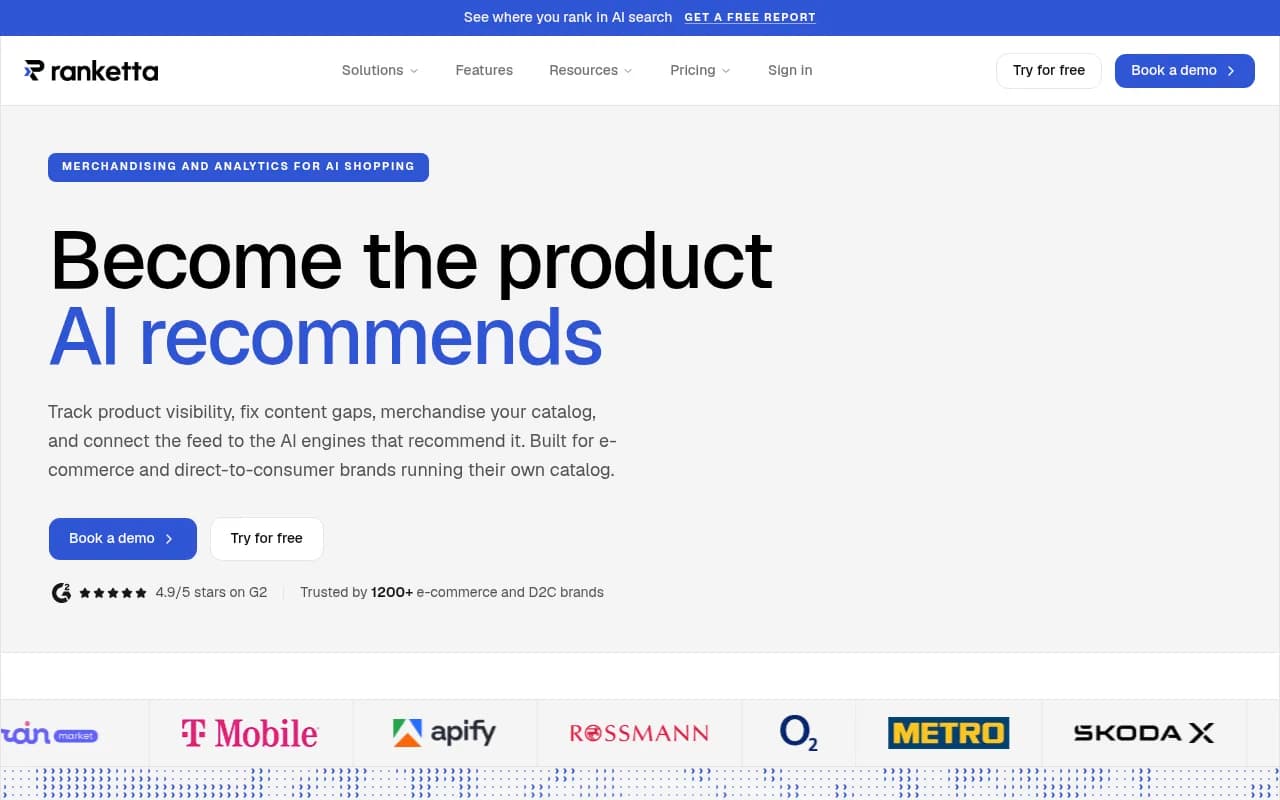
Based on Ranketta's own documentation and blog, the notable parts are:
- Product-level tracking across ChatGPT, Google AI Overviews, AI Mode, Gemini, Perplexity and Copilot, including a Best Sellers view that ranks the products AI recommends most often in your topics.
- A feed enrichment agent. You connect an XML, CSV or JSON feed and it proposes rewrites to weak titles, writes descriptions where yours are thin, maps products to the Google product taxonomy, fills in GTINs where they can be derived, and flags broken fields like condition or currency. Each proposal has a confidence score, and you can set an auto-approval threshold.
- Exports of the cleaned catalog to Google Merchant, Heureka, Zbozi, Shopify, or generic XML and JSON.
- An MCP server so Claude Desktop, Cursor and other clients can query prompts, citations, fan-outs and audit results.
- UI scraping instead of API calls, which it argues gives you what a real shopper sees.
Pricing is public, which is rare in this group: Tracker at 29 EUR/month (2 models, 25 prompts), Starter at 79 EUR/month (adds product data enrichment with 5,000 credits and 2 articles), Growth at 199 EUR/month, Scale at 449 EUR/month, and custom Enterprise and Agency terms.
The catch: I couldn't find independent reviews, and the enrichment agent's quality depends on your feed. Ranketta's own comparison article also names Ranketta as the only platform covering all four of its criteria, which is a criteria list it wrote. Still, if feed quality is your actual problem, this is the most direct tool here.
Yotpo Discover
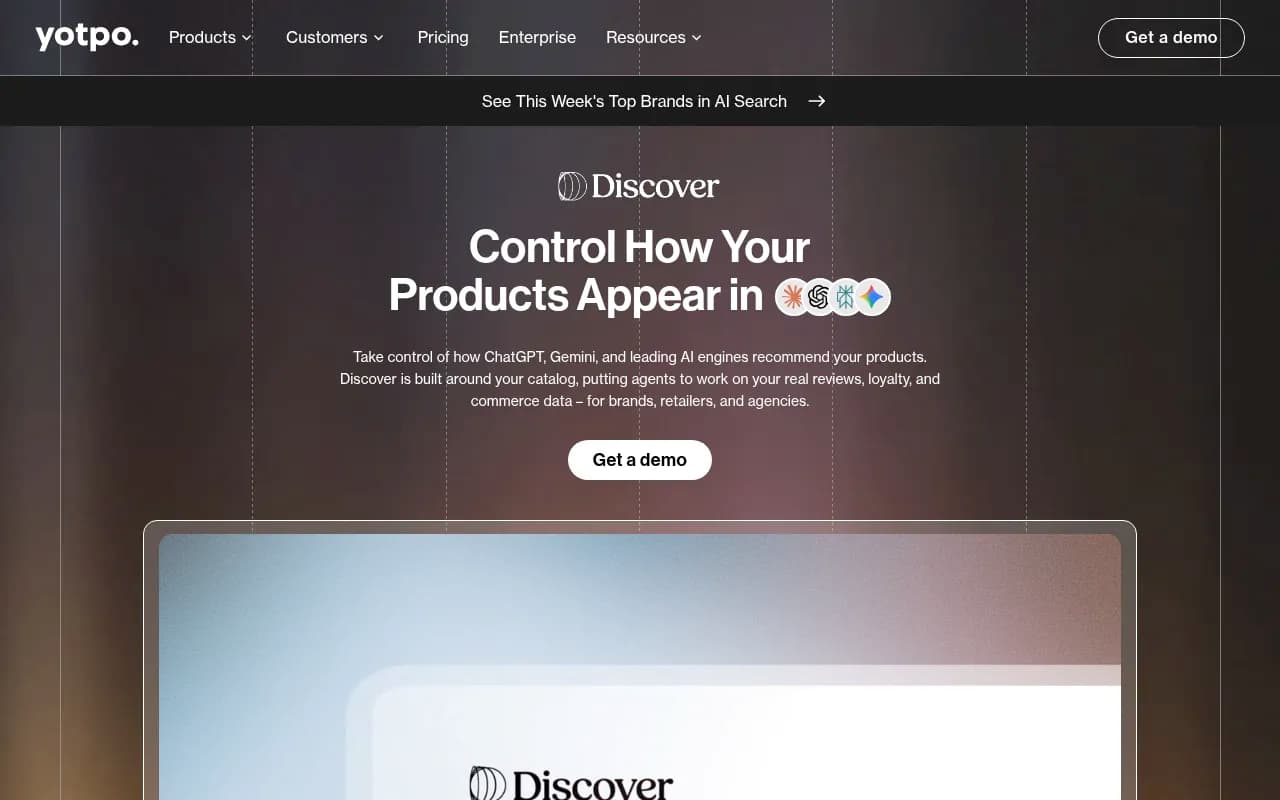
Yotpo Discover comes at the problem from reviews and loyalty. Yotpo says it powers 35k+ commerce brands, and Discover leans on that base of shopper reviews, UGC and loyalty data.
Yotpo Discover
It works through three agents, per Yotpo's materials:
- The Onsite Agent scans your storefront for structural problems like missing schema or weak internal links.
- The Content Agent writes blog content and publisher briefs grounded in real review and order data.
- The Activation Agent prompts verified reviewers and loyalty members to share experiences on off-site platforms AI engines cite, such as Reddit and retail marketplaces.
Tracking runs by product, category, funnel stage and region. Named customers are Beekman 1802 and David Protein. Yotpo's homepage claims +16% #1 product placements in AI answers and +20% awareness-stage shopper visibility, though it doesn't say for whom or over what period.
Pricing is custom enterprise. Yotpo has a free AI visibility score audit at commerce-gpt.yotpo.com, which is a sensible way to see output before a sales call.
Two cautions. First, Yotpo's several "best AI visibility tools" articles all put Discover first and the facts in them are vendor-sourced. Its sources also disagree about engine coverage: the product page lists Claude, ChatGPT, Perplexity and Gemini, while the blog lists ChatGPT, Gemini and Google AI Overviews. Ask for the current list. Second, the Activation Agent leans on Reddit, and Promptwatch Data shows reddit.com's share of ChatGPT citations fell from about 4% to 0.5% on August 14, 2026. Another report found ChatGPT drew only 0.46% of its citations from social platforms in the week of Sep 28 to Oct 4, while Google AI Overviews drew 12.2% (social media citations by AI model). Off-site reviews still help for Google surfaces, but ask how Yotpo weighs this for ChatGPT.
Alhena AI
Alhena markets itself as an AI visibility platform built for ecommerce. It's better known for its AI shopping assistant and support products (it rebranded from Gleen AI in early 2025), and visibility is included in every paid plan.
From the vendor's pages:
- SKU-level tracking across ChatGPT, Google AI Overviews, Perplexity and Gemini.
- Rendering analysis, meaning whether a product card showed price, ratings and images, or whether your brand was merely named in passing. This is the feature I find most interesting, because a mention without a card and a card with a price are very different outcomes.
- Claimed AI-driven revenue attribution.
- Integrations with Shopify, WooCommerce, Magento and Salesforce Commerce Cloud.
Pricing per Alhena's blog: a free tier, then Essentials at $199/month, Growth at $499 and Scale at $999. Its pricing page also lists a per-credit rate and an audit line that I couldn't reconcile with those tiers, so confirm what you're buying.
Alhena's case studies (Tatcha, Victoria Beckham) come from its shopping assistant, not from the visibility product. Don't read them as evidence that the tracking works.
Other tools worth a look
The catalog niche is small, but several general platforms handle product questions reasonably well.
Promptwatch
Promptwatch isn't catalog-native in the way Ranketta is, but it covers things a catalog-only tool tends to skip. It tracks real UIs for ChatGPT, AI Overviews, AI Mode, Gemini, Perplexity and Copilot, includes AI Shopping tracking for ChatGPT shopping carousels and Amazon Alexa product results (you can upload a catalog to track your own products), and Ads Radar for sponsored placements in AI search. IP-verified crawler logs show whether AI bots actually read your product pages or hit errors, and visitor analytics tie AI traffic to conversions. Its Content Agent can publish to Shopify-adjacent CMSs like WordPress, Webflow and Framer, and the Action Board turns gaps into a prioritized to-do list.

Plans run from a free Explore tier to Essential at $95/month and Professional at $245, with Business at $579 (includes Shopping Insights and Ads Radar). Check promptwatch.com/pricing before budgeting. It makes most sense when your question is "what is AI traffic worth and what do we fix first", rather than only feed hygiene.
Azoma and Bluefish
Azoma targets agentic-commerce GEO for AI shopping agents, and Bluefish AI pitches enterprise AI visibility plus agentic commerce.

Both are worth a demo if you sell through large marketplaces, though I'd want references before trusting either.
Naridon and Zoovu
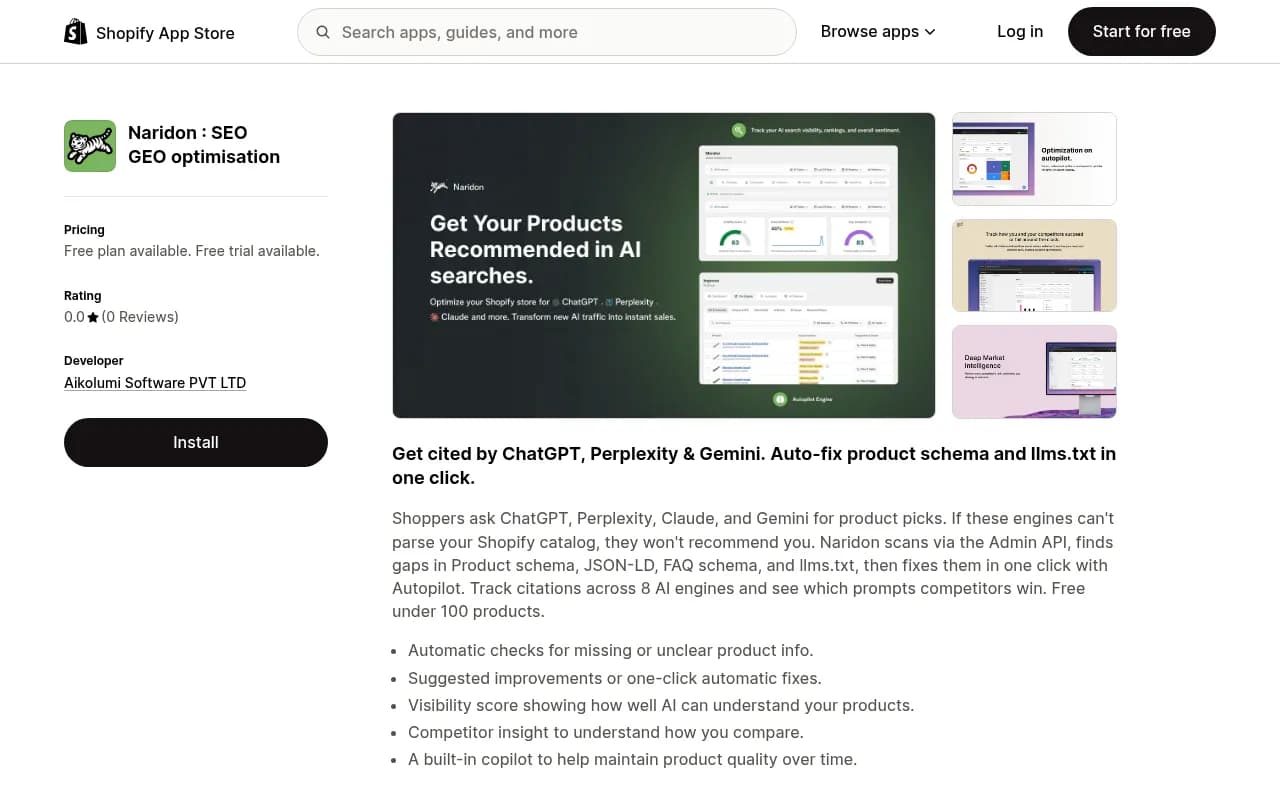
Naridon is a Shopify-native GEO monitor, a lightweight option for smaller stores. Zoovu is a different animal: it handles on-site AI product discovery rather than off-site visibility, so it complements the others rather than competing with them.

General trackers
If you only need monitoring at low cost, Otterly.AI and Peec AI are common entry points, and Profound sits at the enterprise end. None are catalog-native.



For a wider browse, the directories at bestgeosoftware.com and ai-rank-tools.com list many more.
Comparison table
| Tool | Product-level tracking | Fixes what? | Public pricing | Best for |
|---|---|---|---|---|
| Ranketta | Yes, SKUs and Best Sellers | Product feed (titles, descriptions, GTINs), exports to channels | From 29 EUR/mo | Feed-heavy retailers and marketplaces |
| Yotpo Discover | Yes, by product, category, region | Schema, content, off-site reviews | No, custom enterprise | DTC brands already on Yotpo reviews |
| Alhena AI | Yes, with rendering analysis | Mostly reporting plus its agent suite | Yes, from $199/mo (free tier) | Brands wanting card-level insight |
| Promptwatch | Shopping carousels, catalog upload | Content, crawl issues, action list | Yes, free to $579+ | AI traffic, crawlers, content execution |
| Azoma / Bluefish | Agentic commerce focus | Varies | Mostly demo-based | Large marketplace sellers |
| Naridon | Basic, Shopify-native | Light | App store pricing | Small Shopify stores |
How to choose
If your feed is the problem
Start with Ranketta. Thin titles, missing GTINs and mismatched prices are the unglamorous reasons products get skipped, and nobody else on this list attacks the feed so directly.
If you already have reviews and loyalty data
Discover is the logical pick, since it turns assets you already own into citation material. Budget for a sales process and ask the Reddit question above.
If you want to see how products render in answers
Alhena's rendering analysis is the differentiator. Pair it with a crawler-log tool if you also want to know whether AI bots can read your pages.
If you need the full picture
When the board asks whether AI search makes money, you'll want crawler logs, traffic attribution and a fix queue in one place. That's where a broader platform like Promptwatch earns its place.
A short pilot plan
- Pick 20 hero SKUs and write 5 buyer prompts per category, mixing commercial ("best X under $Y") and branded prompts.
- Run the same prompts through two tools for two weeks. Compare which SKUs each tool says appear, and spot-check against the real ChatGPT UI.
- Audit those 20 product pages for complete Product schema, accurate price and availability, and a clean merchant feed.
- Fix the top issues, then re-measure. If nothing moves in four to six weeks, the problem is probably content or authority, not the tool.
Final word
None of these tools has independent benchmarks behind it yet, so the vendors' own claims are all we have. Treat the feature lists as hypotheses. The best purchase is the one that surfaces a specific, fixable problem on your own catalog during a trial, and Ranketta, Alhena and Promptwatch all let you start cheaply or free.