Key takeaways
- A good ChatGPT brand tracker does three things: counts mentions, records which URLs get cited, and tells you whether what ChatGPT says about you is correct. Most tools do the first well and the third poorly.
- ChatGPT's behavior changed several times in 2026 (citations per response, fanouts, Reddit share), so tracker numbers are only comparable inside the same time window.
- Separate your own-site citations from third-party citations, and segment prompts by intent: commercial, informational, and branded.
- Monitoring-only tools are fine for reporting. If you want to fix gaps, look for content, crawler, and traffic data in the same product.
- Pricing and feature details below are directional. Confirm on each vendor's site before you buy.
A note on how this list was built
The title says tested, so let me be plain about what that means here. I judged the 11 platforms against a fixed checklist: ChatGPT surface coverage, citation depth, handling of accuracy and sentiment, whether they show query fanouts, and what you can do after you find a gap. I leaned on vendor positioning, public listicles, and Promptwatch's first-party ChatGPT research. I did not run identical prompt sets through every product and I have not verified every price. Treat the rankings as an informed shortlist, not a lab result.
One more caveat. The review sites I read (Qoulomb, SlateHQ, Searchable, Leapd and others) tend to put their own product or an affiliate pick first. Profound being called "best-funded" is a claim from one of them, and I could not verify it.
What ChatGPT brand tracking actually measures
There are three layers, and tools differ on how deep they go.
Mentions
Did ChatGPT name your brand in an answer to a given prompt? Counted across many prompts and many runs, this becomes share of voice or a visibility score. It is the easy part. Every tool on this list does it.
Citations
Which URLs did ChatGPT list as sources? This matters more than it sounds. Promptwatch Data's report on which content types ChatGPT cites most (Sep 28 to Oct 4, 2026) found product pages at 22.4% of citations, landing pages at 16.8%, and listicles at 13.6%. For branded prompts like "is HubSpot good for startups", reviews were 5.6% of citations, about three times their share across all prompts. So a useful tracker should split citations of your own pages from third-party ones, and let you filter by prompt intent.
Accuracy
Is the answer right? Does ChatGPT say you offer a feature you dropped, quote an old price, or confuse you with a competitor? Sentiment scoring is the usual proxy. Real accuracy checking, where the tool compares the answer against your facts, is rarer. Look for something like a brand book or knowledge base that the tool uses as ground truth.
Why ChatGPT tracking numbers keep moving
If you pick a tool and see your visibility swing, it may not be your content. 2026 had several platform-side shifts, all documented in Promptwatch Data:
- Average citations per response dropped around the GPT-5.3 rollout on March 4, 2026 (ChatGPT citation drop).
- reddit.com's share of ChatGPT citations fell from roughly 4% to 0.5% on August 14, 2026 (Reddit citations are dropping in ChatGPT).
- On August 8, 2026, ChatGPT began using the site: operator at scale, jumping from about 0.4% to about 17% of fanout queries (ChatGPT site: operator fanouts).
- Average fanout query length fell from about 117 characters in early December to about 53 characters from April (ChatGPT query fanouts). Shorter, more keyword-like searches mean you should test prompts in both conversational and short form.
- Almost half of ChatGPT responses cite 10 or more unique domains (unique domains per response), so your brand competes with a crowded source list.
The practical takeaway: annotate your dashboards with these dates, and only compare periods on the same side of a change.
The 11 platforms at a glance
| Tool | Best for | ChatGPT strength | Goes beyond monitoring? |
|---|---|---|---|
| Promptwatch | Teams that want to fix gaps, not just see them | Real-UI tracking, citations, crawler logs, AI traffic | Yes, content agent and action board |
| Profound | Large enterprise reporting | Deep analytics | Mostly monitoring |
| Scrunch | Brands and agencies | Monitoring plus agent-ready pages | Partly |
| Otterly.AI | Budget monitoring | Mentions and share of voice | No |
| Peec AI | Mid-size teams | Visibility, citations, competitors | Limited |
| AthenaHQ | Monitoring-first teams | Visibility tracking | Limited |
| Semrush AI Visibility Toolkit | Existing Semrush users | Bolt-on tracking | No |
| Ahrefs Brand Radar | Existing Ahrefs users | Broad brand tracking | No |
| Searchable | ChatGPT-focused tracking | Multi-surface, fanout visibility | Partly, content tools |
| Rankscale | Frequent sampling | Up to hourly sampling (per Searchable's review) | No |
| Qwairy | GEO monitoring | Assistant visibility | Limited |
1. Promptwatch
Promptwatch is where I would start if the goal is more than a dashboard. It tracks the actual interfaces of ChatGPT, Google AI Overviews, AI Mode, Gemini, Perplexity, Copilot and others, by country and language, rather than only API output, which can differ from what users see.

On the three layers above: mentions come with a 0-100 Visibility Score, share of voice, position, and sentiment. Citations include a citation rank and self-citation rate, so you can tell "mentioned but never cited" (a content or crawlability problem) from "not mentioned at all" (a coverage problem). Accuracy is handled through Brand Book instructions that define what counts as a mention, plus per-response sentiment.
What sets it apart is what comes after. IP-verified AI crawler logs show whether GPTBot, OAI-SearchBot and ChatGPT-User actually reach your pages and where they hit errors. Visitor analytics attribute real traffic and conversions from ChatGPT. Query fanouts show the exact searches ChatGPT runs. Then the Action Board and Content Agent turn gaps into planned, written, and published pages, and tracking checks whether they got cited. Crisp reported 2x higher conversion from AI traffic than traditional channels.
Pricing runs from a free Explore tier (ChatGPT only, 10 prompts) through Essential at $95/month, Professional at $245, and Business at $579. Check promptwatch.com/pricing for current numbers.
2. Profound
Profound is the enterprise name most often listed first in third-party roundups. It has deep reporting and a large customer base in big brands. The tradeoff is price, and, from what I could find, less emphasis on Reddit tracking, shopping, and executing the fixes.

3. Scrunch
Scrunch pairs AI search monitoring with agent-ready pages for your site, which is a different angle from pure tracking. Agencies like the multi-brand setup.
4. Otterly.AI
Otterly is the affordable pick. It tracks brand mentions and share of voice across ChatGPT, AI Overviews, AI Mode and Perplexity, and includes GEO audits. It is a monitor, so expect no crawler logs or content generation.

5. Peec AI
Peec AI tracks visibility, citations, and competitor performance, and adds suggestions. A reasonable middle option when you need competitor comparisons without enterprise cost.

6. AthenaHQ
AthenaHQ is a visibility monitoring platform. It does the core job; the question is whether you need more than reporting.

7. Semrush AI Visibility Toolkit
If your team already lives in Semrush, adding the AI Visibility Toolkit keeps everything in one login. The limits are the usual ones for SEO suites: fixed prompt sets and shallower AI-specific data.
8. Ahrefs Brand Radar
Brand Radar covers brand mentions across AI search engines and fits well beside Ahrefs backlink and keyword data. Same caveat as Semrush: great for context, lighter on ChatGPT-specific diagnostics.

9. Searchable
Searchable's own review argues that a good ChatGPT tracker should cover model-only answers, ChatGPT Search, Shopping, and fanout queries. It cites an average of 1.74 underlying searches per response across 6.9 million responses. That is a vendor measurement, and it sits between the 1.84 and 1.0 averages in Promptwatch's fanout data from different periods, which is a good reminder that these numbers drift.

10. Rankscale
Rankscale is cited as sampling as often as hourly. Frequent sampling helps because one ChatGPT response is one sample, not a stable result.
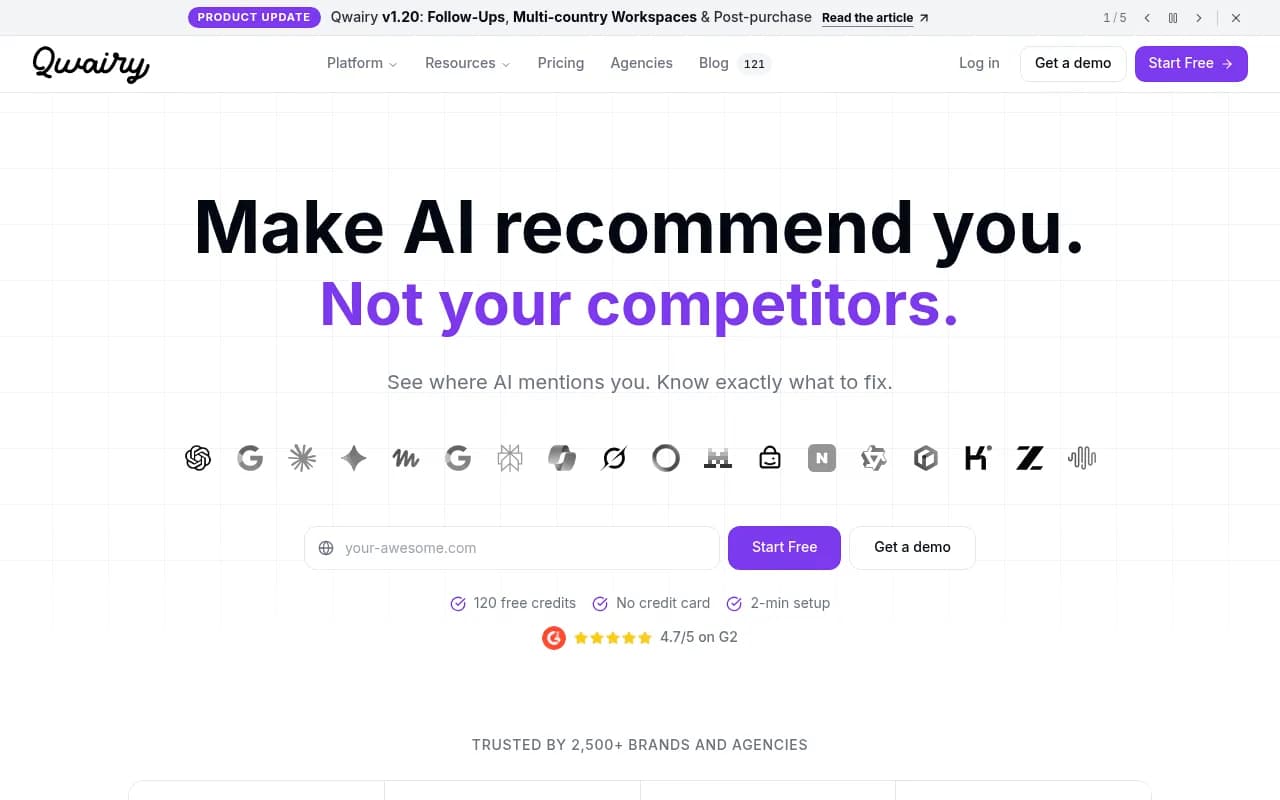
11. Qwairy
Qwairy is a GEO platform for assistant visibility. Worth a trial if you want a lighter monitoring layer.
How to choose
Pick by the problem you have:
- You need a board-ready report on whether ChatGPT mentions you: Otterly, Peec AI, or AthenaHQ will do it.
- You already pay for an SEO suite and want a first look: Semrush or Ahrefs Brand Radar.
- Your brand is mentioned but not cited, or traffic from ChatGPT is flat: you need crawler logs and page-level data, which is where Promptwatch is strongest.
- You run an agency with many clients: check white-label reporting and per-client pricing. Promptwatch's agency plans start at $199/month; Scrunch is also built for this.
- You are an enterprise with procurement requirements: Profound and Promptwatch (ISO/IEC 27001, GDPR) both belong on the shortlist.
Questions to ask in every demo
- Do you track the real ChatGPT interface or only the API?
- How many times is each prompt run per day?
- Can I separate my site's citations from third-party ones?
- Can I segment by commercial, informational, and branded prompts?
- Do you show fanout queries?
- How do you handle accuracy, not just sentiment?
- What happens after I find a gap?
What to do after you start tracking
Tracking alone changes nothing. A workable first month:
- Build 30 to 50 prompts across the three intents. Commercial prompts like "best CRM for small businesses" lean on product pages, landing pages, and listicles, which together make up almost 70% of commercial citations per Promptwatch Data.
- Record a baseline and note the platform changes listed above.
- Check that AI crawlers can read your site. If ChatGPT cannot fetch your pages, no amount of content work helps.
- Fix inaccuracies at the source: your own product and pricing pages first, then reviews and third-party listings.
- Remember decay. Promptwatch's content half-life report found news loses half its cited pages within about 36 days, while landing pages and docs last longest. Refresh accordingly.
For a wider set of options, the GEO software directory at bestgeosoftware.com lists many more platforms, and Promptwatch's data hub has the underlying citation research.
Bottom line
All 11 tools can tell you whether ChatGPT mentioned your brand. Fewer tell you why, and fewer still help you change the answer. Pick the cheapest monitor if reporting is the whole job. If you want citations, crawler access, traffic, and content fixes in one loop, Promptwatch is the one I would trial first, starting with its free tier.