Key takeaways
- Conductor, BrightEdge, Botify and Adobe LLM Optimizer (now branded Adobe Brand Visibility) solve different problems. They are not four versions of the same product.
- Conductor leans on AEO governance and agent infrastructure, BrightEdge on automated on-site optimization, Botify on crawling and indexation at huge scale, and Adobe on GEO measurement and deployment inside Adobe Experience Cloud.
- None of the four publishes reliable pricing. Plan on quotes and annual contracts, and treat third-party price figures as unverified.
- Most "best enterprise SEO platform" lists are written by vendors. Conductor's own ranking puts Conductor first, and Yotpo and SEORCE sell competing products.
- Many enterprise teams end up with a hybrid stack: one suite or crawler, plus a dedicated AI visibility tool for measurement and execution.
Why enterprise SEO buying changed in 2026
For a decade, enterprise SEO software meant rank tracking, site audits, and reporting that could survive a quarterly business review. Those jobs still exist. But now a CMO also asks, "What does ChatGPT say about us?" and a classic rank report does not answer that.
The four platforms in this guide come at the question from different starting points. Two are classic SEO suites that grew AI modules (BrightEdge and Conductor). One is a technical crawler that moved into AI search (Botify). One is a GEO product built into a larger marketing cloud (Adobe). That origin story matters more than the feature checklist, because it tells you what each tool is genuinely good at.
One more thing about the engines themselves. Citation behavior differs a lot by engine. In Promptwatch Data's sources-per-response report, ChatGPT cited about 5 sources per web-search answer, while Google AI Overviews and Perplexity each cited about 10. Copilot swung between under 2 and nearly 17 before settling at the low end. So whichever platform you pick, check that it measures each engine separately instead of blending them into one score.
A note on bias in the rankings you will find
Search for this topic and you will hit a wall of "ranked" lists. Read them with some suspicion. Conductor's own academy article ranks nine enterprise platforms and puts Conductor at number one, with Botify at three and BrightEdge at five. Yotpo's BrightEdge alternatives post pitches its own Yotpo Discover. SEORCE's comparison pitches SEORCE. Indexable's guide pitches an execution layer it sells.
That does not make their facts wrong. It means the ordering is a sales argument. I used these sources for product claims that vendors state about themselves, and I flag them as vendor-stated below.
The four platforms at a glance
| Platform | Starting point | Best for | AI engines (vendor-stated) | Published pricing |
|---|---|---|---|---|
| Conductor | Enterprise SEO suite | AEO governance plus agent infrastructure | ChatGPT, Gemini, Copilot, Claude, traditional search | Not published, usage-based plans |
| BrightEdge | Enterprise SEO suite | Automated on-site optimization | Google, AI Overviews, ChatGPT, Perplexity | Not published |
| Botify | Technical SEO crawler | Millions of URLs, crawl and indexation | No engine list published | Not published |
| Adobe LLM Optimizer | GEO inside Adobe Experience Cloud | Measure, optimize, deploy GEO on Adobe stacks | Not itemized here | Quote only, per-prompt licensing |
Conductor
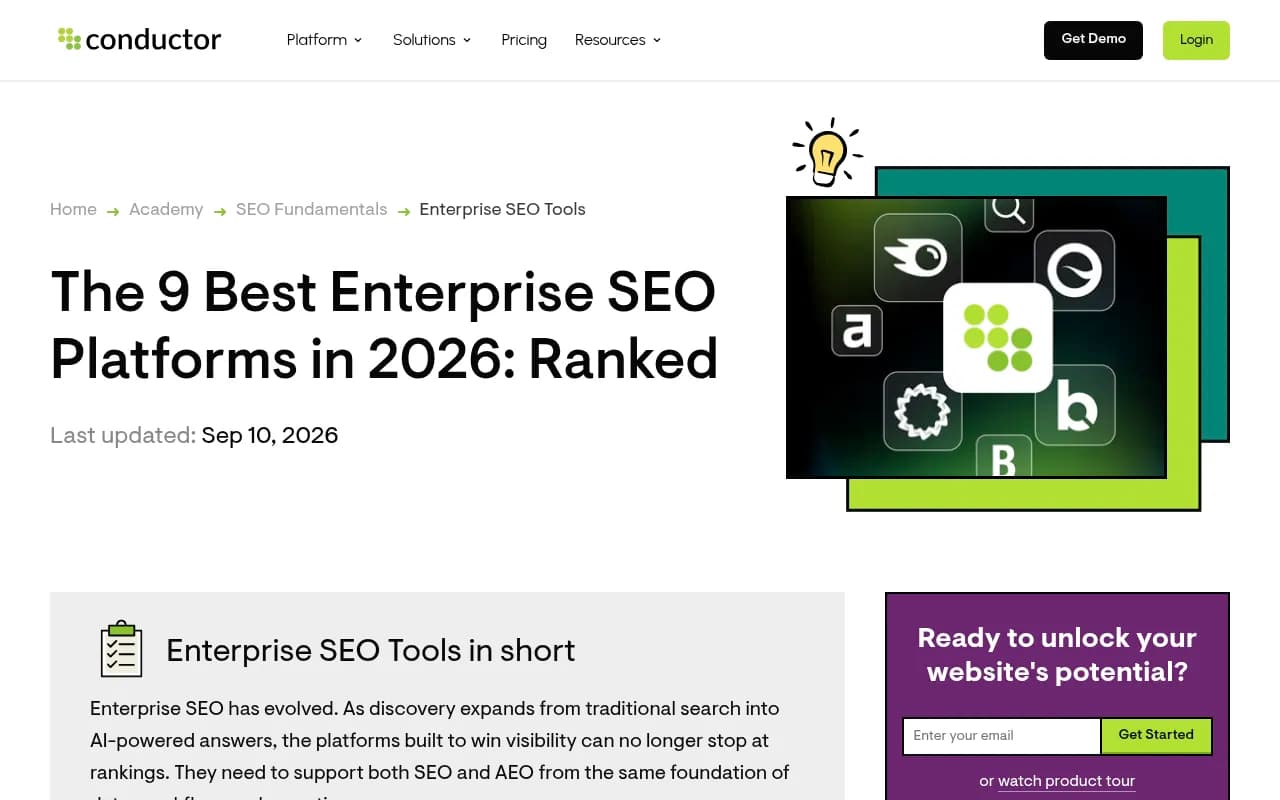
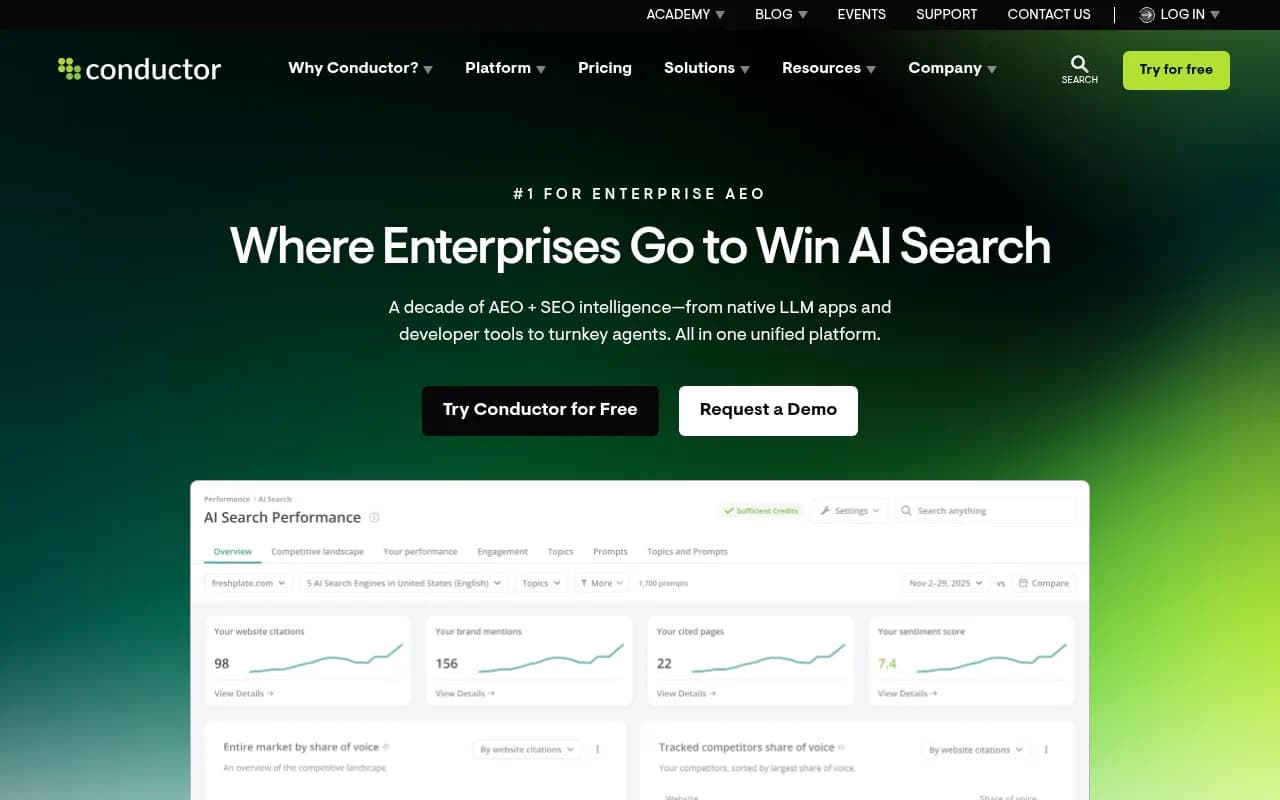
Conductor is an enterprise organic marketing platform built for large, collaborative teams. Its pitch is one foundation of data, workflow and reporting for both SEO and AEO, so distributed teams are not stitching together point solutions.
What stands out
In April 2026, Conductor launched AgentStack, according to a Business Wire release. It combines native apps inside ChatGPT, Claude and Microsoft Copilot with developer infrastructure, including APIs and an MCP server. A BrightEdge-versus-Conductor comparison lists native LLM apps and an MCP server as a Conductor-only capability. Conductor also publishes a 2026 AEO/GEO benchmarks report covering 3.3 billion sessions across more than 13,000 enterprise domains, which reportedly found AI-referred sessions at roughly 1% of traffic but growing 527% year over year. I did not verify that report independently, and the vendor wrote it, so treat the numbers as directional.
Its AI module covers citation tracking, mention tracking, share of voice, tone, and bot-crawl reports, and the Yotpo review notes it is API-first rather than scraping-based. For regulated industries, that matters: teams need to defend how every number was produced.
Where it is weaker
The Yotpo review calls Conductor report-heavy and not commerce-native, with no SKU-level logic and no agent layer that fixes what it finds. Yotpo sells a competing product, so weigh that, but the SKU-level gap is plausible for a general SEO suite. The BrightEdge comparison also says Conductor's approach focuses on on-page optimization and content structure for AI extractability, which means off-site influences like third-party coverage get less attention.
BrightEdge
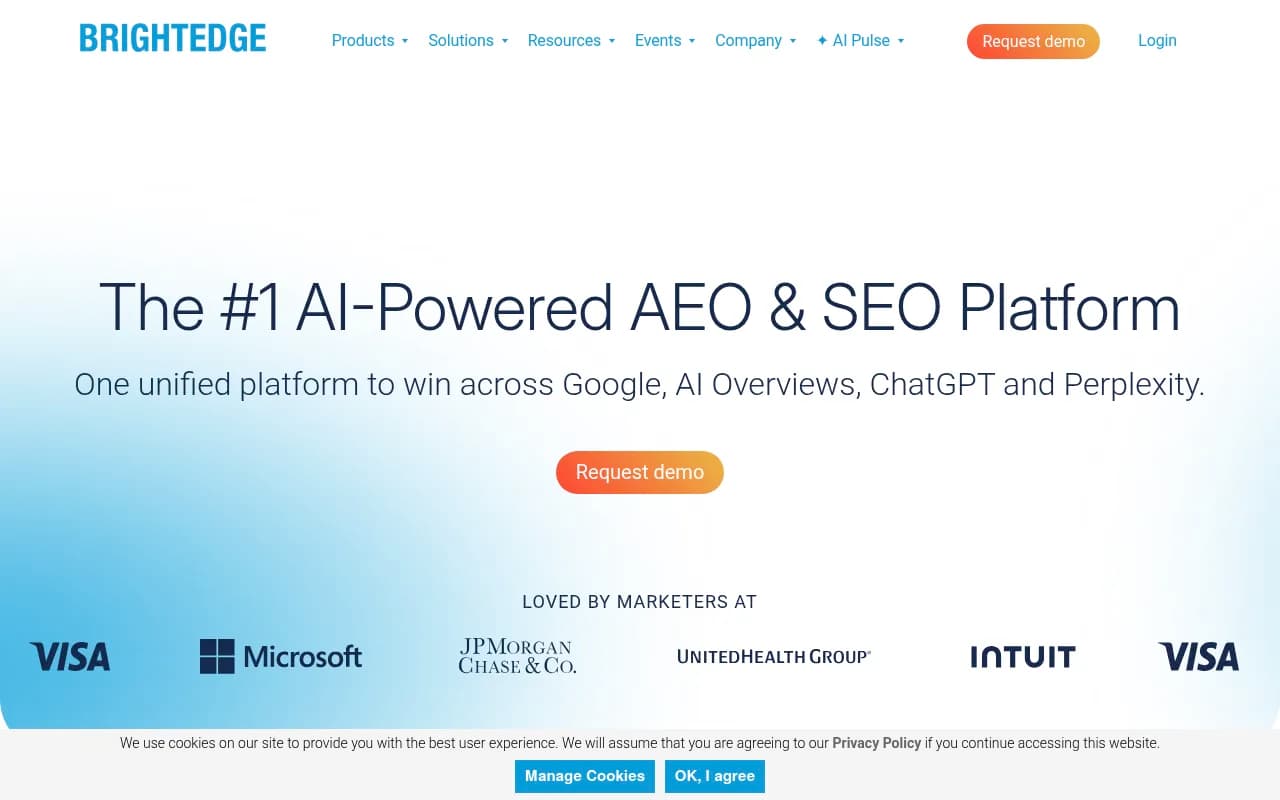
BrightEdge has been a default enterprise pick for years, covering keyword research, content checks and rank tracking. It now describes itself as an AEO and SEO platform across Google, AI Overviews, ChatGPT and Perplexity.
What stands out
Automation. BrightEdge says its Autopilot handles fully automated optimizations on your website, which is the strongest on-site execution claim of the four. It also offers Agent Insights, tracking bot visits and friction points from AI agents, a capability the Conductor comparison marks as BrightEdge-only. Stackmatix points to AI visibility tracking through BrightEdge Prism and an AI Catalyst product that monitors AI Overview appearances and recommends ways to improve citation rates.
Where it is weaker
The interface is dense and data-heavy and takes time to learn, per the same comparison. On Reddit's r/bigseo, one commenter calls it really expensive and prefers Ahrefs or Semrush for all-in-one needs. That thread is old and anecdotal, but the cost complaint shows up repeatedly. BrightEdge's pricing page also reportedly 404s, so expect a sales conversation.
Botify
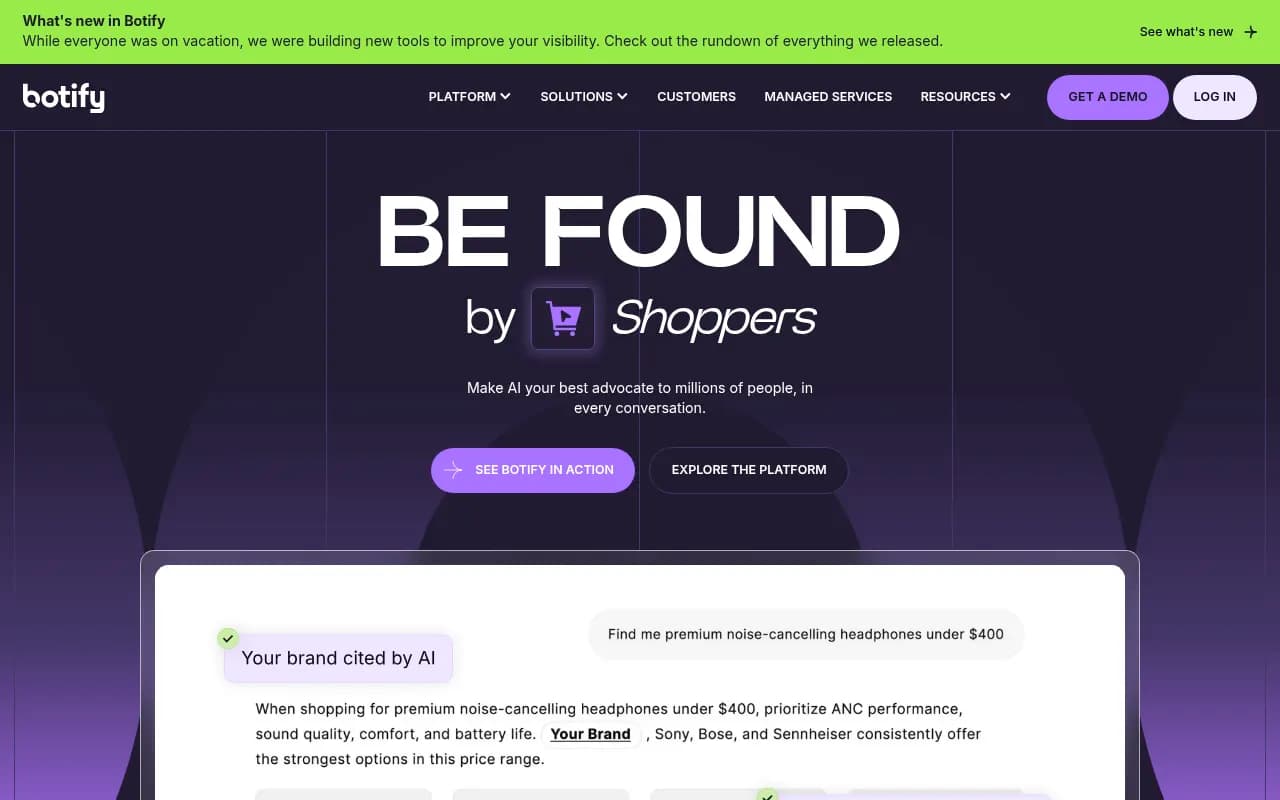
Botify is the technical specialist. EWR Digital calls it the leader in technical enterprise SEO, focused on the relationship between crawling, rendering, indexing and revenue. It is built for sites where crawl budget and indexation make or break results: large e-commerce catalogs and publishers.
What stands out
Scale. Indexable's guide says that if you need crawl and log analysis across millions of URLs, choose Botify. Botify describes AI Activation as automations that optimize, test and deploy content. For AI search, the technical layer matters more than people admit: if AI crawlers cannot reach or render your pages, no amount of content tuning helps.
Where it is weaker
Botify does not publish a list of AI engines it tracks (checked September 20, 2026 by Indexable). It is not a content-workflow or executive-reporting suite in the way Conductor is, so most teams pair it with something else. Conductor's own comparison pages exist because buyers regularly shortlist both.
Adobe LLM Optimizer (Adobe Brand Visibility)
Adobe's product page now calls it Adobe Brand Visibility, pitched as a system to measure, optimize, deploy and prove GEO impact. The older name, Adobe LLM Optimizer, still appears in documentation and reviews.
Adobe LLM Optimizer
What stands out
If you already run Adobe Experience Cloud, this is the natural fit. A vendor-comparison blog from SEORCE (a competitor, so biased) says Adobe reached general availability in October 2025, offers Optimize at Edge to deliver AI-optimized content at the CDN layer, tracks agentic traffic from CDN logs, and supports one-click deployment of optimizations. It also repeats an Adobe claim of a 5x increase in Firefly citations in a week. That was Adobe's own deployment and is unverified.
Adobe also moved deeper into search tooling when Semrush joined its CX Enterprise suite on April 28, 2026. One article reports the deal at about $1.9 billion, but I could not confirm that figure. Semrush's FAQ says there are no changes to existing contracts.
Pricing and access
Adobe publishes no price. The product description lists the license metric as prompts per year, with limits including 800 AIO Service Credits per month. Third parties report packages starting at 1,000 prompts per year, roughly $115K, sold in 200-prompt increments. LLM Pulse, a competitor, cites about 60 euros per tracked prompt per year and says contracts are annual only with no self-serve signup. None of this is confirmed by Adobe. Trials activated after April 1, 2026 reportedly allow up to 100 prompts, one domain and optimizations on up to 10 URLs, but only for certain eligible Adobe customers.
Where it is weaker
Outside the Adobe ecosystem, the value case thins out. One review notes Capterra shows zero user reviews for Brand Visibility, so independent buyer feedback is scarce.
How to choose
| If your main problem is | Start with | Why |
|---|---|---|
| Crawl budget and indexation on millions of URLs | Botify | Built around crawling, rendering and indexing |
| Governance and reporting across many regional teams | Conductor | One workflow for SEO and AEO, plus MCP and agent apps |
| Automated on-site fixes | BrightEdge | Autopilot and Agent Insights |
| You live in Adobe Experience Cloud | Adobe Brand Visibility | CDN-level deployment and agentic traffic from logs |
| Measuring and acting on AI visibility without a suite contract | A dedicated GEO platform | See below |
Questions to ask in every demo
- Which AI engines are tracked from the real user interface, and which come from APIs? Answers can differ between the two.
- Can I see IP-verified AI crawler logs, or only a summary score?
- Does the platform execute changes, or just recommend them?
- What is the unit of pricing (prompts, seats, URLs, credits), and what happens when I exceed it?
- Can I export raw data and reach it through an API or MCP server?
On the crawler question, Promptwatch's AI crawler traffic report shows why it matters. OpenAI made up 79.8% of verified AI crawler requests in the week of Aug 31 to Sept 6, 2026, down from 94.8% in mid-June, as Anthropic, Google, Perplexity and Mistral grew. If a provider is large in that mix but near zero in your own logs, you may be blocked by robots.txt, a CDN or a WAF rule.
The hybrid stack most teams end up with
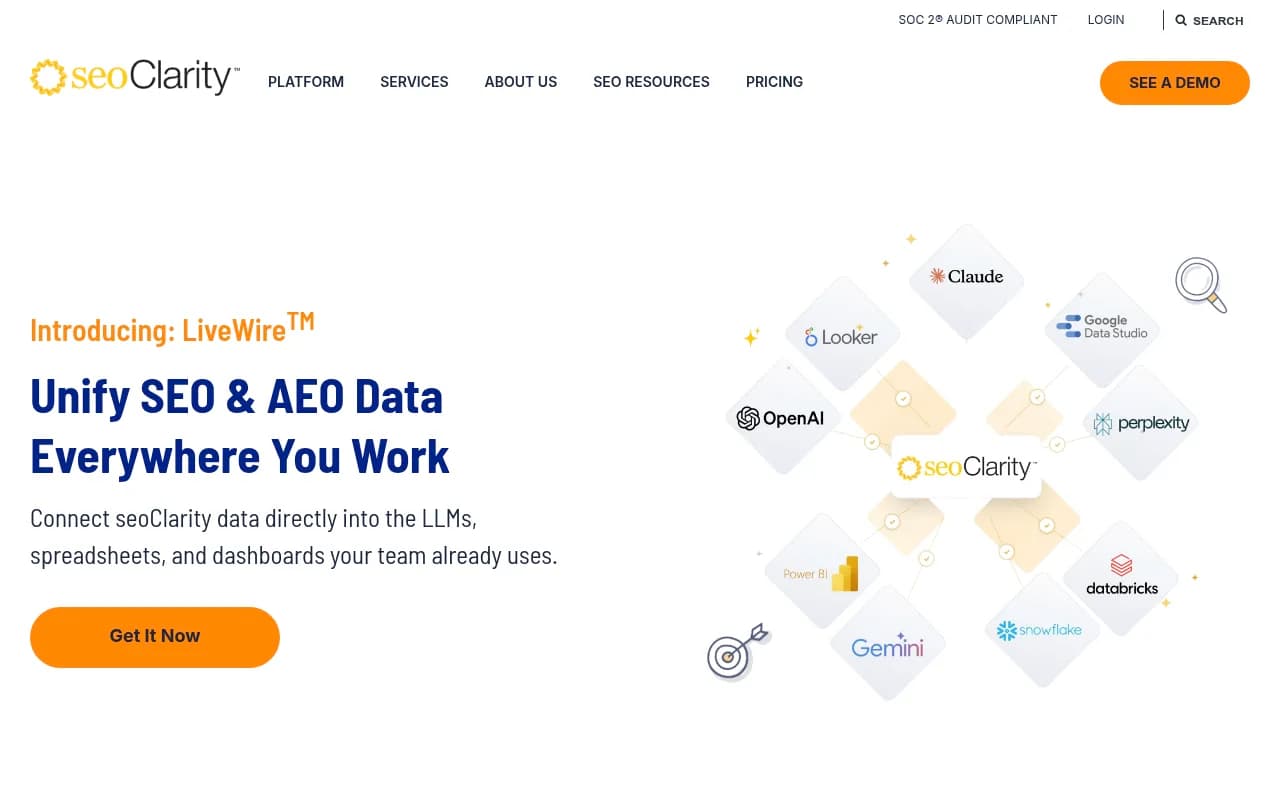
Indexable's recommended 2026 stack pairs an SEO suite (Conductor, BrightEdge or seoClarity) with AI-visibility measurement and an execution layer that ships the work. Yotpo says similar: a brand that keeps its SEO suite and adds a dedicated AI-visibility tool tends to cover more ground than one that swaps one for the other. Both are selling something, but I agree with the shape of the advice. Suites are strong at governance. They are rarely the deepest at AI-specific measurement.
For the AI visibility layer, Promptwatch is the one we use at 1001 SEO Media. It tracks the real interfaces of ChatGPT, AI Overviews, AI Mode, Gemini, Perplexity and Copilot, and its crawler logs and Action Board go beyond monitoring into fixing.

Other enterprise-leaning options in the catalog include Profound, Semrush's AI Visibility Toolkit, and Ahrefs Brand Radar:


For a wider survey, the GEO software directory at bestgeosoftware.com lists many more.
Suites versus dedicated AI visibility tools
| Need | Enterprise suite (Conductor, BrightEdge) | Technical crawler (Botify) | Dedicated GEO platform |
|---|---|---|---|
| Governance and reporting | Strong | Moderate | Varies |
| Crawl and log analysis at scale | Moderate | Strongest | Varies, strong where IP-verified AI crawler logs exist |
| AI citation and sentiment tracking | Included as a module | Limited public detail | Core product |
| Content execution | Platform-dependent | Automations | Often built in |
| Typical buying motion | Annual contract | Annual contract | Monthly or annual |
Recommendation
Pick by your bottleneck, not by a ranking. A site with millions of URLs and indexation problems needs Botify first. A global team that struggles with prioritization and executive reporting should look at Conductor. If you want automation on your own pages, BrightEdge deserves a demo. If your stack is Adobe, Brand Visibility is the path of least resistance, though you should negotiate hard on prompt volume.
In every case, ask for a pilot on your own domain with your own prompts. A demo on the vendor's sample data tells you nothing about whether the platform can find the gap on your site. Get pricing in writing, since none of the four publishes it.