Key takeaways
- For software prompts, ChatGPT leans on docs and help centers (2.64% of citations), vendor sites (2.01%), review sites and analysts (1.57%), and GitHub (1.2%), per Promptwatch Data for Sep 28 to Oct 4, 2026.
- Product pages and landing pages are 39% of all ChatGPT citations, so your own site is the main citation source. Pick a tool that shows which of your pages get crawled and cited, not just whether your name appeared.
- Review sites (G2, Gartner, Capterra, Software Advice) together out-earn any single vendor, Microsoft included. Your G2 and Capterra profiles are part of your GEO surface.
- Monitoring-only tools answer "were we mentioned?" Software teams usually also need crawler visibility, content gap analysis, and a way to ship fixes.
- Most "best GEO tools" listicles are published by vendors that rank themselves. Treat any ranking, including this one, as a starting point and test with a trial.
What ChatGPT actually cites for software prompts
Before picking a tool, look at what you are trying to influence. Promptwatch's report on software-related ChatGPT citations covers organic prompts from Sep 28 to Oct 4, 2026. The top domains:
| Domain | Share of software citations |
|---|---|
| github.com | 1.2% |
| learn.microsoft.com | 0.98% |
| g2.com | 0.73% |
| docs.aws.amazon.com | 0.41% |
| docs.cloud.google.com | 0.35% |
| gartner.com | 0.34% |
| capterra.com | 0.32% |
| intercom.com | 0.28% |
| zapier.com | 0.24% |
Those numbers look small because software citations are spread across a huge long tail. The 23 domains in the report together earn 7.89%. What matters is the mix by source type:
- Docs and help centers: 2.64%
- Vendor sites: 2.01%
- Review sites and analysts: 1.57%
- GitHub: 1.2%
- App stores: 0.47%
Two things stand out to me. First, documentation beats marketing sites. If your docs are behind a login, rendered client-side, or blocked to AI crawlers, you are giving up the biggest bucket. Second, G2, Gartner, Capterra, and Software Advice combined beat every individual vendor in the list. Vendor sites and docs together earn about 3x what review sites do, so owning your own content matters most, but the review profiles are not optional.
Which content types win
The content type report (same week) breaks down all prompts:
| Content type | Share of ChatGPT citations |
|---|---|
| Product pages | 22.4% |
| Landing pages | 16.8% |
| Listicles | 13.6% |
| How-tos | 8.7% |
| Documentation | 7.5% |
| Comparisons | 5.9% |
| News | 5.7% |
For commercial prompts like "best CRM for small businesses," product pages hit 26.0%, landing pages 20.6%, listicles 15.0%, and comparisons 7.9%. Those four types make up almost 70% of commercial citations. For branded prompts, reviews jump to 5.6%, more than 3x their overall share.
Freshness matters too. In Promptwatch's half-life data, landing pages and docs stayed cited for months, while news lost half its pages in about five weeks. A software company's evergreen pages age well. Your launch blog posts do not.
What this means for tool selection
A good GEO tool for a software company should let you do five things:
- Track prompts that map to how buyers evaluate software: category, comparison, and alternatives prompts.
- See which of your URLs (docs, product pages, landing pages) are cited, and which competitors' URLs are cited instead.
- Show whether AI crawlers can actually read your docs and help center.
- Surface review-site and third-party gaps, such as G2 pages that AI cites about you.
- Help you produce or refresh the content types ChatGPT favors.
Also keep in mind that ChatGPT cites a lot of domains per response, so a tool that only counts brand mentions will miss most of the sourcing story.
The best GEO tools for software companies
I am grouping these by what job they do, since software teams rarely need all of them. Pricing figures below are rough and come from vendor-adjacent listicles, so confirm them on each vendor's pricing page.
Promptwatch: monitoring plus action
Promptwatch is the one I would start with for a software company, and the reason is the fit with the data above. It tracks the real interfaces of ChatGPT, Google AI Overviews, Gemini, Perplexity, and others, and it logs IP-verified AI crawler visits, so you can check whether GPTBot or OAI-SearchBot is hitting your docs and where it errors out. Citation Trends classify citations by content type and source type (including Directory), which is the exact lens used in the research above.
On the action side, content gap analysis maps your pages against the prompts AI answers, and the Content Agent can plan, write, and publish to Webflow, Framer, or WordPress. Visitor analytics tie AI referrals to real conversions. Coding agent tracking (Codex, Claude Code, OpenCode) is useful if you sell a developer tool or API and want to know what those agents recommend.
Pricing starts with a free Explore plan (ChatGPT only), then Essential at $95/month, Professional at $245/month, and Business at $579/month, which adds the automated Content Agent. Agency plans start at $199/month. Check promptwatch.com/pricing before buying. The Content Agent is Business and Enterprise only, so if you want automated publishing, budget for that tier.

Profound and Scrunch: enterprise monitoring
Profound is built for large brands that want deep monitoring and analytics, and it is priced accordingly. Scrunch adds agent-ready pages to its monitoring. Both are credible if you are a big software vendor with a dedicated GEO owner. The tradeoff is cost and, in comparison with Promptwatch, less emphasis on crawler logs and execution.


AthenaHQ: B2B and SaaS authority
AthenaHQ positions itself at B2B brands and SaaS, with citation and authority recommendations. One listicle puts its entry price at $295/month. It is a monitoring-plus-recommendations product, so you still need a workflow to ship the changes.

Peec AI and Otterly.AI: cheap, simple trackers
Peec AI (around EUR 85/month per one vendor-adjacent comparison) and Otterly.AI (from about $29/month) are good first purchases if you only want to know whether you show up. Neither will tell you why your docs are not being cited, and neither generates content. That is fine if you already have a content team and a technical SEO who can read server logs.


Ahrefs Brand Radar and Semrush: if you already live there
If your SEO team already pays for Ahrefs or Semrush, the AI visibility add-ons are the path of least resistance. Brand Radar tracks ChatGPT, Perplexity, Gemini, Copilot, and Google AI surfaces. The downside is that suite tools tend to use fixed prompt sets and give you shallower AI-specific data, with no AI crawler logs.

Content tools: Surfer, Frase, and Writesonic
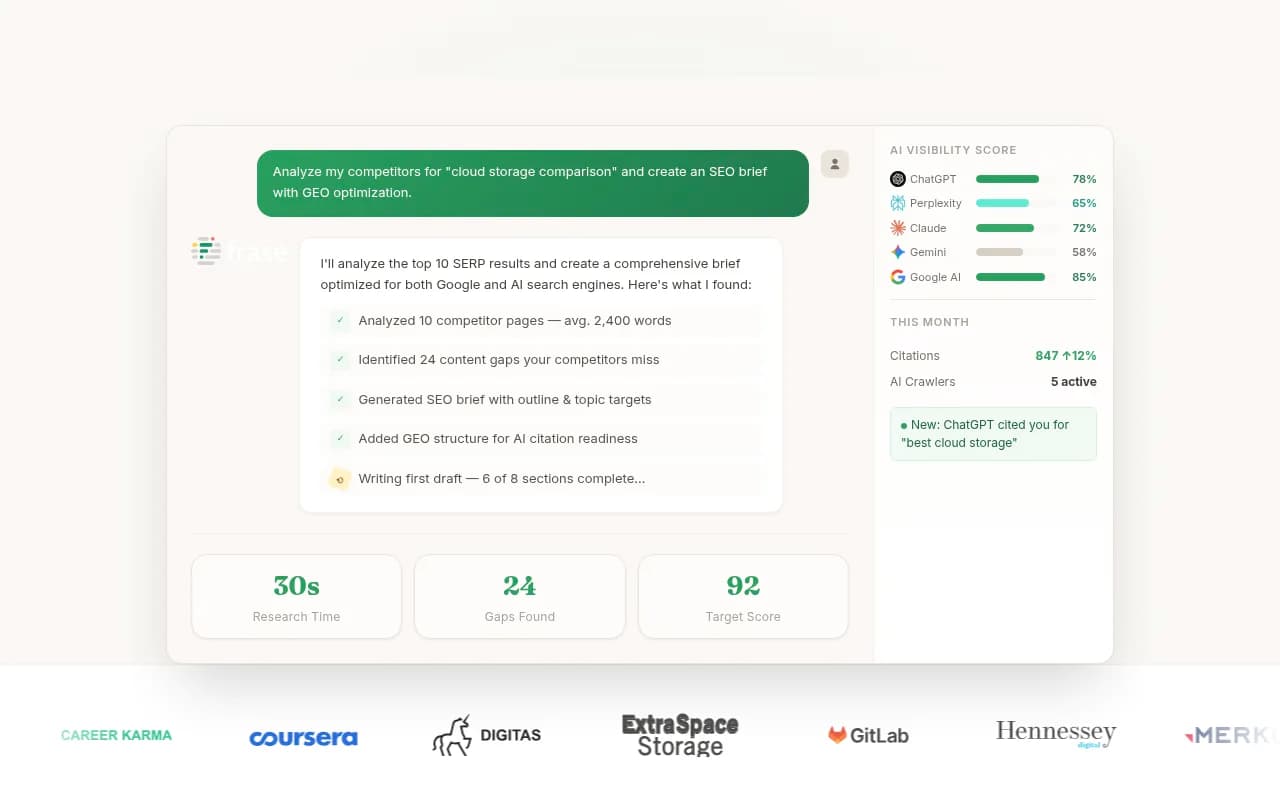
These help you produce pages once you know the gaps. Surfer SEO and Frase handle research-to-draft and on-page optimization, and Writesonic bundles content with tracking. They are weaker at telling you which prompts to target, so pair them with a visibility tool.
Enterprise suites: seoClarity, Botify, BrightEdge, Conductor
These fit large software companies with existing enterprise SEO contracts. seoClarity's ArcAI tracks ChatGPT, Perplexity, AI Mode, AI Overviews, Gemini, and more. Botify leans technical, which matters if crawlability of a large docs site is your main problem.
Comparison table
| Tool | Best for | Crawler visibility | Content execution | Rough entry price |
|---|---|---|---|---|
| Promptwatch | End-to-end GEO for software teams | Yes, IP-verified logs | Yes, Content Agent on Business | Free tier, then $95/mo |
| Profound | Large brands wanting deep monitoring | Limited | Limited | Enterprise pricing |
| AthenaHQ | B2B and SaaS authority work | Not a focus | Recommendations | ~$295/mo |
| Peec AI | Budget first-time tracking | No | No | ~EUR 85/mo |
| Otterly.AI | Cheapest monitoring | No | No | ~$29/mo |
| Ahrefs Brand Radar | Existing Ahrefs shops | No | No | Varies by plan |
| Surfer / Frase | Writing and optimizing pages | No | Yes | $39 to $99/mo |
For more options by category, the GEO software directory lists far more tools than fit here.
How to choose based on your situation
Early-stage SaaS with a small team
Start with the free Explore plan or a cheap tracker, and spend your time on docs and landing pages. A startup does not need a $500 dashboard if nobody is going to ship the fixes. Use Promptwatch's free Agentic Readiness Check to see which AI crawlers can read your site before you spend anything.
Growth-stage SaaS with a content team
This is where Promptwatch's Professional or Business tiers earn their cost. You have people who can write, and what they lack is prioritization: which prompts, which pages, which competitors. Content gap analysis and the Action Board address that directly.
Developer tools and API companies
Your buyers ask Codex and Claude Code, not just ChatGPT. GitHub is the top single domain in the software data, so a public repo with a clear README matters. Pick a tool that tracks coding agents.
Enterprise software vendors
You will likely need SSO, audit logs, and security review. Promptwatch is ISO/IEC 27001 certified and GDPR compliant, and Enterprise adds SSO. Profound, seoClarity, and BrightEdge are the usual comparisons.
What to do with the data once you have a tool
The tool is the easy part. Here is a sequence that matches what ChatGPT rewards for software prompts.
- Check crawler access. Make sure docs and help centers are server-rendered and not blocked in robots.txt for AI bots. A tool with crawler logs shows you errors directly.
- Audit your top 30 commercial prompts. Write them the way a buyer would: "best [category] for [segment]," "[competitor] alternatives," "[you] vs [competitor]."
- Map prompts to page types. Commercial prompts favor product pages, landing pages, listicles, and comparisons. If you have no comparison pages, that is your first gap.
- Keep G2 and Capterra profiles complete and current. Review sites out-earn single vendors in the data.
- Keep a public GitHub presence with clear documentation.
- Refresh evergreen pages. Landing pages and docs hold citations for months, so updating them pays off longer than news posts.
- Re-measure weekly. AI citations are volatile, and a single model rollout can shift things. Average citations per response dropped around the GPT-5.3 rollout, for example.
If you want a broader look at tools that measure AI citations, the AI rank tracking directory is a useful second stop.
What the listicles will not tell you
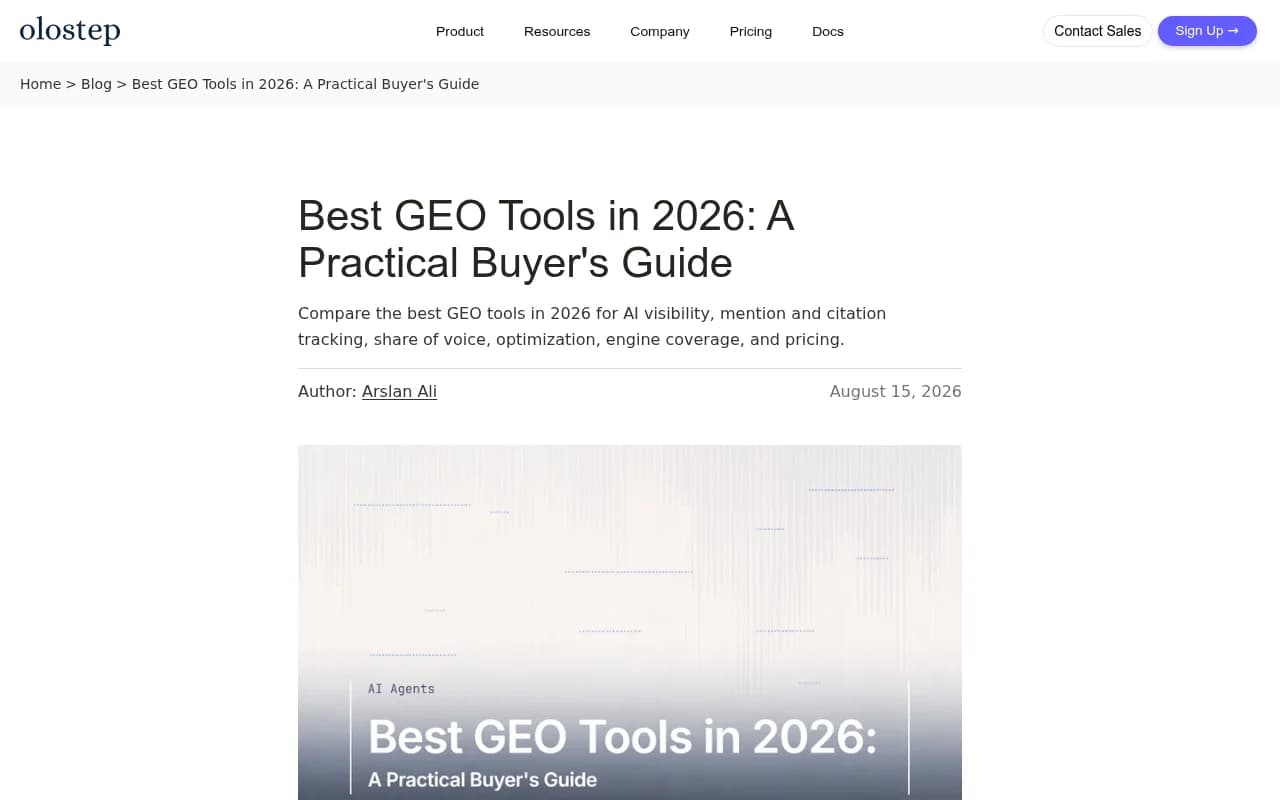
The Olostep guide above says it plainly: most articles on this topic are published by vendors that rank themselves. That applies to a lot of the "top 10" pages out there, and it is worth reading any of them, including this one, with that in mind. Two practical checks help:
- Ask each vendor whether they track real user interfaces or only API outputs. Answers in the ChatGPT app can differ from API responses.
- Ask whether the tool shows which of your pages are cited, or only whether your brand was named.
Also be skeptical of tidy rules like "domain authority barely matters." Promptwatch Data found sites with domain rank 46 to 75 earned almost half of ChatGPT citations in August 2026, with DR 91 to 100 at about 3%, which supports the idea that mid-authority sites compete well. But that is one month, in one model. Verify it for your own category.
Final recommendation
If you sell software, the data points one way: your docs, product pages, landing pages, and review profiles drive citations. Pick a tool that measures those surfaces and helps you fix them. For most software teams that means starting with Promptwatch on a trial, pairing it with whatever writing tool your team already uses, and skipping separate monitor-only subscriptions unless budget is the only constraint. Re-run the software citation report each quarter and compare your own numbers against it.