Key takeaways
- An MCP server lets an AI client like Claude, Cursor, or ChatGPT pull live data from your SEO tools directly, so you stop pasting CSVs into prompts.
- Most people end up running a stack of 3 to 5 servers: one keyword and backlink source, Google Search Console, GA4, a crawler, and one AI visibility source.
- Vendor-authored roundups (including the Nightwatch list this guide draws on) rank their own product first. Verify endpoints and pricing on each vendor's site before committing.
- Rank trackers and keyword databases tell you where you stand. AI visibility MCPs tell you whether ChatGPT, Gemini, and Perplexity mention you. You need both for 2026 workflows.
- Start read-only. Write access to a CMS or Search Console through an agent is where mistakes get expensive.
What an SEO MCP server actually does
The Model Context Protocol is a standard way for an AI client to call external tools. An MCP server wraps one product's API (say, Ahrefs or Google Search Console) and exposes it as a set of tools the model can call mid-conversation. The client connects to many servers at once.
In practice that means you can ask, "Which of my pages lost clicks last month, and what do the top three competitors rank for that I don't?" The model calls Search Console, then a keyword database, then maybe a crawler, and writes up the answer. No exports. No glue scripts.
The ecosystem grew fast. Nightwatch's roundup says there are more than 60 SEO-specific MCP servers by mid-2026, citing SEOptimer. I haven't verified that count, but the direction is believable. Toloka's April 2026 list already treats Ahrefs and DataForSEO as general-purpose agent picks, next to GitHub, Slack, and Notion.
A note on how this list was built
I'm drawing on vendor documentation, the Nightwatch roundup, Answer Socrates' ChatGPT-based testing, the Agility Portal list, and a Reddit thread where someone ran three SEO MCP servers for a month. That thread's verdict: Semrush's MCP is the most polished and has the biggest brand recognition, while DataForSEO's is raw and powerful. Claude handled multi-step research well in that test.
Treat that as one person's experience, not a benchmark. And since no source here gives current pricing for all 12, every price is something you check yourself.
The 12 MCP servers, grouped by job
Rather than a flat ranking, I've grouped these by what they do in a real workflow. A "best" server depends on which dataset you already pay for.
| # | MCP server | Main job | Access model | Best for |
|---|---|---|---|---|
| 1 | Ahrefs | Backlinks, keywords, site data | Official remote endpoint | Link analysis, competitor research |
| 2 | Semrush | Keywords, domain analytics | Official remote endpoint | Polished all-round research |
| 3 | DataForSEO | Raw SERP, keyword, backlink APIs | Official endpoint | Custom, high-volume workflows |
| 4 | SE Ranking | Rank tracking, research, AI visibility | Official endpoint | Mid-market teams |
| 5 | Nightwatch | Rank tracking, AI tracking, audits | Hosted SSE endpoint | One connection for ranks and AI data |
| 6 | Google Search Console | First-party search performance | Open source or official | Your own query and page data |
| 7 | Google Analytics (GA4) | Traffic and conversions | Official or open source | Tying SEO to outcomes |
| 8 | Screaming Frog | Site crawling | Local | Technical audits |
| 9 | Peec AI | LLM citation tracking | Vendor MCP | AI answer monitoring |
| 10 | AlsoAsked | People Also Ask mapping | Vendor MCP | Question and intent research |
| 11 | Keywords Everywhere | Volume and CPC | Vendor MCP | Quick keyword checks |
| 12 | Promptwatch | AI visibility, crawler logs, content actions | Hosted MCP with 110+ tools | Closing the loop on AI search |
Endpoint and plan details change often. Confirm on each vendor's site.
Keyword and backlink data servers
Ahrefs
If you already pay for Ahrefs, its MCP is the fastest way to get backlink and keyword data into an agent conversation. It shows up in several roundups, including Toloka's agent list. The sweet spot is competitor link gap work: ask the model to compare referring domains across three competitors, then draft an outreach shortlist.
The weakness is cost. Heavy agent sessions can burn through API units quickly, because a model that explores freely will call tools more than you would by hand. Set a budget before you let an agent loose.
Semrush
Semrush is the one the Reddit tester called most polished. That tracks with my expectations: big vendor, clean tool descriptions, predictable outputs. Good descriptions matter more than people think, because the model chooses tools by reading them.
DataForSEO
DataForSEO is the raw-power option. You get SERP results, keyword data, and backlink endpoints with few guardrails. If you're building repeatable workflows (daily SERP snapshots, bulk keyword clustering), it's where you'll end up. It also takes more prompt discipline, because the model gets less hand-holding. Promptwatch and several other platforms use DataForSEO under the hood, which says something about its reach.
SE Ranking
SE Ranking ships an official MCP and now covers AI visibility research next to classic rank tracking. For a mid-sized team that doesn't want an Ahrefs or Semrush bill, it's a reasonable single source. There's also a separate SE Ranking Visible product for AI tracking.
Rank tracking and monitoring
Nightwatch
Nightwatch's pitch is rank tracking, AI search visibility, and site audits through one connection. Its server is hosted at https://mcp.nightwatch.io/sse, per the vendor, and is included on paid plans and during a 14-day trial. The company says it tested against eight MCP clients, including Claude Desktop, Claude Code, Cursor, Windsurf, ChatGPT, Continue, Cline, and Zed.
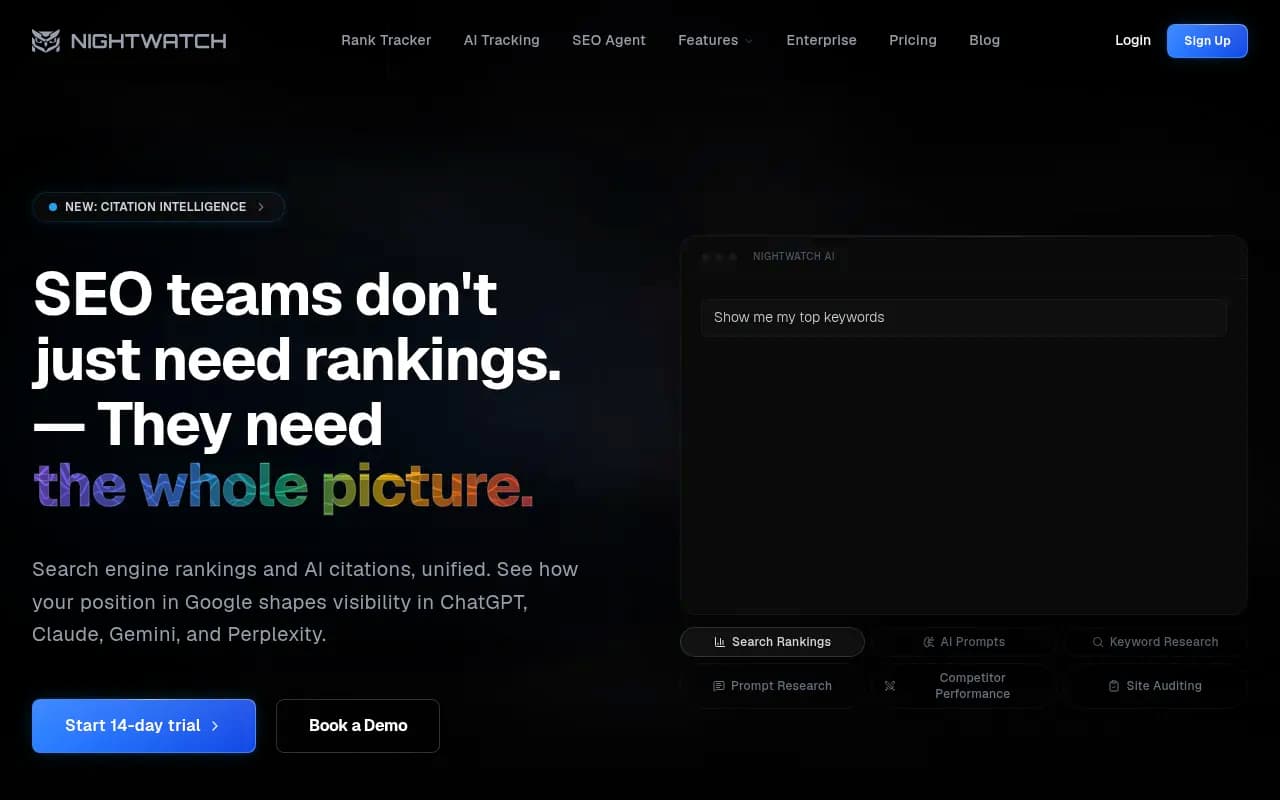
Remember the bias: the article ranking Nightwatch first was written by Nightwatch. The product may well deserve it. But you should run your own trial before believing a vendor's top pick.
First-party data: Search Console and GA4
I'd install these two before anything paid. They're free or close to it, and they carry the data no third-party tool can fake: your actual impressions, clicks, and conversions.
Google Search Console
The best everyday prompt is a diff. "Compare the last 28 days to the previous 28 and list pages that lost more than 30% of clicks, with the queries responsible." A model handles this in one pass. Doing it by hand in the UI takes an afternoon.
Going further, ask which pages rank on page one in Google but never appear in AI answers. That question needs an AI visibility source alongside Search Console, which is where the later sections come in.
GA4
GA4 closes the loop on outcomes. Pair it with Search Console and you can ask which organic landing pages actually convert, not just which get clicks. A caution: sessions from AI assistants often arrive with messy referrer data, so check how your GA4 channel grouping treats them before drawing conclusions.
Crawling and intent research
Screaming Frog
The Screaming Frog MCP puts the crawler in your agent's reach. Ask for pages with missing titles, redirect chains, or orphaned URLs, then have the model write the fix list. It runs against a local install, so it's fast and your crawl data stays on your machine.
AlsoAsked
People Also Ask data maps how questions branch from a seed topic. That's useful for content outlines. It's also useful for AI search, since each AI answer tends to split a prompt into several sub-searches.
Keywords Everywhere
Volume and CPC lookups, cheap and quick. It won't replace a full keyword database, but for a model that needs a sanity check on demand, it's enough.
AI visibility MCP servers
This is the category that didn't exist two years ago, and it's where most teams have the biggest blind spot. Classic rank data says nothing about whether ChatGPT recommends you.
A LinkedIn roundup of AI visibility MCPs lists Radarkit, Peec AI, Profound, OtterlyAI, and SE Ranking. Most of these are monitoring tools: they answer "was my brand mentioned?"
Peec AI
Peec AI tracks brand mentions and citations across AI models, and the Nightwatch list includes it as a niche pick for LLM citations. Good for pulling mention data into a conversation. You'd need other tools for the fix.

Promptwatch
Promptwatch goes past monitoring. Its hosted MCP server exposes 110+ tools over live prompt, citation, crawler, and traffic data, so an agent can answer questions like "which pages do AI crawlers hit but never cite?" That question needs IP-verified crawler logs and citation data joined together, which most trackers don't have.

One documented use: TreeHouse, the company behind Pararius and Huurwoningen.nl, used the Promptwatch MCP to automate weekly reporting while growing AI search to roughly 25% of organic conversions, according to Promptwatch's case study. The platform also has an Action Board and a Content Agent that can plan, write, and publish to Webflow, Framer, or WordPress, so the MCP is one entry point into a wider optimize-and-verify loop. Check promptwatch.com/pricing for the current plans, since MCP and API access is listed from the Essential tier.
For a wider look at tools in this space, the GEO software directory covers dozens of options.
Real workflows worth testing
A list of servers is only useful if you know what to ask. These are the workflows where an MCP stack beats the dashboards.
Weekly decline triage
Search Console plus GA4. Prompt: find pages with the largest click drops, check whether conversions fell too, and list likely causes. Add a crawler MCP to check whether the drop coincides with a technical change.
Competitor gap in two directions
Pull keyword gaps from Ahrefs or Semrush. Then pull prompt gaps from an AI visibility server. Pages you rank for but never get cited on are the interesting ones. Promptwatch's own research found that ChatGPT now draws very little from social platforms (0.46% of citations from Sep 28 to Oct 4, 2026), while Google AI Overviews drew 12.2% from them in the same week, per Promptwatch Data. Your gap list should differ by engine.
Writing for fan-outs
AI engines split one prompt into several searches. Promptwatch's fan-out data shows average fan-out queries are short, with length falling to about 53 characters in April 2026. When your agent drafts headings, have it write keyword-style phrases like "Best CRM for small agencies 2026" and cover the comparison, pricing, and alternatives sub-questions. The averages there also moved around a lot (2.15 fan-outs per response in December 2025, 1.0 in April 2026), so don't assume the pattern holds still.
Crawler access checks
An agent with log access can answer whether GPTBot or ClaudeBot hit errors on your key pages. Insist on IP-verified data. Promptwatch's AI crawler traffic report counts only requests whose IPs match operator-published ranges, and shows OpenAI's share of verified requests at 79.8% in Aug 31 to Sep 6, 2026, down from 94.8% in early June. User-agent-only logs let spoofed bots in and skew that picture.
How to choose your stack
| If you need | Start with | Add |
|---|---|---|
| Free, fast wins | Search Console, GA4 | Screaming Frog |
| Link and competitor research | Ahrefs or Semrush | Search Console |
| Custom bulk workflows | DataForSEO | GA4 |
| One rank and AI tracker | Nightwatch or SE Ranking | Search Console |
| AI visibility with fixes | Promptwatch | Search Console, a crawler |
A few rules that have saved me trouble:
- Connect fewer servers than you think you need. Every server adds tool descriptions to the model's context, and too many makes tool selection worse.
- Start read-only. Don't give an agent write access to a CMS or Search Console until you trust its output.
- Log what the agent calls. Paid APIs bill per call and models explore.
- Cross-check numbers. A model summarizing three data sources will occasionally blend them, so spot-check against the source dashboard.
Setup basics
Most clients take a JSON config. A typical remote server entry looks like this, using Nightwatch's published endpoint as the example:
{
  "mcpServers": {
    "nightwatch": {
      "url": "https://mcp.nightwatch.io/sse"
    }
  }
}
Remote servers usually handle authentication through OAuth or an API key in a header. Local ones, like Screaming Frog or open-source Search Console connectors, run as a process on your machine. Follow each vendor's docs, since config keys differ by client.
What I'd actually run
For a small team: Search Console, GA4, one keyword source (Ahrefs or Semrush, whichever you already pay for), and one AI visibility server. That's four connections, and it covers rankings, outcomes, competitors, and AI answers.
If AI search is a revenue priority rather than an experiment, pick the AI visibility server that can act on the data, not just report it. Monitoring-only tools tell you the problem exists. You still have to fix it.
For more tools to pair with your MCP stack, the AI rank tracking directory and agentic SEO tools directory are good places to keep browsing.