Key takeaways
- A mention is your brand name appearing in an AI answer. A citation is the AI linking to or crediting your page as a source. You can have either one without the other.
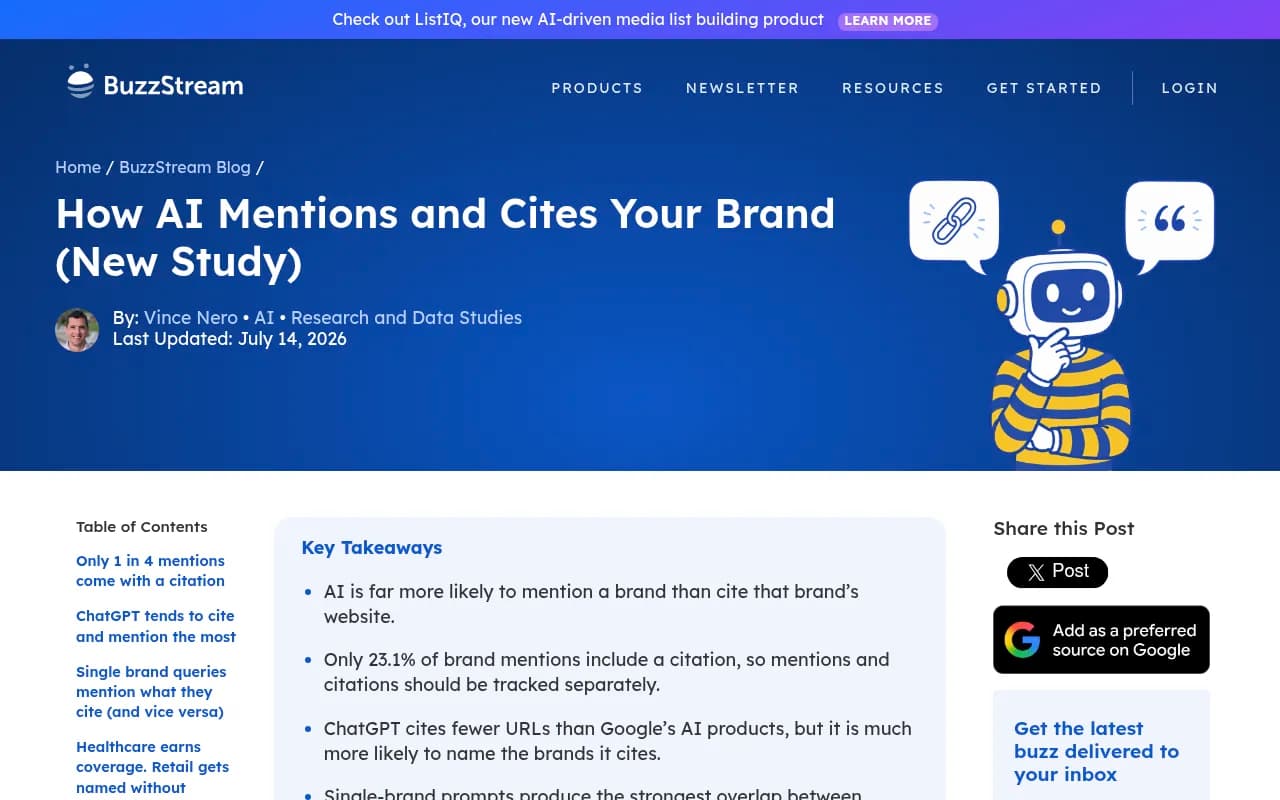
- BuzzStream's July 2026 study of 12,000 AI responses found only 23.1% of brand mentions also carried a citation, while 69.9% of citations included the brand name.
- Open-ended category prompts are the hardest place to earn both. In the same study only 7.2% of mentions on "best X" prompts came with a citation.
- Track mention rate and citation rate as two numbers. The gap between them tells you whether you have a content problem or a brand problem.
- Being cited usually means sharing the answer with many other sites, so position and sentiment matter as much as the citation itself.
Why this distinction matters
You open a dashboard, see your brand name inside a ChatGPT answer, and screenshot it for the team Slack. Nice. But was that a mention or a citation?
The two look alike from the outside. Both put your brand into an AI-generated answer. They come from different mechanisms, they need different work to earn, and they lead to different outcomes. Lumping them into one "visibility" number is one of the most common mistakes in GEO reporting right now, and it hides the exact thing you need to fix.
This guide defines both terms, shows what the data says about how often they overlap, and walks through a practical way to measure and close the gap.
What is an AI mention?
A mention happens when an AI names your brand in its response. No link, no source credit. "Tools like Asana and Monday.com help teams manage projects" is two mentions.
Mentions come from two places:
- The model's training data. If your brand appeared often alongside a topic across the sources the model learned from, it associates you with that topic.
- Third-party pages retrieved during a live search. If a review site or industry roundup names you, the AI may repeat that in its answer.
BuzzStream puts it plainly: a mention with no citation points to memory from training data, while a citation suggests the model needed more evidence and retrieved it live. That is a useful rule of thumb, though not a law. Treat it as a hypothesis when you read your own data.
A mention puts you in the consideration set. Someone asks which tools do a job, your name is on the list, and they may search for you later. What it does not do is credit your page, send a click, or give you an attribution trail.
Where mentions come from in practice
Similarweb's write-up cites AirOps research finding that 85% of brand mentions in AI answers come from third-party pages rather than brand-owned content. I haven't verified that figure independently, so attribute it to AirOps. But it fits what most teams see: reviews, listicles, forums and press coverage are doing the heavy lifting. PR and community presence are not soft branding here. They feed the mention layer directly.
What is an AI citation?
A citation is the AI crediting a specific page as a source, usually as a clickable link or a numbered reference. It generally comes from live retrieval, where the model searches the web and builds the answer from what it finds.
Citations signal that your page was good enough to stand behind an answer. They can send traffic, and they give you something you can measure and, importantly, correct. A bare mention gives you nothing to fix if ChatGPT describes your product with the wrong pricing model. A citation points at a page you control or can influence.
One wrinkle. Citations do not always carry your name. You can be cited without being mentioned, for example when the AI uses your documentation to answer a question but never names your company in the text. BuzzStream found this happens in roughly 30% of citations.
Side-by-side comparison
| Dimension | Mention | Citation |
|---|---|---|
| Format | Brand name in the text, no link needed | Clickable link or numbered source |
| What it signals | The model recognizes you and finds you relevant | The model trusts a specific page as a source |
| Typical origin | Training data or third-party references | Live web retrieval |
| Traffic impact | Indirect, often shows up as branded searches | Direct click-through possible |
| Correctable? | Hard, no source to fix | Yes, you can improve the cited page |
| Main lever | PR, reviews, community, entity building | Retrievable, quotable, specific pages |
What the data says about how often they overlap
BuzzStream's study (last updated July 14, 2026) used Xofu to track 12,000 responses across Google AI Mode, Google AI Overviews, Gemini and GPT-5.4-mini, covering about 200 brands in 10 industries. It asked two questions: when a brand is mentioned, how often is its domain also cited, and the reverse.
The headline numbers:
- 23.1% of mentions come with a citation in the same response.
- 69.9% of citations include the brand name in the text.
- ChatGPT cited fewer URLs than Google's AI products, but was more likely to name the brands it cited.
So AI names brands far more often than it sources them. If you only watch citations, you miss most of your presence. If you only watch mentions, you overestimate how much authority you have.
Prompt type changes everything
The overlap shifts a lot depending on how the user asks:
| Prompt type | Mentioned, also cited | Cited, also mentioned |
|---|---|---|
| Single brand ("Is Asana good?") | 39.0% | 79.1% |
| Head-to-head ("Asana vs Monday.com") | 35.8% | 65.3% |
| List or category ("Best project management tools") | 7.2% | 36.5% |
That last row is the one to stare at. On open-ended category prompts, where buyers form their shortlist, only 7.2% of mentions had a matching citation. Those are the prompts that set the buyer's frame, and they are where most brands are mentioned but not sourced.
Being cited means sharing the stage
Even when you do earn a citation, you are rarely alone. In Promptwatch's data for ChatGPT responses with at least one citation (Sep 28 to Oct 4, 2026), 47.6% of responses cite 10 or more unique domains, and only 1% cite a single domain. For organic prompts with no brand named, 52.5% cite ten or more. For brand-specific prompts the most common count is five domains.
Two takeaways. First, a citation is one of many, so where you appear in the answer and how you are described matter. Second, on brand-specific prompts the handful of cited domains (review sites, forums) shape how ChatGPT describes you, which is a reason to care about third-party pages and not only your own.
Which pages earn citations
If your mentions outrun your citations, the usual cause is that you have no specific, retrievable page for the question being asked. What does ChatGPT actually cite? From Promptwatch's content type report (Sep 28 to Oct 4, 2026):
| Content type | Share of ChatGPT citations |
|---|---|
| Product pages | 22.4% |
| Landing pages | 16.8% |
| Listicles | 13.6% |
| How-tos | 8.7% |
| Documentation | 7.5% |
| General articles | 6.1% |
| Comparisons | 5.9% |
| News | 5.7% |
| FAQ pages | 3.3% |
| Reviews | 1.7% |
Product and landing pages together take about 39% of citations. For branded prompts, reviews jump to 5.6%, more than three times their overall share, so that is where your own reputation on review sites pays off.
Longevity matters too. In Promptwatch's half-life analysis, landing pages and docs stayed cited for months, while news lost half its cited pages within about 36 days. If you want durable citations, build pages that stay true, not only pages that react to the news cycle.
An r/AISearchLab thread makes a related point: citation selection favors pages with a clear, quotable statement that matches the answer's wording, something like "X is best for Y because Z." Vague brand copy loses to a page that states the answer directly.
Why you need both
They are not competing goals. AirOps reports that brands earning both a mention and a citation in the same response were 40% more likely to reappear in later answers on the same topic. Similarweb repeats the figure. I'd treat it as directional, since I haven't checked the underlying method, but the logic is sensible: mentions teach the model you belong to a category, citations show it you have evidence.
What happens if you lean on one?
- Mentions only: awareness with nothing to back it. A competitor with sourced pages can displace you when the model rebalances.
- Citations only: strong pages, but without the third-party presence that earns mentions, rivals who own the category conversation get named first.
Citation sets are also volatile. A brand cited on Monday can be gone on Tuesday, so single snapshots mislead. Look at rates over many runs.
Diagnosing your gap: a worked example
Take one buyer question and run it five times on one engine. Suppose your brand is named in four answers and credited as a source in one.
- Mention rate: about 80%.
- Citation rate: about 20%.
Read separately, that says reputation is fine, but when the model goes looking for a source it reaches for someone else's page. The fix is not more brand-building. It is one strong, citable page aimed at that exact question.
Now flip it. Cited often, rarely named. That is a brand problem: your content is useful but the model does not associate your name with the category. Look at earned media, reviews and entity consistency.
| Pattern | Likely diagnosis | First move |
|---|---|---|
| High mention, low citation | Content gap | Build or refresh a specific, quotable page for the prompt |
| Low mention, high citation | Brand association gap | Earn third-party mentions, reviews, listicle inclusion |
| Low both | Coverage gap | Map the prompts, start with pages and PR together |
| High both | Healthy | Defend with refreshes, watch competitors |
Also check sentiment. Neither signal is an endorsement by default. The model can name you as the thing to avoid, and a citation can point at a critical review.
How to track both separately
A practical routine:
- Build a prompt set that mixes branded, comparison and no-brand category prompts. The no-brand ones are where the gap is widest.
- Run each prompt many times across engines. Platforms differ. You may earn citations on Perplexity and only mentions on ChatGPT for the same question.
- Record for each run: mentioned or not, cited or not, position in the answer, sentiment, and which competitors share the response.
- Calculate mention rate and citation rate per prompt and per engine.
- Sort the no-brand results into piles: where you are mentioned but uncited, where you are absent, and which competitor pages are being cited instead.
- Fix the biggest gaps first, then re-measure.
Doing this by hand does not scale past a few dozen prompts, which is where tools come in.
Tools worth looking at
I'll start with the one I'd reach for. Promptwatch tracks the real interfaces of ChatGPT, Google AI Overviews, AI Mode, Gemini, Perplexity and others, and shows position, sentiment and where your pages land in the source list. It also logs AI crawler visits, so you can see whether a page you want cited is even being fetched, and its content gap analysis points at the prompts where you are absent.

Similarweb's walkthrough shows how its tool surfaces the split: the Prompt Tracking view shows which prompts produce mentions versus citations, and a "Not Mentioned" filter finds prompt gaps. Its Citation Analysis tab lists the top domains and URLs driving citations in your category.
Similarweb AI Brand Visibility
Advanced Web Ranking separates plain-text mentions, inline links and citations in its AI metrics. One caution from its docs: if you have not added brand references to a project, it only tracks link mentions based on the default alias, so plain mentions can be missed. Check that setting in whatever tool you use.
Other options in the catalog, depending on your needs:
| Tool | Angle |
|---|---|
| Profound | Enterprise visibility and analytics |
| Peec AI | Lighter prompt-level tracking |
| Otterly.AI | Affordable brand monitoring |
| AirOps | Content workflows plus mention and citation research |
| Omnibound | B2B mention and citation rate tied to pipeline |
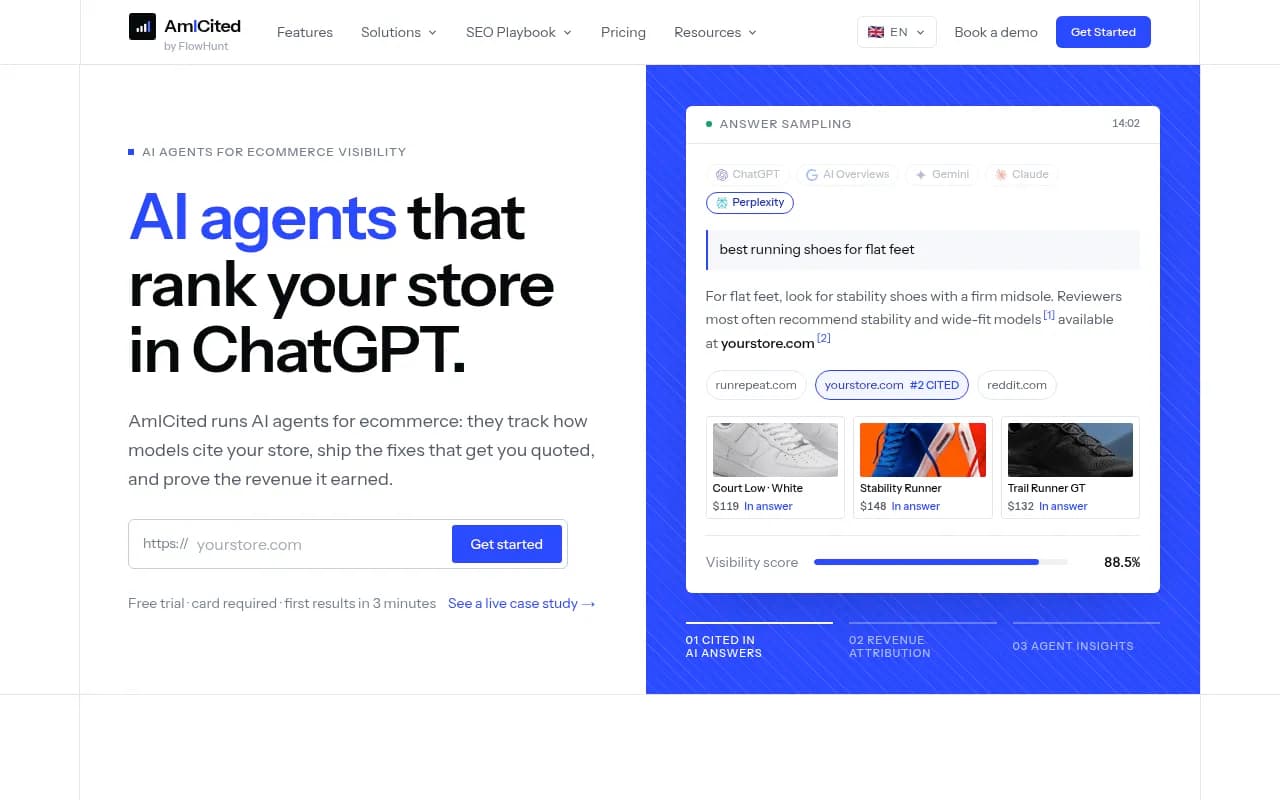
| AmICited | Focused citation tracking |



For a wider look, the GEO software directory at bestgeosoftware.com lists many more. Be honest about what you need. A pure monitor tells you the gap exists. It will not help you close it.
How to move from mentioned to cited
Once you know where you are named but not sourced, the work is fairly concrete.
Build the page the question deserves
For every high-mention, low-citation prompt, write or refresh one page that answers it directly. State the claim plainly near the top, with specifics. Product pages, landing pages, comparisons and listicles dominate ChatGPT citations, so a blog post alone may not be the right format.
Make sure AI can reach it
A great page that crawlers cannot read earns nothing. Check robots.txt, rendering and errors for AI bots. Crawler logs make this visible rather than guessed.
Earn the third-party mentions
Since most mentions originate off-site, get included in reviews, roundups and forums that the AI already pulls from. On brand-specific prompts, those few cited domains shape your description. Note that platform behavior shifts quickly. Promptwatch Data shows reddit.com's share of ChatGPT citations fell from about 4% to 0.5% on August 14, 2026, and from Sep 28 to Oct 4, 2026 ChatGPT drew 0.46% of citations from social platforms versus 12.2% for Google AI Overviews. Where you invest in mentions should follow the engine that matters to your buyers.
Refresh and re-measure
Citations decay, especially for news-style content. Put refreshes on a schedule and compare mention and citation rates before and after.
Common mistakes
- Chasing citations and ignoring mentions. Mentions build the reputation that later earns citations.
- Treating a single run as truth. Sets change run to run.
- Averaging across engines. ChatGPT, Perplexity and Google differ, so split the data.
- Counting a citation as a win without reading the sentence around it.
- Optimizing "general content" instead of a concrete page for a concrete prompt.
FAQ
Do mentions without links still help?
Yes, probably. They shape which brands the model associates with a category, and Similarweb and AirOps both argue they feed future citations. But a mention alone gives you no click and no source to correct.
Can I be cited without being mentioned?
Yes. BuzzStream's data suggests roughly 30% of citations came without the brand name in the text. Your content informed the answer but the model did not credit your name.
Which one should I prioritize?
Both, in order of your gap. Measure first. If mention rate is high and citation rate is low, build pages. If it is the reverse, build presence off-site.
Are these numbers stable?
No. AI answer behavior changes quickly, so treat any study, including the ones here, as a snapshot with a date on it.
Bottom line
A mention gets your name into the room. A citation makes your page part of the evidence. Most brands collect far more of the first than the second, with BuzzStream's 23.1% overlap as a reasonable benchmark to compare yourself against. Track the two rates separately, find the prompts where the gap is widest, and write one specific page for each before you worry about anything else.