Key takeaways
- LLMs repeat the story the web already tells about you. Consensus across sources matters more than how much new content you publish.
- Start by auditing individual claims AI makes (pricing, audience, category, reputation), then trace each one to the page it came from.
- Fix the pages you own first. Landing pages, docs, pricing and comparison pages stay cited the longest, so corrections there persist.
- For third-party sources, ask for factual corrections. If that fails, publish stronger content AI will prefer to cite.
- Re-test on a schedule. Search-connected tools like Perplexity can shift in weeks, while ChatGPT's base model may take months.
What a negative AI narrative actually looks like
Try this now. Open ChatGPT or Perplexity and type "What does [your company] do?" then "What are the pros and cons of [your company]?" Those are the two diagnostic prompts Scale Theory recommends, and they are a good place to start.
What comes back is usually one of a few things:
- A product you retired two years ago, described as current
- Wrong pricing, or "expensive" with no context
- You are filed in the wrong category
- Described as a poor fit for small teams (or enterprises) when it is the opposite
- A complaint from a three-year-old review repeated as settled fact
The frustrating part is that it is rarely one wrong page. It is a pile of small signals that add up to a story, and the model repeats the story with a straight face.
Why LLMs get your brand wrong
There are five common causes, drawn from Scale Theory's breakdown and my own experience:
- Old product and pricing pages still indexed and still cited
- Competitor comparison pages that frame you on criteria that no longer apply
- Old bad reviews that were never answered or updated
- Reddit and forum threads that include a strong opinion
- Training data cutoffs, so the base model simply does not know what changed
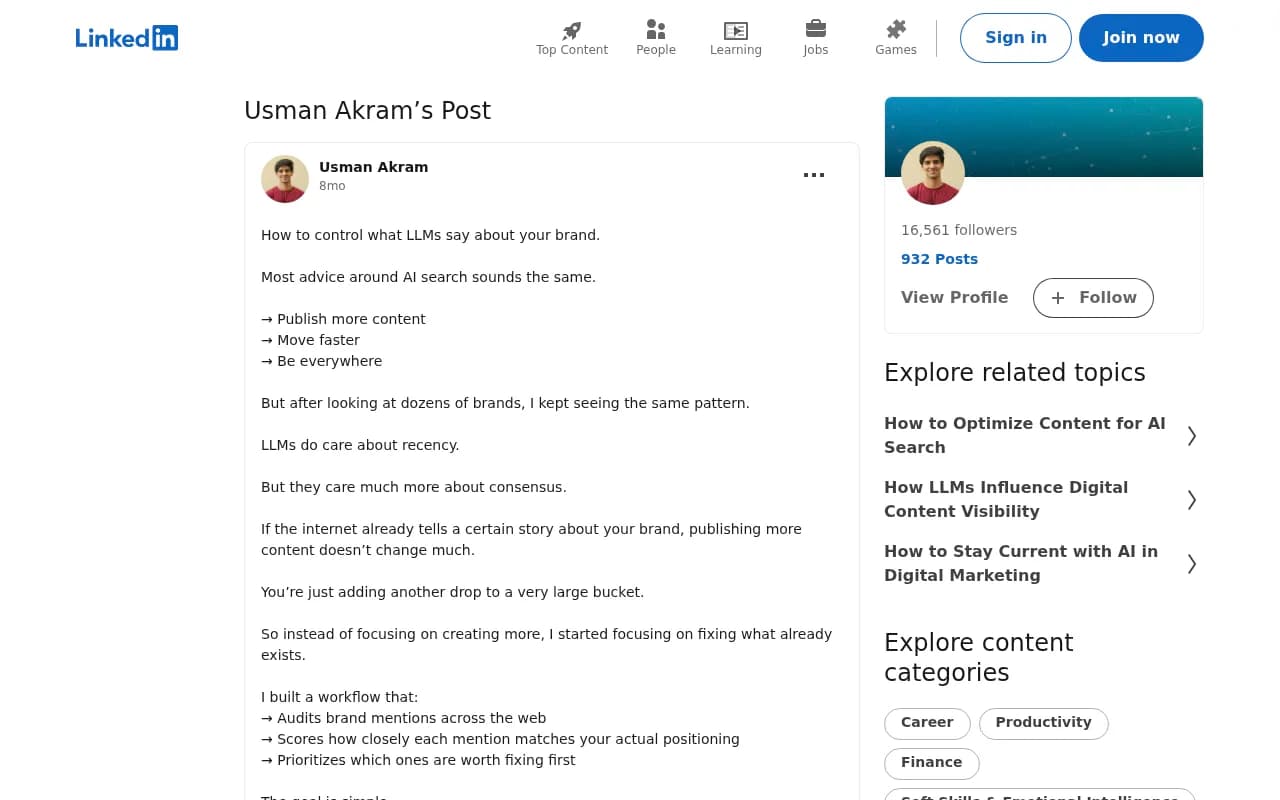
Usman Akram, Discoverability Lead at Modash, put the principle bluntly in a March 2026 LinkedIn post: LLMs care about recency, but they care much more about consensus. If the internet already tells a certain story about your brand, publishing more content just adds another drop to a very large bucket. That is his experience across dozens of brands, not a controlled study. But it matches what I see: volume does not fix a narrative, alignment does.
Step 1: Audit claims, not just mentions
A visibility score tells you whether you are mentioned. It does not tell you what is being said. For a narrative problem you need the claims.
Build a simple sheet with these columns:
| Claim AI makes | Models that say it | Accurate? | Source it traces to | Fix owner |
|---|---|---|---|---|
| "Pricey for small teams" | ChatGPT, Gemini | Partly | Old pricing page, 2023 review | Content |
| "Lacks mobile app" | Perplexity | No | Competitor comparison page | Content + PR |
| "Built for enterprise only" | ChatGPT | No | Homepage copy | Web team |
Run the same prompts across models and countries, and save the answers. That baseline is what you will compare against in two weeks and two months. Prompt it the way your buyers do: "is [brand] good for startups," "[brand] vs [competitor]," "[brand] pricing."
This matters because of which prompts decide a negative narrative. In Promptwatch Data's content type report (Sep 28 to Oct 4, 2026), branded prompts, the ones that name a company, lean heavily on a specific set of sources. Product pages are 23.3% of branded citations and landing pages 22.8%, almost half. Reviews rise to 5.6%, more than 3x their share across all prompts, and social posts to 3.0%, almost 4x.
So for the prompts that matter most, your own pages are the biggest lever, and reviews and social are the next one.
Tools for the audit
You can do this manually in a spreadsheet, and Akram built an AirOps workflow that pulls Semrush data, analyzes mentions with ChatGPT and writes a prioritized fix list into Google Sheets. For ongoing tracking, a platform is easier. Promptwatch has Brand Narrative, which pulls the individual claims AI makes about you and your competitors out of every tracked response, groups the repeated ones, shows which models say each, and scores themes like Pricing, Features, Support and Reputation from 0 to 100. Its Fact Check feature (Business plan and above) lets you mark a claim inaccurate and then finds which crawled pages on your site state it or its opposite.

Other tools in this area include Profound for enterprise monitoring, and Peec AI and Otterly.AI as lighter-weight trackers:



If you want to compare more options, the GEO software directory at bestgeosoftware.com lists many of them.
Step 2: Trace each claim to its source
A wrong claim is a symptom. The cause is a page. For every inaccurate or damaging claim, find out where the model got it. Look at the citations in the response, and for models that run web searches, look at the query fan-outs, the actual searches the model ran. Our guide-level explanation of fan-outs is in the Promptwatch Academy.
Sort sources into three buckets:
- Pages you own (old pricing, stale docs, vague homepage copy)
- Third-party pages you can influence (review sites, directories, partner pages, listicles)
- Pages you mostly cannot change (competitor content, news, forum threads)
Do not skip the first bucket because it feels too obvious. In my experience most of the damage starts there. A stale feature page you forgot about is a much more common culprit than a hostile blogger.
Step 3: Fix what you own first
Go through your pages in order of priority and correct anything outdated, inconsistent or wrong. Scale Theory's advice is to make sure each correction reinforces a single, clear narrative across all surfaces. That consistency is the part people miss. Fixing the pricing page but leaving the old number on a docs page just creates a conflict, and conflict is how models end up hedging or choosing the wrong version.
Write sentences AI can lift
Use direct, self-contained sentences that make sense without surrounding context. Compare:
- Weak: "As we mentioned above, our plans work for teams like yours."
- Better: "Acme's Starter plan costs $29 per month and is built for teams of 1 to 10 people."
The second one can be extracted and quoted correctly. The first cannot.
Turn each negative phrase into a content fix
The trick is to trace the negative phrase back to a fixable content gap. If AI says you are a poor fit for smaller teams, ask why. Maybe your only pricing example is an enterprise tier, or your case studies are all large companies. The fix is then a small-team pricing section, a use-case page and two relevant customer stories. Not a rebuttal blog post.
Pages to prioritize
Promptwatch's recommendations from the same content-type report are a decent checklist:
- Make the homepage, product pages and docs answer pricing, features and who the product is for
- Add a plain-language FAQ page about your brand
- Make product pages easy to compare
- Collect reviews on the sites trusted in your category
- Get listed in the "best of" roundups ChatGPT cites, and publish your own comparison pages
Why landing and docs pages are the right bet
Content does not stay cited forever. Promptwatch Data's content half-life study tracked pages ChatGPT cited on July 6, 2026 for 90 days. After 30 days, ChatGPT still cited 78% of landing pages and 76% of docs; after 60 days, 69% and 67%. Comparisons held at 72% and 63%. Product pages, reviews and how-tos sat around 55% at day 60, with half-lives of 74 to 77 days. News decays fastest: half of news pages were gone after 36 days.
| Content type | Still cited after 30 days | Still cited after 60 days |
|---|---|---|
| Landing pages | 78% | 69% |
| Docs | 76% | 67% |
| Comparisons | 72% | 63% |
| Product pages, reviews, how-tos | n/a | about 55% |
| News | about half gone by day 36 | 41% |
The practical read: corrections on landing, pricing, docs and comparison pages should persist for months. A press release gives you a short burst and then fades. Pricing pages are classified as landing or product pages, so they land in the durable group.
Step 4: Deal with sources you do not own
Third-party fixes are slower and less predictable. A sensible order:
- Send a short, factual correction request to the site owner. Include the specific line, the correct fact and a link to your canonical page. Keep it polite and boring.
- If they do not update, publish a stronger source that AI can cite instead: a clear comparison page, a detailed FAQ, a data-backed explainer.
- Get accurate coverage on sites AI already trusts in your category, through review platforms, roundups and credible PR.
A few things not to do. Thrive Agency's guidance on bad-review summaries is worth following: do not publish thin AI-written content to push bad mentions down, and do not threaten reviewers unless you have a clear legal basis. It tends to backfire, and mass-produced filler just adds noise to the very consensus you are trying to correct.
For review-driven problems, answer the reviews. Respond to the old complaint with what changed. Tools like Reputation.com and BrightLocal help multi-location businesses manage this at scale:

For outreach to get accurate mentions on pages AI already cites, Respona and CrowdReply exist, though use them for genuine, accurate contributions only:

How much should you worry about Reddit?
Less than a year ago, and more than zero. Promptwatch Data's Reddit report shows reddit.com's share of ChatGPT citations fell from about 3.83% to roughly 0.52% around August 14, 2026, though Promptwatch flags the size of the drop as provisional. Google surfaces moved more slowly: AI Overviews slid from about 2.5% to 2.1%, and AI Mode from 2.22% to 1.54%. So a negative thread may matter less in ChatGPT but still shows up in Google. Do not build your entire plan around it, and do not ignore it. Dedicated Reddit tracking, like the reports in Promptwatch, helps you see which threads are actually being cited rather than guessing.
Step 5: Fill the narrative gaps with new content
Once the existing pages are cleaned up, new content has a job: supply the facts the model is missing. Given the consensus point above, think of it as adding clear, consistent evidence, not volume.
Good candidates:
- A plain-language "What is [brand]?" page and a brand FAQ
- Honest comparison pages against your main competitors, with criteria that reflect your current product
- Pricing explainers by team size
- Use-case pages for the audiences AI says you do not serve
- Original data or research that others will cite
Branded prompts pull heavily from FAQ pages (4.8% of branded citations) and press releases (2.1%), both above their overall shares, so those are worth having even though they feel mundane.
If you need to produce this at some pace, content tools range from general writers to GEO-specific platforms. Promptwatch's Content Agent plans, writes and publishes against the gaps it finds in your visibility data (Business plan and above), with a review inbox so a human approves each piece. Alternatives include AirOps for content workflows and Writer for enterprise brand controls:

Whatever you use, keep a human reading the output. A negative narrative is the wrong time to publish sloppy, generic AI text.
Step 6: Check that AI can actually read the fix
A corrected page does nothing if the crawler never sees it. Check robots.txt, rendering and errors. IP-verified AI crawler logs show whether GPTBot, ClaudeBot, PerplexityBot and others are reading the updated pages, and where they fail. Promptwatch's crawler logs do this, and free options include its Agentic Readiness Check and AI Crawler URL Inspector.
A weekly site audit helps catch the boring problems, like broken links, orphaned pages and missing sitemap entries, that keep your best correction buried.
Step 7: Measure and re-test
Expect two speeds. Scale Theory's view (a vendor claim, but consistent with how these systems work) is that search-connected tools like Perplexity can update within weeks, while ChatGPT's base model may take months. In practice, you will often see the live-search surfaces change first, because they are reading your updated pages directly.
A simple cadence:
- Re-run your baseline prompts every two weeks and compare against the saved answers
- Watch whether Perplexity and AI Overviews start citing your updated pages
- Track claim counts: how many models still say the inaccurate thing
- Track sentiment by topic, and Share of Voice against competitors
- Look at referral traffic and conversions from AI sources
| Metric | What it tells you |
|---|---|
| Claim frequency | Whether a specific wrong statement is shrinking |
| Sentiment score | Whether tone is improving, independent of mentions |
| Citation of your own pages | Whether the fix pages are being used as sources |
| Share of Voice | Your slice of brand mentions versus competitors |
| AI referral traffic | Whether the story change brings visits |
If you do not want to build all this by hand, platforms like Promptwatch track these metrics together, and there is a free AI visibility report if you want a baseline before committing to anything. Other trackers worth a look are Scrunch, AthenaHQ and Ahrefs Brand Radar, though they differ a lot in how much they help with the fix versus just the monitoring:


For a wider list of rank and visibility trackers, see ai-rank-tools.com.
A realistic 30-60-90 day plan
Days 1 to 30
Build the claim audit, save the baseline, trace sources, and fix the owned pages: homepage, pricing, product, docs, FAQ. Send correction requests to third parties.
Days 31 to 60
Publish comparison pages, use-case pages and the brand FAQ. Respond to old reviews. Pursue accurate placements in roundups. Re-test every two weeks.
Days 61 to 90
Review what moved. Expect live-search surfaces to have changed first. Revisit the claims that persist, trace them again, and decide whether the cause is a missing page, a stubborn third-party source or training data you simply have to wait out.
Common mistakes
- Publishing a lot of new content without fixing the old pages that contradict it
- Fixing one page and leaving conflicting facts elsewhere
- Treating a single model's answer as the truth, rather than running multiple prompts across models
- Over-investing in news coverage, which decays fastest
- Pushing back on reviewers aggressively instead of responding with facts
- Declaring victory after one good answer
Should you get help?
If the problem spans many markets, dozens of third-party sources or a regulated category, an agency can save time. 1001 SEO Media works on AI search and GEO alongside technical SEO and digital PR, which are the three levers most narrative fixes depend on. For a first pass, though, the audit and owned-page fixes above are something most in-house teams can start this week.
The short version: find the specific claim, find the page behind it, correct that page, make sure the rest of the web is not contradicting it, and then check again in two weeks. It is slow and a bit dull, and it works better than publishing more.