Key Takeaways
- Start with one question: do you need brand-level data or product-level (SKU) data? That one answer removes half the market.
- Score every candidate on the same five questions: what you sell, how the data is collected, what evidence backs each number, what happens after the report, and what drives the price.
- ChatGPT answers are noisy. Promptwatch Data shows 47.6% of responses cite 10 or more domains, so a tool that only tells you "you were mentioned" tells you very little.
- Read vendor documentation and plan pages, not homepages, and run a two-week trial on your own prompts before signing annually.
- One caveat up front: I found no public sign that Ranketta shut down or changed. "After Ranketta" here means leaving it or comparing against it. Confirm your own situation first.
Why a framework beats a feature list
Most comparison pages for this category count dashboards. That is the wrong unit. Two tools can both list ChatGPT, Gemini and Perplexity coverage and still answer entirely different questions.
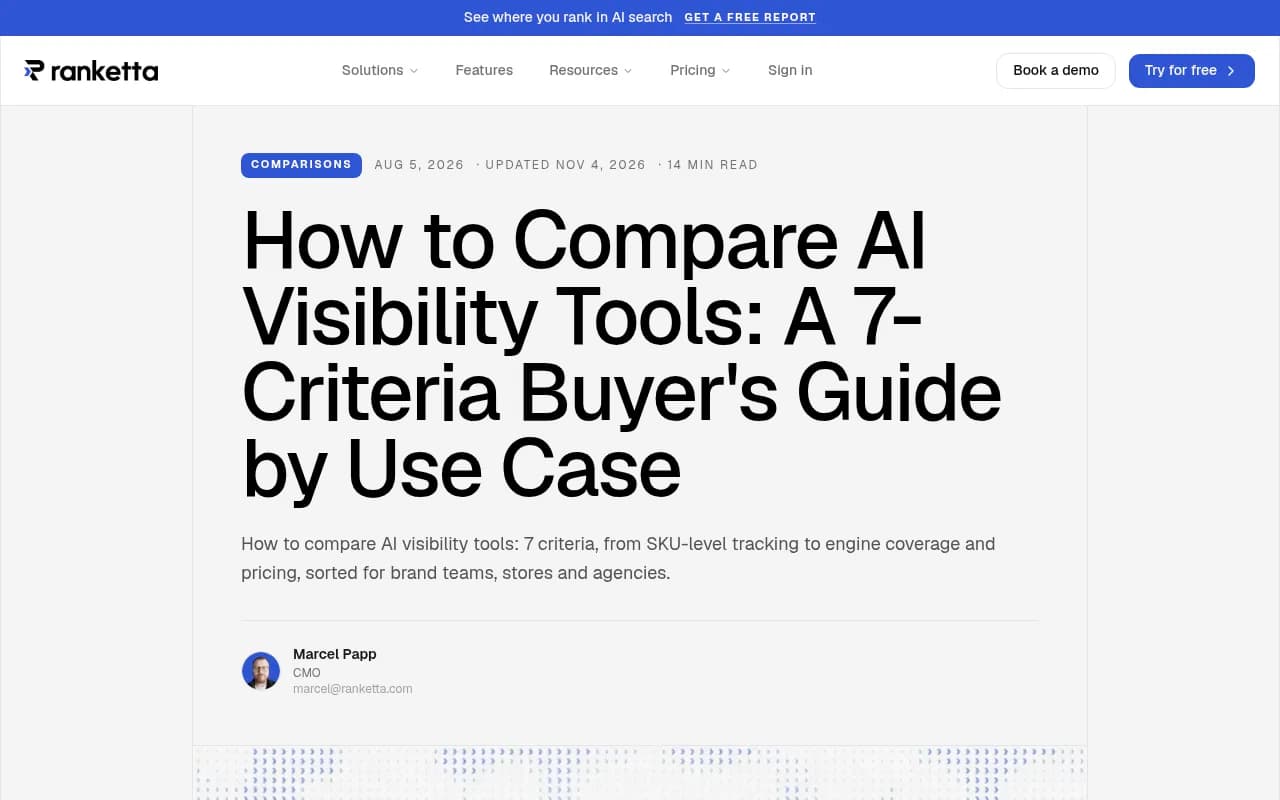
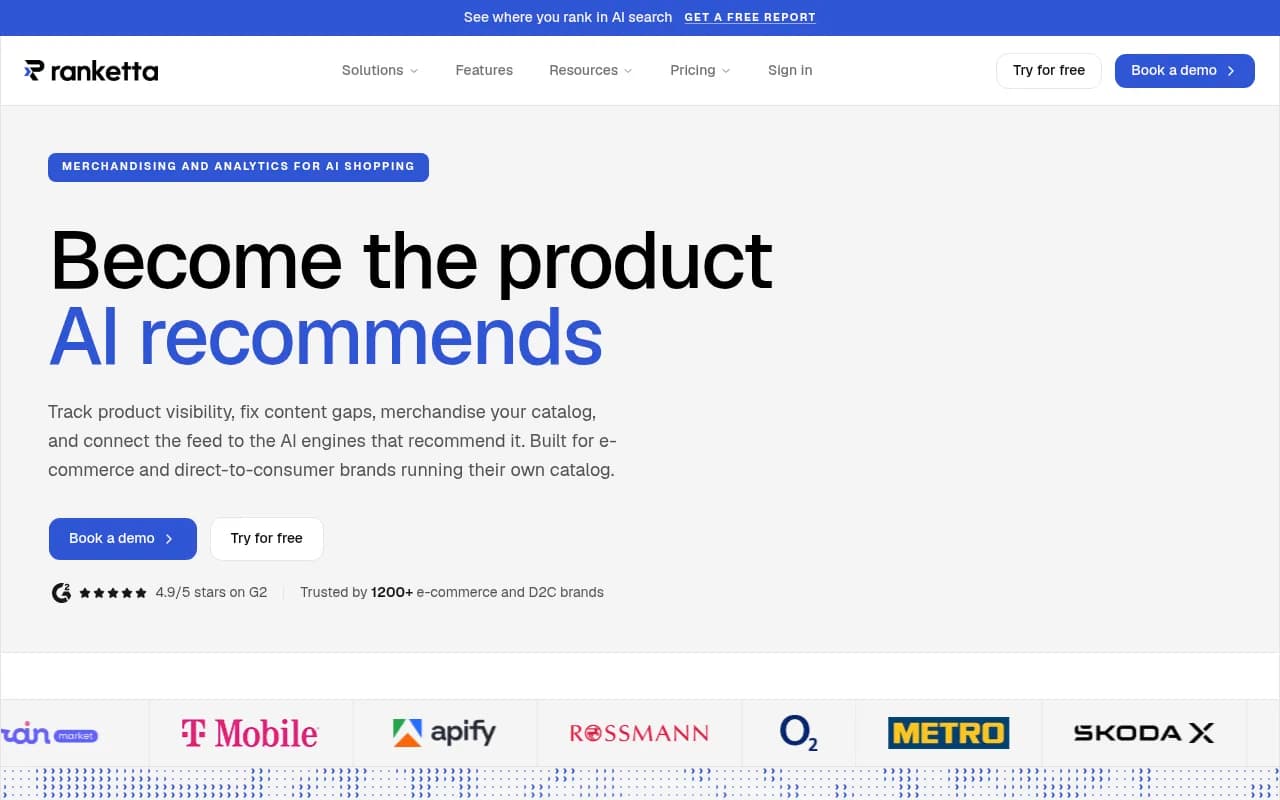
Ranketta is a good example. It is built around products: it maps a SKU to the AI answers that recommend it, by prompt and country, with the share of answers that include the product and its average position. That is exactly what a store with its own catalogue needs. Ranketta's own buying guide admits the flip side: if there is no catalogue behind the brand, most of that does not apply, and a tool built around brand mentions and sentiment is the more honest fit.
So the right replacement depends on why you are looking. Maybe you outgrew product-level tracking. Maybe you never sold products and picked it for the wrong reasons. Maybe you want the whole loop, from gap to published fix to measured result. The five questions below handle all three.
Question 1: What are you actually selling?
Pick the buyer profile before you open a single pricing page.
| Profile | What you need to see | Tool type to shortlist |
|---|---|---|
| Brand or SaaS team, no catalogue | Mentions, share of voice, sentiment, cited sources | Brand-level visibility platform |
| Store with its own catalogue | Which SKUs get recommended, product data fixes, shopping surfaces | Product-level or catalogue-aware tool |
| Agency | Many clients, white-label or pitch reporting, cost per client | Multi-project agency plans |
| Local or multi-location | City or coordinate-level answers | Local-aware tracking |
| Enterprise with a large site | Crawlability, technical fixes, governance | Enterprise suite |
If you sell products, keep a catalogue-aware tool on the list. Ranketta stays in the running, and so do Alhena AI and Yotpo Discover, both pitched at ecommerce catalogs.
Yotpo Discover
If you do not sell SKUs, drop the catalogue tools and move on. Paying for SKU matching you never use is the most common mismatch I see in this category.
Question 2: How is the data collected?
This is the question vendors answer vaguely. Ask three things.
- Does the tool read the real interface of each AI product, or call an API? User-facing answers and citations can differ from API output, and the difference is often the thing you care about.
- Which engines are on your plan versus sold as add-ons? Ranketta's own guide notes that most tools in this space, itself included, limit engines per plan or sell some as add-ons. Profound's comparison lists Peec as covering ChatGPT, Perplexity and AI Overviews by default, with Gemini, AI Mode and Claude at extra cost.
- How are prompts built and how often are they re-run? GeoSuite's framework separates user-supplied prompts, vendor-curated prompts and prompts generated from the brand's own context, and favors the last for long-tail coverage.
There is a data-backed reason to care about re-running. Promptwatch Data's ChatGPT query fanouts report shows average searches per response easing from about 2.15 in early December 2025 to about 1.84 by early March 2026, then 1.0 in April, while average query length dropped from roughly 117 characters to about 53. Fanout behavior moves in steps after model updates. A prompt set you built in the spring may be measuring a different system by autumn.
Tools that read live interfaces and track at the prompt level include Promptwatch, which monitors the actual ChatGPT, AI Overviews, AI Mode, Gemini, Perplexity and Copilot interfaces by country and language, and Superlines, which also positions itself on real AI interfaces rather than APIs.

Superlines
Question 3: What evidence sits behind each number?
A score without a source is a screenshot waiting to be questioned by your CFO. Look for three kinds of evidence.
- The raw responses, so you can read what the AI actually said.
- The cited sources, with position in the source list.
- Your own search and traffic data next to it.
Here is why a bare "cited or not" is weak. In Promptwatch Data's unique domains report (Sep 28 to Oct 4, 2026), 47.6% of ChatGPT responses cited 10 or more domains and 66.1% cited at least 8. For organic prompts with no brand named, 52.5% cited 10 or more. Brand-specific prompts were different: 21.3% cited 10 or more, and the most common count was 5 domains.
Three consequences for your evaluation:
- You share almost every answer with many other sites, so position and description matter more than presence.
- You need to see which competitors and third-party sources appear beside you.
- One prompt tells you little. Demand tracking across many prompts, repeated runs, and ideally a view of how the answer describes you.
Brand-specific prompts draw on fewer sources, so check which review sites and forums get cited for your name. Those are often the pages worth fixing first.
Tools that expose responses and citations well include Peec AI for lean tracking, Profound for enterprise depth, and Gauge for prompt-level intelligence.



Question 4: What happens after the report?
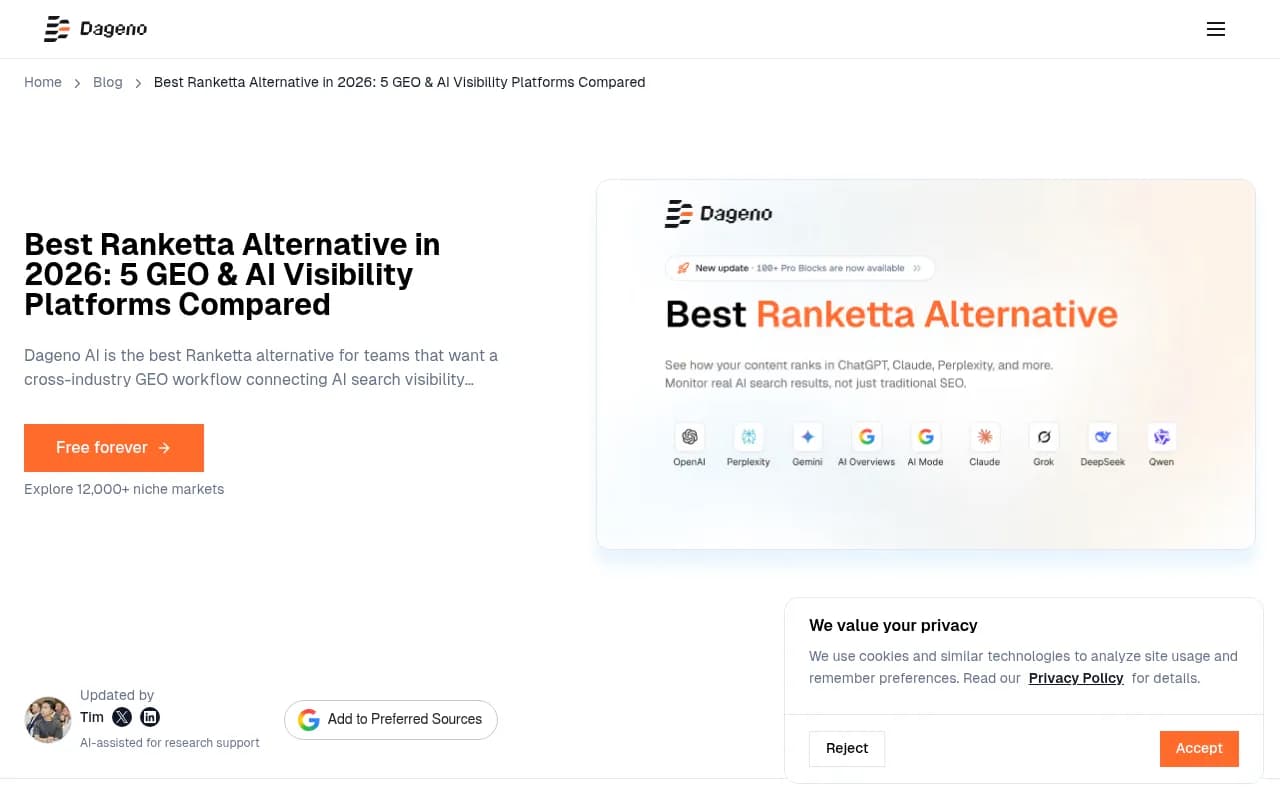
Dageno's framing is useful here. The right platform should help you answer four things: where are we invisible, why are competitors winning, what should we do, and did the action work? Many tools stop after the first. Profound's own comparison table says as much about the budget end of the market, noting that Peec suits you if you just need basic data and not if you want recommendations to improve visibility.
A fair test is to pick one valuable entity, a flagship product or a core solution, and trace the whole chain: prompts, AI answers, competitors, citations, diagnosed gap, executed action, visibility change, business outcome. Count the steps the tool does and the steps left to you.
Three groups of tools show up at this stage:
- Monitoring-first tools. Good for reporting, thin on action. Examples: Otterly.AI, Rankscale.
- Action-loop platforms. Gaps turn into briefs, content and tracked results. Promptwatch sits here, with an Action Board, a Content Agent that publishes to WordPress, Webflow or Framer, crawler logs and AI traffic attribution. Dageno AI and ReachLLM also pitch execution.
- SEO suites with AI tracking added. Semrush and Ahrefs Brand Radar are convenient if you already live in them, but the prompt sets and AI-specific depth tend to be narrower.

If you want the post-report work handled, see how Promptwatch's Content Agents and AI crawler logs fit the loop. For a wider list of options, the GEO software directory is a decent place to browse.
Question 5: What drives the price?
Headline monthly price rarely predicts what you pay. Check these drivers instead:
- Engines included versus add-ons
- Prompt and response volume
- Number of projects, markets or clients
- Faster-than-daily tracking
- Content generation credits
- Seats
Figures in Profound's comparison page (a vendor with a stake in the comparison, so treat them as dated) put Athena from $295 a month, Peec from 89 euros, Scrunch from $100 and SE Visible from $99. Promptwatch lists Essential at $95 a month, Professional at $245 and Business at $579, with agency plans from $199; confirm everything at promptwatch.com/pricing, since plans change.
| Plan check | Why it matters |
|---|---|
| Are all engines included? | Add-ons quietly double the bill |
| Responses, not just prompts | Daily runs across engines multiply volume |
| Fix tools included? | Content and crawler data may cost extra |
| Client or market limits | Agencies and multi-country brands hit these first |
Treat any claim that sounds like a guarantee as a reason to look closer. Nobody can guarantee a citation.
Running the two-week trial
Use the same inputs for every finalist.
- Write 30 to 50 prompts your buyers would plausibly type, mixing organic, brand-specific and competitor comparison types.
- Use the same engines and the same markets in every tool.
- Check that the numbers reproduce. Run the same prompt twice and see whether the tool shows variance honestly.
- For stores, verify that the products in the report are products you sell, matched correctly.
- Pick one gap and see how far the tool takes you toward fixing it.
- Export the data. If you cannot get it out, you cannot leave later.
GeoSuite adds a sixth idea worth stealing: longitudinal tracking with a versioned prompt set. A snapshot is fine for a pitch. Only the month-over-month curve tells you whether your actions work.
Putting the answers together
| If your answers look like this | Shortlist |
|---|---|
| Sells SKUs, wants product-level data | Ranketta (stay), Alhena AI, Yotpo Discover |
| Brand team, wants monitoring only, tight budget | Peec AI, Otterly.AI, Rankscale |
| Brand team, wants fixes and measured results | Promptwatch, Dageno AI, Profound |
| Already deep in an SEO suite | Semrush, Ahrefs Brand Radar, SE Ranking Visible |
| Agency with many clients | Promptwatch agency plans, Scrunch, Search Party |
| Large site with technical crawl problems | Botify, Promptwatch crawler logs |
My honest take: most teams leaving a niche tool are not unhappy with the data. They are tired of being handed it and left alone. If that is you, weight Question 4 heavily. If you sell products and Ranketta already tracks your SKUs accurately, the case for leaving is weaker than the alternatives pages suggest, and several of those pages are written by competitors. Promptwatch's own side-by-side comparison of GEO platforms is also vendor-authored, so apply the same trial discipline to it.
To start cheaply, run the free AI visibility report to see how ChatGPT, Gemini and Perplexity currently describe you, then use the five questions to narrow the field to two tools and trial both.