Key takeaways
- The local pack, Google AI Overviews, Ask Maps and ChatGPT each score local businesses differently, but they pull from the same pool of facts: your Google Business Profile, reviews, citations and website.
- Consistency beats cleverness. One accurate, well-documented entity across every surface is the core job now.
- Review text matters more than review count for AI answers. Models read what customers actually say.
- Third-party mentions get you into crowded AI answers. Almost half of ChatGPT responses cite 10 or more domains, so you will always share the answer.
- Measure both channels separately: map rankings in a local tracker, AI mentions in an AI visibility tool.
Why local SEO split into several channels
For years, local SEO meant one goal: land in the map pack's three slots. That still matters. But in 2026 your customer might find you in at least four places.
| Channel | What it is | What it leans on |
|---|---|---|
| Local pack (Google Maps) | Map plus three listings above organic results | Google Business Profile signals, reviews, proximity, citations |
| Google AI Overviews | AI summary at the top of search results | Structured, well-written web content, schema, trust signals |
| Ask Maps | Gemini-powered conversational search inside Google Maps | Places data, reviews, profile completeness |
| ChatGPT and Perplexity | Chatbots answering "best plumber in Leeds" style questions | Web search retrieval, third-party mentions, directories, reviews |
The e2msolutions playbook (March 2026) and Localo's write-up (May 2026) both describe Ask Maps as a Gemini feature launched in March. I could not verify the details beyond those two sources, so treat the specifics as reported rather than confirmed.
One more caveat worth stating. One analysis from Marketers Center argues the local pack, local organic and AI search score a business against three different formulas. I think that is right. Which means a single trick will not win all three. What wins all three is a clean foundation that each system can read.
The shift from pages to entities
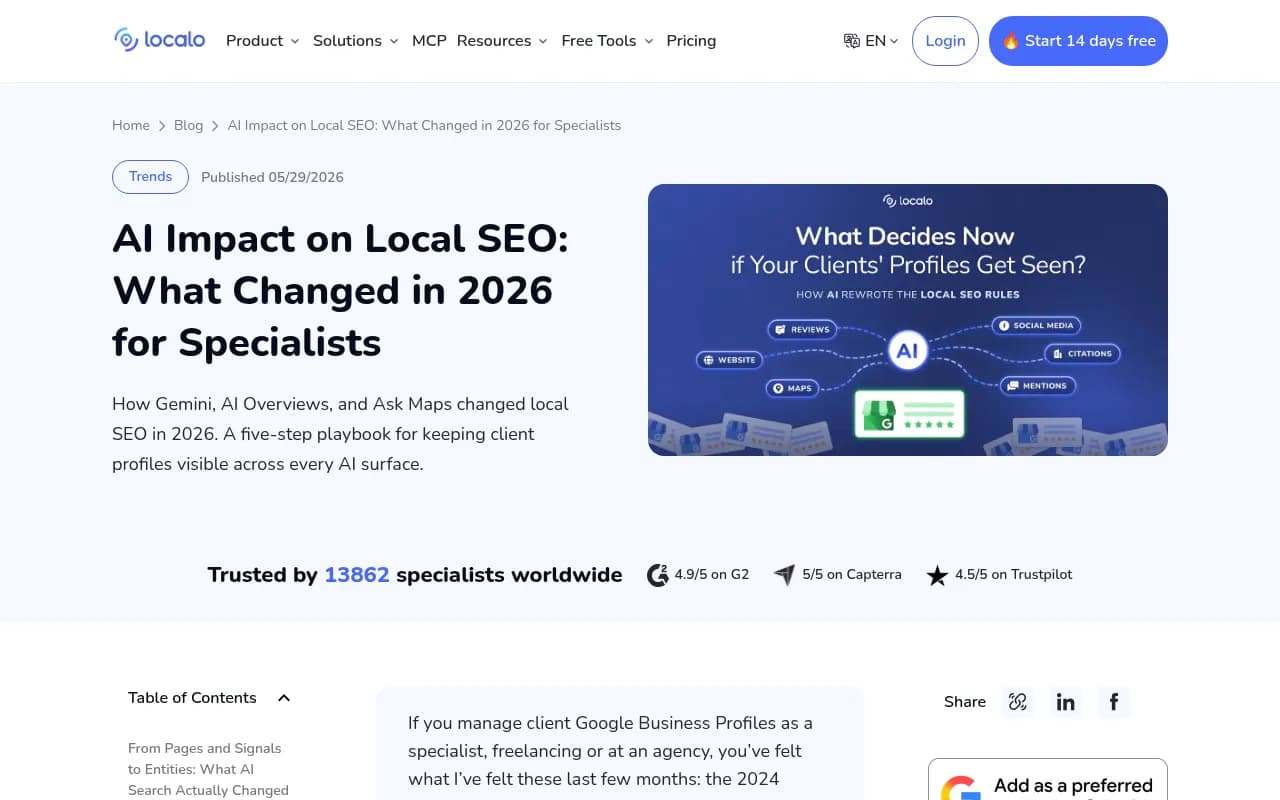
Localo's framing is the best I have read on this. Your job moved from "rank higher in the local pack" to "make sure the AI has an accurate, well-documented picture of this business and can recommend it without hesitation."
An entity here is just your business treated as one object: a specific category, address, phone number, hours and services, described the same way in lots of places. If your Facebook page says you close at 5, your GBP says 6 and a directory says you moved in 2022, a language model has reasons to hedge. When it hedges, it recommends someone else.
Step 1: Fix the Google Business Profile properly
The GBP is the single source feeding the local pack, Ask Maps and a lot of AI local answers. A Reddit thread in r/localseo made a point I agree with: local AI answers lean on GBP data, categories, attributes and especially review text, not just website copy.
Checklist:
- Pick the most specific primary category, then add secondary categories that genuinely apply.
- Fill in every attribute that fits (accessibility, payment types, service options, appointment links).
- List services and products with real descriptions, not keyword lists.
- Keep hours accurate, including holidays. Stale hours are the most common trust killer.
- Add recent photos regularly, with real staff and real jobs.
- Use Q&A and posts to answer the questions people actually ask, in plain language.
This is the boring part. It is also where most local businesses lose.
Step 2: Treat reviews as content
Counting stars is the old way. In 2026 the words inside reviews are training and retrieval material.
A review that says "Marco fixed our boiler on a Sunday in Hackney and explained the repair" tells an AI the service, the place, the speed and the person. A review that says "great service!" tells it almost nothing.
You cannot write reviews, and you must not fake them. But you can shape what customers write:
- Ask specific questions in your request: "What did we fix for you, and where?"
- Send the request within a day of the job, while details are fresh.
- Reply to every review, using natural wording that mentions the service and area where it is true.
- Watch for patterns in negative reviews. AI summaries repeat complaints.
Tools like BrightLocal and Podium help with requests and monitoring.
For multi-location brands, platforms such as SOCi, Chatmeter and Reputation.com handle reviews, listings and replies across dozens or hundreds of locations.
Step 3: Lock down citations and listings
Citations used to be a pure local pack signal. Now they do double duty. They confirm your details to Google, and they are the third-party pages AI engines pull from.
Promptwatch's data on ChatGPT shows why this matters. In the Sep 28 to Oct 4, 2026 window, 47.6% of cited responses cited 10 or more unique domains, and for unbranded prompts that rose to 52.5%. A query like "best plumber in Leeds" is exactly that type of unbranded prompt. This is general AI-search data, not a local-only study, but the implication for local is clear: you will share the answer with many other sources, so being present on the review sites, directories and listicles that get cited is how you get in.
Practical steps:
- Audit name, address and phone number across the major directories and fix mismatches.
- Prioritize industry-specific directories over generic ones. Legal, medical, home services and hospitality all have sites AI engines trust.
- Pursue "best of" lists in local publications and niche blogs.
- Remove or merge duplicate listings.
Synup is built for fixing listings and replying to reviews, and Yext handles verified brand data pushed out to many channels.
Step 4: Make your website searchable by AI
The website still matters, just differently. Promptwatch Data recorded that on August 8, 2026, ChatGPT began using the site: operator at scale, with site:-scoped fanout queries jumping from about 0.4% to about 17% of all fanouts, and searches per response rising from roughly 1.08 to 1.83. My read for local businesses: your own location and service pages can now be searched directly, so they need to be crawlable, indexed and specific.
What to build:
- One page per location, each with unique content: local team, neighborhood details, parking, nearby landmarks, real photos.
- One page per core service, not one page listing everything.
- LocalBusiness schema with accurate name, address, geo coordinates, opening hours and sameAs links to your social profiles.
- Comparison and pricing content that answers the questions AI fans out into: cost, how long it takes, alternatives, what to look for.
- A clear FAQ section with real answers, not filler.
Schema and entity tooling can reduce the manual work. InLinks and WordLift both focus on entity-based markup and internal linking.

Also check your robots.txt. If you block AI crawlers by accident, none of the above matters.
Step 5: Do not ignore social profiles, but be selective
Promptwatch's October 2026 data shows a sharp split. From Sep 28 to Oct 4, social platforms made up 0.46% of ChatGPT's citations, while Google AI Overviews drew 12.2%. In AI Overviews, YouTube was 4.28%, Facebook 2.38% and Instagram 1.61%. Perplexity sat at 2.7%.
That report is general, not local. My inference is that complete, active Facebook and Instagram profiles matter mostly for Google's AI surfaces, and YouTube is worth a short video or two per service. Reddit is a weaker bet: its share of ChatGPT citations collapsed from about 4% to 0.5% on August 14, 2026, so do not build a ChatGPT strategy around Reddit threads.
Step 6: Match content type to what gets cited
Promptwatch found that product pages were the most cited content type in ChatGPT at 22.4% in that same early-October window, followed by landing pages and listicles. For a local business, the equivalent is service pages and location landing pages. They are also long-lived: Promptwatch's half-life study found landing pages and docs stayed cited longest, while news lost half its pages within 36 days. So an evergreen service page beats a news-style blog post for staying power.
For travel, food and other local-adjacent industries, see Promptwatch's travel citation report, where booking and search sites earn more than half of citations. If you are a hotel or tour operator, that tells you where your listings must be strong.
Step 7: Measure both channels
The mistake I see most is tracking one and assuming the other follows. It does not. You need two views.
| Question | What to track | Example tools |
|---|---|---|
| Where do I rank on the map? | Geo-grid rankings, GBP insights, calls, direction requests | BrightLocal, Birdeye Search AI |
| Do AI engines mention me? | Mentions, citations, sentiment across ChatGPT, Gemini, Perplexity, AI Overviews | Promptwatch, Peec AI, Otterly.AI |
| Is AI sending traffic? | AI referral visits and conversions | Promptwatch, Trakkr |
| Are my listings clean? | NAP consistency, duplicates, review volume | Synup, Yext, Chatmeter |
For local-specific AI visibility with location-level tracking, Birdeye Search AI is worth a look.
For tracking what ChatGPT, Gemini, Perplexity and AI Overviews say about your business, and which pages and third-party sources they cite, Promptwatch is a strong option. It monitors the real interfaces of those engines, and on the Business plan it can pin monitors to exact coordinates so ChatGPT, AI Overviews and AI Mode answer as if asked from your location. That is handy for "near me" prompts across several branches. Its crawler logs also show whether AI bots are reading your location pages at all.

If you want lighter, cheaper monitoring, Peec AI and Otterly.AI cover basic prompt tracking.


To compare more options, the directory at bestgeosoftware.com lists GEO platforms side by side.
A 30-day plan
Week 1: foundation
Audit the GBP, fix categories and attributes, correct hours. Run a citation audit and list every mismatch.
Week 2: reviews and listings
Set up a review-request flow with specific prompts. Fix listing errors. Reply to the last 20 reviews.
Week 3: website
Rebuild or expand location and service pages. Add LocalBusiness schema. Check crawlability and robots.txt.
Week 4: measurement
Build a prompt list of 20 to 50 real customer questions ("best emergency dentist near me", "who fixes boilers in Hackney"). Track them weekly in an AI visibility tool, and set up geo-grid tracking for your top keywords.
Common mistakes
- Optimizing for the pack and ignoring AI, or the reverse.
- Copy-pasting the same location page with the city name swapped.
- Chasing review volume while ignoring review content.
- Keyword-stuffing the GBP business name, which risks suspension.
- Assuming a ChatGPT mention means Google AI Overviews will mention you too. The sources differ.
What to do first
If you only have an afternoon, fix your GBP categories and hours, then reply to your recent reviews. Those two changes help every channel in the table above. Everything else builds on a profile that is accurate, specific and consistent.