Key takeaways
- Generic AI output usually comes from weak inputs, vague prompts and no human editing. The brief fixes the first two.
- A useful brief covers persona, task, context and format. Anything you leave out, the model fills with the average of the internet.
- The single biggest upgrade is a specific angle plus source material the model can't invent on its own: your data, your examples, your opinions.
- Voice rules work best as short instruction files with examples and banned phrases, not adjectives like "friendly".
- Brief tools like Surfer, Frase, Clearscope and MarketMuse help with SEO structure, but they can't supply the original thinking. That part is yours.
Why AI articles come out generic
Ask a model to "write about AI chatbots" and you get the article everyone else got. It's not lazy. It's averaging. With no constraints, the most probable output is the middle of everything it has read.
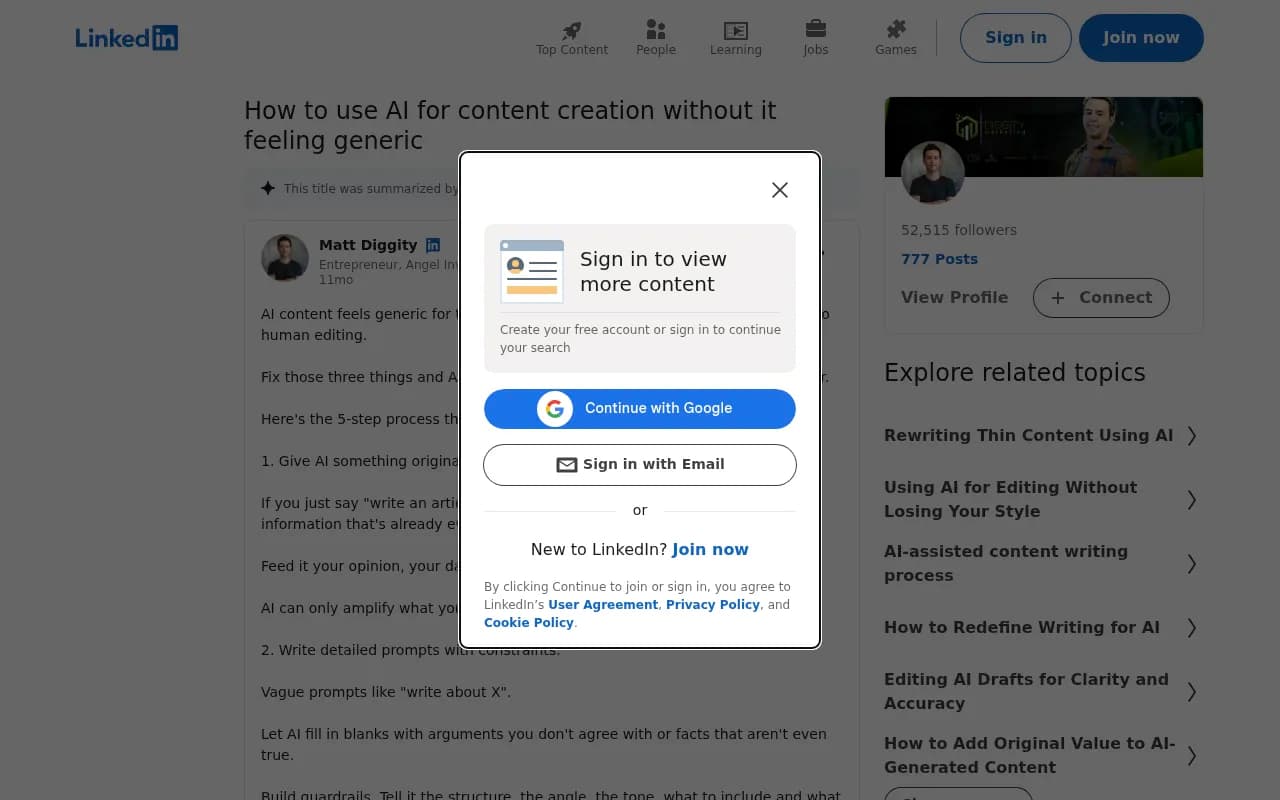
A LinkedIn post from Matt Diggity boils it down to three causes: weak inputs, vague prompts, and zero human editing. I agree with all three, and the first one is the one people skip. If the only thing going into the model is a keyword, the only thing coming out is a keyword-shaped article.
Search Atlas frames it as garbage in, garbage out. Its argument is that AI can't infer intent or apply brand judgment, so every rule has to be written down. Human writers fill gaps with experience. Models fill gaps with filler. (The performance numbers on that page, like 50 to 100% more organic traffic, are vendor claims. Treat them as marketing, not benchmarks.)
So the job of a brief is simple: remove every gap the model would otherwise fill with filler.
The four parts of a brief that works
eesel's guide to briefs for AI writers organizes a brief into four areas: persona, task, context and format. It's a handy checklist, so I'll use it as the spine here.
| Area | What it answers | What goes wrong without it |
|---|---|---|
| Persona and objective | Who is writing, for whom, and why | Bland, tone-less copy aimed at "everyone" |
| Structure and SEO | Keywords, outline, internal links, CTA | Keyword stuffing or a shapeless article |
| Context and sources | Brand background, data, links to cite | Invented facts, promotional product mentions |
| Format and constraints | Length, banned phrases, style rules | The usual AI cadence and vocabulary |
Now the details of each.
Start with a specific business goal
"Write a blog post about X" isn't a goal. Compare it with eesel's example: rank top 3 for "best AI chatbots" and drive free-trial sign-ups. That sentence tells the model what the article is for, which changes what it includes. A post meant to drive sign-ups needs a comparison and a clear next step. A post meant to build authority needs depth and a point of view.
Write the goal in one sentence and put it at the top of the brief. If you can't, you aren't ready to commission the article from a human either.
Define the reader, not the demographic
"Marketers" is useless. Say whether the reader is a beginner or an expert, what they already know, and what problem made them search. A marketing manager who has been burned by a bad AI rollout needs a different article from a founder trying AI for the first time.
A short audience block might look like this:
Audience: In-house content leads at B2B SaaS companies (10-200 staff).
They already use ChatGPT daily. They are frustrated by drafts that need
2+ hours of rewriting. They do not need a definition of generative AI.
That last line matters. Telling the model what to skip is as useful as telling it what to cover, and it kills the throat-clearing intro that makes AI articles so recognizable.
Give the model a role and a tone you can verify
eesel suggests assigning a persona, such as an experienced content strategist writing for marketing managers, then stating the tone explicitly. Fine. But "professional but approachable" is the tone equivalent of "write about AI chatbots". Every model already defaults to it.
Make tone checkable instead:
- Sentences average under 20 words, with some very short ones.
- First person is allowed. Opinions are required.
- No sentence starts with "In today's...".
- Contractions are fine.
- Never use: delve, landscape, crucial, game-changer, unlock, leverage.
A reviewer can check each of those in ten seconds. Nobody can check "approachable".
Build a voice file once, reuse it forever
Amar Chetri describes a custom instruction file built from his best work, with a "Voice DNA" the model is told to match. One detail I like: the instructions tell the model to flag where a personal anecdote would strengthen a section, using a placeholder like [INSERT STORY ABOUT FAILURE]. That's honest. The model can't invent your failures, so it asks for them.
A solid voice file contains:
- Three to five paragraphs of your real writing, pasted in as examples.
- A list of habits to copy (conversational metaphors, blunt openers).
- A list of phrases to ban.
- A rule that it must leave placeholders instead of making up experiences.
eesel calls the difference between a one-line command and an outline with style examples "zero-shot" versus "few-shot". The few-shot version wins almost every time, because examples carry more information than adjectives.
Pick an angle and make the model defend it
This is the part most briefs skip, and it's the reason most AI articles read like each other. If you ask for "pros and cons of X", you get a balanced list with no spine.
Give the article a position instead:
- Weak: "Compare three content optimization tools."
- Better: "Argue that content scoring tools are worth paying for only on pages that already rank on page two, and say why they fail on new pages."
The second version forces a claim, which forces reasoning, which forces specifics. You may disagree with the claim. That's fine. A draft with a point of view is easier to edit than a draft with none.
Feed it material it can't make up
This is where briefs earn their keep. eesel recommends supplying links to studies, data or internal documents as the source of truth, and calls it an effective way to prevent invented facts and figures. I'd go further: the more original material you load in, the less the model needs to rely on its generic memory.
Useful inputs, roughly in order of impact:
- Your own data (survey results, product usage, customer numbers).
- Quotes or notes from a subject-matter expert, even rough call notes.
- Specific examples and screenshots from your product or client work.
- Two or three authoritative external sources the article must cite.
- Competitor pages you want to beat, with a note on what they miss.
A practitioner workflow quoted in eesel's guide, from a Reddit thread, does this in stages: run deep-research bots first, build an extensive brief with all headings and talking points, train several AIs on background, tone and style, then feed each AI one section at a time with its talking points. Section-by-section generation keeps the model focused and stops it padding. It's more work, but for pages that matter I think it's the right trade.
SEO parameters, without the stuffing
A brief still needs the search basics. From eesel's checklist:
- One primary keyword and a short list of secondary keywords.
- An outline with H2s and H3s.
- Specific internal links with suggested anchor text.
- An instruction to cite credible external sources.
- The exact call to action.
Give the model the links and anchors. If you let it choose, you get links to nowhere or invented URLs. And tell it plainly that keywords should appear where a human would say them.
Where brief tools fit
Plenty of tools generate the SEO half of a brief from live search results. They're good at the scaffolding. None of them can write your angle.
| Tool | What it helps with in a brief | Watch out for |
|---|---|---|
| Surfer SEO | Term and heading suggestions from top-ranking pages | Scores can push you toward copying competitors |
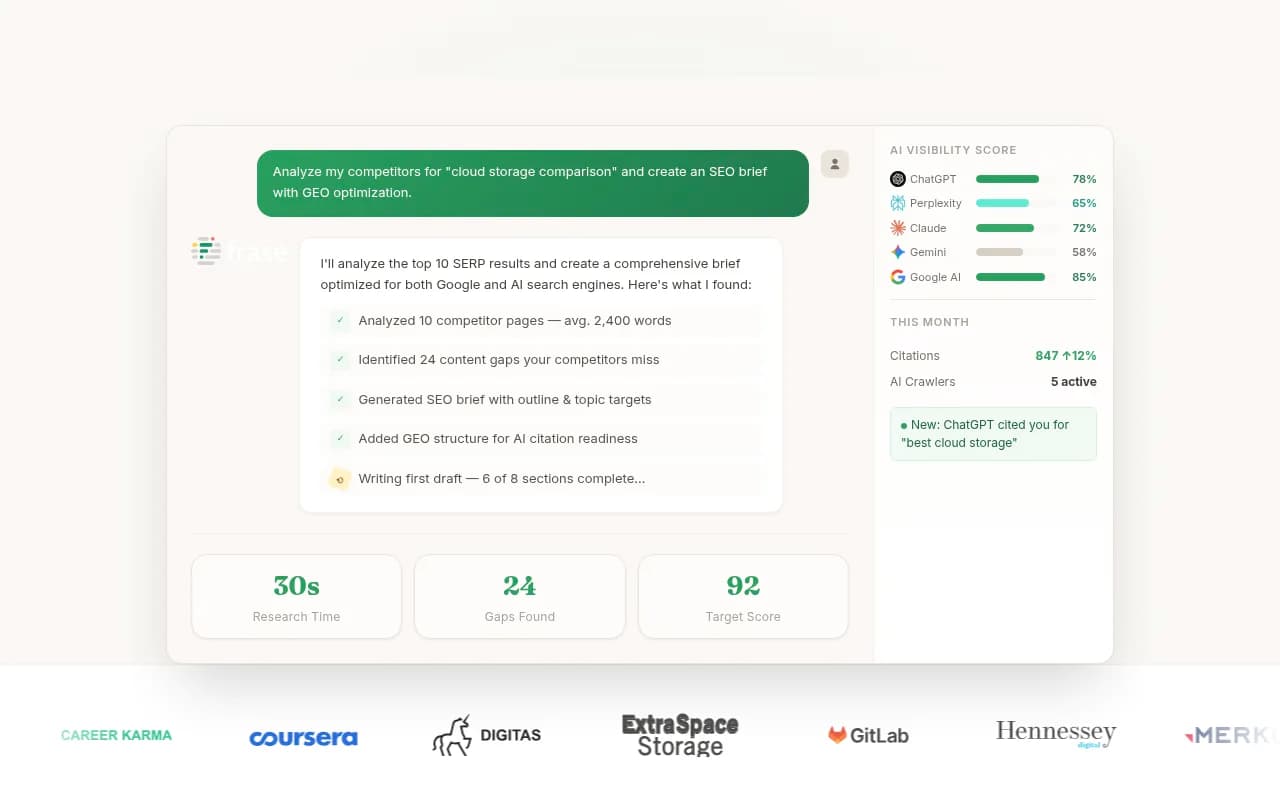
| Frase | Research and outline built from search results | Outlines still need your angle added |
| Clearscope | Topic coverage grounded in search data | Strong on coverage, silent on originality |
| MarketMuse | Content planning and topic gaps | Heavier planning tool than quick brief maker |
| Outranking | AI-assisted briefs and drafts in one place | Draft quality depends on what you feed it |
| Search Atlas | Brief generation inside a wider SEO platform | Its published claims are vendor-sourced |


I haven't compared pricing for these, and plans change, so check each vendor's site before committing. If you want to browse more options, the directory at surferstack.com lists content and SEO tools with reviews and alternatives.
Add the brand context
Tell the model about your company and product in a few sentences, plus how it should mention them. Without that, product mentions come out either absent or breathlessly promotional. eesel notes that brand and product background helps mentions land naturally.
For an AI writing assistant that holds brand rules for you, enterprise tools like Writer let you set terminology and style controls once. Jasper has a similar brand voice setup and its own content brief template post. For quick editing passes, Grammarly and Wordtune can catch tone problems, though they won't fix a missing angle.


Write constraints as rules, not wishes
Search Atlas is right that AI follows rules deterministically. So write rules.
- "Open with a concrete scenario or a claim, never a definition."
- "Every section must include one specific example, number or named source."
- "If you don't have a fact, write [NEEDS SOURCE] instead of guessing."
- "Don't end with a summary paragraph that repeats the article."
- "Remove generic advice and replace it with a specific observation." (A Facebook group post suggests a rewrite prompt like this. Low authority source, but the instruction is sound.)
That [NEEDS SOURCE] rule is one of my favorites. It converts hallucinations into visible to-do items, which are cheap to fix.
A brief template you can copy
GOAL
One sentence: what this article must achieve.

AUDIENCE
Who, their level, their problem, what to skip.

PERSONA AND TONE
Role: ...
Tone rules (checkable): ...
Banned phrases: ...
Voice samples: [paste 3 paragraphs]

ANGLE
The position this article defends: ...

SEO
Primary keyword: ...
Secondary: ...
Outline: H2/H3 list
Internal links + anchors: ...
CTA: ...

SOURCES (source of truth)
- Our data: ...
- Expert notes: ...
- Must-cite links: ...

BRAND CONTEXT
2-4 sentences, plus how to mention the product.

FORMAT AND CONSTRAINTS
Length, structure, [NEEDS SOURCE] rule, opening rule.
WG Content makes the point bluntly: slop in, slop out, and AI can't write the brief for you without human input. I'd soften that slightly. AI can draft the scaffolding from kickoff notes and brand guidelines, which is a workflow Digital Applied covers. But the angle and the source material have to come from a person.
Review the draft against the brief
A good brief gives you a review checklist for free. After the draft comes back, check:
- Does it defend the angle, or drift into balance?
- Is every number tied to a source you supplied?
- Any banned phrases or the usual AI cadence?
- Did it leave placeholders where it needed your stories?
- Would a reader who knows the topic learn anything new?
If the answer to the last one is no, the fix is rarely a better prompt. It's more original input. Go get another data point or a quote from someone who does the work, and rerun.
Briefing for AI search visibility
If you also want articles that get cited by ChatGPT or Google AI Overviews, brief for it. That means naming the questions AI answers actually cover and making sure pages are crawlable. According to Promptwatch's data on which content types ChatGPT cites most (Sep 28 to Oct 4, 2026), product pages were the top type at 22.4% of citations, followed by landing pages and listicles. That's a reason to include concrete, structured product and comparison content in briefs, not just essays.
Tools like Promptwatch can show which prompts and gaps to build briefs around, and you can turn a citation's prompts into a content brief inside it.

If you're shopping for GEO software more broadly, the GEO software directory is a decent starting point.
Common mistakes
- Writing a brief that's just a keyword and a word count.
- Describing tone with adjectives instead of rules and samples.
- Skipping the angle because "the AI will find one".
- Letting the model pick links and sources.
- Generating the whole article in one pass when the topic is complex.
- Treating the first draft as final. Human editing is the third leg of the problem Diggity names, and no brief removes it.
The short version
A brief is a list of decisions you refuse to leave to the model: the goal, the reader, the angle, the facts, the voice and the rules. Make those decisions once, save them as a template and a voice file, and the drafts stop sounding like everyone else's. Start with the angle and the source material. Those two do most of the work.