Key takeaways
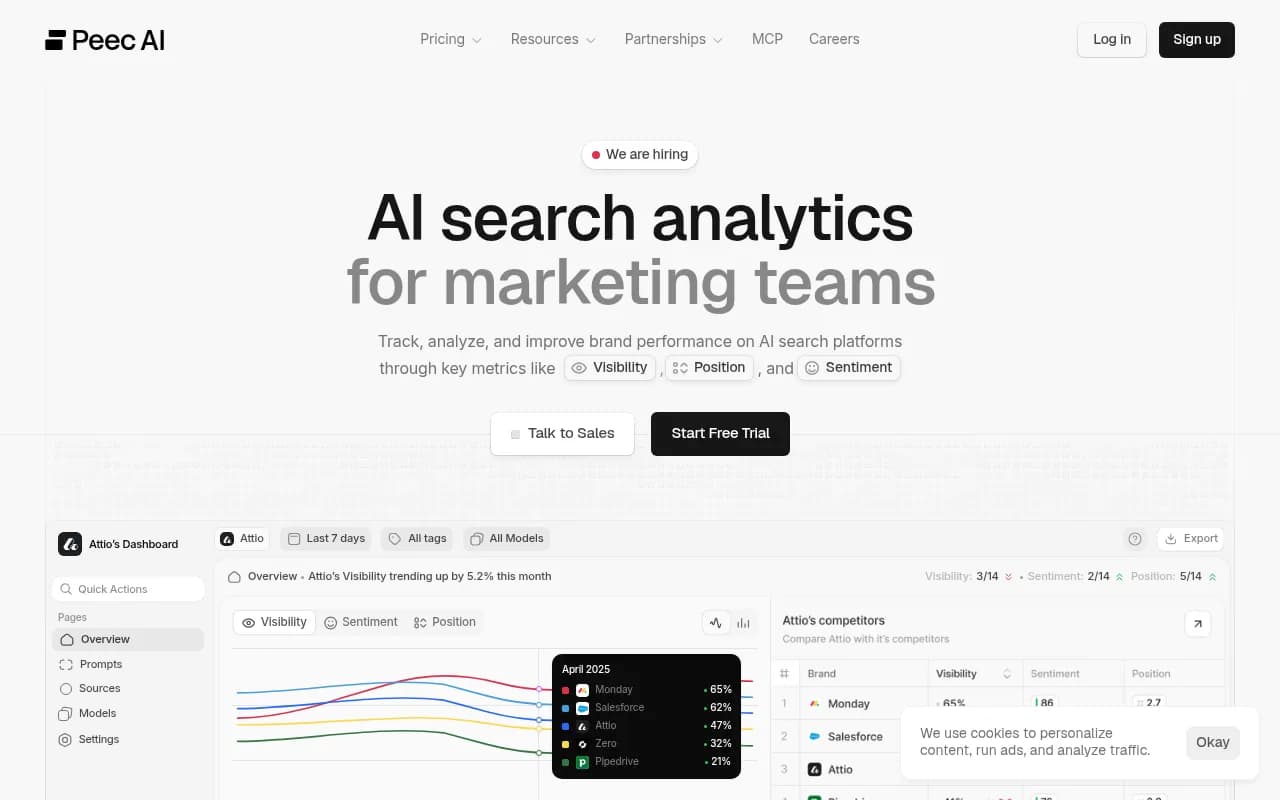
- Peec AI is a solid monitoring tool, but its Pro plan caps you at 100 prompts, 4 base AI engines, and zero content creation features.
- Most alternatives fall into the same trap: they show you a dashboard and leave you to figure out what to do next.
- The platforms worth switching to are the ones that close the loop -- find the gap, generate the content, track the result.
- If you need content generation alongside monitoring, look at Writesonic GEO, AirOps, Surfer SEO, and Promptwatch.
- If you need broader model coverage or deeper citation data, Ahrefs Brand Radar and Scrunch AI are worth a look.
- Pure monitoring tools like Otterly.AI are fine for small budgets, but they won't move the needle on their own.
Peec AI does what it says on the tin. You set up your prompts, pick your AI engines, and watch your brand visibility scores roll in. For a lot of teams, that's genuinely useful -- especially when you're just getting started with GEO and need to understand where you stand.
But at some point, the dashboard stops being enough.
You know you're invisible for certain prompts. You can see competitors getting cited where you aren't. What you can't do -- inside Peec AI -- is fix it. There's no content creation, no gap analysis that tells you what to write, no crawler logs showing you whether AI bots are even visiting your pages. The Pro plan (around €199/mo) covers four base engines: ChatGPT, Perplexity, Google AI Overviews, and DeepSeek. Claude, Gemini, and Google AI Mode are Enterprise add-ons. You're capped at 100 prompts and 9,000 AI answers per month.
That's a real ceiling for teams that want to grow their AI visibility, not just measure it.
So what actually works better? Here are seven platforms that go beyond the dashboard -- either by generating content, closing the gap between insight and action, or both.
1. Promptwatch -- the full action loop
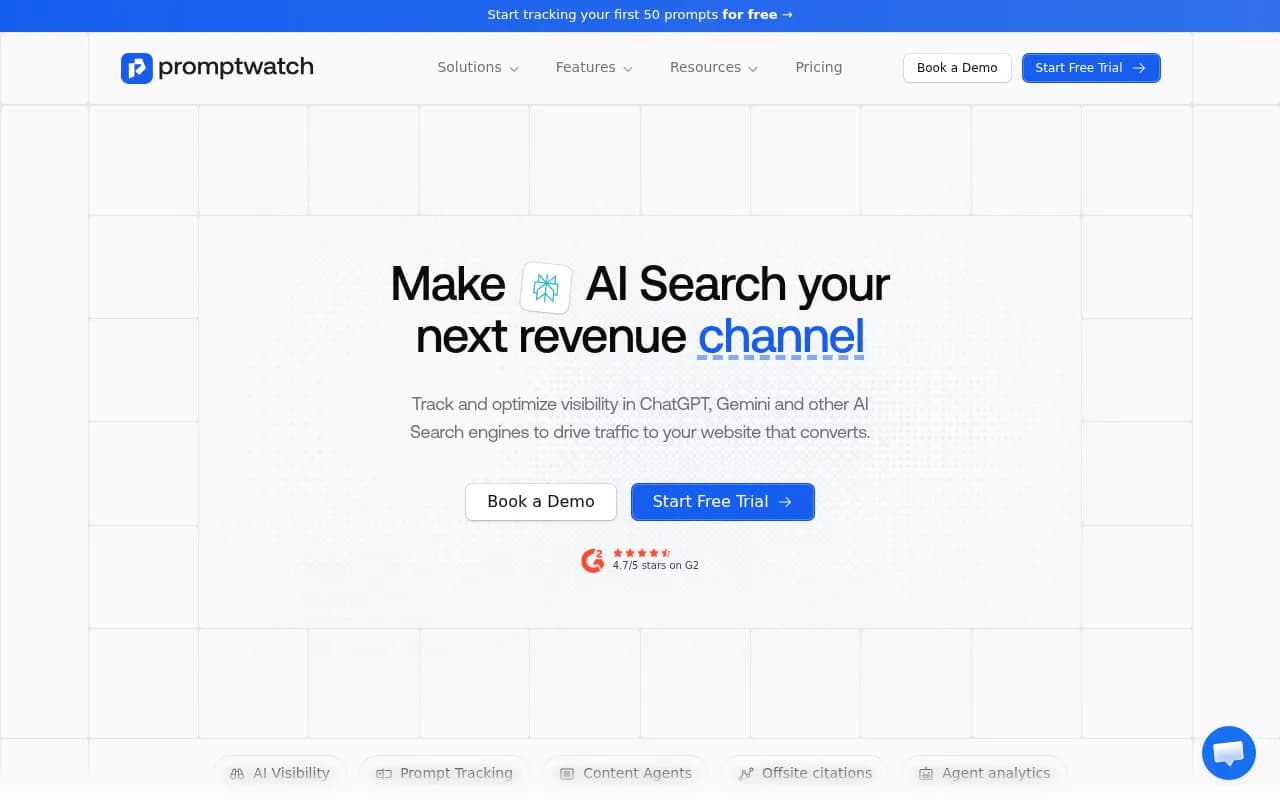
Promptwatch is the most complete option on this list if your goal is to actually improve your AI visibility rather than just report on it. Most tools show you that you're missing from an AI response. Promptwatch shows you why, and then helps you do something about it.
The core workflow is an "action loop": find gaps with Answer Gap Analysis, generate content to fill them with Content Agents, then track whether that content gets cited. That third step -- connecting publish date to crawl date to first citation -- is something almost no other tool does at the page level.
A few things stand out compared to Peec AI specifically:
- It monitors 10 AI models (ChatGPT, Perplexity, Claude, Gemini, Google AI Overviews, Google AI Mode, Grok, DeepSeek, Copilot, Meta AI) -- all in the base plans, not as enterprise add-ons.
- Content Agents generate articles, comparisons, and briefs grounded in real prompt data and citation analysis, not generic SEO templates.
- AI Crawler Logs show you which pages ChatGPT, Claude, and Perplexity are actually reading, how often they return, and what errors they hit. Peec AI has nothing equivalent.
- Prompt Intelligence gives you volume estimates and difficulty scores so you can prioritize which gaps to fill first.
Pricing starts at $99/mo (Essential: 1 site, 50 prompts, 5 articles), $249/mo (Professional: 2 sites, 150 prompts, 15 articles, crawler logs), and $579/mo (Business: 5 sites, 350 prompts, 30 articles). There's a free trial.
The honest caveat: if you only need basic brand monitoring and have no interest in content production, this is more platform than you need. But for teams that want to move the needle, it's the most complete option available.
2. Writesonic GEO -- monitoring plus content in one place
Writesonic started as an AI writing tool, and that heritage shows. Its GEO module adds AI visibility tracking on top of a content generation engine that's already mature. The combination is genuinely useful: you can identify which prompts you're missing from, then immediately draft content targeting those gaps without switching tools.
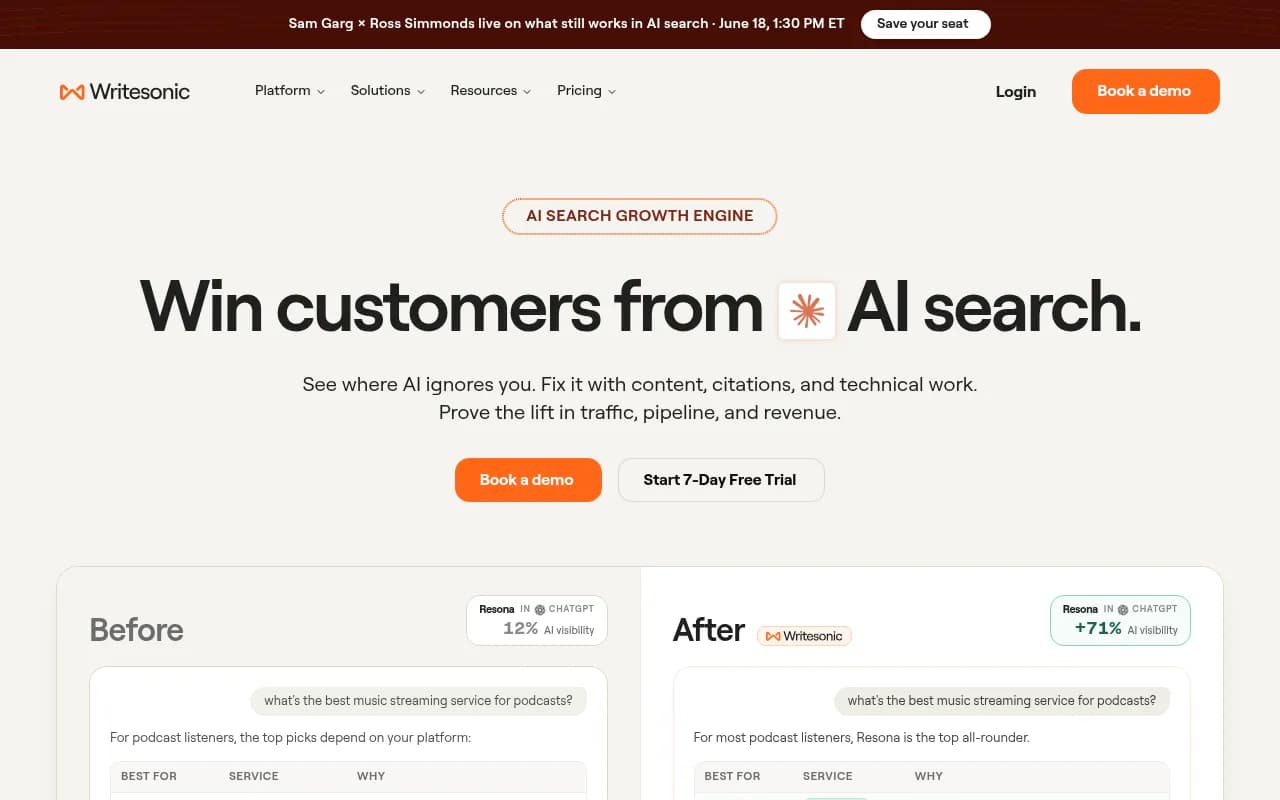
It covers the major AI engines -- ChatGPT, Perplexity, Gemini, Google AI Overviews -- and includes share-of-voice tracking and competitor comparisons. The content side handles articles, landing pages, and social copy with brand voice controls.
Where it falls short: the GEO monitoring features feel like they were bolted onto an existing writing platform rather than built from the ground up. Prompt-level analytics are less granular than dedicated GEO tools, and there's no equivalent to crawler logs or citation-level tracking. Good for content-heavy teams; less good if you need deep visibility data.
3. AirOps -- content workflows at scale
AirOps sits in a slightly different category. It's less of a monitoring tool and more of a content production engine -- but it's worth including here because it's one of the few platforms that explicitly connects AI search visibility goals to content output at scale.
The core idea is workflow automation: you define a content process (research, brief, draft, optimize, publish), and AirOps runs it across hundreds of pages simultaneously. For teams managing large sites that need to produce GEO-optimized content systematically, this is genuinely powerful.
What it doesn't do is monitor AI responses directly. You won't get visibility scores or citation tracking out of the box. It's best used alongside a monitoring tool rather than as a standalone replacement for Peec AI. But if content production is your bottleneck -- and it usually is -- AirOps addresses that more directly than almost anything else.
4. Surfer SEO -- content optimization with AI search in mind
Surfer SEO has been around long enough that most SEOs already have an opinion on it. What's changed in 2026 is how explicitly it's targeting AI search optimization alongside traditional rankings.

The Content Editor gives you real-time feedback on NLP terms, structure, and depth as you write. The newer AI search features flag which content elements are likely to get cited in AI responses -- not just which keywords to include. It's not a replacement for a dedicated GEO monitoring tool, but for teams that want their content to perform in both traditional and AI search, Surfer's optimization layer is hard to beat.
Pricing is more accessible than most enterprise GEO tools, which makes it a reasonable complement to a lighter monitoring setup.
5. Scrunch AI -- enterprise monitoring with content guidance
Scrunch AI targets larger brands and agencies that need systematic AI visibility monitoring across multiple markets. It covers the major AI engines, tracks citations and share of voice, and includes competitive benchmarking that goes deeper than Peec AI's offering.

The content side is more advisory than generative -- Scrunch will tell you what kind of content to create and which gaps to prioritize, but it won't write the articles for you. For enterprise teams with dedicated content teams, that's fine. For smaller teams that need the full stack in one tool, it's a limitation.
Pricing is on the higher end and not fully transparent without a demo. Worth it for large-scale monitoring; less so if you're a single-brand team.
6. Otterly.AI -- affordable monitoring for smaller teams
Otterly.AI is the most direct like-for-like alternative to Peec AI in terms of scope. It tracks brand mentions across AI engines, shows you citation sources, and gives you competitive share-of-voice data. The interface is clean and the pricing is more accessible than most tools in this space.
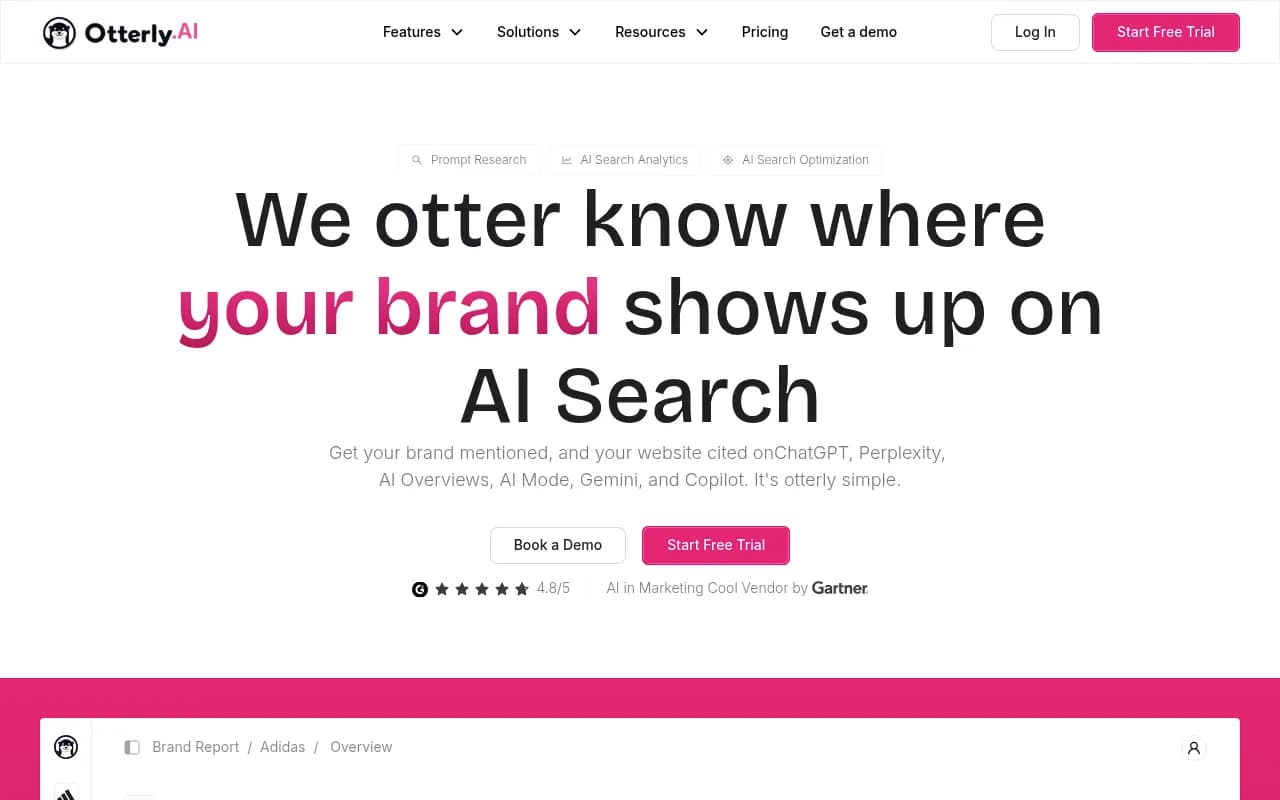
What it doesn't do: generate content, analyze crawler behavior, or give you prompt volume data. It's monitoring-only, which is fine if that's genuinely all you need. But if you're switching from Peec AI because you want to actually improve your visibility -- not just measure it -- Otterly.AI has the same ceiling.
That said, it's a reasonable choice for teams with a tight budget who want reliable tracking without the complexity of a full GEO platform.
7. Ahrefs Brand Radar -- real prompt data, not simulated queries
Most GEO tools build their own prompt sets. They guess what users might ask, run those guesses through AI engines, and report back. The problem is that visibility scores built on hypothetical prompts can be misleading -- you might look great for questions nobody actually asks.
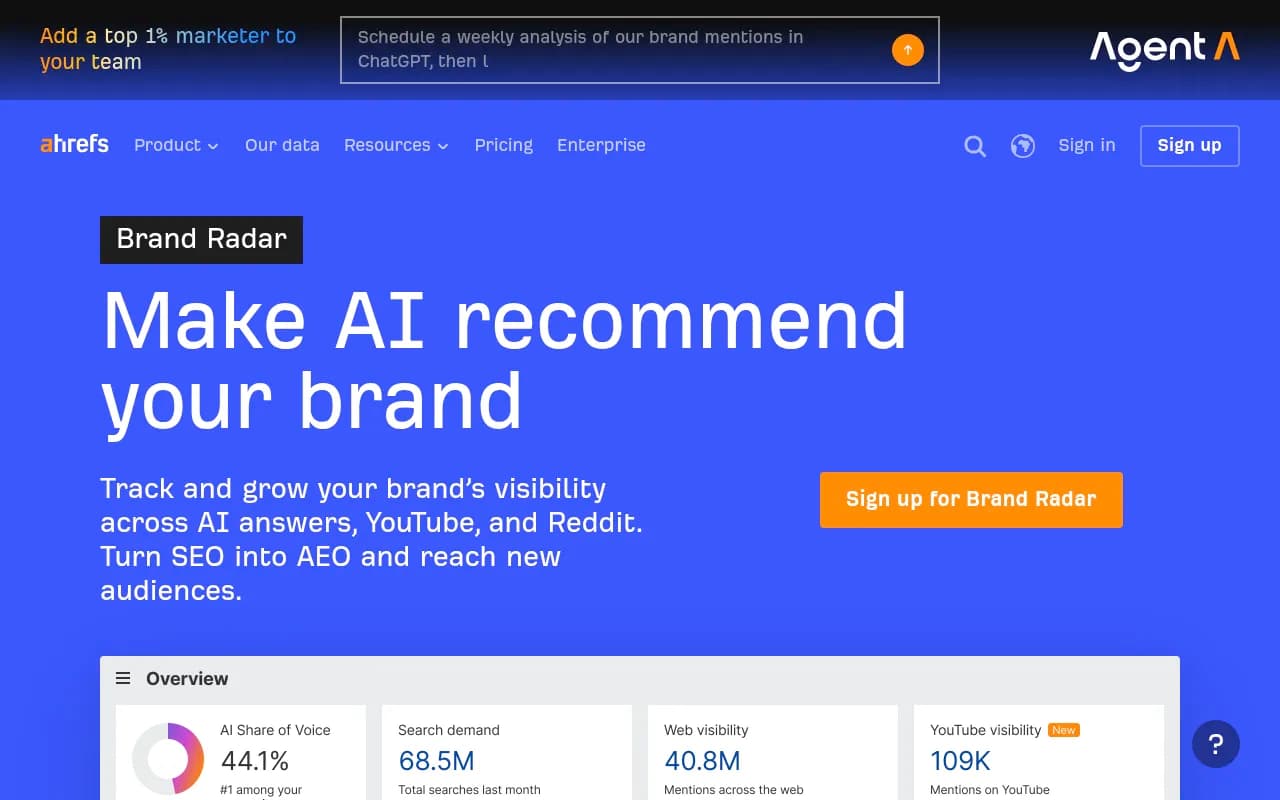
Ahrefs Brand Radar takes a different approach. Its 243M+ prompts come from real search data -- specifically "People Also Ask" questions with actual search volume behind them. That's an architectural difference, not a feature difference. Every visibility metric is anchored in real behavior.
Coverage spans six AI engines (ChatGPT, Perplexity, Gemini, Copilot, Google AI Overviews, Google AI Mode) plus YouTube, TikTok, and Reddit. Pricing starts at $50/mo for 2,500 checks, scaling up to $699/mo for all six AI indexes with custom prompt checks included.
The limitation: Brand Radar is still primarily a monitoring and data tool. There's no content generation, no content briefs, no crawler logs. It's the best option if data quality is your top priority and you have a separate content workflow. If you want everything in one place, you'll need to pair it with something else.
How these platforms compare
Here's a quick breakdown of where each tool sits on the monitoring-to-optimization spectrum:
| Platform | AI model coverage | Content generation | Crawler logs | Prompt data quality | Starting price |
|---|---|---|---|---|---|
| Peec AI | 4 base (Claude/Gemini = enterprise) | None | None | Simulated | ~€89/mo |
| Promptwatch | 10 models | Yes (Content Agents) | Yes | Real + simulated | $99/mo |
| Writesonic GEO | 4-5 models | Yes (full writing suite) | No | Simulated | ~$49/mo |
| AirOps | No monitoring | Yes (workflow automation) | No | N/A | Custom |
| Surfer SEO | Limited | Yes (content editor) | No | N/A | ~$89/mo |
| Scrunch AI | 5+ models | Guidance only | No | Simulated | Custom |
| Otterly.AI | 4-5 models | None | No | Simulated | ~$49/mo |
| Ahrefs Brand Radar | 6 models + social | None | No | Real search data | $50/mo |
What to actually look for when switching
The most common mistake when evaluating Peec AI alternatives is comparing feature lists without thinking about what you're trying to accomplish.
If you're switching because you want more model coverage, Ahrefs Brand Radar and Promptwatch both cover more engines in their base plans than Peec AI's Pro tier.
If you're switching because monitoring alone isn't moving the needle, you need a platform with content generation built in. Writesonic GEO and Promptwatch both do this. AirOps does it at scale if you have a large content operation.
If you're switching because of price, Otterly.AI is the most affordable like-for-like option. Just know you're trading features for cost.
If you're switching because you want to understand why AI models aren't citing you -- not just that they aren't -- look for platforms with crawler logs and citation-level analysis. That's a short list: Promptwatch is the most accessible option that includes this.
One thing worth saying plainly: most of the tools in this space are monitoring dashboards with good branding. They show you a visibility score, a competitor comparison, and a list of prompts where you're missing. That's useful data. But data without action doesn't improve your AI visibility. The platforms that actually move the needle are the ones that help you create content, fix technical issues, and track whether those changes worked.
That's a harder product to build, which is why most tools haven't built it yet.
A note on Peec AI's actual strengths
Before switching, it's worth being honest about what Peec AI does well. The unlimited countries and languages at no extra cost is a genuine differentiator -- most competitors charge per region or limit international tracking to higher tiers. The UI is clean and the onboarding is fast. For teams that are new to GEO and want to get a baseline quickly, it's a reasonable starting point.
The ceiling hits when you need to act on what you're seeing. That's when the alternatives above become worth the switch.
Bottom line
The GEO tool market in 2026 has a lot of dashboards and not enough optimization. Most Peec AI alternatives will give you a slightly different version of the same monitoring experience -- more engines here, better UI there, lower price somewhere else.
The tools that actually justify switching are the ones that help you close the gap between "I can see I'm invisible" and "I've done something about it." For most teams, that means either pairing a strong monitoring tool (Ahrefs Brand Radar) with a content tool (Surfer SEO, AirOps), or choosing a platform that handles both ends of the loop natively.
If you want the latter in a single product, Promptwatch is currently the most complete option available -- and the only one in this comparison with crawler logs, content generation, and page-level citation tracking all in the same platform.