Key takeaways
- Perplexity cites almost exactly 10 sources per answer, so you can measure your share of a fixed number of slots per prompt, and changes you see usually come from your content rather than engine noise.
- B2B SaaS teams should monitor five prompt families: category, comparison, alternatives, use-case, and brand-specific prompts. 30 to 60 well-chosen prompts beat 500 random ones.
- Unlike ChatGPT, Perplexity still gives LinkedIn and Reddit a small but equal share of citations (0.86% each in late September to early October 2026), so those channels are worth watching.
- A tool must run prompts against the real Perplexity interface, show cited sources per prompt, and track competitors. Anything that only reports a vague score is not enough.
- Tracking is only half the job. Pick a tool that tells you what to fix, or pair a tracker with a content workflow.
Why Perplexity deserves its own tracking
Most B2B SaaS teams lump all AI engines together in one dashboard and call it a day. I think that hides the most useful signal. Perplexity behaves differently from ChatGPT, and its audience (researchers, developers, early adopters) overlaps heavily with people who evaluate software.
The key fact is stability. According to Promptwatch Data's average sources per response report, Perplexity cites almost exactly 10 sources per answer, with barely a decimal of daily movement. ChatGPT cites about 5 per web-search answer, and Copilot's average swung from under 2 to nearly 17 within a few weeks. A stable 10-slot answer is rare, and it makes Perplexity a decent test bench. If your citation pickup moves after you update a pricing page or publish a comparison, that change is probably yours.
It also gives mid-authority sites a real path. Ten slots per answer means there is room beyond G2 and a couple of big publishers.
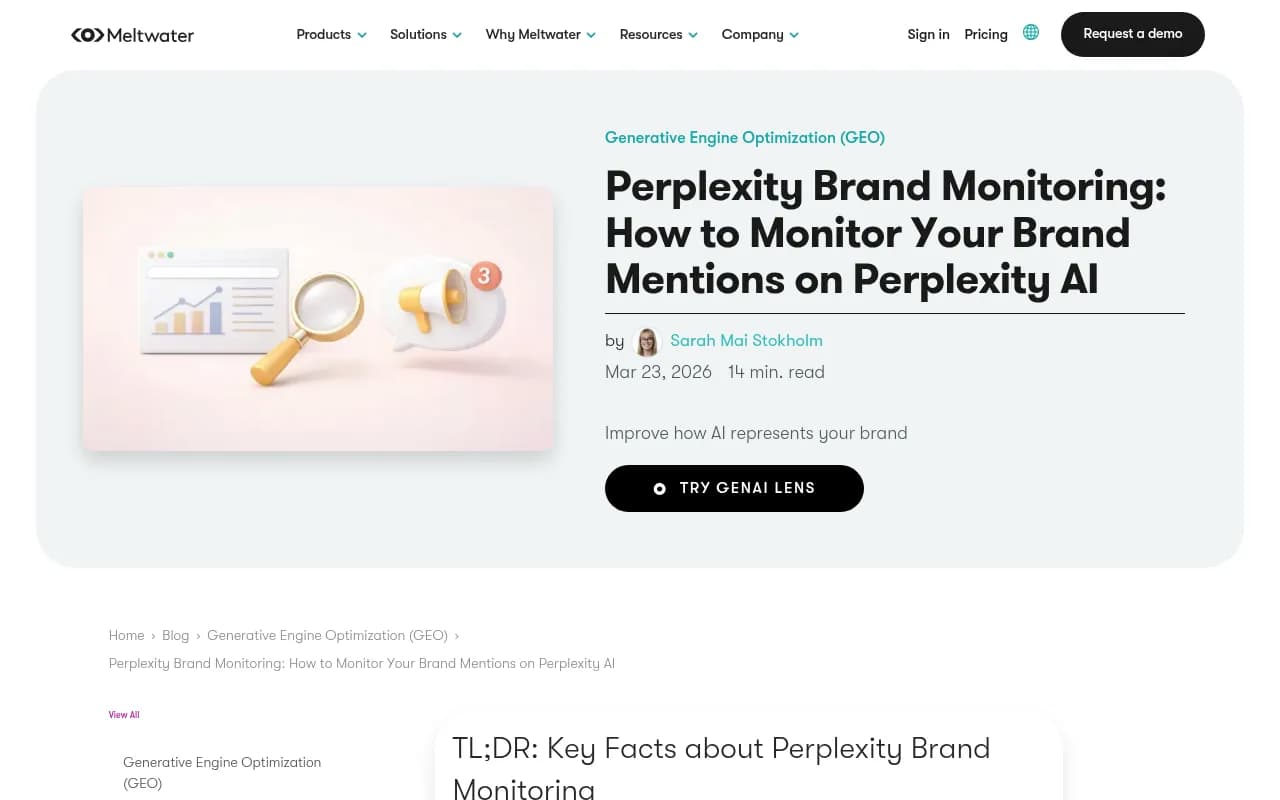
Meltwater's Perplexity brand monitoring guide (March 2026) makes a similar argument: monitor prompts, track the sources influencing answers, then fix inaccuracies and gaps. The workflow is sound. What it does not settle is which prompts to monitor, which is where most teams go wrong.
The five prompt families to monitor
Start from how a buyer actually researches software. Each family below answers a different question about your brand.
1. Category prompts
These are the discovery prompts where nobody has named a vendor yet.
- "best [category] software for mid-market companies"
- "what is the best tool for [job to be done]"
- "top [category] platforms for [industry]"
This is the family that drives pipeline and the one where you are most likely to be absent. Your metric is simple: are you in the answer at all, and in what position?
2. Comparison prompts
The buyer already has two names and wants a verdict.
- "[your brand] vs [competitor]"
- "[competitor] vs [competitor] for [use case]"
Monitor both the ones that include you and the ones that don't. The second group shows you where competitors are being shortlisted without you.
3. Alternatives prompts
"Alternatives to [incumbent]" is one of the highest-intent patterns in SaaS. Track alternatives prompts for your two or three biggest competitors, and for any product you realistically replace. If you are a challenger, this is where you win your first mentions.
4. Use-case and persona prompts
These are narrower and written the way a real person types them.
- "how do I automate [workflow] as a RevOps manager"
- "which [category] tool integrates with Salesforce and Slack"
- "[category] software for a 20-person startup"
Persona framing matters because AI answers change with who the asker appears to be. A tool that lets you tag prompts by persona saves you from guessing.
5. Brand and reputation prompts
- "what is [your brand]"
- "is [your brand] worth it"
- "[your brand] pricing" and "[your brand] reviews"
These check accuracy. Wrong pricing, outdated features, or a stale positioning line will show up here first. Perplexity pulls from live sources, so inaccurate answers usually trace back to a specific page you can fix.
How many prompts is enough?
A Reddit thread in r/ProductMarketing about B2B SaaS monitoring tools centered on a set of 50 tracked prompts, and that matches what I see in practice. Roughly 50 prompts split across the five families (for example 15 category, 10 comparison, 10 alternatives, 10 use-case, 5 brand) is enough to see patterns without drowning in noise. Add more only when you have a reason, like a new product line or market.
What to read in the results
Once prompts run daily, look at four things:
- Share of the 10 slots that point to your own domain versus competitors, review sites, and third-party blogs.
- Position of your brand in the answer text. Mentioned first versus mentioned fifth are different outcomes.
- Which competitors keep appearing alongside you.
- Which URLs get cited, and whether they are pages you control.
The last one is underrated. For software prompts, Promptwatch's ChatGPT citation data for October 2026 (Sep 28 to Oct 4) found docs and help centers earned the largest share at 2.64%, vendor sites 2.01%, and review sites and analysts like G2, Gartner, and Capterra 1.57%. Vendor sites and docs together earned about three times what review sites did. That is ChatGPT data, not Perplexity, so treat it as a proxy for what to audit rather than a promise. But it suggests the same priority list: your own docs and product pages first, then complete G2 and Capterra profiles, then a public GitHub presence if you sell to developers.
Don't ignore social sources on Perplexity
This is where Perplexity diverges sharply from ChatGPT. In Promptwatch's social media citations report for October 2026 (Sep 28 to Oct 4), ChatGPT drew only 0.46% of its citations from social platforms, while Google AI Overviews drew 12.2%. Perplexity sat at 2.7%, with LinkedIn and Reddit tied at 0.86% and YouTube at 0.79%. X peaked at 0.1%.
Small numbers, but real ones. For a B2B SaaS brand it means LinkedIn posts and Reddit threads can still be cited on Perplexity in a way they largely cannot on ChatGPT. Add a few prompts where community discussion is likely to be the source, and use a tool that reports which Reddit threads and LinkedIn posts are being cited. Reddit's collapse in ChatGPT is covered in Promptwatch's Reddit citation report, which is another reason not to assume one engine's behavior carries over.
What a tool needs to handle Perplexity properly
Before comparing vendors, set the bar:
- Runs prompts against the real Perplexity interface, not only an API model, since user-facing answers and citations can differ.
- Shows every cited URL per prompt, with position, not just a visibility score.
- Lets you group prompts by topic, intent, and persona.
- Tracks competitors automatically, including ones you didn't list.
- Covers multiple countries and languages if you sell internationally.
- Connects visibility to something you can act on: content gaps, crawler access, or traffic.
I would also be wary of tools that give a single "AI score" with no way to inspect the underlying answers. MADX Digital's write-up on AI brand monitoring for SaaS makes a similar point about which tools to distrust. Always click through to the raw response.
Tools that track Perplexity for B2B SaaS
There are well over a hundred AI visibility tools now. Here are the ones worth a shortlist for a SaaS team, grouped by what they are good at. I have not tested pricing for each, so confirm on the vendor sites.
Tracking plus action
Promptwatch is the one I'd start with if you want to move past reporting. It monitors the real Perplexity interface (alongside ChatGPT, AI Overviews, Gemini, Claude and others), shows citations per prompt, and adds prompt volumes and difficulty so you can pick which prompts deserve effort. Its content gap analysis shows which prompts competitors win and you don't, and the Content Agent can draft and publish pages to fill them. IP-verified AI crawler logs show whether PerplexityBot and Perplexity-User can actually read your pages. Plans start at $95/month, with a free tier limited to ChatGPT, so check promptwatch.com/pricing.

Profound is a strong enterprise monitoring platform, though it costs more and leans toward reporting rather than execution.

Monitoring-focused trackers
Otterly.AI and Peec AI are the usual picks for lean teams that want prompt tracking at a lower price. They answer "were we mentioned" well. They do not give you crawler logs or content generation.


AthenaHQ, Scrunch AI, and Qwairy sit in a similar space, with differing depth on reporting and agency features.


SEO suites adding AI tracking
If your team already lives in Semrush or Ahrefs, the add-ons are convenient. The trade-off is usually a fixed prompt set and shallower AI-specific data.

Built for B2B pipeline
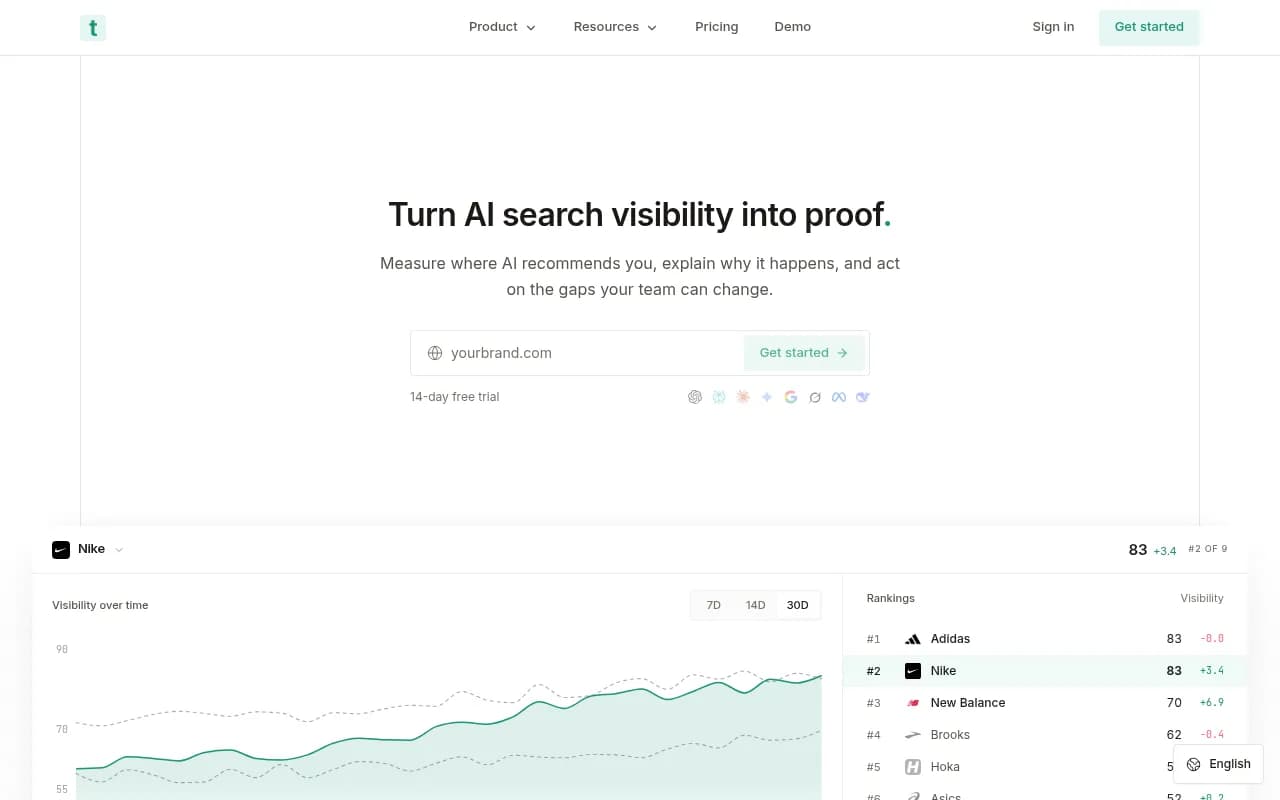
Omnibound positions itself around tying AI visibility to pipeline, and Trakkr and Passionfruit focus on traffic and revenue attribution. Worth a look if your CFO asks what AI visibility is worth.
PR and media monitoring
Meltwater's GenAI Lens is the natural choice if your comms team already uses Meltwater. Sight AI's roundup of B2B brand tracking tools makes the fair point that Brandwatch, Talkwalker, Sprout Social, and similar tools monitor web, social, and media but mostly miss what AI models say about you.
Quick comparison
| Tool | Real Perplexity UI tracking | Crawler logs | Content creation | Best for |
|---|---|---|---|---|
| Promptwatch | Yes | Yes | Yes (Content Agent) | Teams that want to fix gaps, not just see them |
| Profound | Yes | Limited | No | Enterprise monitoring |
| Otterly.AI | Yes | No | No | Budget prompt tracking |
| Peec AI | Yes | No | No | Lean teams, simple dashboards |
| Semrush AI toolkit | Partial | No | Via Semrush | Teams already on Semrush |
| Ahrefs Brand Radar | Partial | No | No | Link and mention research |
| Meltwater GenAI Lens | Yes | No | No | PR and comms teams |
For wider lists, the GEO software directory and the AI rank tracking directory cover more options than I can here.
A practical setup in one afternoon
- Write 50 prompts across the five families. Pull real phrasing from sales calls, support tickets, and your own Search Console queries.
- Add your brand, three to five direct competitors, and any review sites you want flagged.
- Run daily on Perplexity plus at least one other engine so you can compare.
- After two weeks, list every prompt where you are absent and a competitor appears.
- For each gap, find the cited URLs. Are they a competitor's comparison page, a G2 category page, a Reddit thread? That tells you what to build or earn.
- Check crawler access. If PerplexityBot is blocked or errors on your pricing page, nothing else matters.
- Ship one change per gap and re-check in two to four weeks. Because Perplexity's slot count is stable, you can read the result fairly cleanly.
What to fix first
For SaaS brands, the usual quick wins are boring ones: a clear pricing page, a comparison page for each major competitor, updated docs, complete G2 and Capterra profiles, and a LinkedIn or Reddit presence where your buyers actually talk. None of this is new. The difference is that you now have prompt-level evidence for which one matters.
Common mistakes
- Tracking only brand prompts. You will look great and learn nothing.
- Judging by a single run. Answers vary, so look at trends over weeks.
- Treating ChatGPT results as Perplexity results. The social citation numbers above show how different they are.
- Buying a tracker with no path to action, then having nobody own the findings.
If you would rather hand the work to specialists, 1001 SEO Media runs GEO programs for SaaS brands using Promptwatch under the hood. Otherwise, start with the prompt list. It costs nothing and it is the part most teams skip.
Bottom line
Perplexity is the most measurable AI engine right now: about 10 citations per answer, steady day to day. Pick prompts across category, comparison, alternatives, use-case, and brand intent, track them in the real interface, and choose a tool that shows you why you are missing rather than just that you are.