Key takeaways
- I could not confirm whether Ranketta has a public MCP server or REST API. Check with them before you build on it.
- If your workflow needs both an MCP server and an API, ZeroRank is the cheapest documented entry point at $39/mo, per a vendor comparison from Geoptie.
- Quotas matter more than sticker price. Otterly's $189 plan caps API and MCP at 2,000 requests a month each, which is thin for agencies syncing many dashboards.
- Promptwatch offers a hosted MCP server with 110+ read and write tools plus REST API v2 on every plan, and it also fixes visibility gaps rather than only reporting them.
- MCP servers have had real security problems. Scope your keys and prefer read-only access until you trust the setup.
Why people look for a Ranketta alternative with MCP and API access
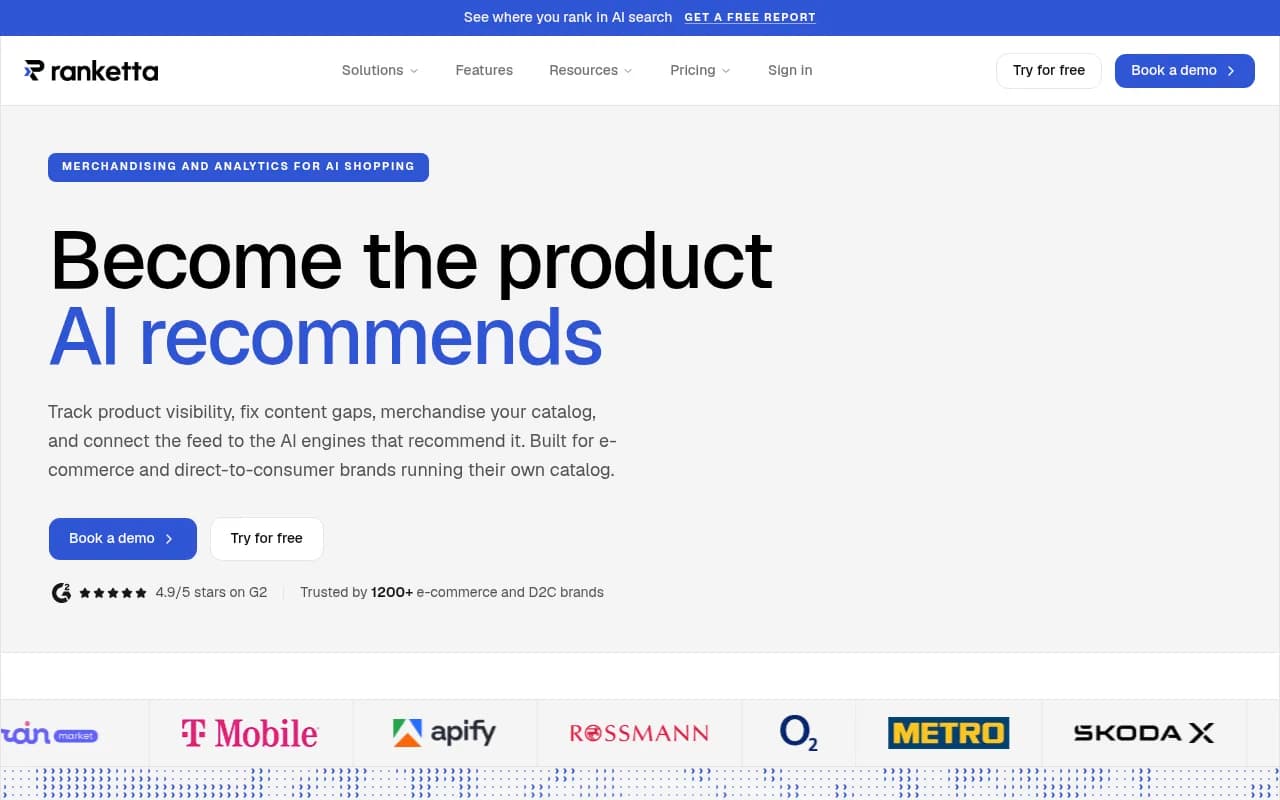
Ranketta describes itself as an AI visibility platform built for agentic commerce. Per its LinkedIn page, it tracks ChatGPT, Google AI Overviews and AI Mode, Perplexity, Gemini and Claude. A comparison page from Ansvisor says it is aimed at online stores, with product-level tracking and a merchandising agent that rewrites product data. Its own blog says it rewrites titles, descriptions, categories and GTINs and writes them back to Shopify or Google Merchant Center.
That is a narrow, useful job. It is also the reason some teams outgrow it. If you want to pull visibility data into a warehouse, trigger a Slack alert when share of voice drops, or let Claude or Cursor query your numbers directly, you need two things: a documented REST API and an MCP server.
Here is the catch. In my research I did not find confirmation that Ranketta ships either one. That doesn't mean it doesn't. It means you should ask before you assume. Everything below is about tools where the access is documented.
MCP and API, and why you want both
MCP (Model Context Protocol) was introduced by Anthropic in November 2024, and Microsoft, OpenAI and Google have since adopted it, according to Merge's overview. It lets an AI client call a tool's functions in plain language. A REST API does the same job for scripts, ETL jobs and dashboards.
They solve different problems:
- MCP is for people. A strategist asks Claude "which prompts did we lose this week?" and gets an answer without opening a dashboard.
- A REST API is for pipelines. A nightly job exports citations to BigQuery, or a client portal reads live numbers.
Most custom workflows end up needing both. A tool that has only one forces you to bolt the other on yourself.
How the auth differs
This detail decides who on your team can actually use the thing. According to Geoptie's comparison, OAuth MCP servers can be added through the connector settings in ChatGPT and Claude, so non-technical people can connect them. Key-based servers are set up in Claude Code, Cursor or Codex, which suits technical users better.
Comparison of documented MCP and API access
The figures below come from Geoptie's October 2026 comparison, checked against vendor pricing and docs. Geoptie is itself a vendor in that list, so treat its framing with some caution. Always confirm on the vendor's pricing page.
| Tool | MCP from | API from | Auth | Notable limits |
|---|---|---|---|---|
| ZeroRank | $39/mo | $39/mo | OAuth (MCP), bearer key (REST) | 60 requests/min on Starter, read-only or read/write keys |
| Geoptie | $99/mo | $99/mo | API key in header | 24 read and 24 write tools, 120 requests/min per key |
| SE Ranking | $129/mo | $129/mo | OAuth or API key | 180+ tools, 25,000 API credits/month on Core |
| Ahrefs Brand Radar | $129/mo | $129/mo | Hosted connector | 200,000 API units/month on Lite |
| Peec AI | $95/mo | Enterprise only | OAuth or personal access token | 51 read and 48 write tools, 200 requests/min per project |
| Otterly AI | $189/mo | $189/mo | OAuth only | 2,000 API and 2,000 MCP requests/month on Standard |
| Scrunch | $500/mo | $500/mo | OAuth | 51 tools, API reserved for agency and enterprise |
| Profound | Enterprise | Enterprise | OAuth or API key | About 60 tools, 600 requests/hour per key |
The pattern is clear. Cheap plans often get you in the door, but the API gets walled off (Peec) or capped hard (Otterly). Read the limits, not just the price.
The alternatives worth a look
Promptwatch
Promptwatch is the pick if you want the workflow to include fixing visibility, not just reading it. Most tools in the table above are dashboards with an API bolted on. Promptwatch is a closed loop: it monitors what AI says about your brand, traces which pages get cited, writes and publishes content against the gaps, then measures whether the pages got crawled, cited and clicked.

On access specifically, it has a hosted MCP server with 110+ read and write tools for Claude, Claude Code, ChatGPT, Cursor, Lovable, Codex and any MCP client, with one-click OAuth or an API key. REST API v2 covers visibility, prompts, responses, citations, sentiment, crawler and visitor analytics, shopping, Ads Radar, site audit, content and publishing, with date ranges up to 92 days so a full quarter fits in one request. Both are on every plan, with 500 requests per hour on Essential up to 10,000 on Business. The docs cover setup.
A few things matter for the Ranketta crowd in particular:
- ChatGPT Shopping insights and an Ads Radar for sponsored placements in AI answers (Shopping is on Business and Enterprise). See the ChatGPT Shopping feature.
- IP-verified AI crawler logs, so you can tell an access problem from a content problem.
- Agent Chat, which builds dashboards and PDF reports from a conversation, plus the Action Board for prioritized to-dos.
- Content Agent with publishing to WordPress, Webflow and Framer on Business and Enterprise.
Pricing starts at $95/mo for Essential, $245/mo for Professional and $579/mo for Business, with agency plans from $199/mo. Confirm on promptwatch.com/pricing. There is a 7-day free trial on monthly billing, and a free AI visibility report if you want to see your baseline first. For a head-to-head against one of the bigger names, see Promptwatch vs Profound.
Honest caveat: Ranketta's product-feed rewriting for Shopify and Merchant Center is its own specialty. Promptwatch covers shopping visibility and content, but if your whole problem is GTINs and product titles, Ranketta's focus is a real advantage.
ZeroRank
The cheapest documented route to both. Per Geoptie, ZeroRank gives you an OAuth MCP server and a bearer-key REST API on the $39 Starter plan, with keys that can be read-only or read/write and coverage of 17 platforms. The API limit is 60 requests/min on Starter, and there is no API on the free tier. Good for a solo operator wiring up a first workflow.
Peec AI
Peec has one of the larger MCP toolsets (51 read and 48 write tools) from $95/mo, and it imports catalogs from Shopify, a CSV or Merchant Center, which makes it a natural step from Ranketta for catalog-heavy teams. The wrinkle is that the REST API is Enterprise only. If you need scripts and pipelines, that is a dealbreaker on lower plans.

Otterly.AI
Otterly is quick to set up and well liked, rated 4.7 on G2 from 54 reviews according to Ranketta's own comparison. Its MCP and API start at $189/mo (Standard), OAuth only, with 31 read and 15 write tools. Standard is capped at 2,000 API and 2,000 MCP requests a month. Fine for a nightly export. Tight if you sync many clients.

Profound
Profound has the widest engine coverage and about 60 MCP tools, with OAuth or API key and 600 requests/hour per key. Access is Enterprise. Worth it if procurement and SOC 2 matter more than price.

Scrunch
Scrunch has an OAuth MCP server with 51 tools and 1,000 records per request, but the API is reserved for agency and enterprise plans and the entry is around $500/mo. Pricey for what most small teams need.

SE Ranking and Ahrefs Brand Radar
If you already pay for an SEO suite, the cheapest move may be using what you have. SE Ranking offers 180+ tools across SEO and AI search from $129/mo. Ahrefs Brand Radar has a hosted connector from $129/mo with 200,000 API units a month on Lite. Both meter by credits or units, so cost per call depends on how much data comes back, according to Geoptie.

Geoptie
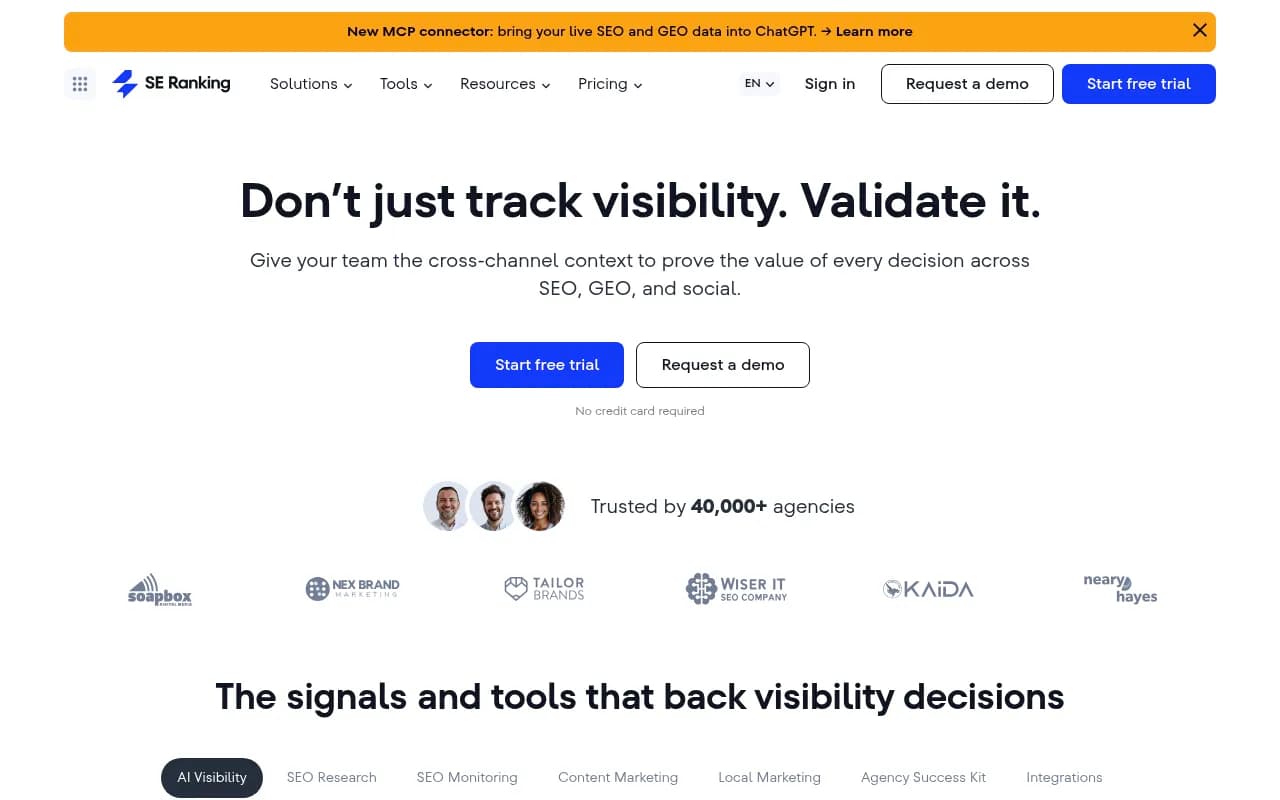
Geoptie offers 24 read and 24 write tools, 120 requests/min per key and no monthly cap, with keys you can scope to a single brand. MCP and API start at $99/mo. The scoped keys are nice for agencies. Since it wrote the comparison above, weigh the claims accordingly.
How to choose
Start from the workflow, not the feature list.
- Name the job. Nightly export to a warehouse? Ask-your-data in Claude? Auto-publishing content? Each points to a different tool.
- Do the quota math. Multiply clients by dashboards by refresh frequency. Compare to the monthly or per-minute cap.
- Check who connects it. If a marketer without a terminal needs it, you want OAuth. If an engineer owns it, an API key is fine.
- Look for scoped keys. Read-only keys limit damage if something leaks or an agent misbehaves.
- Decide whether you need action, not just data. If the output of your workflow is "publish a page" or "fix a crawl error", pick a platform that does that.
For browsing more options, the GEO software directory lists many of these side by side.
Security notes before you wire an agent into your stack
MCP is young. Equixly's March 2025 assessment, cited by Merge, found command injection flaws in 43% of tested MCP implementations, with 30% vulnerable to SSRF and 22% allowing arbitrary file access. That is dated and covers implementations in general, not the vendors above. Still, it's a good reason to be careful.
Practical rules:
- Start read-only. Add write scopes only for a specific job.
- One key per workflow, so you can revoke without breaking everything.
- Don't paste keys into shared prompts or repos.
- If you plan to let agents take actions across many systems, a gateway such as Arcade.dev adds delegated user auth, per-action policy and audit evidence. It has a free tier and Team at $25/month plus usage.
What the data says about product pages
Ranketta's bet is that product data matters, and Promptwatch Data supports the premise. In Promptwatch's report on ChatGPT citation share by content type (Sep 28 to Oct 4, 2026), product pages were the most cited type at 22.4% of classified citations, followed by landing pages at 16.8% and listicles at 13.6%. For commercial prompts, product pages reached 26.0%. So if you sell things, product content is worth fixing. The open question is whether you fix it with a specialist feed tool, an all-round visibility platform, or both.
A sensible setup for most teams
If you run an online store and Ranketta's product rewriting is working, keep it. Add a second tool for the workflow layer: something with a documented API and MCP, so reporting and automation don't depend on a dashboard login. For solo operators on a budget, ZeroRank is the cheap test. For teams that want monitoring, content creation, crawler logs and publishing in one loop, Promptwatch is the one I'd trial first, since the 7-day free trial costs nothing and you can test the MCP server on day one.
And email Ranketta. If they have an API or MCP in beta, you may not need to switch at all.