Key takeaways
- Searchable is a niche AI search visibility tool with limited public pricing transparency, making direct tier comparisons harder than with most competitors
- The platform covers basic brand monitoring across AI engines but lacks content generation, crawler logs, and prompt volume data that more complete platforms offer
- For small teams just starting with AI visibility, the entry price may be acceptable -- but you'll likely hit the ceiling fast
- Several alternatives at similar or lower price points offer meaningfully more capability, especially if you need to act on the data, not just view it
- If your goal is to improve AI visibility (not just measure it), the tool you choose needs to go beyond monitoring
Pricing pages for AI visibility tools have gotten... creative. You see terms like "AI search monitoring," "brand mentions," and "citation tracking" scattered across tiers, and it's genuinely hard to tell what you're actually buying. Searchable is no exception.
This guide cuts through that. We'll look at what Searchable's pricing structure actually delivers at each level, where the gaps are, and how it stacks up against other tools in the same space. If you're deciding whether to spend money here, this should help you decide.
What Searchable is (and what it's trying to do)
Searchable sits in the AI search visibility category -- tools that track how your brand appears in AI-generated responses from engines like ChatGPT, Perplexity, Google AI Overviews, and Gemini.
The core pitch is straightforward: you set up your brand and some tracked prompts, and the tool shows you whether you're being cited, how often, and by which AI models. That's useful information. The question is always what you can do with it.
Searchable positions itself as accessible and easy to set up -- a reasonable pitch for smaller teams who don't want to navigate an enterprise platform. But "easy to set up" and "actually moves the needle" aren't the same thing.
Searchable's pricing tiers: what you get
Searchable doesn't publish fully transparent pricing in the way that, say, Promptwatch does (where $99/mo, $249/mo, and $579/mo tiers are clearly documented with specific prompt counts and feature breakdowns). Searchable's pricing tends to surface through demos and sales conversations, which is itself a signal worth noting -- it usually means pricing is flexible, but it also means you can't easily compare without talking to someone.
Based on available information, Searchable operates across roughly three tiers:
Entry-level tier
The entry plan covers basic brand monitoring across a handful of AI models. You can track a limited set of prompts, see whether your brand is mentioned in responses, and get some basic reporting. There's no content generation, no crawler log access, and limited competitor comparison.
Who this works for: teams that genuinely just want to know "are we showing up in ChatGPT?" and nothing else. If that's the whole question, this tier answers it.
Who this doesn't work for: anyone who wants to know why they're not showing up, or what to do about it.
Mid-tier
The middle plan typically adds more tracked prompts, more AI models, and some form of competitive benchmarking. You can see how your brand compares to competitors across different AI engines, which is genuinely useful context.
The gap here is still the action layer. Knowing that a competitor is cited more than you in Perplexity is interesting. Knowing which specific content gaps are causing that, and having tools to close them, is what actually changes the outcome. Most mid-tier plans from monitoring-focused tools stop at the interesting part.
Enterprise / custom tier
At the top end, Searchable offers custom pricing for larger teams and agencies. This typically includes more sites, more prompts, white-labeling for agencies, and dedicated support.
Custom pricing is fine, but it makes budget planning harder. You're committing to a conversation before you know whether the product fits.
The real cost question: monitoring vs. optimization
Here's the thing about AI visibility pricing in 2026 -- the sticker price is only part of the story. The more important question is: what does it cost you to not be able to act on the data?
A monitoring-only tool at $200/month sounds reasonable. But if it shows you that competitors are outranking you in AI responses and gives you no path to fix it, you're paying for a dashboard that makes you feel informed while the gap stays open.
The tools that justify their price are the ones that close the loop: find the gap, create the content, track the improvement.
This is a real tension in how AI visibility tools are priced right now. Most are priced like monitoring dashboards because that's what they are. A few are priced like optimization platforms because they actually do more.
How Searchable compares to alternatives
Let's be direct about the competitive landscape. Searchable is one of the smaller players in a category that now includes well-funded platforms with significantly broader feature sets.
| Tool | Prompt tracking | Content generation | Crawler logs | Reddit/YouTube | ChatGPT Shopping | Transparent pricing |
|---|---|---|---|---|---|---|
| Searchable | Yes | No | No | No | No | Partial |
| Otterly.AI | Yes | No | No | No | No | Yes |
| Peec AI | Yes | No | No | No | No | Yes |
| AthenaHQ | Yes | No | No | No | No | Partial |
| Promptwatch | Yes | Yes | Yes | Yes | Yes | Yes |
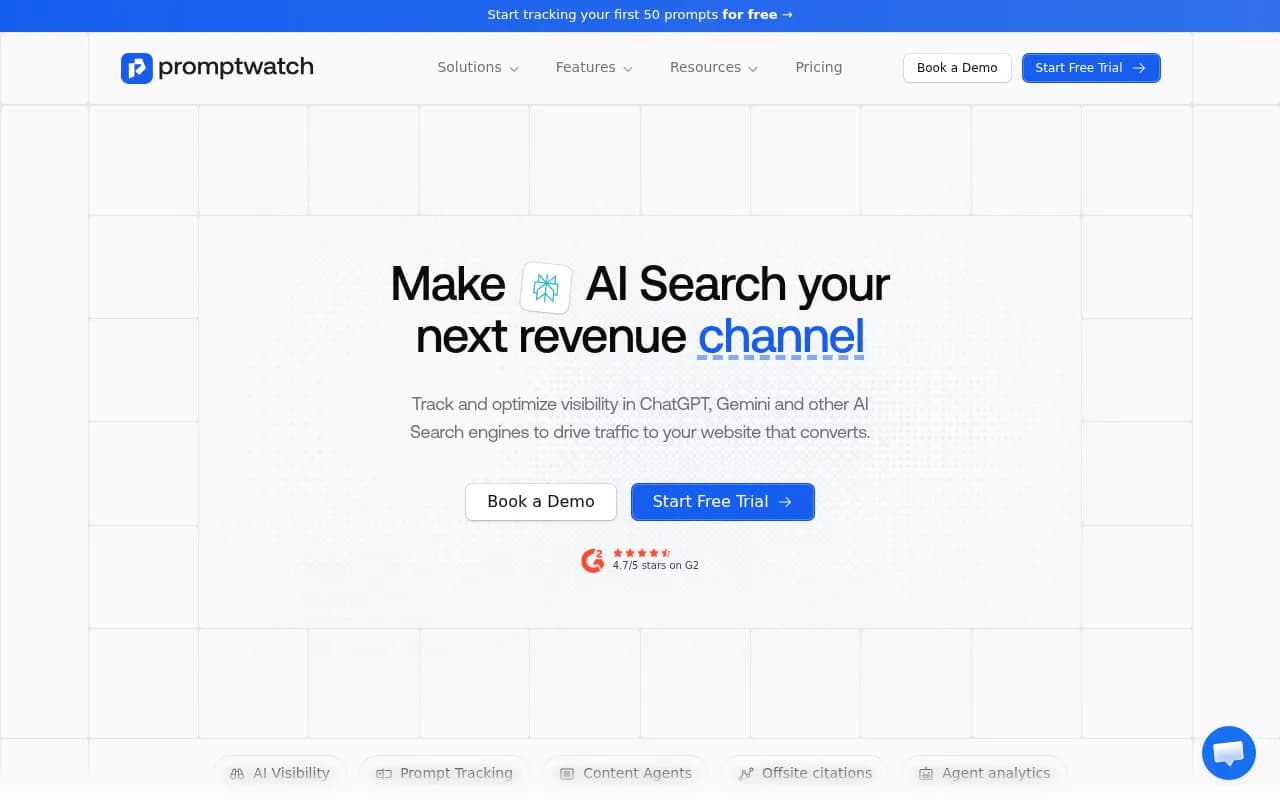
Promptwatch is the clearest example of what the full-stack version of this category looks like. It tracks prompts across 10 AI models, generates content based on answer gap analysis, logs AI crawler activity on your site, and tracks ChatGPT Shopping appearances. Pricing is public: $99/mo for the entry tier, $249/mo for professional, $579/mo for business.
That's not to say Searchable has no place. For a team that genuinely only needs basic monitoring and isn't ready to invest in optimization, a simpler tool might be the right starting point. But it's worth knowing what you're trading away.
Otterly.AI
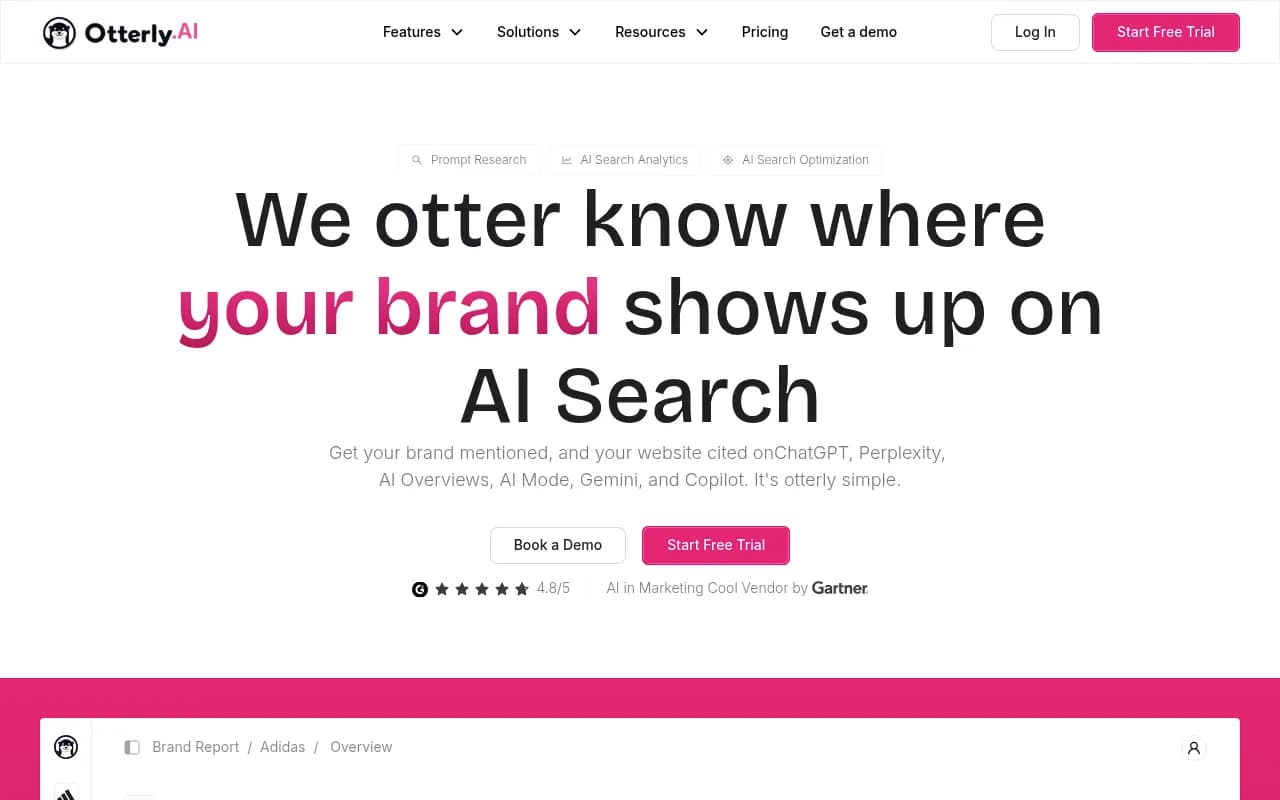
Otterly.AI is another monitoring-focused option with transparent pricing. It's affordable and easy to use, which makes it a reasonable starting point for small teams. Like Searchable, it doesn't offer content generation or crawler logs, but its pricing is clearly published, which makes budgeting easier.
Peec AI
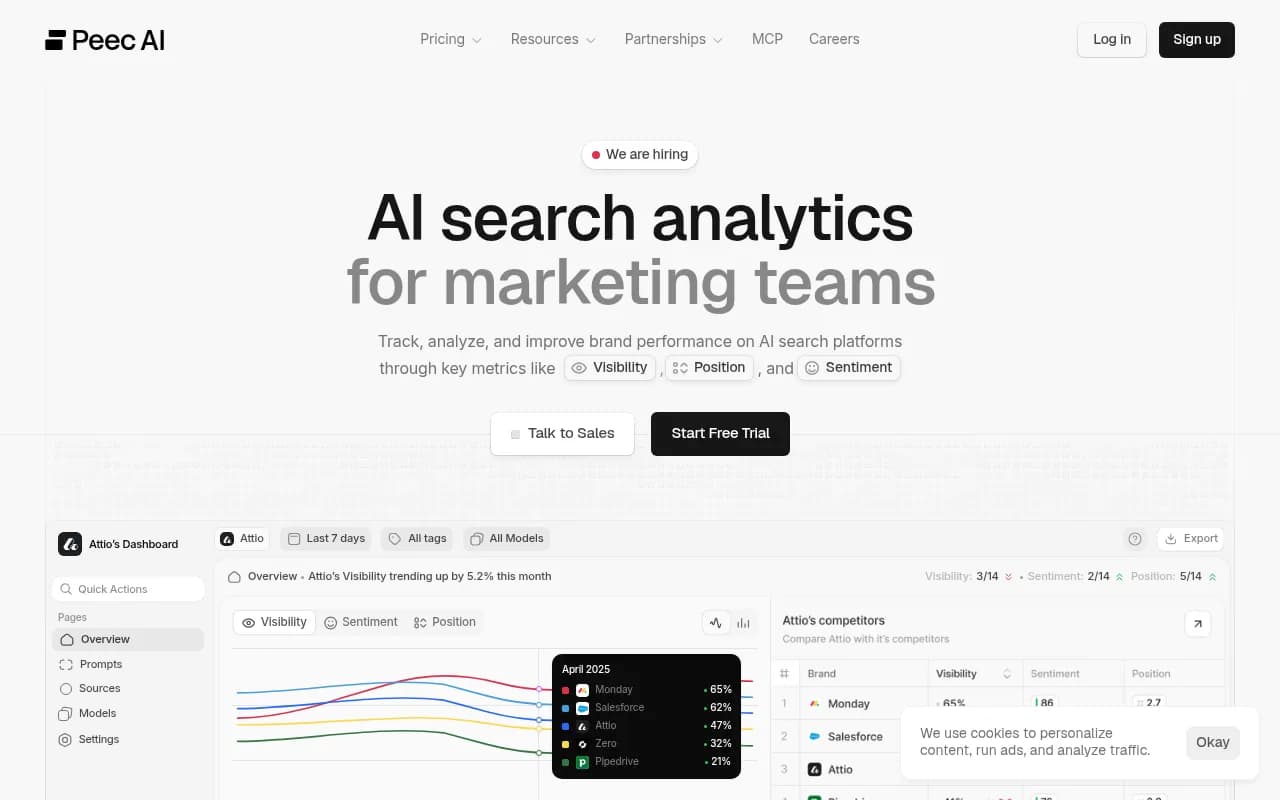
Peec AI sits in a similar space -- basic AI visibility tracking with a clean interface. It includes some smart suggestions for improving visibility, which is a step beyond pure monitoring. Still no content generation, but the suggestions layer is useful.
AthenaHQ
AthenaHQ is more enterprise-oriented and has a stronger analytics layer than Searchable. It's monitoring-focused but goes deeper on competitive analysis. The tradeoff is that it's more expensive and still doesn't help you create content.
Scrunch AI
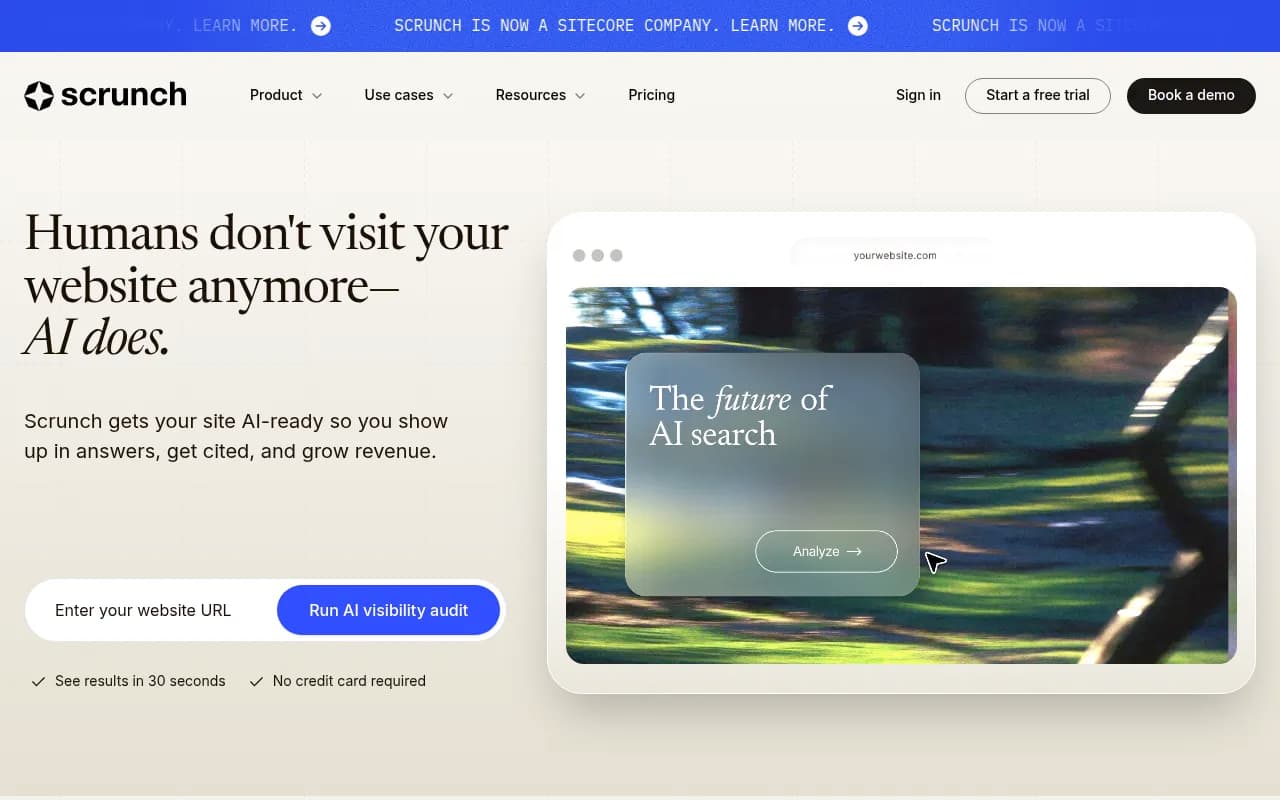
Scrunch AI is worth mentioning for agencies specifically. It has a solid multi-brand monitoring setup and is priced for agency use cases. Like most in this category, it's primarily a monitoring tool.
What to actually look for when evaluating pricing tiers
When you're comparing AI visibility tools, here's a practical checklist for evaluating whether a tier is worth the price:
Prompt volume and quality. How many prompts can you track? More importantly, are they prompts you define, or is the tool using fixed prompts that may not reflect how your customers actually search? Fixed prompts are a real limitation -- your customers don't all ask the same question the same way.
Which AI models are covered. A tool that only tracks ChatGPT and Google AI Overviews is missing Perplexity, Gemini, Claude, Grok, and others. In 2026, AI search is fragmented across many engines. Coverage matters.
Competitor visibility. Can you see how competitors are performing, not just your own brand? This context is what turns data into strategy.
Content gap analysis. Does the tool tell you what content you're missing -- the specific topics and questions AI models want answers to but can't find on your site? This is the difference between knowing you have a problem and knowing what to do about it.
Crawler logs. Can you see when AI crawlers like ChatGPT's GPTBot or Perplexity's PerplexityBot are hitting your site, which pages they're reading, and whether they're encountering errors? This is surprisingly rare among monitoring tools and genuinely useful for diagnosing why content isn't being cited.
Traffic attribution. Can you connect AI visibility to actual website traffic and revenue? Without this, you're optimizing for a metric that may or may not connect to business outcomes.
Transparent pricing. If you have to book a demo to find out what something costs, that's a friction point worth noting. It's not necessarily a dealbreaker, but it does make comparison harder.
The hidden cost of switching later
One thing that doesn't show up in pricing comparisons: the cost of migrating when you outgrow a tool.
If you start with a basic monitoring tool and then realize six months later that you need content generation and crawler logs, you're not just paying for a new tool -- you're also losing the historical data you built up, re-onboarding your team, and rebuilding your prompt tracking setup from scratch.
This is worth factoring in upfront. A tool that costs $50/month more but covers your needs for the next two years is cheaper than a tool that costs $50/month less but requires a platform switch in six months.
The AI visibility category is moving fast. Platforms that were monitoring-only a year ago are adding optimization features. Platforms that had optimization features are adding crawler logs and traffic attribution. If you're evaluating Searchable, ask yourself honestly: where will your needs be in 12 months, not just today?
Who Searchable makes sense for
To be fair about this: Searchable isn't a bad tool. It's a limited one. There's a real use case for it:
- Small teams or solo marketers who want a basic read on AI visibility without a complex setup
- Organizations that are just starting to think about AI search and want to understand the landscape before committing to a larger platform
- Teams where the primary question is "are we showing up at all?" rather than "how do we improve?"
If that's your situation, Searchable's entry tier is probably fine. You'll get useful data, and the learning curve is low.
But if you're a marketing team, SEO team, or agency that's serious about improving AI visibility -- not just measuring it -- you'll want a platform that can help you close the gaps it finds.
Alternatives worth considering at each price point
Budget-conscious options (under $100/month)
For teams that want basic AI visibility tracking without a large commitment, Otterly.AI and Peec AI are the most transparent options at this price point. Both publish their pricing, both cover the core monitoring use case, and both are easier to evaluate than tools that require a sales call.
Mid-range options ($100-300/month)
This is where the category gets interesting. Promptwatch's Essential tier at $99/month and Professional tier at $249/month cover significantly more ground than monitoring-only tools at similar prices -- including content generation, crawler logs (Professional), and prompt volume data. For teams that want to actually improve their AI visibility, this range is where the ROI math starts to work.
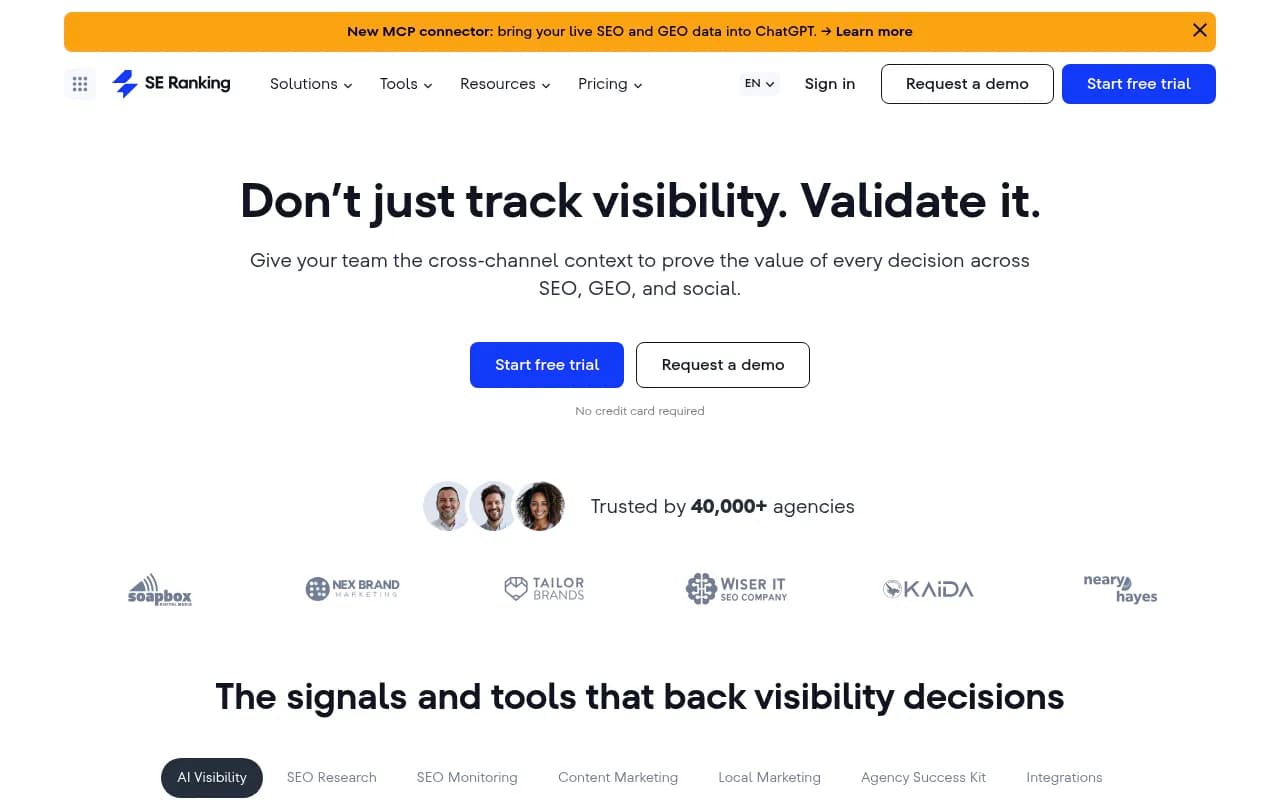
SE Ranking's AI visibility features are also worth considering if you're already using it for traditional SEO -- the integration reduces tool sprawl.
Enterprise options (custom pricing)
For large brands and agencies, Profound and BrightEdge both offer enterprise-grade AI visibility with strong analytics. Both require custom pricing conversations, but both have the depth to justify it for the right organization.
The bottom line on Searchable's pricing
Searchable's pricing is hard to evaluate precisely because it's not fully transparent -- which is itself a mild frustration when you're trying to make a budget decision. What's clear from the feature set is that it's a monitoring tool, not an optimization platform.
If you're comparing it purely on price against other monitoring tools, it's competitive. If you're comparing it against what the category's best platforms can do, the gap is significant.
The question to ask yourself isn't "is Searchable affordable?" It's "does Searchable get me to the outcome I actually need?" For most marketing and SEO teams in 2026, that outcome isn't knowing your AI visibility score -- it's improving it. A tool that only does the former will leave you with good data and no clear path forward.
For teams ready to move beyond monitoring, Promptwatch is the most complete option in the category right now, with transparent pricing and a clear path from gap identification to content creation to citation tracking.