Key takeaways
- Searchable and Evertune both sit at the high end of the AI visibility market, with pricing and feature sets aimed squarely at enterprise brand teams.
- Evertune starts at $3,000/month and leans heavily into statistical rigor, brand perception tracking, and a unique AI Advertising layer that converts visibility data into paid campaigns.
- Searchable is positioned as a monitoring-first platform with strong brand intelligence features, but has limited public information on content optimization capabilities.
- Neither platform is a strong fit for teams below the Fortune 500 line -- the entry price alone rules out most mid-market buyers.
- For teams that need to go beyond monitoring and actually fix their AI visibility gaps, there are platforms better suited to the full optimization cycle.
Why this comparison matters in 2026
AI search isn't a trend anymore. ChatGPT, Perplexity, Google AI Overviews, Claude, and Gemini are now the first stop for millions of purchase decisions, research queries, and brand comparisons. If your brand isn't being cited in those answers, you're losing ground to competitors who are -- and traditional SEO rankings won't tell you why.
That's created a new category of enterprise software: AI visibility platforms. And two names that come up repeatedly in Fortune 500 conversations are Searchable and Evertune. Both pitch themselves as the serious, enterprise-grade option. Both have real clients. Both cost serious money.
But they're not the same product, and the differences matter depending on what your team actually needs.
This guide breaks down what each platform does, where each one excels, where each one falls short, and what questions to ask before you sign anything.
What Searchable does
Searchable is an AI brand visibility platform built for large organizations that need to track how their brand appears across AI-generated answers at scale. The core value proposition is monitoring: run a large set of prompts across multiple AI models, see where your brand appears, track share-of-voice against competitors, and get alerts when something changes.
The platform targets enterprise marketing and brand teams that are managing visibility across multiple markets, product lines, or regions. It's designed to give executives a dashboard view of AI brand presence -- the kind of reporting that goes into a quarterly brand health review.
Where Searchable is strong:
- Brand mention tracking across major AI models
- Competitor share-of-voice comparisons
- Multi-market and multi-language monitoring
- Executive-level reporting and dashboards
Where Searchable is less clear:
- Content optimization and gap analysis capabilities are limited in public documentation
- No widely documented AI crawler log access
- Content generation features are not a core part of the product pitch
- Pricing is enterprise-negotiated, which makes it hard to evaluate ROI before a sales call
The honest summary: Searchable is a solid monitoring platform for teams that need to know where they stand. It's less useful for teams that need to act on what they find.
What Evertune does
Evertune has a more distinctive positioning. According to its own published materials, it's "built on visibility" -- meaning the platform uses AI visibility data as the foundation for advertising strategy, not just reporting.
The headline differentiator is AI Advertising: Evertune takes what it learns about how AI models perceive your brand and turns that into paid advertising campaigns. The idea is that if AI models are forming opinions about your brand based on certain signals, you can use paid media to reinforce or correct those signals. That's a genuinely different angle from most competitors.
Evertune also emphasizes statistical rigor. Multiple independent reviews note that the platform is designed for teams that want confidence intervals and methodology documentation, not just a dashboard number. For regulated industries or large organizations with internal research standards, that matters.
Starting price is $3,000/month, which one independent review noted "filters out most teams below the Fortune 500 line." That's not a criticism -- it's just the reality of who the product is built for.
Where Evertune is strong:
- Statistical methodology and data confidence for enterprise research teams
- AI Advertising integration -- turning visibility data into paid campaigns
- Brand perception tracking at scale
- Depth of analysis for teams that need to defend their numbers internally
Where Evertune is less clear:
- Content optimization and gap analysis are not prominently featured
- The AI Advertising angle is interesting but adds complexity -- teams need paid media infrastructure to use it
- At $3,000/month entry, the cost-to-value calculation is high-stakes
Head-to-head comparison
| Feature | Searchable | Evertune |
|---|---|---|
| Starting price | Enterprise (custom) | ~$3,000/month |
| Target buyer | Fortune 500 brand teams | Fortune 500 brand + media teams |
| AI model coverage | Multiple models | Multiple models |
| Brand monitoring | Yes | Yes |
| Competitor share-of-voice | Yes | Yes |
| Statistical rigor / methodology | Not prominently documented | Core differentiator |
| AI Advertising integration | No | Yes (unique feature) |
| Content gap analysis | Limited | Limited |
| Content generation | Not documented | Not documented |
| AI crawler logs | Not documented | Not documented |
| Reddit / YouTube tracking | Not documented | Not documented |
| Multi-language / multi-region | Yes | Yes |
| Free trial | Not standard | Not standard |
| Best for | Brand monitoring at scale | Brand perception + paid media strategy |
The table tells a clear story: both platforms are strong at monitoring and brand intelligence. Neither is built around the optimization loop -- finding gaps, creating content to fill them, and tracking whether it worked.
The monitoring-only problem
This is worth spending a moment on, because it affects both platforms.
Knowing that your brand appears in 23% of relevant AI responses is useful. Knowing that a competitor appears in 61% is alarming. But neither number tells you what to do next.
The platforms that are pulling ahead in 2026 are the ones that close that loop -- they show you the specific prompts where competitors are visible and you're not, generate content briefs or full articles targeting those gaps, and then track whether the new content starts getting cited. That's a fundamentally different product from a monitoring dashboard, even a very good one.
Searchable and Evertune are both monitoring-first. Evertune's AI Advertising angle is a creative workaround -- use paid media to influence AI perception -- but it's not the same as fixing the underlying content gaps that cause AI models to ignore your brand in the first place.
For teams that want to actually move the needle on AI visibility, not just measure it, there are platforms built specifically around that workflow.
Promptwatch is one example worth looking at. It's built around what it calls an action loop: Answer Gap Analysis shows exactly which prompts competitors are visible for but you're not, Content Agents generate articles and briefs grounded in real prompt data, and page-level tracking shows whether the new content starts getting cited. It's a different philosophy from Searchable or Evertune -- less about brand perception reporting, more about fixing the gaps.
That's not to say Searchable or Evertune are wrong for every team. If your primary need is executive-level brand health reporting or integrating AI visibility data into a paid media strategy, they're worth evaluating. But if your team is asking "what do we actually do to get cited more?" -- monitoring alone won't answer that.
Who should consider Searchable
Searchable makes sense for large brand teams whose primary deliverable is reporting. If you're running quarterly brand health reviews, tracking AI share-of-voice across product lines, or need a platform that integrates into an enterprise data stack, Searchable fits that brief.
It's also a reasonable choice if your organization is in an early stage of AI visibility measurement -- you need to establish a baseline before you can optimize. Monitoring-first makes sense when you don't yet know what you're working with.
The caution: if your team is eventually going to need to act on the data, make sure you understand what that workflow looks like before signing. Monitoring platforms can become expensive dashboards that generate reports nobody acts on.
Who should consider Evertune
Evertune is the more interesting product for teams that have both a brand function and a paid media function, and want those two things to talk to each other. The AI Advertising integration is genuinely novel -- no other platform in this category does it -- and for teams with the media budget to use it, it could be a real differentiator.
The statistical rigor angle also matters for specific contexts. If you're in a regulated industry, or if your internal research team will scrutinize the methodology behind your AI visibility numbers, Evertune's documentation of its statistical approach is a real advantage over platforms that just show you a percentage.
The caution: $3,000/month is a significant commitment, and the AI Advertising feature only delivers value if you have the paid media infrastructure and budget to act on it. If you're buying Evertune primarily for monitoring and the advertising integration is a "nice to have," you're probably overpaying.
Other enterprise options worth knowing about
Searchable and Evertune aren't the only enterprise-grade options. A few others that come up in the same conversations:
Profound is the most-funded platform in the category ($155M raised, $1B valuation) and is widely considered the enterprise leader for pure AI visibility analytics. It has Fortune 500 clients and deep feature coverage, though pricing is similarly enterprise-negotiated.
Scrunch AI is another enterprise-focused platform with a strong reputation in regulated industries.
AthenaHQ targets enterprise monitoring with a clean interface, though like Searchable and Evertune, it's primarily a monitoring platform without deep content optimization.
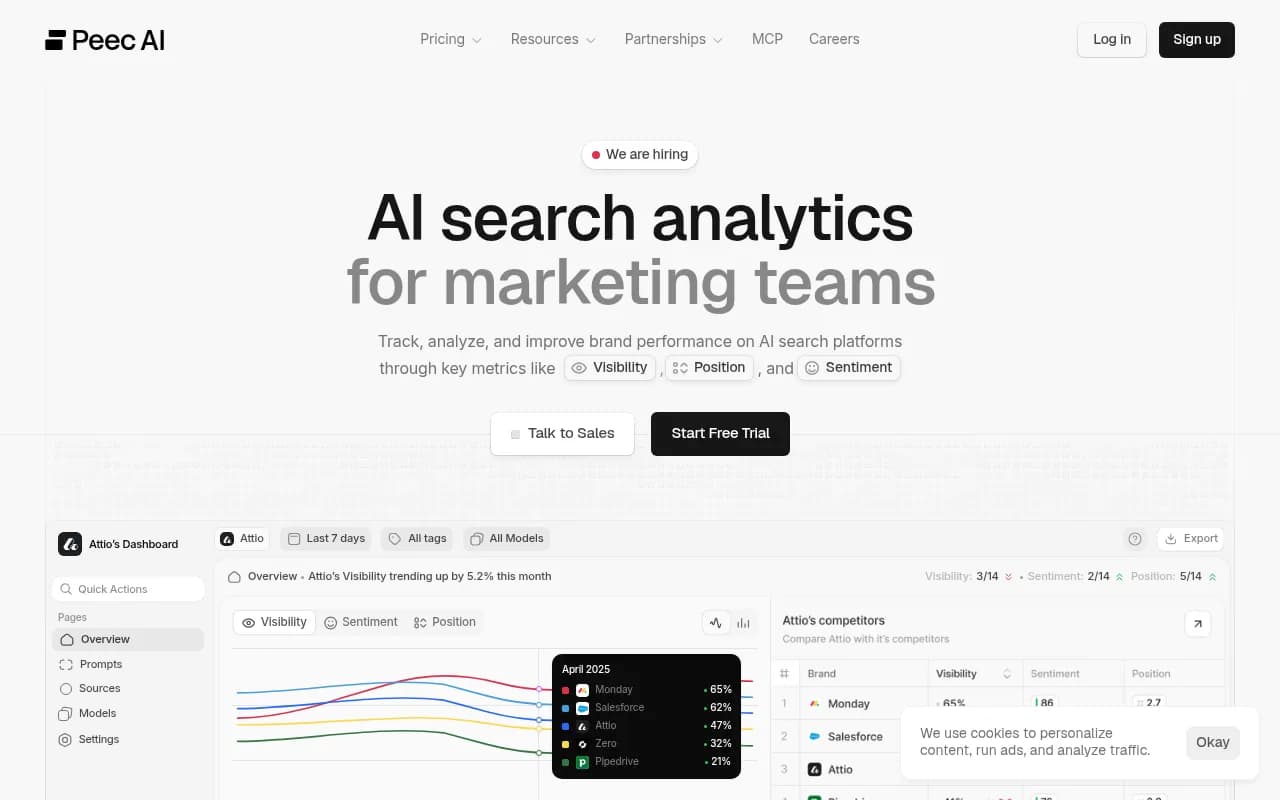
For teams that want broader coverage of the market before committing to an enterprise contract, mid-market platforms like Peec AI offer serious analytics at a fraction of the price.
And for agencies managing multiple clients across the AI visibility space, Search Party is worth a look.
Questions to ask before you buy either platform
If you're evaluating Searchable or Evertune (or any enterprise AI visibility platform), these are the questions that will save you from a bad contract:
On coverage: Which AI models does the platform actually monitor? "Multiple models" can mean ChatGPT only, or it can mean ten models including Perplexity, Gemini, Claude, Grok, and DeepSeek. Get a specific list.
On prompt methodology: How are prompts selected? Fixed prompts give you consistent data but miss the long tail of how real users actually query. Platforms that track real user prompt patterns give you more actionable data.
On content optimization: What does the platform tell you to do when your visibility is low? If the answer is "here's a report," that's a monitoring tool. If the answer involves specific content recommendations or gap analysis, that's an optimization tool.
On attribution: Can the platform connect AI visibility to actual traffic or revenue? This is where most enterprise platforms fall short. Knowing your brand appears in AI answers is useful; knowing that AI citations are driving conversions is what justifies the budget.
On AI crawler logs: Does the platform show you when AI crawlers are visiting your site, which pages they're reading, and whether those pages are getting cited? This is a relatively new capability but increasingly important for understanding why some content gets cited and some doesn't.
On contract terms: Enterprise AI visibility is a fast-moving space. A two-year contract signed today might lock you into a platform that's been lapped by competitors in six months. Push for shorter initial terms or meaningful exit clauses.
The broader picture
The AI visibility tools market raised over $300 million between mid-2025 and spring 2026. That money is going into a category that didn't exist three years ago, and the platforms are still figuring out what enterprise buyers actually need.
Searchable and Evertune are both real products with real clients. They're not vaporware. But the category is splitting into two camps: monitoring platforms that show you data, and optimization platforms that help you act on it. Both Searchable and Evertune sit firmly in the first camp.
That's fine if monitoring is what you need. It's a problem if you're expecting the platform to help you actually improve your AI visibility -- because neither platform is primarily built for that.
The teams winning at AI search in 2026 aren't just the ones with the best dashboards. They're the ones who found the gaps, created content to fill them, and tracked the results. Whatever platform you choose, make sure it can support that cycle -- or at least doesn't get in the way of it.