Open Forge AI Review 2026
Open Forge AI tracks brand and competitor visibility across AI search engines, translates gaps into plain-English next steps, and ships the fixes through a platform of AI agents.

Key takeaways
- Open Forge AI is a genuine all-in-one attempt at AI visibility: it monitors brand mentions, tracks competitors, and then uses named AI agents (Helix, Phoenix, Apex, Orion) to actually build citations, refresh content, and execute fixes rather than just reporting numbers.
- Pricing is simpler than most competitors: $149/month per rooftop for local businesses, $399/month for online brands, with unlimited users, unlimited agent usage, and month-to-month billing. No free trial, though, and onboarding is demo-gated.
- The platform is bootstrapped and early-stage. There are no independent reviews on G2, Capterra, or Trustpilot, no public API documentation, and only four tracked AI surfaces (ChatGPT, Perplexity, Claude, Google AI Overviews) that we could confirm.
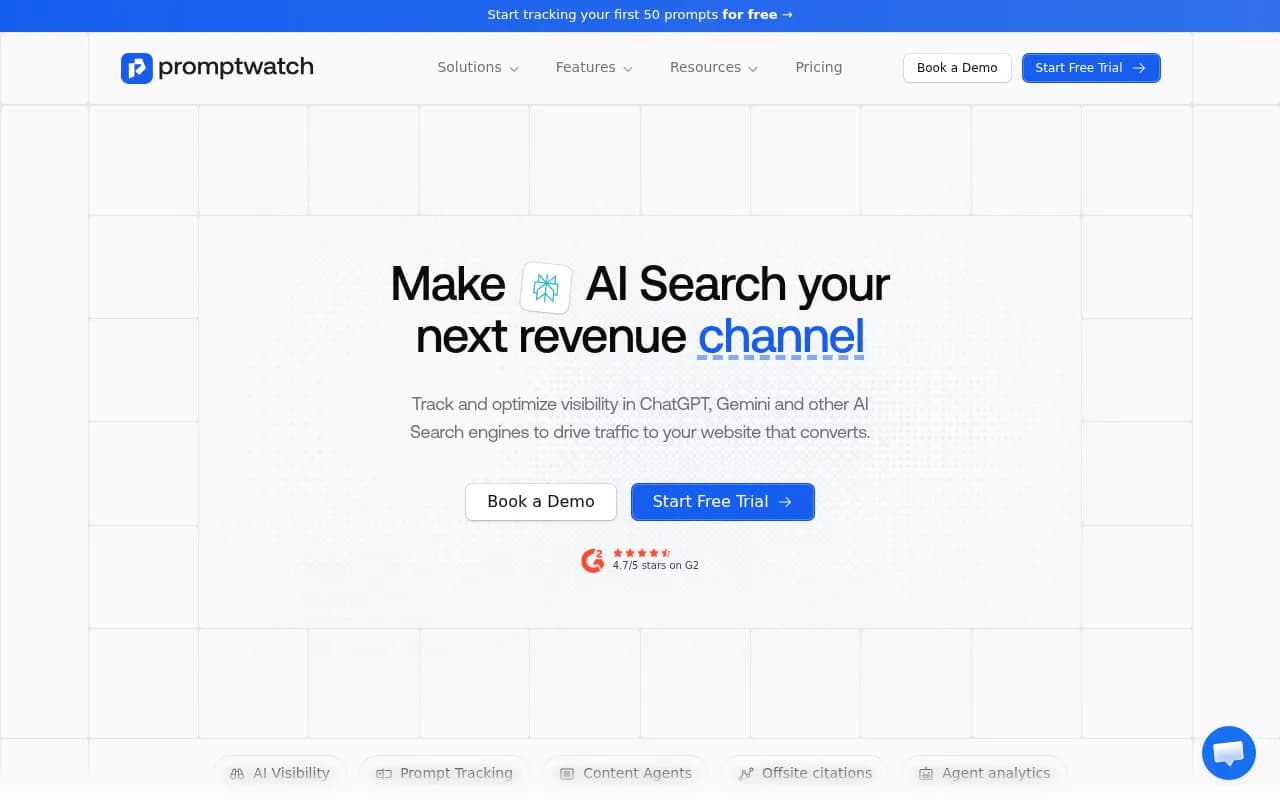
- Compared with Promptwatch, Open Forge lacks AI crawler logs, Reddit and YouTube citation tracking, ChatGPT Shopping and Ads Radar, prompt volume and difficulty scoring, query fan-outs, and CMS publishing to Webflow, Framer, and WordPress. Promptwatch also covers 10+ AI models versus Open Forge's confirmed four.
- Best fit: small-to-midsize marketing teams and local businesses that want a hands-on vendor with white-glove onboarding and don't need enterprise-scale data.
What Open Forge AI actually does
Open Forge sits in the crowded AI brand visibility space, but its pitch has a slightly different shape than most. The homepage frames it as "track AI visibility, get the action plan, ship the fixes," and the product genuinely tries to cover that full loop rather than stopping at a dashboard.
The monitoring side covers the basics: brand mention tracking, sentiment analysis, competitor citation tracking, share of voice, visibility mapping, and content gap identification across AI search engines. Third-party breakdowns (Graphite's AEO tools research) confirm it tracks ChatGPT, Perplexity, Claude, and Google AI Overviews, and includes some technical extras that competitors often skip, like a JSON-LD generator and an LLMs.txt creator. There's also an ICP simulator for modeling how ideal customer profiles interact with AI search, which is a nice touch for B2B teams.
The execution side is where Open Forge puts its weight. Four named agents handle specific jobs: Helix secures third-party citations, Phoenix refreshes old content, Apex creates AI-optimized content for topics your audience searches, and Orion targets competitive queries. There's a workflow builder for custom automations (the site's example is pushing content to your CMS daily), a chat interface for strategizing against your data, MCP support, Google Analytics integration, social listening, and API access. It's an ambitious feature set for a bootstrapped team.
Pricing
Open Forge's pricing is unusually straightforward for this category:
- Local & brick-and-mortar: $149/month per rooftop, with white-glove onboarding, unlimited agent usage, unlimited users, and multi-location tracking.
- Online brands & businesses: $399/month, plus a sliding scale for additional brands. Adds unlimited query tracking, an ICP simulator, and custom dashboards.
- Growth Cannon Data Platform: $3,999/month for analyzing thousands of businesses at scale, aimed at agencies sending AI visibility audits to prospects.
- Managed service: $4,999/month for done-for-you AEO with a dedicated operator.
Month-to-month billing, no long-term commitment, unlimited team seats at no extra cost. That's a refreshing change from the seat-based pricing that punishes collaborative teams elsewhere in this market. The catch: there's no free trial, and you'll need to request a demo to get started. Third-party sources have also listed entry pricing anywhere from $199 to $399 over time, which suggests pricing has shifted, so confirm current numbers before budgeting.
Who it's for
The customer base skews toward small and midsize teams. Testimonials come from local businesses (Grade Potential tutoring, Resident Company Club), agencies managing client visibility (Helium SEO, Full Funnel Growth, PlayerCoach), and B2B SaaS companies (Quilter AI, Cobu, Concept3D, AppViewX). The "direct line to the founders" promise and white-glove onboarding signal a vendor that wins on service rather than scale. If you're a solo marketer or a small agency that wants a responsive vendor and doesn't need deep data infrastructure, that's a real advantage.
Strengths
The execution loop is the strongest thing here. Most tools in this space show you a visibility score and wish you luck. Open Forge's agents actually build citation-ready content, refresh stale pages, and pursue competitor gaps, and the workflow builder can automate that on a schedule. The unlimited-usage model (agents, content, users) removes the anxiety of metered pricing that plagues almost every competitor.
The bootstrapped, customer-funded positioning also means something. Founders Jason Patel and Lucas Jones are visibly involved, answering support questions and hopping on calls. For teams burned by venture-backed tools that pivoted or repriced, that stability has value.
Limitations
Be honest with yourself about the gaps. The biggest one is validation: there are no independent reviews on G2, Capterra, or Trustpilot. Every testimonial on the site is vendor-selected, including the impressive-sounding "243.3% increase in ChatGPT-attributable direct traffic" from Quilter AI. Maybe it's accurate, but you have no way to verify it, and the platform is too young to have earned the benefit of the doubt.
The data layer is thin where it matters. Compared with what Promptwatch offers, Open Forge is missing AI crawler logs (seeing when ChatGPTBot or ClaudeBot actually visits your pages and what errors they hit), Reddit and YouTube citation tracking, ChatGPT Shopping and Ads Radar, prompt volume and difficulty scoring, query fan-outs, and page-level citation analytics. Promptwatch's dataset spans more than 4.5 billion analyzed citations and covers 10+ AI models including Grok, DeepSeek, Copilot, Mistral, and Google AI Mode; Open Forge's confirmed coverage is four surfaces. If your strategy depends on understanding why you're invisible, not just that you're invisible, that difference compounds.
There's no public API or integration documentation either, despite the site advertising API access. Authoritas explicitly flagged this gap. And no free trial means you're buying on faith after a sales demo.
Bottom line
Open Forge AI is a legitimate effort at closing the monitor-to-execute gap, and its pricing model is friendlier than most. For a local business or a small marketing team that wants a hands-on vendor and simple, unlimited usage, it's worth a demo. But it's an early-stage product with no independent validation, a narrow data foundation, and unverified performance claims. Teams that need to understand the mechanics behind their AI visibility, crawler-level insight, citation analytics across Reddit and YouTube, prompt intelligence, and coverage across the full model landscape, will get more from Promptwatch, which pairs monitoring with the same kind of agentic execution Open Forge promises, on top of a much deeper dataset.
Frequently asked questions
What is Open Forge AI?
How much does Open Forge AI cost?
Does Open Forge AI offer a free trial?
Which AI search engines does Open Forge AI track?
Is Open Forge AI a good alternative to Promptwatch?
Similar and alternative tools to Open Forge AI