Key takeaways
- Best for end-to-end AI visibility + content action: Promptwatch — tracks citations across 10 AI engines, generates content from real gap data, and includes crawler logs. Starts at $99/mo.
- Best for content research + GEO optimization on a budget: Frase — strong brief and editor workflow, now with AI search tracking. From $39/mo.
- Best for traditional SEO teams adding AI visibility: Surfer SEO — mature content editor, now expanding into AI visibility. From ~$99/mo.
- Best for enterprise content quality control: Clearscope — clean, focused editor trusted by Intuit, Adobe, and Shopify. From ~$170/mo.
- Best for agencies managing multiple clients: Rankability — unlimited clients and users on all plans, built specifically for agency workflows. From $99/mo.
- Best for AI writing at scale with brand governance: Jasper or Writer — if your primary need is generating on-brand content fast, not tracking AI visibility.
AirOps has carved out a real niche as a content workflow platform that bridges traditional SEO and AI search. It helps teams create content designed to get cited in ChatGPT, Perplexity, and Gemini, and it has solid case studies to back that up — Webflow, Chime, Ramp, and Carta are all on the customer list. The pitch is essentially: know where to act, then execute faster than anyone else.
But AirOps isn't the right fit for everyone. The pricing jumps sharply from a free Insights tier to $200/mo for Solo and $2,000/mo for Pro, which puts the full feature set out of reach for smaller teams. Some users find the workflow-builder approach more complex than they need. And if your primary goal is monitoring AI visibility rather than building content pipelines, there are more focused tools that do that job better.
Here's a look at the strongest alternatives, what each one actually does well, and where they fall short.
Promptwatch
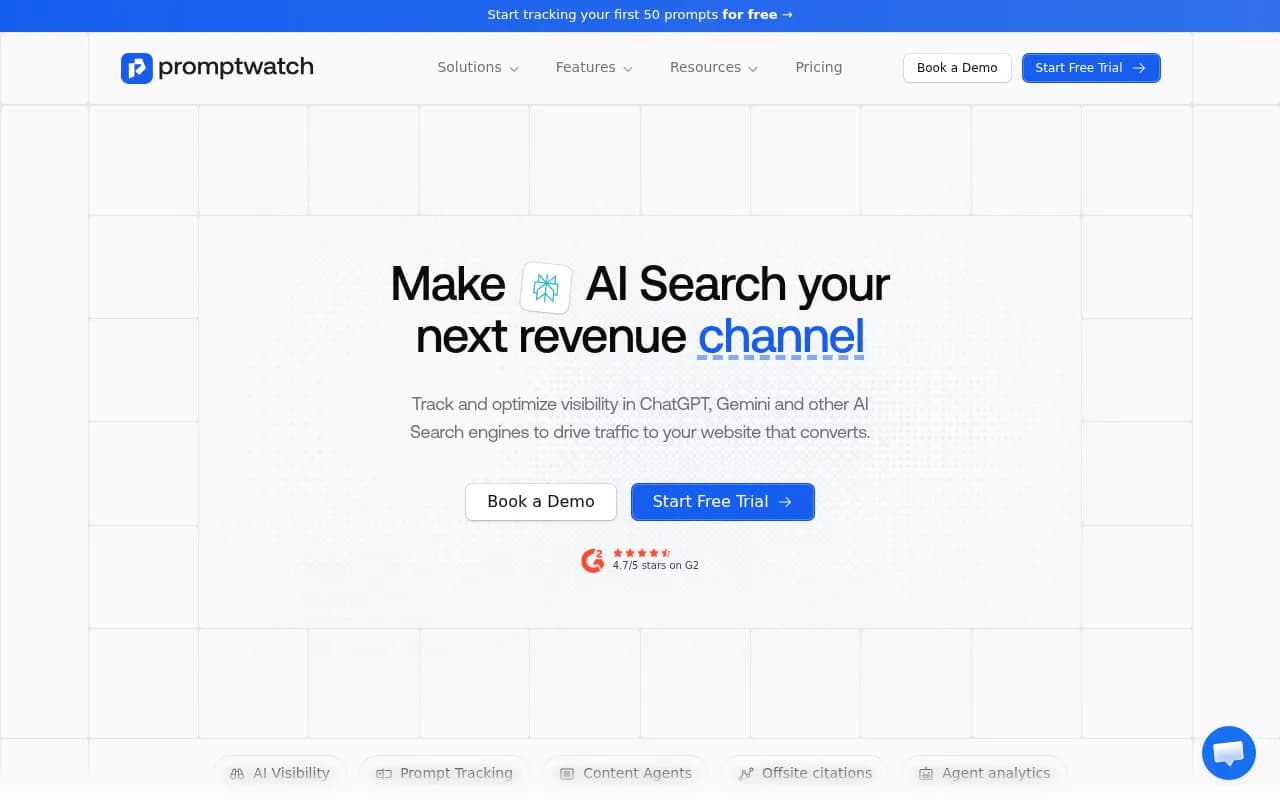
If AirOps is primarily a content production platform that also tracks AI visibility, Promptwatch is the opposite: it starts with deep AI visibility data and then helps you act on it. The distinction matters more than it sounds.
Promptwatch tracks how your brand appears across 10 AI engines — ChatGPT, Perplexity, Claude, Gemini, Google AI Overviews, Google AI Mode, Grok, DeepSeek, Copilot, and Mistral. It monitors real user-facing responses, not just API outputs, which means the citation data reflects what people actually see. That's a meaningful difference when AI interfaces serve different answers than API calls return.
Where it goes beyond monitoring: the Answer Gap Analysis shows you exactly which prompts competitors appear in that you don't. Not vague topic suggestions — specific questions AI models are already answering with your competitors' content. From there, Content Agents generate articles, listicles, and comparison pages grounded in that gap data, with prompt volumes, persona targeting, and competitor analysis baked in.
The crawler log feature is something most competitors simply don't have. You can see when ChatGPT or Perplexity's crawlers hit your site, which pages they read, what errors they hit, and how long it takes a newly published page to go from crawl to citation. That feedback loop is genuinely useful for understanding whether your content strategy is working.
Compared to AirOps, Promptwatch is more focused on the visibility-and-optimization cycle and less on building complex multi-step content workflows. AirOps has a more elaborate pipeline builder; Promptwatch's content generation is more directly tied to gap data. If you want to know why you're not being cited and fix it systematically, Promptwatch is the stronger choice. If you need a full content operations platform with custom workflow automation, AirOps has more flexibility there.
Pricing: Free trial available. Essential $99/mo (1 site, 50 prompts, 5 articles), Professional $249/mo (2 sites, 150 prompts, 15 articles, crawler logs), Business $579/mo (5 sites, 350 prompts, 30 articles). Agency and enterprise pricing available.
Best for: Marketing and SEO teams that want to understand their AI search visibility, find content gaps, and generate content that actually closes those gaps — without paying AirOps Pro prices.
Frase
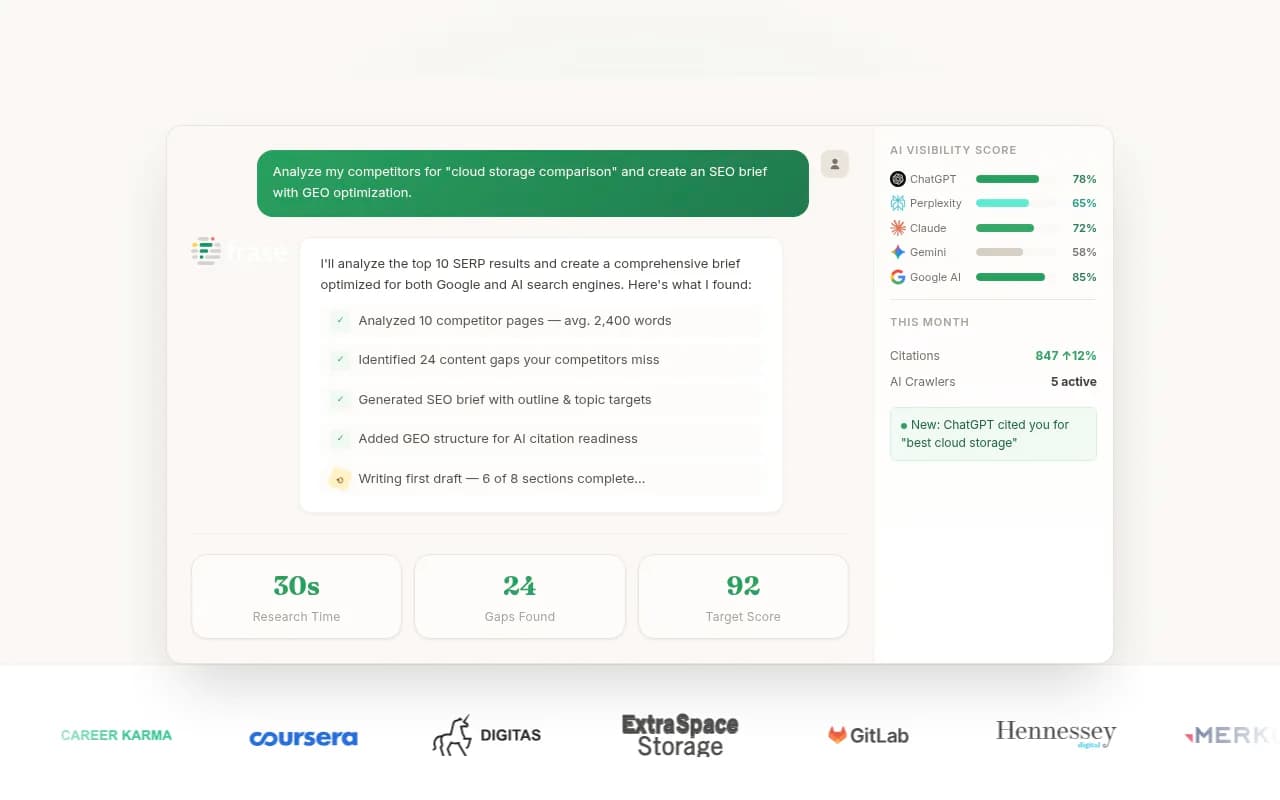
Frase has been a content research and optimization tool for years, and it's now positioning itself as an "agentic SEO and GEO platform." The core workflow is solid: research a topic, analyze what's ranking and what AI search surfaces, generate a brief, write and optimize in the editor. It's genuinely one of the more streamlined tools for going from blank page to published article.
The GEO angle is newer. Frase now tracks visibility across Google, ChatGPT, and Perplexity, and it claims to identify content gaps and tell you "exactly what to do next." In practice, the AI visibility tracking is less deep than dedicated GEO platforms — it doesn't cover as many AI engines as Promptwatch or AirOps, and the gap analysis is less granular. But for teams that primarily care about Google rankings and want AI search coverage as a secondary feature, Frase's all-in-one approach is genuinely convenient.
The pricing is the most accessible on this list. At $39/mo, you get a functional content research and writing workflow that would cost significantly more in AirOps. The trade-off is that Frase's AI visibility features feel like additions to an SEO tool rather than a purpose-built GEO platform.
Compared to AirOps specifically: Frase is simpler, cheaper, and more focused on the individual content piece. AirOps is better for teams that need to run content at scale with custom workflows and want deeper AI search analytics. Frase is better for content teams that want a capable research-to-publish workflow without the complexity.
Pricing: 7-day free trial, paid plans from $39/mo.
Best for: Content teams and individual SEOs who want a capable brief-to-publish workflow with basic AI visibility tracking, at a price that doesn't require budget approval.
Surfer SEO
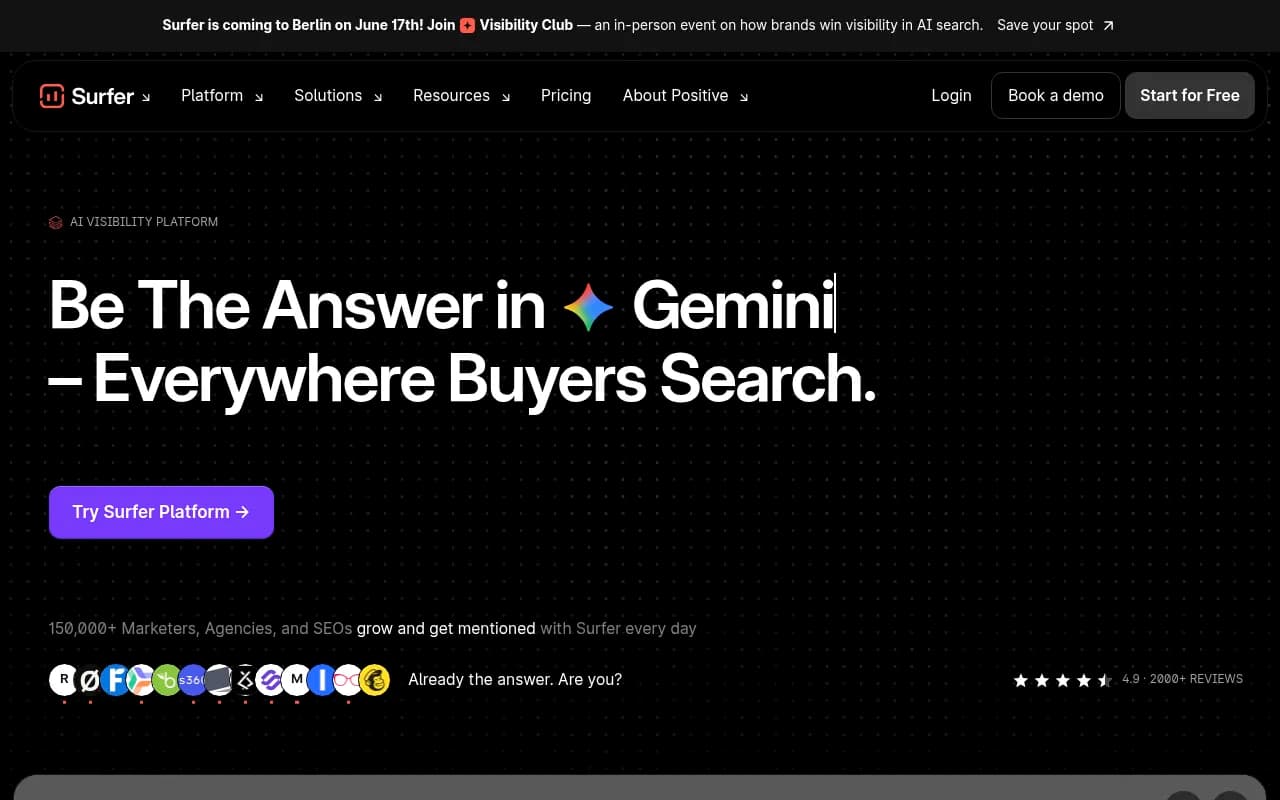
Surfer has been one of the go-to content optimization tools for SEO teams for several years, and it's now expanding into AI visibility. The content editor is genuinely good — it analyzes top-ranking pages, gives you a content score, and tells you which terms to include and how often. The feedback loop between writing and optimization is tight.
The AI visibility angle is newer for Surfer. It's now positioning itself as an "AI Visibility Platform" tracking Google and AI search engines like ChatGPT, Gemini, and Perplexity. The direction is clear, but the AI visibility features are less mature than dedicated GEO platforms. Surfer's strength is still in the content editor and on-page optimization, not in citation tracking or crawler analytics.
Where Surfer beats AirOps: the content editor is more polished and easier to use for writers who aren't technical. The optimization scoring is well-established and trusted by a large user base. If your team writes content and needs real-time optimization feedback, Surfer's editor is hard to beat.
Where it falls short: the AI visibility tracking doesn't go as deep as AirOps or Promptwatch. There's no crawler log, no prompt volume data, and the gap analysis is less actionable. It's a content optimization tool that's adding AI visibility, not the other way around.
Pricing: Free trial available, paid plans from ~$99/mo.
Best for: SEO teams and content writers who want a mature, well-tested content editor with optimization scoring, and are happy to use a separate tool for deeper AI visibility tracking.
Clearscope
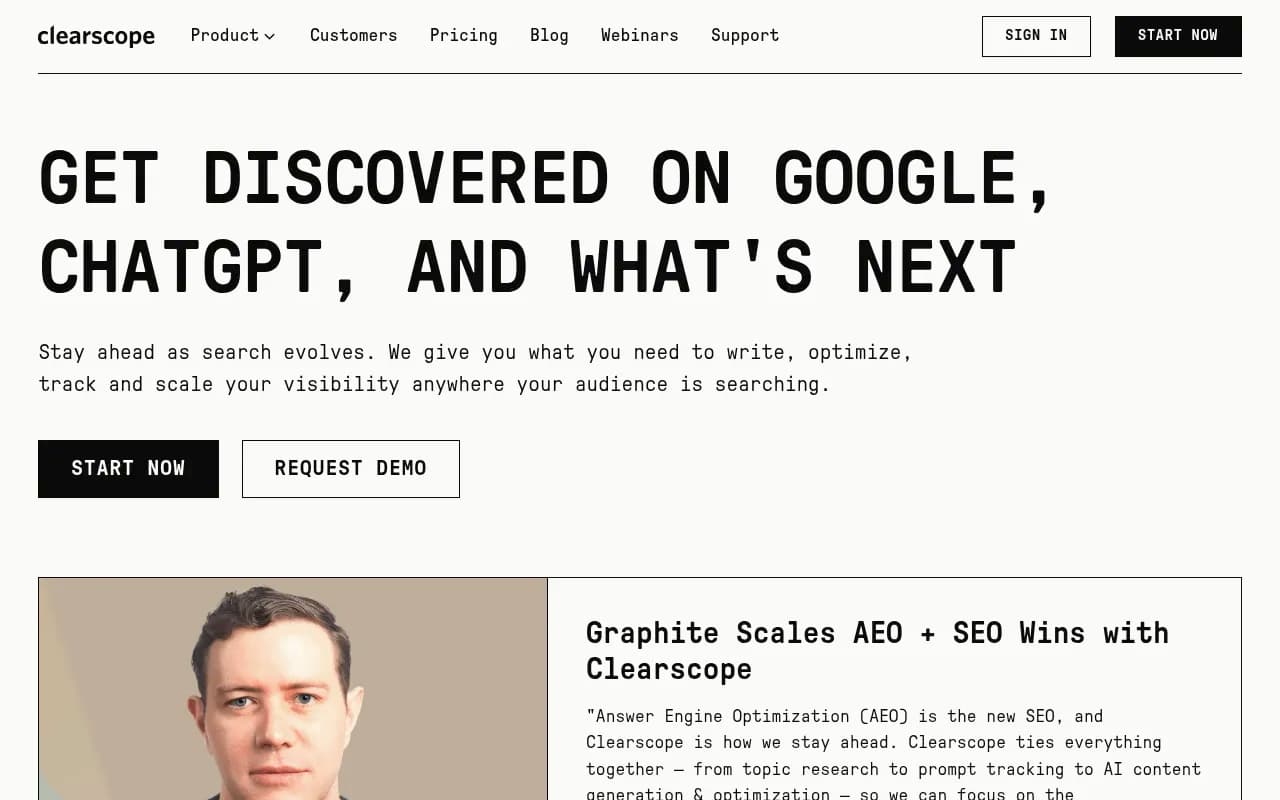
Clearscope is the most polished content intelligence tool on this list. The editor is clean, the topic research is thorough, and the content scoring is reliable enough that teams at Intuit, Adobe, Shopify, and IBM use it daily. If content quality and topical authority are your primary concerns, Clearscope is hard to argue with.
It's now tracking visibility across Google and AI chatbots like ChatGPT and Gemini, and the "Topic Explorations" feature helps teams build content clusters rather than chasing individual keywords. The AI visibility features are real, but they're positioned as part of a broader content strategy tool rather than a dedicated GEO platform.
Compared to AirOps: Clearscope is more focused on content quality and less on workflow automation. AirOps lets you build multi-step content pipelines; Clearscope gives you a better editor and more reliable optimization signals. If your team's bottleneck is writing quality content, Clearscope is the stronger choice. If your bottleneck is producing content at scale with automated workflows, AirOps wins.
The pricing is higher than Frase and Surfer, starting around $170/mo, but the product quality justifies it for teams that care about content standards.
Pricing: From ~$170/mo (credit-based plans, enterprise pricing on request).
Best for: Content teams at mid-size to enterprise companies that prioritize content quality and topical authority, and want a reliable editor that won't produce garbage.
Semrush
Semrush is the broadest tool on this list by a significant margin. It covers SEO, PPC, social, content, PR, and now AI visibility through its AI Visibility Toolkit. If you need one platform that does everything, Semrush is the obvious choice.
The AI visibility features are real — Semrush tracks brand presence in AI Overviews and LLM-generated results, and the AI Visibility Checker is a free entry point. But the AI search monitoring uses fixed prompts rather than letting you define your own prompt set, which limits how targeted the analysis can be. There's no crawler log, no prompt volume data, and no content generation tied directly to AI gap analysis.
Compared to AirOps: Semrush is better if you need a full SEO and marketing platform and want AI visibility as one feature among many. AirOps is better if AI search visibility and content production for AI search is your primary focus. The two tools don't really compete directly — Semrush is a Swiss Army knife, AirOps is a more specialized instrument.
Pricing: Free tier available, paid plans from $117.33/mo (billed annually).
Best for: Teams that already use Semrush for SEO and want to add AI visibility monitoring without switching platforms. Not the right choice if AI search is your primary focus.
Writesonic GEO
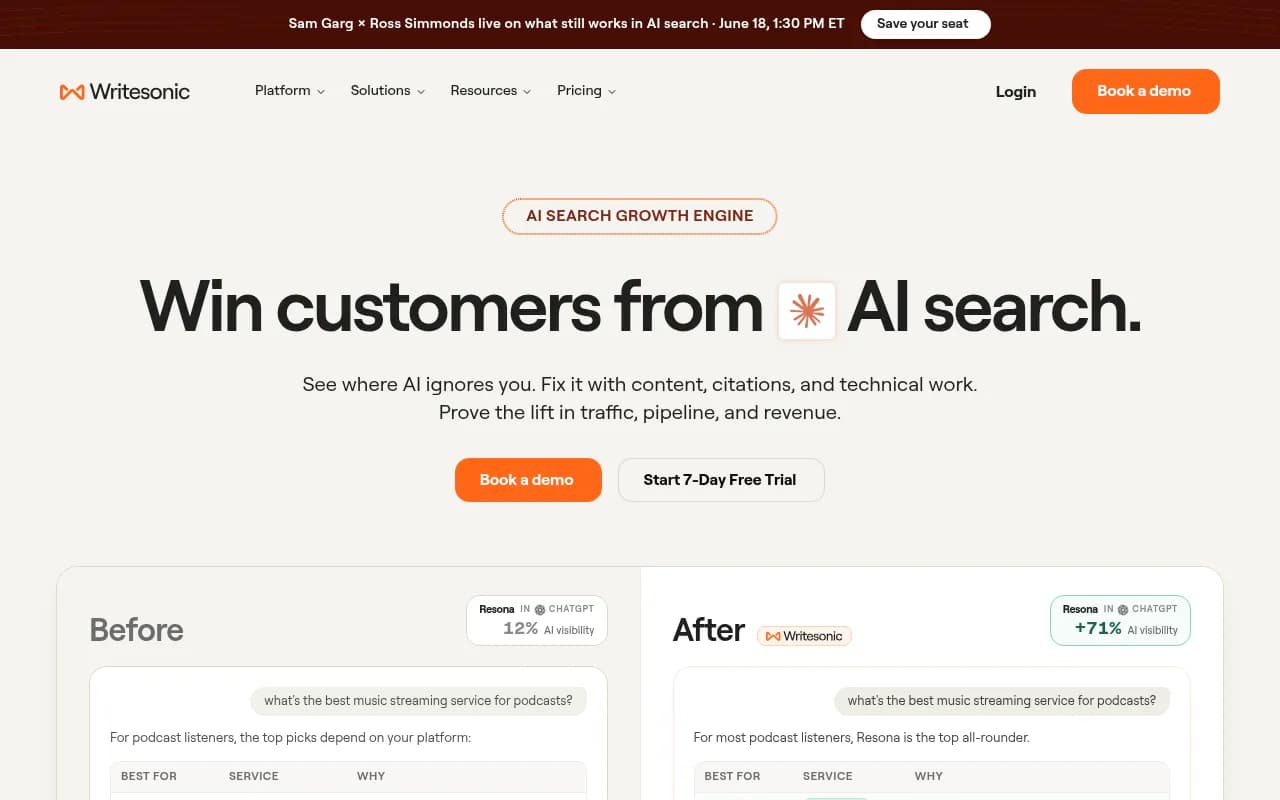
Writesonic has repositioned itself as an "AI Search Growth Engine," tracking 10 AI platforms and combining visibility monitoring with content generation. The pitch is similar to AirOps: see where AI ignores you, fix it with content, prove the lift in traffic and revenue.
The platform covers ChatGPT, Claude, Gemini, Google, Copilot, and Grok, and it includes content agents that can generate and publish content designed to improve AI visibility. The before/after framing in their marketing — showing a brand going from 12% to 71% AI visibility — is compelling, though real results will vary significantly by industry and competitive landscape.
Compared to AirOps: Writesonic GEO is a closer competitor than most tools on this list. Both combine AI visibility tracking with content generation. Writesonic has a lower entry price ($79/mo annually vs AirOps' $200/mo) and a more established content generation product. AirOps has deeper workflow customization and stronger enterprise case studies. Writesonic is the better choice for teams that want a capable GEO platform without AirOps' complexity or price.
Pricing: 7-day free trial, paid plans from $79/mo (annual billing).
Best for: Marketing teams that want a combined AI visibility and content generation platform at a more accessible price point than AirOps.
Rankability
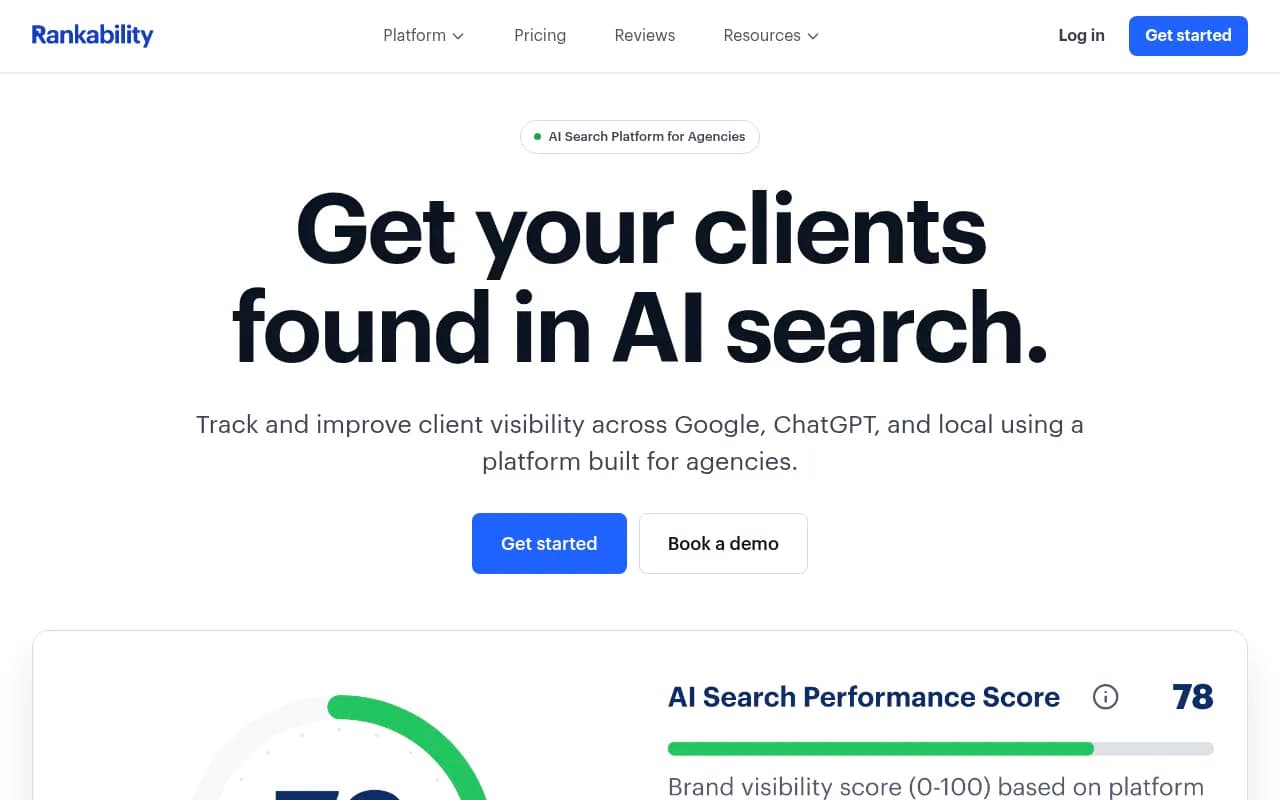
Rankability is built specifically for agencies, and that focus shows. All plans include unlimited clients and users, which is unusual and genuinely valuable for agency pricing. The platform covers AI search visibility tracking across ChatGPT, Perplexity, Google AI Mode, Gemini, Claude, Copilot, and Grok, alongside content briefs and on-page SEO scoring.
The content brief workflow is solid — AI-assisted briefs with competitor analysis and on-page scoring that agencies can use across client accounts without per-seat costs eating into margins. Users who've switched from Surfer SEO specifically mention that Rankability is easier to use and produces better results for their workflows.
Compared to AirOps: Rankability is more focused on the agency use case and less on enterprise content operations. AirOps has more sophisticated workflow automation and deeper AI search analytics. Rankability is cheaper and simpler, with a pricing model that works better for agencies managing many clients.
Pricing: From $99/mo (Starter), unlimited clients and users on all plans.
Best for: SEO agencies that need to manage AI visibility and content optimization across multiple clients without paying per-seat or per-client fees.
Jasper
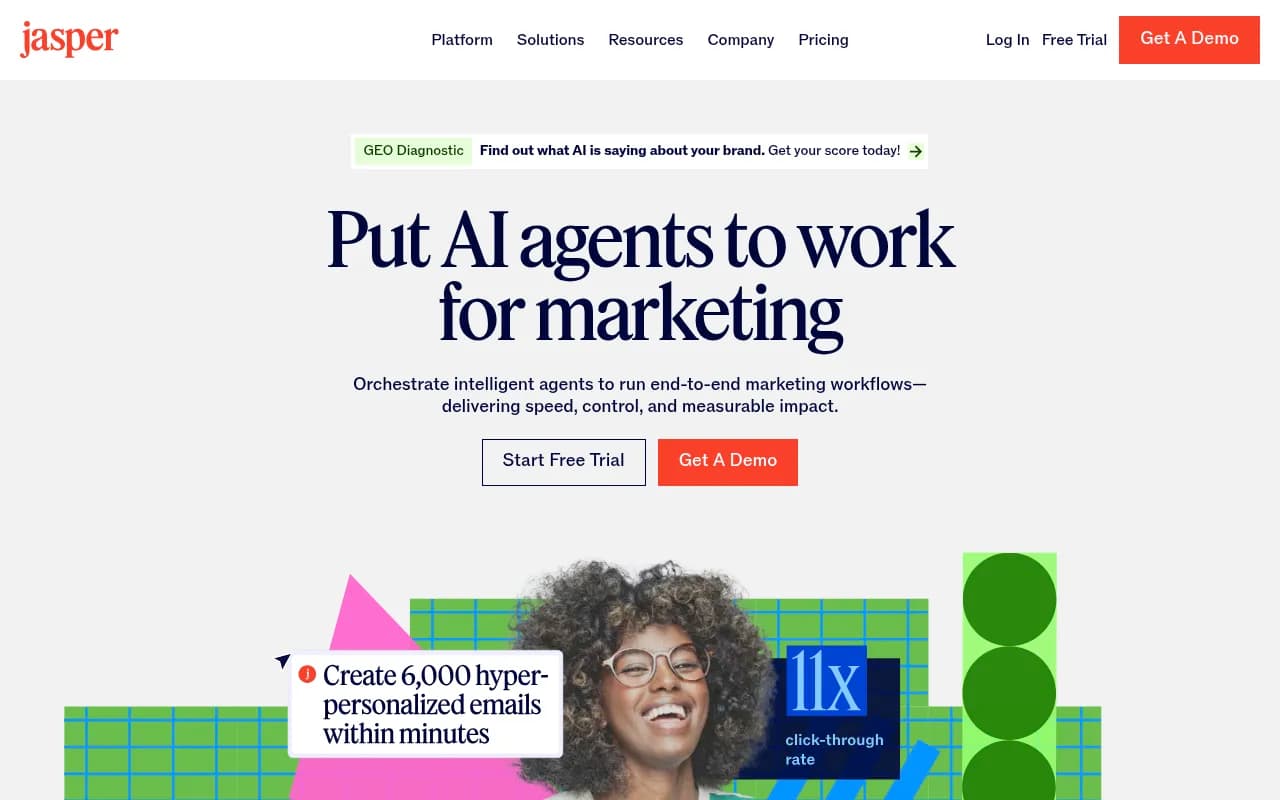
Jasper is primarily an AI writing platform for marketing teams, not an AI visibility tracker. It generates long-form content, ads, emails, and social copy with brand voice controls and collaboration features. The SEO/AEO/GEO solution page exists, but Jasper's core strength is content generation at scale, not gap analysis or citation tracking.
The brand voice and governance features are genuinely good. Jasper IQ stores brand guidelines, style guides, and visual guidelines, and applies them consistently across generated content. For large marketing teams that need to produce a lot of on-brand content quickly, Jasper is a strong choice.
Compared to AirOps: AirOps is more directly focused on AI search visibility and content that gets cited. Jasper is better for teams that need to produce large volumes of on-brand marketing content across multiple formats. If your goal is specifically to improve AI search citations, Jasper is the wrong tool. If your goal is scaling content production with brand consistency, Jasper is worth a look.
Pricing: Free trial available, Pro from $59/mo (annual), Enterprise custom.
Best for: Marketing teams that need to produce high volumes of on-brand content across multiple formats, and where brand consistency matters more than AI search optimization.
Writer
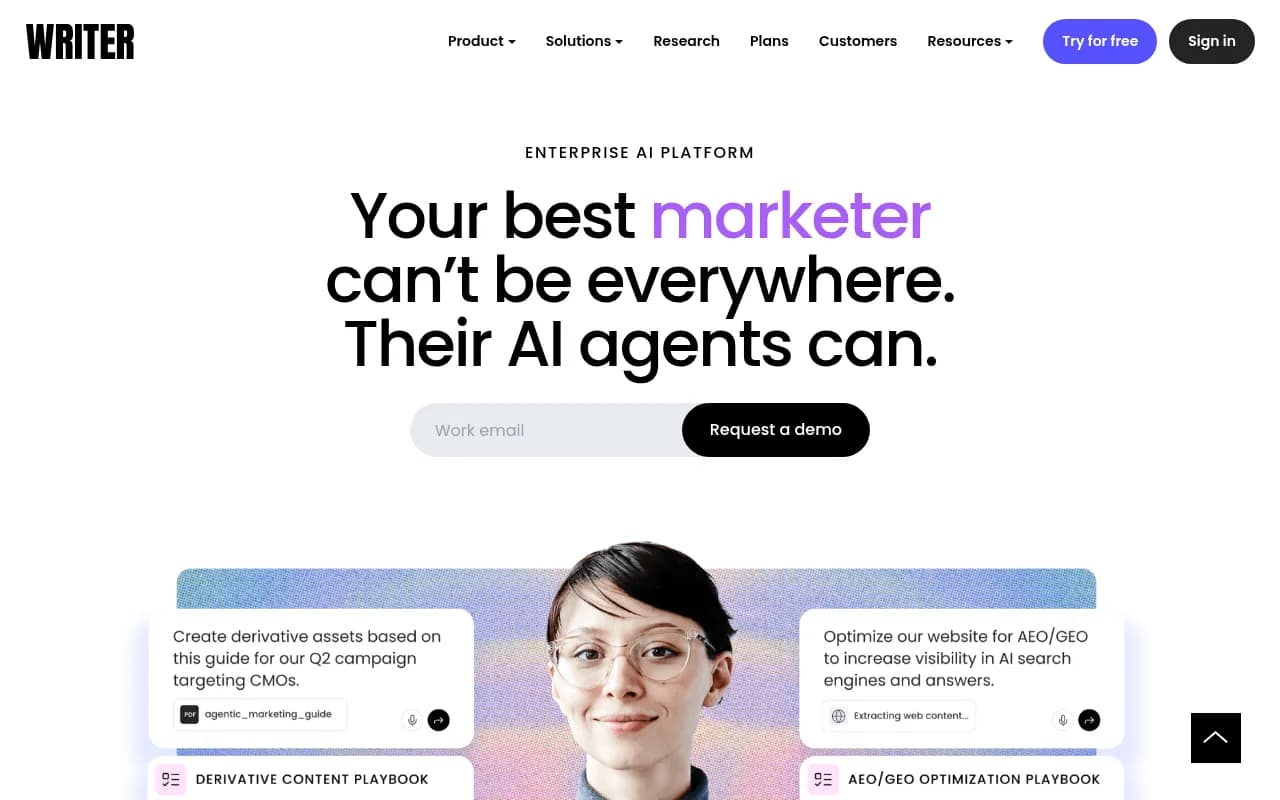
Writer is an enterprise AI platform focused on agentic work — it runs end-to-end marketing workflows with brand voice enforcement, compliance controls, and style guide adherence baked in. The target customer is Fortune 500 companies that need AI-generated content to meet legal and brand standards automatically.
The AEO/GEO optimization angle is present — Writer has a playbook for optimizing content for AI search — but it's one workflow among many rather than the core product. Writer's real differentiation is in governance: it can pull Semrush data, apply brand rules, and generate compliant content in a way that a standalone content tool can't.
Compared to AirOps: Writer is a more enterprise-grade platform with stronger compliance and governance features. AirOps is more focused on AI search visibility and content production for that specific goal. If you're at a large company where legal review of AI-generated content is a real concern, Writer's governance features are worth the premium. If you're a growth team trying to win AI search citations, AirOps or Promptwatch are more directly relevant.
Pricing: Free trial available. Starter from $29/user/mo (annual). Enterprise custom pricing.
Best for: Enterprise teams at regulated companies where AI content needs to meet compliance and brand standards, and where governance is as important as output quality.
How to choose
The right tool depends on what problem you're actually trying to solve.
If your primary goal is understanding and improving your AI search visibility — knowing which prompts you're missing, why competitors are getting cited instead of you, and generating content to close those gaps — Promptwatch is the most complete option. It covers the full loop from gap identification to content creation to citation tracking, at a price that doesn't require a $2,000/mo commitment.
If you want a combined AI visibility and content workflow platform similar to AirOps but at a lower price, Writesonic GEO is the closest alternative. Frase is the better choice if you primarily care about content research and optimization with basic AI visibility coverage.
For agencies managing multiple clients, Rankability's unlimited-client pricing model is hard to beat. For teams that already live in Semrush, adding the AI Visibility Toolkit is the path of least resistance. For pure content quality and topical authority, Clearscope is the most polished editor on the market.
Jasper and Writer are in a different category — they're content generation platforms, not AI visibility trackers. They make sense if your bottleneck is content production volume and brand consistency, not AI search citations.
AirOps itself is a strong product with real enterprise case studies. But at $2,000/mo for the full Pro tier, it's priced for companies that have already committed to AI search as a strategic priority. Most teams will find a better fit — and better value — in one of the alternatives above.