Key takeaways
- Promptwatch is the pick if you want to go beyond monitoring: content gap analysis, a Content Agent that publishes to your CMS, IP-verified crawler logs, and traffic attribution, from $95/mo.
- Profound and seoClarity ArcAI are the closest enterprise-grade peers. Both document brand fact-checking, which Conductor's public materials don't confirm.
- BrightEdge and Botify suit large teams already invested in those suites, particularly technical SEO groups.
- Semrush and Ahrefs fit teams that want AI tracking as an add-on to a classic SEO toolkit, though costs stack up fast.
- Scrunch and Search Atlas are the cheaper entry points, but both cap what you get at the low end.
Why people look for Conductor alternatives
Conductor is a serious platform. It combines AI search tracking, AI content creation and 24/7 site monitoring, and it has a long enterprise track record (Verizon, Microsoft, American Express and Citibank are named on its pricing page). On G2 it sits at 4.5 out of 5 from 809 reviews, per a seoClarity comparison checked in late September 2026. So why shop around?
A few recurring reasons. First, pricing is opaque. Plans are Essentials, Growth and Enterprise, with usage limits public but no dollar figures. Second, AI Search Credits are the same 2,500 per year on both Essentials and Growth, and Conductor itself says daily tracking eats credits quickly. Third, log file analysis (including AI crawlers) and the Data API are Enterprise-only. Fourth, engine coverage is murky: the docs list nine engines, but marketing pages list fewer, so you need to confirm by plan. And G2 reviewers mention a learning curve and missing features.
None of that makes Conductor bad. It means the right alternative depends on what you actually need: cheaper entry, deeper AI-specific data, or tools that do the work rather than report on it. A quick note on the data behind these choices: AI search behaviour shifts month to month. Promptwatch Data shows, for example, that ChatGPT drew just 0.46% of its citations from social platforms in the week of Sep 28 to Oct 4, 2026, while Google AI Overviews drew 12.2% (social media citations report). A tool that only tracks one engine will miss that kind of split.
Conductor at a glance
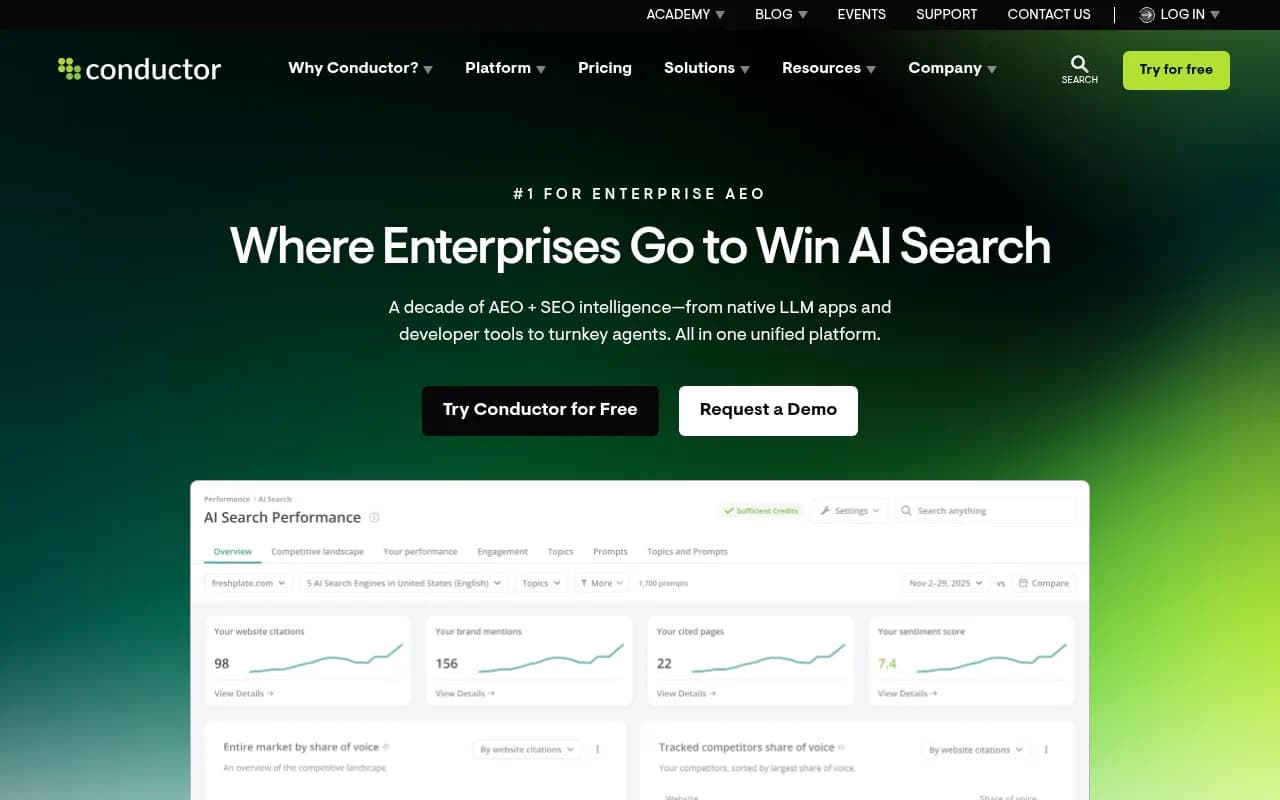
For reference: Conductor tracks ChatGPT, Gemini, Copilot, Claude and traditional search, and pairs that with Conductor Creator for content and always-on monitoring. Pricing is usage-based with a free trial on Essentials. SSO starts at Growth.
The alternatives
Promptwatch

Promptwatch is the one I'd look at first if your frustration with Conductor is that it shows you the picture without helping you change it. Plenty of platforms tell you whether your brand was mentioned. Promptwatch is built around the next question: why you are or aren't visible, and what to do about it.
The loop works like this. IP-verified AI crawler logs show which bots (GPTBot, ClaudeBot, PerplexityBot and others) hit which pages and where they hit errors. Citation analytics show which of your pages get cited, plus Reddit, YouTube and LinkedIn mentions. Content gap analysis finds the prompts competitors win and you don't. Then the Content Agent plans, writes and publishes to Webflow, Framer or WordPress, and the published pages are tracked through crawls, citations and AI traffic. Underperformers come back as items on the Action Board. Most competitors stop at the monitoring step.
Compared with Conductor, a few differences matter. Promptwatch monitors the real interfaces of ChatGPT, Google AI Overviews, AI Mode, Gemini, Perplexity and Copilot, so you see what users see, not just API output. Prompt volumes, difficulty scores and query fan-outs help you choose prompts, which Conductor says it can't do (it states reliable AI prompt volume data isn't available). Crawler logs are included rather than reserved for the top tier. Visitor analytics tie AI traffic to conversions. Promptwatch is used by 1,840+ brands and agencies and rated 4.7/5 on G2.
Pricing is public: a free Explore plan (ChatGPT only, 10 prompts), Essential at $95/mo, Professional at $245/mo and Business at $579/mo, with agency plans from $199/mo and custom Enterprise. Confirm current numbers at promptwatch.com/pricing.
Trade-offs: it isn't a keyword research or backlink tool, and it isn't a classic SERP rank tracker, although it pulls in Search Console and Bing data. If you rely on Conductor for traditional enterprise SEO workflows, you'd likely run Promptwatch alongside a suite rather than instead of it.
Best for: teams that want AI visibility tied to traffic and revenue, plus agents that handle the content work. Also strong for agencies running many client workspaces. For more options in this category, the GEO software directory at bestgeosoftware.com is a useful cross-check.
Profound

A note first: the profound.com URL in some listings belongs to a market research report service, a different company. The AI visibility product is at tryprofound.com. Everything below refers to the AI visibility platform.
Profound is probably Conductor's most direct AI-native rival. Enterprise plans cover up to nine answer engines (ChatGPT, Perplexity, AI Mode, Gemini, Copilot, DeepSeek, Claude, AI Overviews and Exa), daily tracking, ChatGPT Shopping, CSV and JSON export, API access and SSO/SAML. Unlimited seats on every plan is a nice touch compared with seat-based suites. Its FactCheck feature checks AI answers against a knowledge base, which is something Conductor's public materials don't confirm.
Profound now pitches itself as an "AI Marketer" with credit-based agents, so it's moving beyond pure tracking. Agent Analytics integrates with Cloudflare, Akamai, AWS, Fastly, Vercel, Netlify and WordPress for crawler data.
Where it falls short: there are no public prices beyond a 7-day trial (50 prompts, three engines, no exports or API, and the trial prompts can't be customized). Expect a sales process. It also doesn't track Reddit or LinkedIn citations as deeply, and has no CMS publishing pipeline in the way Promptwatch does.
Best for: enterprises that want a dedicated AI visibility vendor with fact-checking and strong security documentation, and are comfortable with custom quotes.
BrightEdge
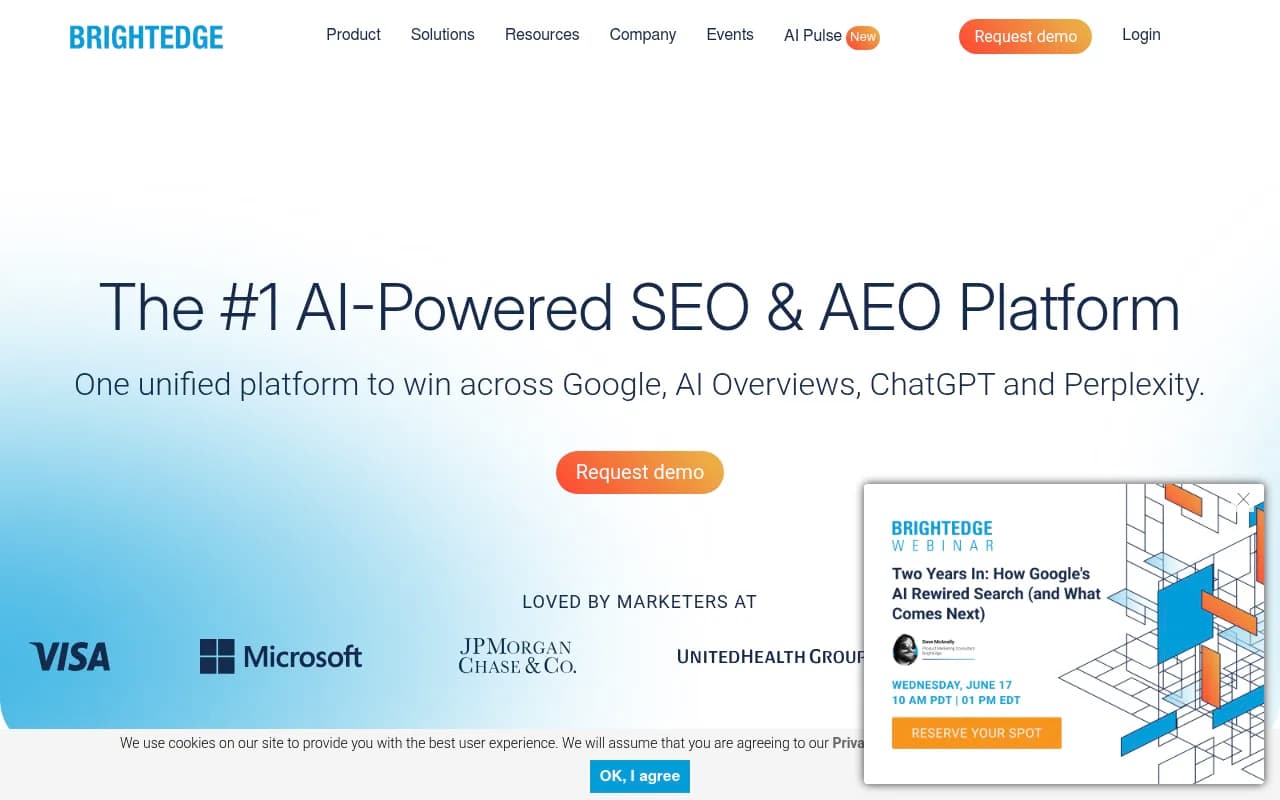
BrightEdge is the other classic enterprise SEO name, and the comparison with Conductor is long-running. It bundles AI Catalyst into its platform and has Agent Edge, which serves content when AI agents visit your site. It markets itself as a unified AEO and SEO platform across Google, AI Overviews, ChatGPT and Perplexity.
The honest drawback: its AI Catalyst page names only three engines, and engine coverage in launch materials versus product pages doesn't fully match, so ask which engines (including AI Mode) are tracked today. Pricing is custom. Industry estimates of $1,500 to $3,000+ per month exist, but I couldn't verify them on BrightEdge's own site, so treat that as a rough guide. Its customer success team is large (60+ members), and training is free for customers.
Best for: large organizations already running BrightEdge for traditional SEO who want AI visibility inside the same contract. If AI search is your main priority, a specialist will likely go deeper.
seoClarity (Clarity ArcAI)
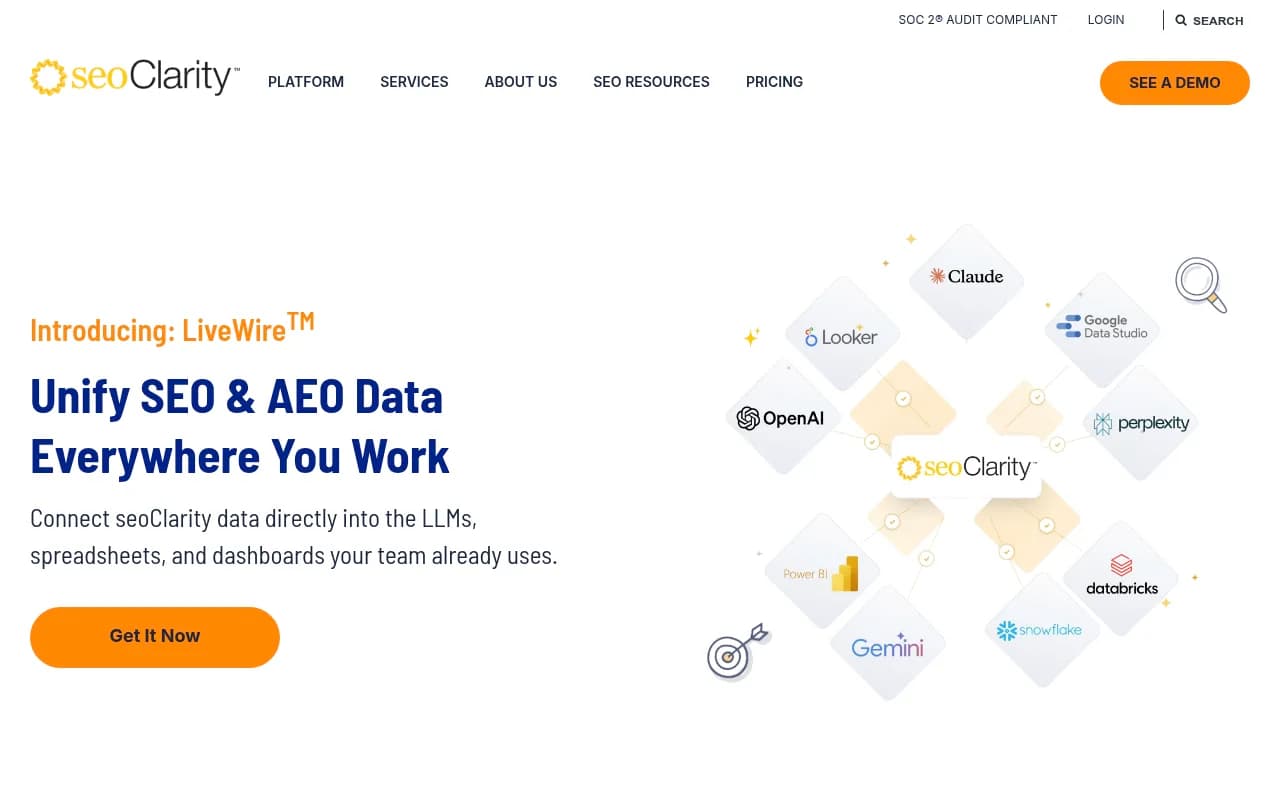
seoClarity is the most interesting like-for-like Conductor alternative on paper. ArcAI covers 10 AI engines on every plan, including ChatGPT, Gemini, Perplexity, AI Mode, AI Overviews, Copilot, Grok, DeepSeek, Doubao and Claude. Its prompt research is grounded in search demand and mapped to buyer-journey stages. ArcAI Accuracy builds a source-of-truth index from your own site and flags AI answers that contradict it. ArcAI Indexer submits new pages to AI engines, and the API and MCP server come with all paid subscriptions, whereas Conductor locks its Data API to Enterprise.
The broader platform also brings the traditional SEO depth you'd expect: rank tracking, log file analysis, site audits, content gaps and automation. G2 shows 4.5 out of 5 from 216 reviews for the whole platform, with complaints about a learning curve and limited features. Note that I can't point to meaningful ArcAI-specific reviews yet.
Usage is metered in Question Queries (one prompt, one engine, one location), so costs scale with how many prompts and markets you track. Pricing is custom, with enterprise packages reported from around $4,500/mo. One caveat on sources: much of the head-to-head material comes from seoClarity itself, so weigh it accordingly.
Best for: enterprise and mid-market teams wanting full SEO plus AI tracking with fact-checking and business-unit competitor sets.
Scrunch
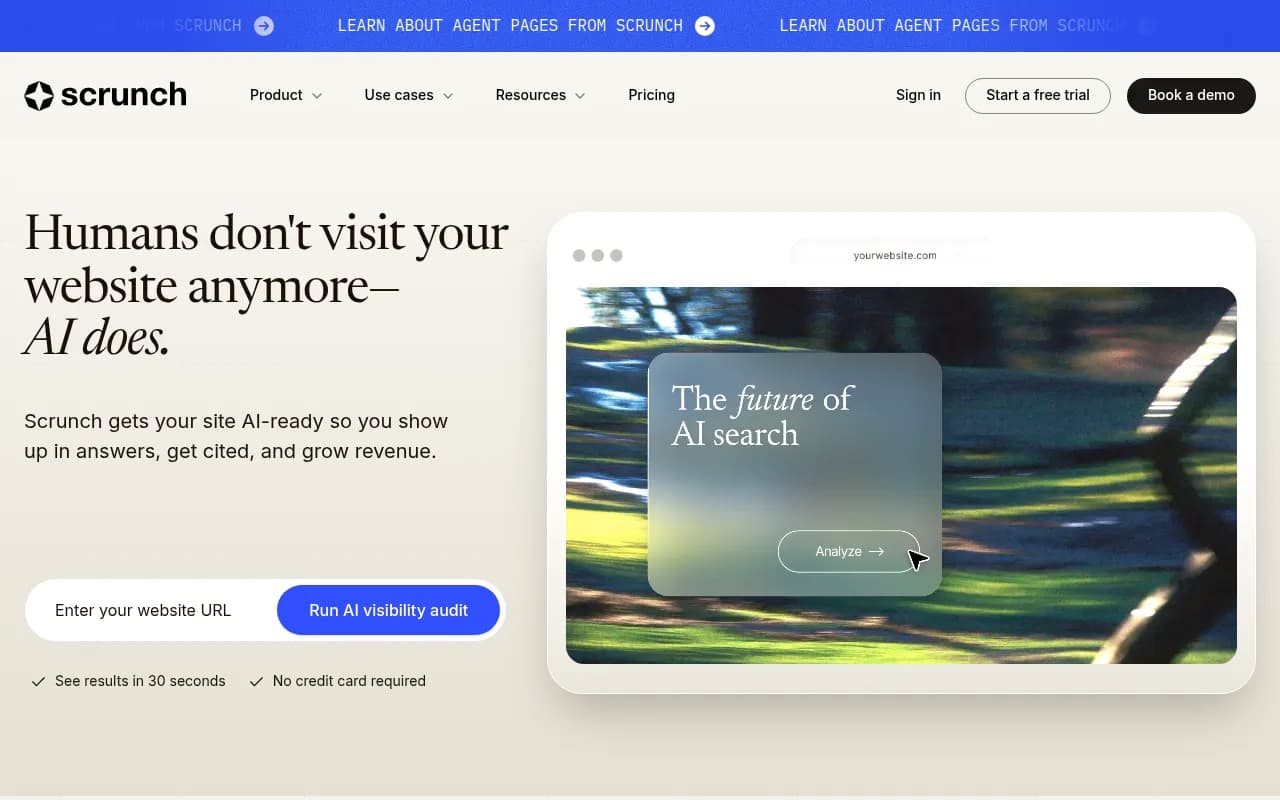
Scrunch (the live domain is scrunch.com) has a distinctive angle: its Agent Experience Platform serves AI agents an optimized version of your site, alongside Agent Traffic analytics and site diagnostics. For brands worried about how bots read their pages, that's different from anything in Conductor's core pitch.
Pricing is more transparent than Conductor's. Core is $250/mo with a 7-day trial: 125 prompts, 5,000 responses a month, 5 users, 1 country, and 4 LLMs (ChatGPT, Perplexity, AI Overviews, Copilot). Claude, Gemini and AI Mode, plus AXP, API, Looker Studio and MCP access, require Enterprise. So the low tier is limited. Scrunch's own pages also disagree on plan names and prices, so verify before buying. It reports 500+ brands and agencies as customers.
Best for: brands that want to experiment with agent-ready pages, and agencies that like a published entry price.
Semrush
Semrush is the practical choice when your team already lives in a classic SEO suite. The AI Visibility Toolkit launched in September 2025 and costs $99/mo per domain, or comes bundled in Semrush One from about $199/mo. Core plans are Pro $139.95, Guru $249.95 and Business $499.95 per month (from the Promptwatch comparison article; confirm on Semrush's site). You get keyword research, backlinks, site audit, content tools and PPC data in one login.
The weakness is depth. The toolkit leans keyword-focused rather than prompt-level, and meaningful LLM coverage is a paid add-on. There's also no crawler log analysis for AI bots. One Reddit r/bigseo thread has a team choosing Semrush over BrightEdge and Conductor on functionality, though that's one anecdote.
Best for: teams that want one affordable SEO suite with AI tracking bolted on, rather than an enterprise governance platform.
Ahrefs
Ahrefs is the strongest option here for backlink and keyword data, and Brand Radar adds AI visibility tracking across ChatGPT, Perplexity, AI Overviews and Gemini. Base plans run $29 (Starter), $129 (Lite), $249 (Standard) and $449 (Advanced) per month. Brand Radar is priced separately, around $199/mo per AI index or $699/mo for the bundle, so a full stack can pass $828/mo before seats. Ahrefs also publishes figures like 400M monthly AI prompts in its index.
Trade-offs: there's no content publishing workflow, no enterprise workflow tooling comparable to Conductor's, and the share-of-voice definitions differ between its own pages. Its free Webmaster Tools tier is generous.
Best for: SEO specialists and link builders who want AI visibility data without switching away from Ahrefs.
Search Atlas
Search Atlas bets on automation. Its OTTO agent applies technical and content fixes, and the platform also covers ads, rank tracking and reporting. Pricing: Starter $99/mo (no AI visibility at all), Growth $199/mo (ChatGPT, Gemini and AI Mode, 100 queries), Pro $399/mo (six platforms including Copilot, Perplexity and Claude), and Agency from $999/mo (250 LLM queries).
Those query caps are small. This reads as an SMB and agency tool, not an enterprise replacement for Conductor. Testimonials on its site come mainly from agency owners and small businesses. Still, at those prices, with a 7-day trial and publishing to WordPress, Shopify and Webflow, it's a cheap way to test whether automation helps.
Best for: small agencies and SMBs that want automation and low cost over enterprise controls.
Botify
Botify comes from the technical SEO side, which is its real strength: large-site crawling, log analysis and tools like PageWorkers and SpeedWorkers for pushing changes. AI visibility is sold as an add-on covering three to five engines depending on the page (ChatGPT, Google AI Mode, Perplexity), and it recently added an MCP server and GEO reporting. Pricing wasn't available, so assume a custom quote.
If your problem is crawl efficiency on millions of pages, in e-commerce or retail particularly, Botify is worth a demo. If your problem is prompt-level brand tracking, it's thinner than the AI-native tools.
Best for: large-site technical SEO teams.
How to choose
Pick by the problem you're trying to solve, not by brand name.
- You want AI visibility tied to traffic, plus agents that write and publish: Promptwatch.
- You want an enterprise AI-native peer with fact-checking: Profound or seoClarity ArcAI.
- You're staying inside a legacy enterprise suite: BrightEdge, or stay with Conductor.
- You need public pricing and a low entry point: Scrunch, Search Atlas, Semrush or Ahrefs.
- You manage huge sites with crawl problems: Botify.
Whatever you shortlist, test it on your own prompts. Engine lists differ between vendors' docs and marketing pages (Conductor, BrightEdge, Botify and Profound all show this), so get engine coverage and credit usage confirmed in writing. For a wider view of the category, the tracker directory at ai-rank-tools.com lists more options. And if you'd rather have specialists run the program, an agency like 1001 SEO Media handles SEO and GEO work end to end, which can be cheaper than staffing a platform.