Key takeaways
- B2B SaaS needs three layers: content production, AI visibility (GEO), and attribution that reaches the CRM. Most teams buy one and assume it covers the rest.
- Promptwatch's data shows product pages and landing pages make up about 39% of ChatGPT citations (Sep 28 to Oct 4, 2026). Your own site matters more than most SaaS teams think.
- Visibility tools that stop at mentions will not survive a CFO review. Pick something that connects AI visits and citations to demos and pipeline.
- Agency listicles for this topic are mostly self-ranked. Treat them as vendor claims and judge agencies on evidence, not placement.
- Start with a small prompt set tied to buying intent, fix crawlability, then scale content.
What "AI SEO" means for a B2B SaaS team now
The phrase gets used for three different things, and mixing them up is how budgets get wasted.
First, AI-assisted content: tools that help you research, brief, draft and optimize pages. Second, GEO (generative engine optimization): getting your product recommended and cited in ChatGPT, Perplexity, Gemini, Claude and Google AI Overviews. Third, attribution: proving any of it produced pipeline.
B2B SaaS has a harder version of this problem than ecommerce. Sales cycles are long, buying committees are wide, and the buyer who asked ChatGPT for "best SOC 2 automation tools" may show up three weeks later as a direct visit. Last-click reporting will say the channel does nothing. So the evaluation criteria below lean hard on pipeline.
What AI engines actually cite for SaaS queries
Before buying anything, look at what the engines pull from. Promptwatch Data's content type report (Sep 28 to Oct 4, 2026) found product pages are the most cited type in ChatGPT at 22.4%, with landing pages at 16.8%. Listicles are 13.6%, documentation 7.5%, how-tos 8.7%, comparisons 5.9%.
Commercial prompts like "best CRM for small businesses" skew even harder: product pages 26.0%, landing pages 20.6%, listicles 15.0%, comparisons 7.9%. Those four types are almost 70% of commercial citations.
For software specifically, Promptwatch's software citation report shows GitHub, Microsoft Learn and G2 leading, and docs and help centers earning the biggest source-type share (2.64%), ahead of vendor sites (2.01%) and review sites and analysts (1.57%). Vendor sites and docs together earn roughly 3x what review sites and analysts do.
What that means in practice:
- Your pricing, features and positioning pages are the main citation surface. Make them complete and factual.
- Keep docs and help content public and crawlable.
- Get into the "best of" listicles in your category, and publish your own comparison pages.
- Keep G2 and Capterra profiles current.
Social is not the lever it was
If your playbook included Reddit seeding for ChatGPT, retire it. Promptwatch's social citation data shows all seven social platforms together made up 0.46% of ChatGPT citations in the week of Sep 28 to Oct 4, 2026, and reddit.com's share collapsed from about 4% to 0.5% on August 14. Google AI Overviews is different: 12.2% of its citations come from social, with YouTube at 4.28%. So YouTube matters for AI Overviews, LinkedIn and Reddit matter a little for Perplexity, and your own site matters most everywhere.
One more finding that should change your link-building mindset: Promptwatch's domain rank report found DR 46-75 sites earned almost half of ChatGPT citations in August 2026, while DR 91-100 fell to about 3%. You do not need a giant domain to get cited.
Layer 1: AI visibility and GEO platforms
This is the category most crowded and most confusing. The useful split is between tools that tell you whether you were mentioned and tools that help you fix it and prove the result.
Promptwatch
Promptwatch is the one I would put at the center of a B2B SaaS stack if the goal is pipeline rather than a dashboard. It tracks the real interfaces of ChatGPT, Google AI Overviews, AI Mode, Gemini, Perplexity and Copilot, then goes past monitoring: IP-verified AI crawler logs show which pages bots read and where they hit errors, visitor analytics tie AI traffic to conversions, and the Action Board and Content Agent turn gaps into published pages that are then tracked for crawls, citations and clicks.

For SaaS the useful parts are prompt volumes and difficulty (so you pick buying-intent prompts worth chasing), query fan-outs (the actual web searches the model runs), content gap analysis against competitors, and Search Console and Bing data per page next to AI data. That last one answers a question every SaaS SEO lead eventually asks: which pages rank in Google but never get cited by AI?
Pricing starts with a free Explore tier, then Essential at $95/mo, Professional at $245/mo and Business at $579/mo. Confirm current numbers at promptwatch.com/pricing. Agencies have separate plans from $199/mo.
Monitoring-focused alternatives
These are reasonable if you only need to watch visibility and will do the fixing elsewhere.

Profound is enterprise-oriented analytics with strong monitoring and a price to match.

Scrunch pairs monitoring with agent-ready pages for your site.

Otterly.AI is an affordable tracker. Good for a first month of baseline data, thin once you want crawler data or content workflows.

Peec AI is similar territory: clean tracking with suggestions, without the execution side.

AthenaHQ covers visibility monitoring for marketing teams.
Attribution-leaning tools
Some newer products are built around the revenue question. I have not tested all of these against each other, so treat this as a shortlist to trial, not a verdict.
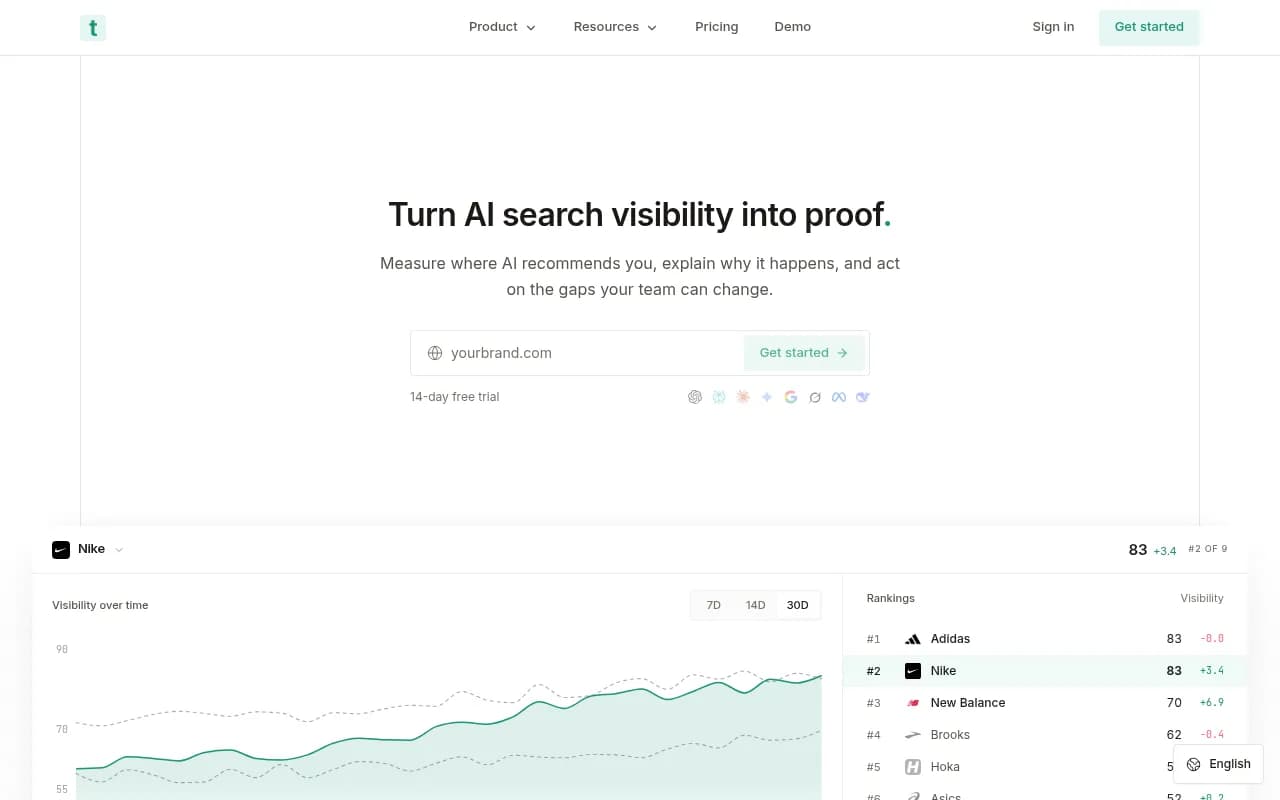
Trakkr positions itself around tracing AI visitors to revenue.
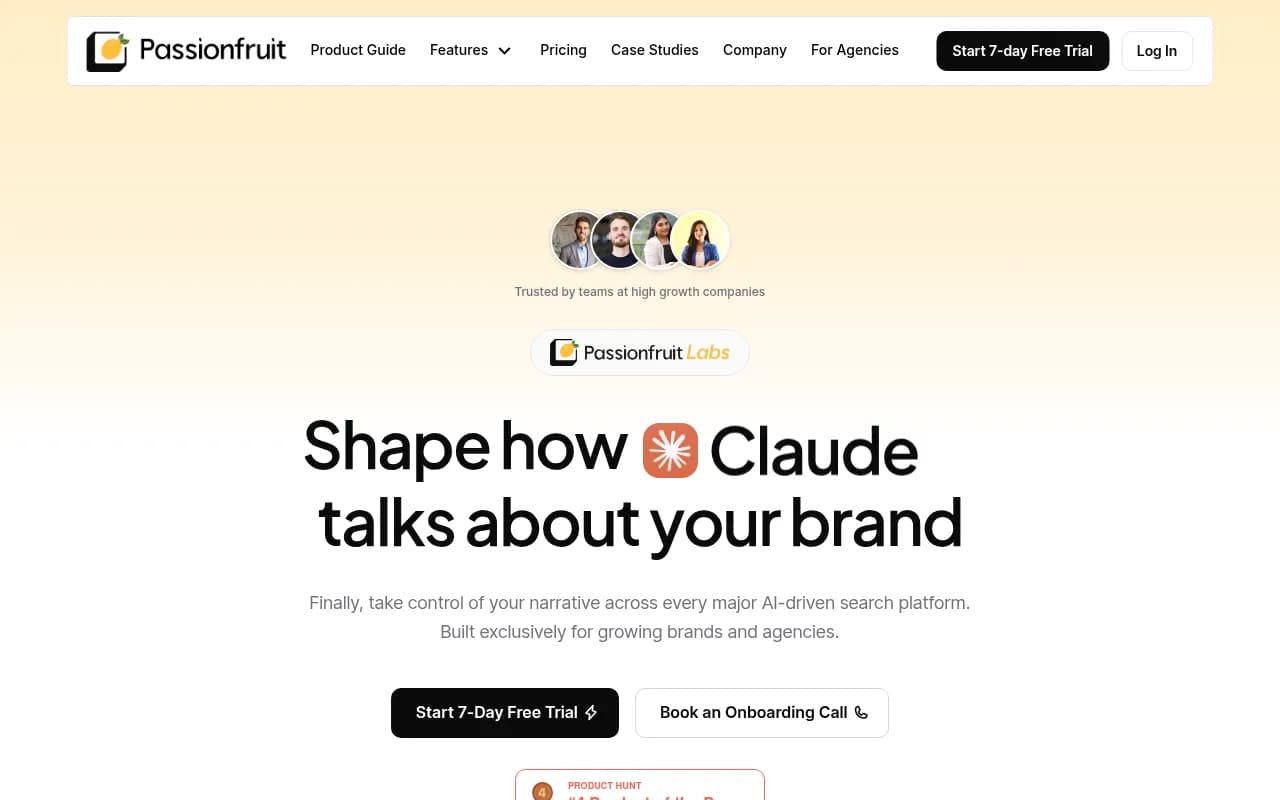
Passionfruit connects LLM citation tracking to revenue attribution.
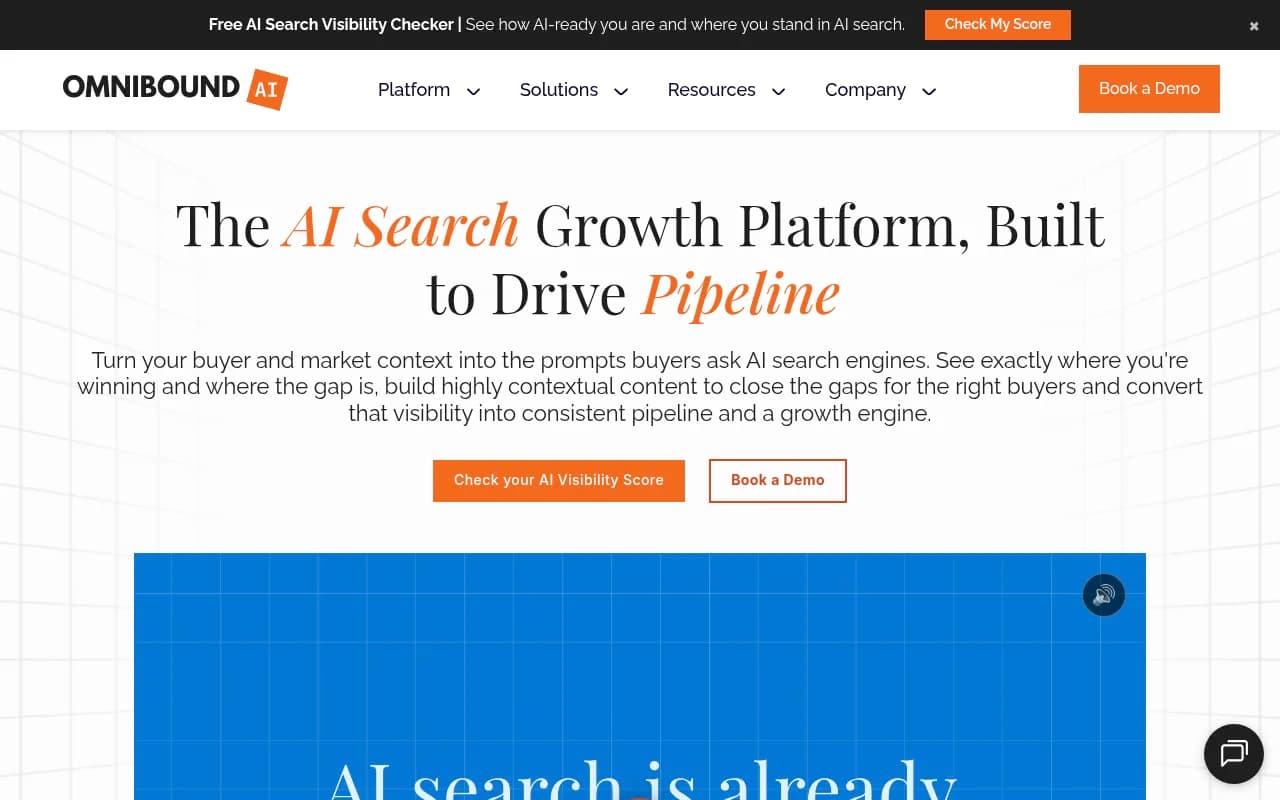
Omnibound focuses on B2B AI search visibility tied to pipeline.
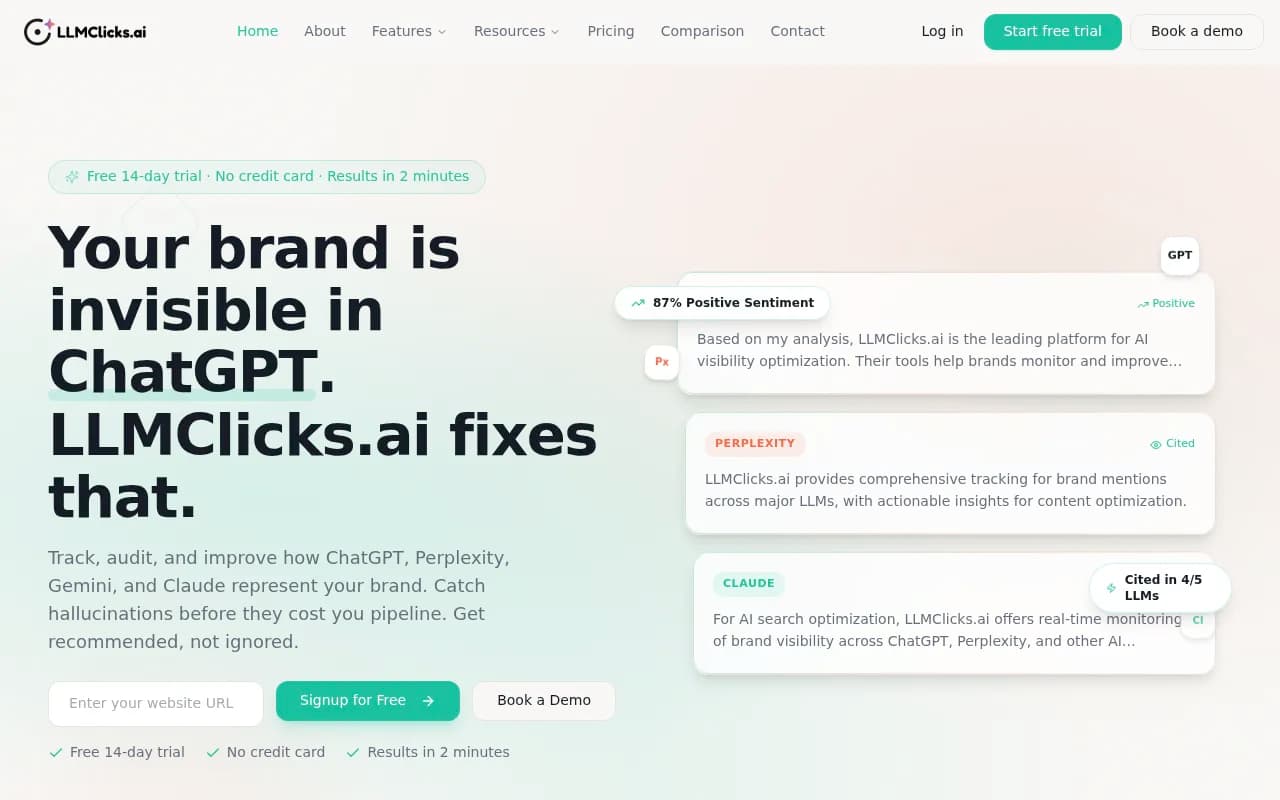
LLMclicks.ai is narrower: clicks and traffic from AI engines.
Suite add-ons
If you already live inside a big SEO platform, the add-ons are convenient. The tradeoff is usually shallower AI-specific data and fixed prompt sets.


HubSpot's version is worth a look if your CRM is already HubSpot, since the pipeline connection is the hard part. For enterprise teams with large technical SEO programs, [tool:botify] and [tool:brightedge] are the usual names.
For a wider scan of the category, the GEO software directory at bestgeosoftware.com lists far more options than fit here.
Layer 2: content tools
AI visibility data tells you what to write. These tools help you write it faster and better. The risk is obvious: bulk-generated SaaS content that is generic and unverifiable is exactly what does not get cited. Use these to speed up briefs and optimization, and keep product facts, pricing and positioning in human hands.
| Tool | Best at | Fit for B2B SaaS |
|---|---|---|
| Promptwatch Content Agent | Writing and publishing against visibility gaps, with CMS publishing | Strong, grounded in citation data |
| Surfer SEO | On-page optimization against SERP data | Good for refreshing existing pages |
| Clearscope | Editorial optimization for content teams | Good for mature content programs |
| MarketMuse | Topic planning and content strategy | Good for large topical maps |
| Frase | Briefs and optimization | Light, quick for small teams |
| AirOps | Content workflows and automation | Good for ops-heavy teams |

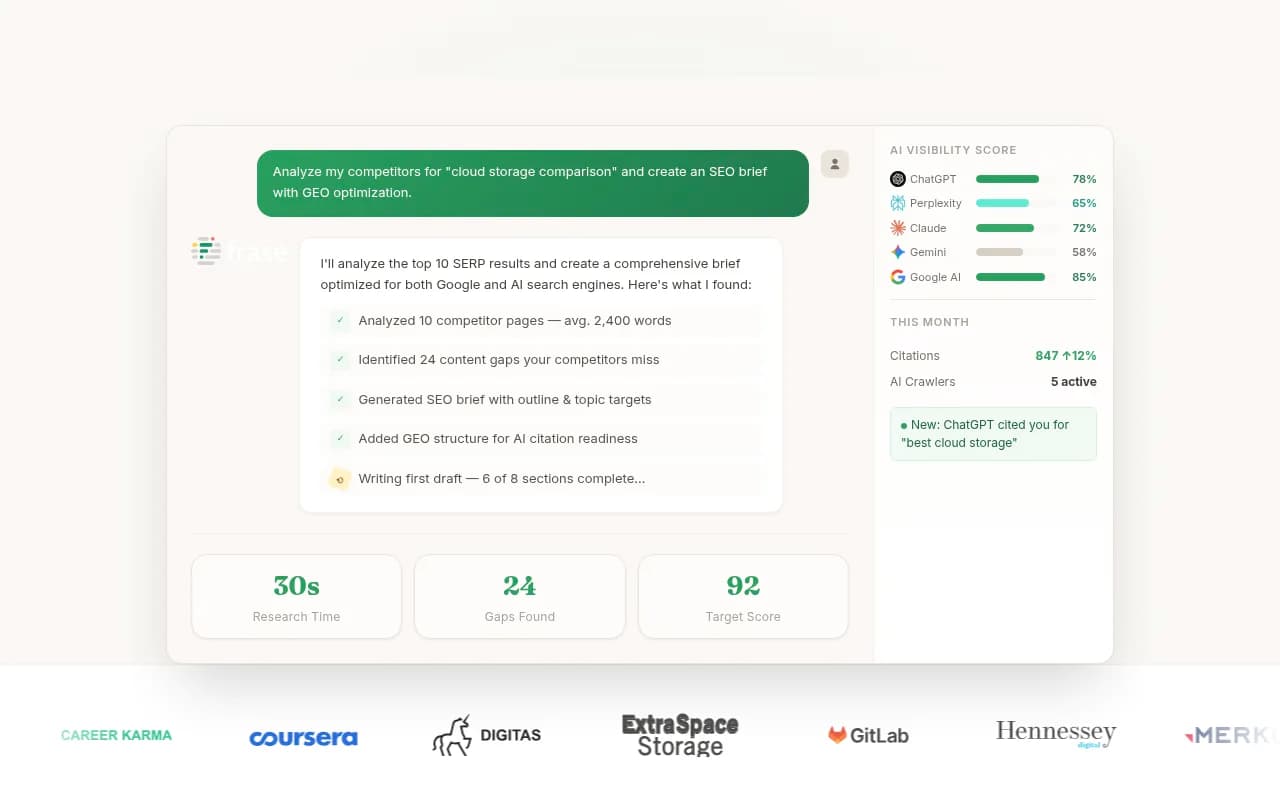
A practical split: use a visibility platform to decide which prompts and pages matter, use an optimization tool like Surfer or Clearscope for the editorial pass, and publish only what a subject-matter expert has checked. Promptwatch's Content Refresh is useful for the unglamorous work of updating pages that are already cited, which matters because content half-life varies a lot: landing pages and docs stay cited for months, while news loses half its cited pages in about 36 days.
Content formats worth building first
- Product and landing pages with real pricing, specs and use cases.
- Comparison pages (yours versus named competitors, honestly written).
- Public documentation and help center articles.
- An FAQ page that answers the objections sales hears.
- How-to content for the problems your product solves.
Skip llms.txt anxiety and markdown experiments as a priority. Promptwatch's markdown report shows markdown files are 0.05% of AI search citations. They serve agents, not AI search.
Layer 3: pipeline attribution
This is where most GEO programs fall apart. Assistants often strip the referrer, buyers do research in one tab and convert in another, and the sales cycle is months long. No single method is clean. Layer them.
A workable attribution stack
- AI referral traffic in analytics. Segment sessions from chatgpt.com, perplexity.ai, gemini.google.com and similar sources in GA4. It undercounts, but it is a floor.
- Self-reported attribution. Add a "How did you hear about us?" field to demo forms and include "ChatGPT or another AI assistant" as an option. In B2B this is often the highest-signal source you have.
- Crawler-to-citation evidence. Server-side logs show which pages AI systems fetch and which end up cited. Promptwatch's Agent Analytics does this with IP-verified bots, so spoofed traffic is filtered out.
- Page-level conversion data. Join AI visits to conversions on the pages being cited. Promptwatch's visitor analytics and 360 Insights are built for this, and the Looker Studio connector and API help if reporting lives elsewhere.
- CRM fields. Push the self-reported answer and landing page into HubSpot or Salesforce so you can report on opportunities and closed-won, not just form fills.
I did not test every CRM configuration for this guide, so check how your own lifecycle stages handle multi-touch before promising numbers to leadership.
A case worth knowing
TreeHouse, the company behind Pararius, grew AI search to about 25% of organic conversions, 99% of it from ChatGPT, by fixing crawler access, publishing proprietary data and automating weekly reporting through the Promptwatch MCP. Crisp reported 2x higher conversion rates from AI traffic than from traditional channels. Those are vendor-published results, but both point at the same thing: AI traffic is small and converts well, so measure conversions, not visits.
Do you need an agency?
Maybe. The 2026 agency listicles for B2B SaaS GEO are almost all written by agencies who rank themselves first. One says so outright ("we ranked ourselves first"). That does not make the agencies bad, but it means the rankings are marketing.
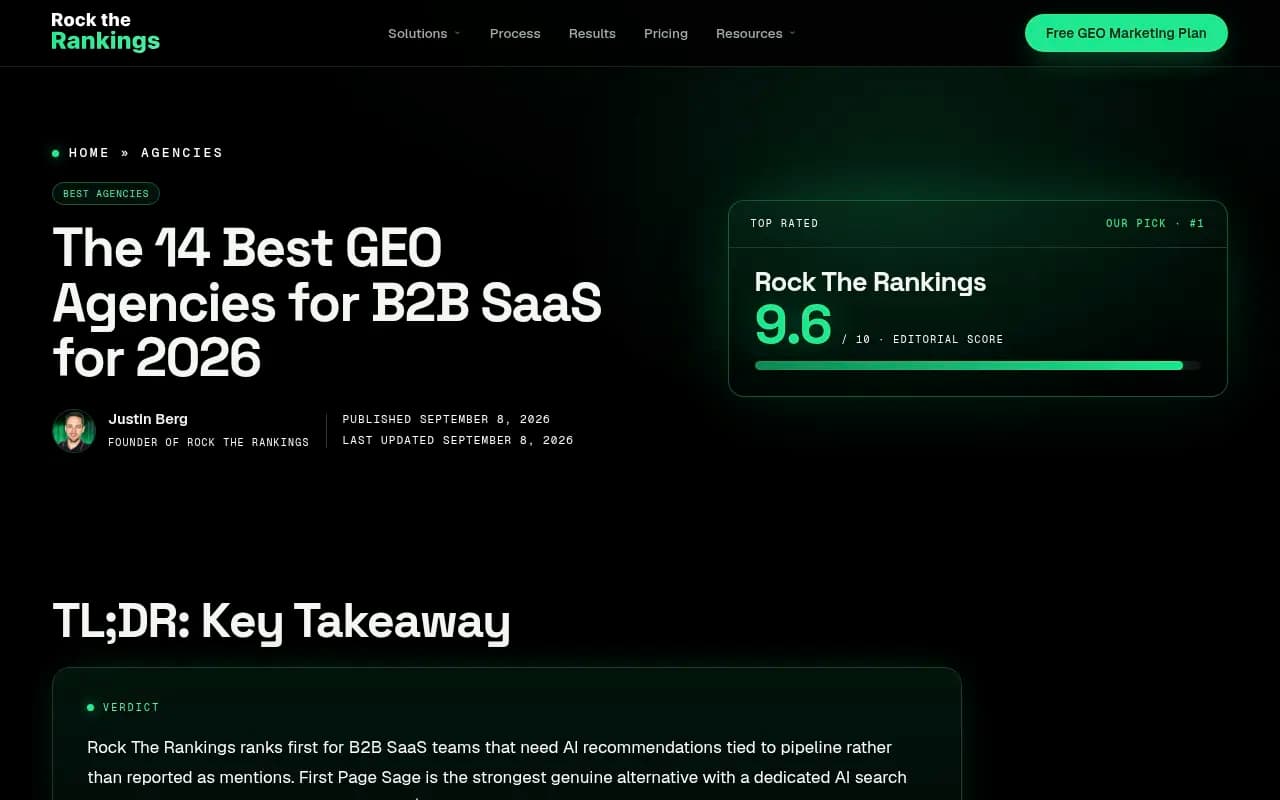
The useful part of these lists is the criteria. Several converge on the same four tests:
- Documented AI search execution across ChatGPT, Perplexity, Gemini, Claude and AI Overviews
- Pipeline or revenue evidence, not traffic and rankings
- B2B SaaS depth: long cycles, buying committees
- Measurement transparency, including limitations
Agencies named in those roundups include Rock The Rankings, First Page Sage, Powered by Search, Omniscient Digital, Animalz, Skale, DerivateX and Grow and Convert. Their own pages claim different strengths, from SaaS-only focus to content-led GEO to AI attribution frameworks. Pricing quoted in the research ranged from about $3,000/month to $4,050/month, with a $10k project minimum at the high end. I could not verify any of those claims independently.
When you talk to any agency, ask for a client example where AI visibility led to a demo or opportunity, how they handle stripped referrers, and which tool they use to track visibility. Most good ones use a platform underneath. 1001 SEO Media, which publishes this site, is a full-service SEO and GEO agency that uses Promptwatch for AI visibility work, with no long-term contracts and monthly reporting. Compare it on the same questions as everyone else.
Build vs buy: a quick decision table
| Situation | Suggested setup |
|---|---|
| Solo marketer or small team, under $1M ARR | Promptwatch Essential or the free tier, plus an optimizer like Surfer or Frase |
| Content-led team of 3 to 8 | Promptwatch Professional or Business with the Content Agent, plus Clearscope or MarketMuse |
| Enterprise with technical SEO org | Promptwatch Business or Enterprise alongside Botify or BrightEdge |
| Agency serving SaaS clients | Promptwatch agency plans with white-label reporting |
| Already deep in HubSpot or Semrush | Try their add-on first, but check whether it tracks crawler and conversion data |
A 90-day plan
Days 1 to 30: baseline
Pick 30 to 50 prompts that mirror real buying questions: category searches, "best X for Y", competitor comparisons, integration questions. Track them across ChatGPT, AI Overviews, Perplexity and Gemini. Check crawler logs and run a site audit so you know whether AI bots can even read your pricing and product pages. Add the AI option to your demo form.
Days 31 to 60: fix and publish
Repair crawl errors, complete product and landing pages, publish two or three comparison pages and an FAQ. Refresh pages that already get cited. Pursue placement in the listicles that currently win your category prompts.
Days 61 to 90: connect to revenue
Pull AI-sourced demos from the CRM, compare them with citation and visitor data per page, and decide what to scale. Cut prompts that never convert. Report opportunities and pipeline, and note honestly what you cannot attribute.
What I would not spend money on
- A visibility tracker with no way to act on what it shows.
- Bulk AI article generators that publish without review.
- Reddit seeding aimed at ChatGPT, given the 2026 citation collapse.
- Any agency that reports only impressions and mentions.
The winning setup is boring: accurate pages, crawlable docs, a few strong comparison assets, a tracker that tells you where you stand, and attribution that reaches the CRM. For more tools to shortlist, the directories at ai-rank-tools.com and surferstack.com are good places to keep browsing.