Key takeaways
- Otterly.AI's entry plan ($29/mo) gives you 15 prompts across 4 engines -- enough to explore, not enough to monitor a real brand at scale.
- Claude is not tracked by Otterly at all; Gemini and Google AI Mode are paid add-ons on self-serve plans.
- The alternatives below split into three camps: full-stack platforms that connect tracking to content action, focused analytics tools for clean reporting, and AI visibility modules bolted onto established SEO suites.
- If you want to not just see where you're invisible but actually fix it, look for platforms with content gap analysis and content generation -- most tools on this list stop at the data layer.
- Coverage matters: ChatGPT, Perplexity, Gemini, Claude, Google AI Overviews, Grok, and DeepSeek are now all meaningful traffic sources. A tool that misses two or three of them is leaving you with blind spots.
Why people look for Otterly.AI alternatives
Otterly.AI was one of the first dedicated AI visibility tools, and it deserves credit for that. But in 2026, the market has moved fast, and a few friction points come up repeatedly when teams start shopping around.
The pricing jump is the most common complaint. The Lite plan at $29/mo sounds reasonable until you realize 15 prompts won't cover a real category. The Standard plan at $189/mo is where most teams actually land -- and that's a steep gap to discover two weeks in. On top of that, Claude isn't tracked at all, and Gemini plus Google AI Mode are paid add-ons rather than included features. For a tool positioned around multi-LLM coverage, those are meaningful gaps.
The other issue is actionability. Otterly shows you data -- where you appear, where you don't, how competitors compare. That's useful. But it doesn't tell you what to write, what content is missing, or how to close the gap. For teams that want to move from "we know we're invisible" to "we fixed it," that's a problem.
That's the context for this list. The 10 tools below range from monitoring-focused platforms to full optimization stacks. Some are cheaper than Otterly; some cost more but do significantly more. The right choice depends on what you actually need.
How to evaluate AI visibility tools
Before getting into the list, here's what actually matters when comparing these platforms:
- Engine coverage: Does it track ChatGPT, Claude, Gemini, Perplexity, Google AI Overviews, Grok, DeepSeek, and Copilot? Missing even two of these is a real blind spot in 2026.
- Prompt depth: How many prompts can you track? Can you set custom prompts, or are you stuck with presets?
- Content action layer: Does the tool help you fix gaps, or just show them?
- Crawler and citation data: Can you see which of your pages AI engines are actually reading and citing?
- Pricing transparency: Is the useful tier affordable, or does the real functionality start at enterprise pricing?
| Tool | Engine coverage | Content generation | Crawler logs | Entry price |
|---|---|---|---|---|
| Promptwatch | 10+ engines | Yes | Yes | $99/mo |
| Peec AI | 5+ engines | No | No | ~$49/mo |
| AthenaHQ | 6+ engines | No | No | Custom |
| Profound | 6+ engines | No | No | Custom |
| Semrush AI Toolkit | 4 engines | No | No | Add-on |
| Writesonic GEO | 4 engines | Yes | No | $49/mo |
| SE Ranking Visible | 4 engines | No | No | Add-on |
| Scrunch AI | 5+ engines | No | No | Custom |
| Conductor | 5+ engines | No | No | Enterprise |
| Nightwatch | 4 engines | No | No | $39/mo |
| Rankscale | 4 engines | No | No | ~$49/mo |
The 10 best Otterly.AI alternatives in 2026
1. Promptwatch -- best overall for brands that want to act on their data
Promptwatch is the most complete AI visibility platform available right now, and the one most worth comparing to Otterly if you're serious about GEO. The core difference isn't the tracking -- it's what happens after.
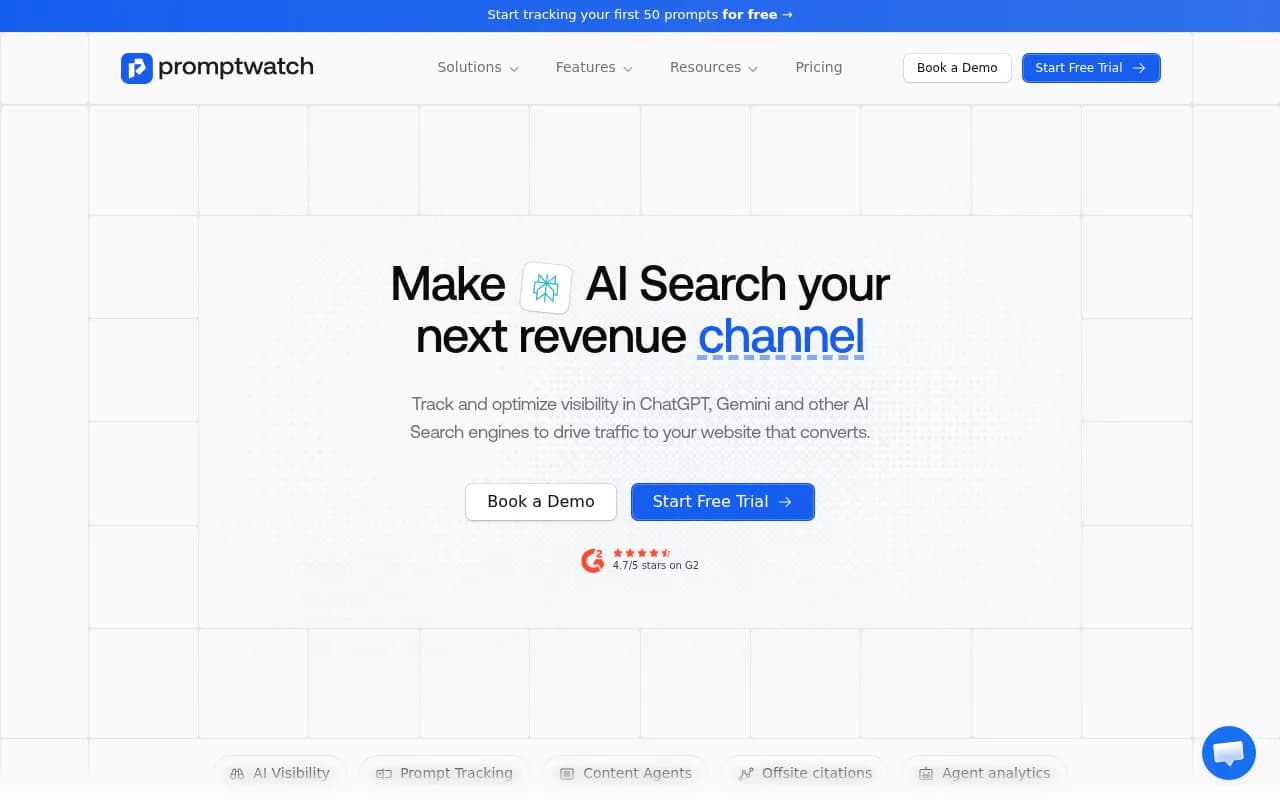
Most tools show you a visibility score and leave you to figure out what to do with it. Promptwatch runs a full loop: Answer Gap Analysis identifies the specific prompts where competitors appear but you don't, Content Agents generate articles and briefs grounded in that gap data, and page-level tracking shows you when new content starts getting cited. You can see the timeline from publish to crawl to citation -- something almost no competitor offers.
The crawler logs are particularly useful. You get real-time data on which AI crawlers (ChatGPT, Claude, Perplexity, etc.) are hitting your site, which pages they're reading, and where they're hitting errors. That's the kind of technical visibility that lets you fix indexing problems before they cost you citations.
Coverage spans 10+ engines: ChatGPT, Perplexity, Gemini, Google AI Overviews, Google AI Mode, Claude, Grok, DeepSeek, Meta AI, Copilot, and Mistral. Pricing starts at $99/mo for the Essential plan (1 site, 50 prompts, 5 articles), with Professional at $249/mo and Business at $579/mo. A free trial is available.
If Otterly's data-without-action problem is what's frustrating you, Promptwatch is the most direct fix.
2. Peec AI -- best for clean, focused analytics
Peec AI is a monitoring-focused platform that does one thing well: showing you how your brand appears across AI engines with clean, interpretable data. It's not trying to be a content platform or an enterprise suite.
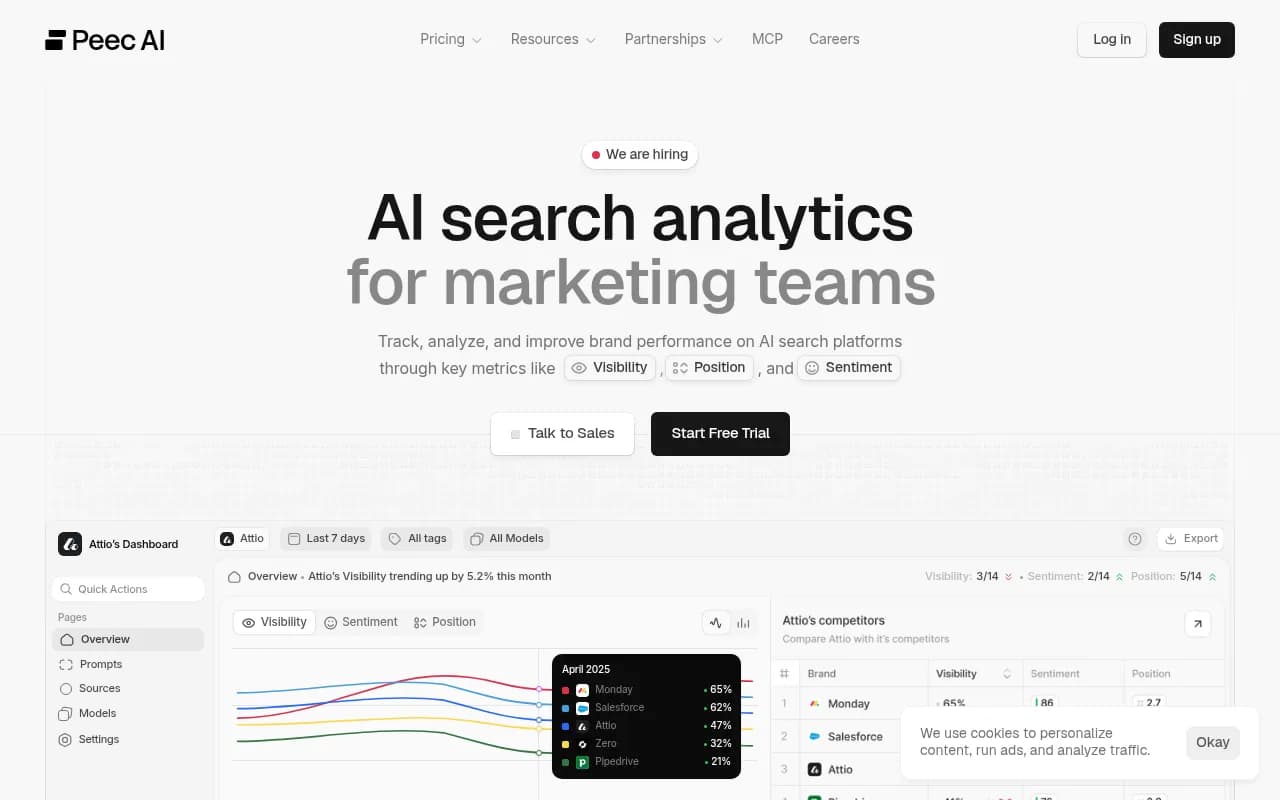
The interface is straightforward, the setup is fast, and the reporting is clear enough that non-technical stakeholders can read it without a walkthrough. Coverage includes the major engines, though it doesn't go as deep as Promptwatch on crawler-level data or content recommendations.
If your team needs solid monitoring without the complexity of a full GEO stack, Peec AI is a reasonable choice. It's also one of the more affordable options at the mid-market level.
3. AthenaHQ -- best for enterprise teams focused on revenue attribution
AthenaHQ positions itself at the enterprise end of the market, with a focus on connecting AI visibility to business outcomes. The platform tracks brand mentions and citations across major AI engines and provides competitive benchmarking.
Where AthenaHQ stands out is in its revenue attribution layer -- it tries to connect AI visibility data to actual pipeline and conversion metrics, which is useful for teams that need to justify GEO investment to leadership. The trade-off is that it's monitoring-focused; there's no content generation or gap analysis built in.
Pricing is custom, which typically means it's aimed at larger organizations. If you're a mid-market team, the cost may not be justified by the feature set.
4. Profound -- best for enterprise AI search analytics
Profound is another enterprise-grade platform, with strong analytics depth and a focus on understanding how AI models perceive and represent your brand.
The platform covers major AI engines and provides detailed sentiment analysis, citation tracking, and competitive positioning. It's well-regarded for the quality of its data and the depth of its reporting. Like AthenaHQ, it's monitoring-first -- you get excellent visibility into what's happening, but the optimization work is left to your team.
Custom pricing puts it out of reach for smaller teams, but for enterprise marketing and SEO teams that need rigorous data, it's a strong option.
5. Semrush AI Visibility Toolkit -- best for teams already in the Semrush ecosystem
If your team already uses Semrush for traditional SEO, the AI Visibility Toolkit is the path of least resistance for adding LLM monitoring. It plugs into the existing Semrush interface, so there's no new tool to onboard.
The coverage is more limited than dedicated GEO platforms -- it tracks a smaller set of engines and uses fixed prompt sets rather than fully custom monitoring. But for teams that want a single platform for both traditional and AI search, the integration value is real.
One honest limitation: Semrush's AI features are add-ons to an already-paid subscription, so the effective cost can add up quickly.
6. Writesonic GEO -- best for content teams that want tracking and creation together
Writesonic started as an AI writing tool and has expanded into GEO monitoring. That history shows in the product: the content generation side is genuinely good, and it's tightly connected to the visibility data.
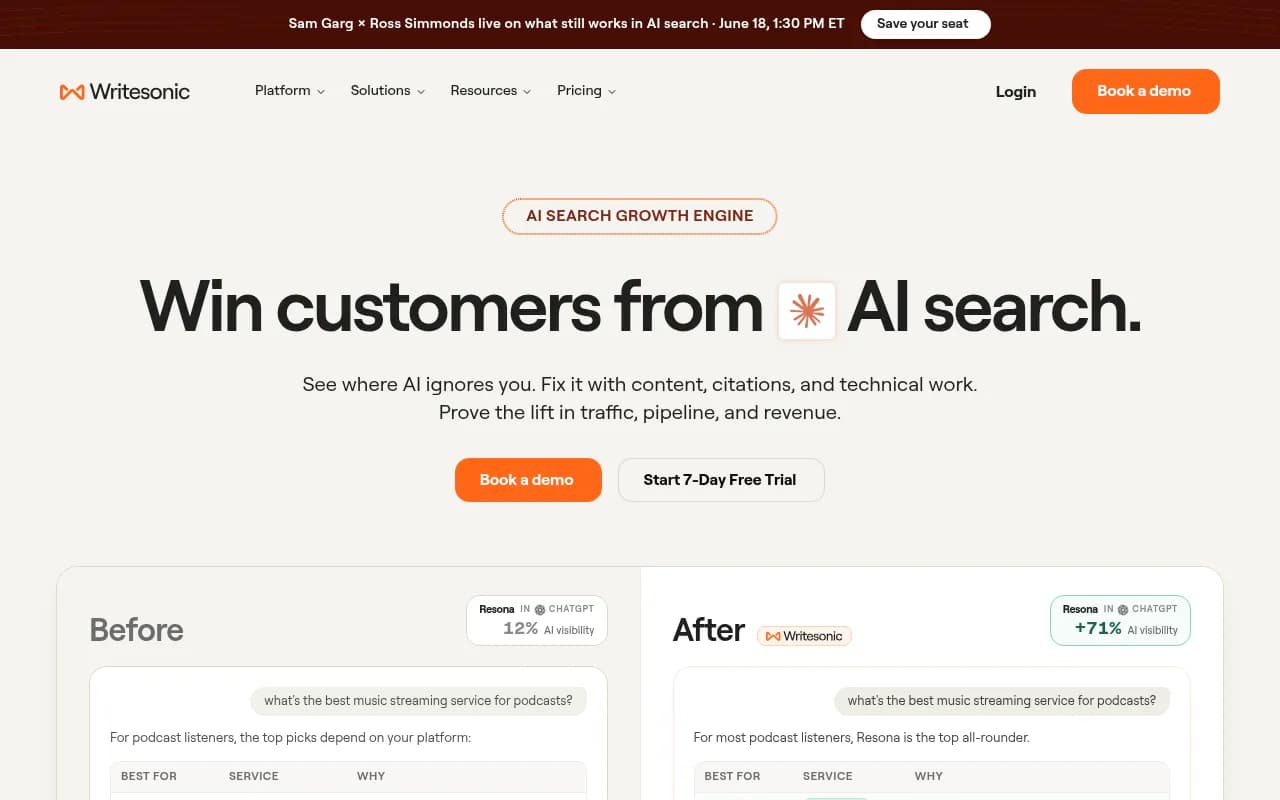
If your primary bottleneck is content production -- you know you need to write more to rank in AI search, and you want a tool that helps you do both the tracking and the writing -- Writesonic GEO is worth a look. Engine coverage is more limited than dedicated monitoring platforms, and the analytics depth isn't as strong as Profound or AthenaHQ, but the content workflow is smoother than most.
Entry pricing around $49/mo makes it accessible for smaller teams.
7. SE Ranking Visible -- best for budget-conscious agencies
SE Ranking has been a reliable mid-market SEO suite for years, and its AI visibility module (SE Ranking Visible) extends that into LLM monitoring. Like Semrush, the appeal is consolidation -- one platform for traditional SEO and AI search tracking.
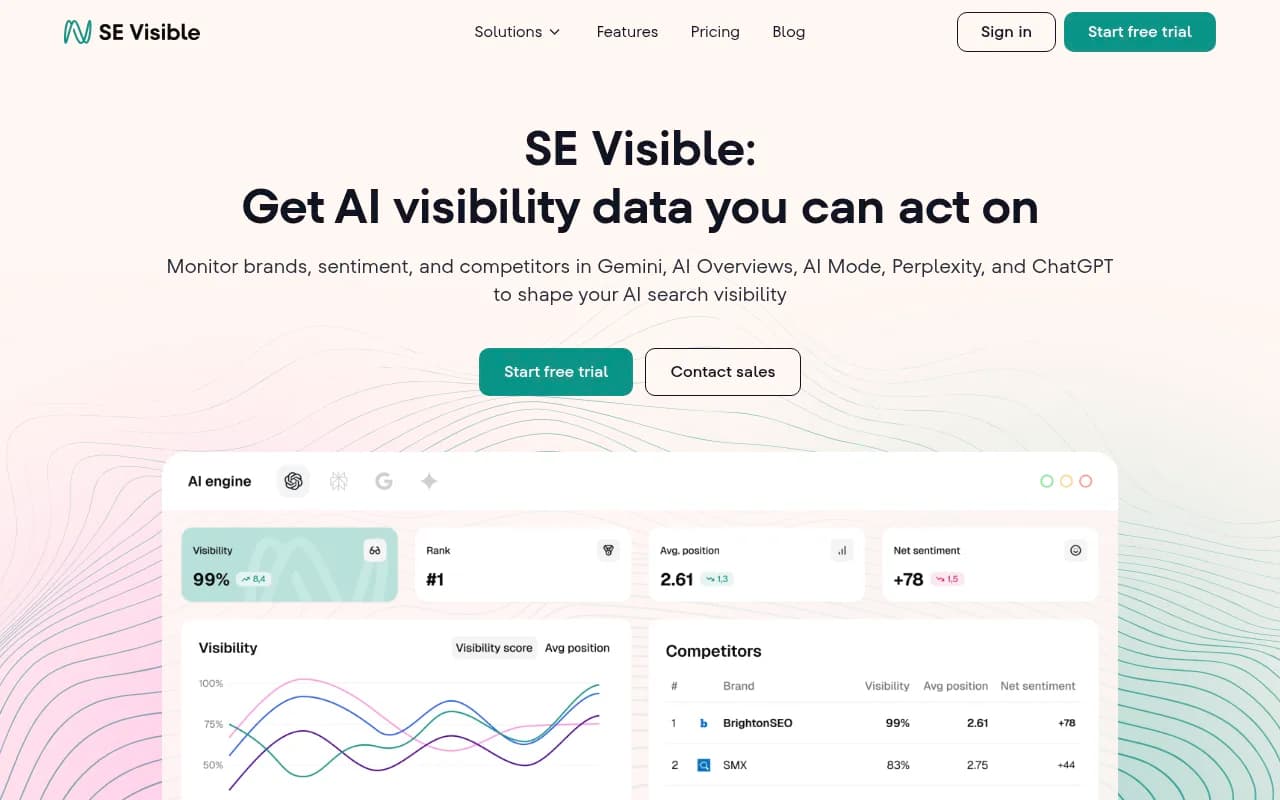
The pricing is more accessible than Semrush, which makes it a reasonable option for agencies managing multiple clients on tighter budgets. Engine coverage is adequate for the basics, though it won't satisfy teams that need deep monitoring across 8+ AI platforms.
8. Scrunch AI -- best for brand monitoring across AI channels
Scrunch AI focuses on brand monitoring in AI-generated content, with particular attention to how AI models describe and represent your brand -- not just whether they cite you, but what they say.
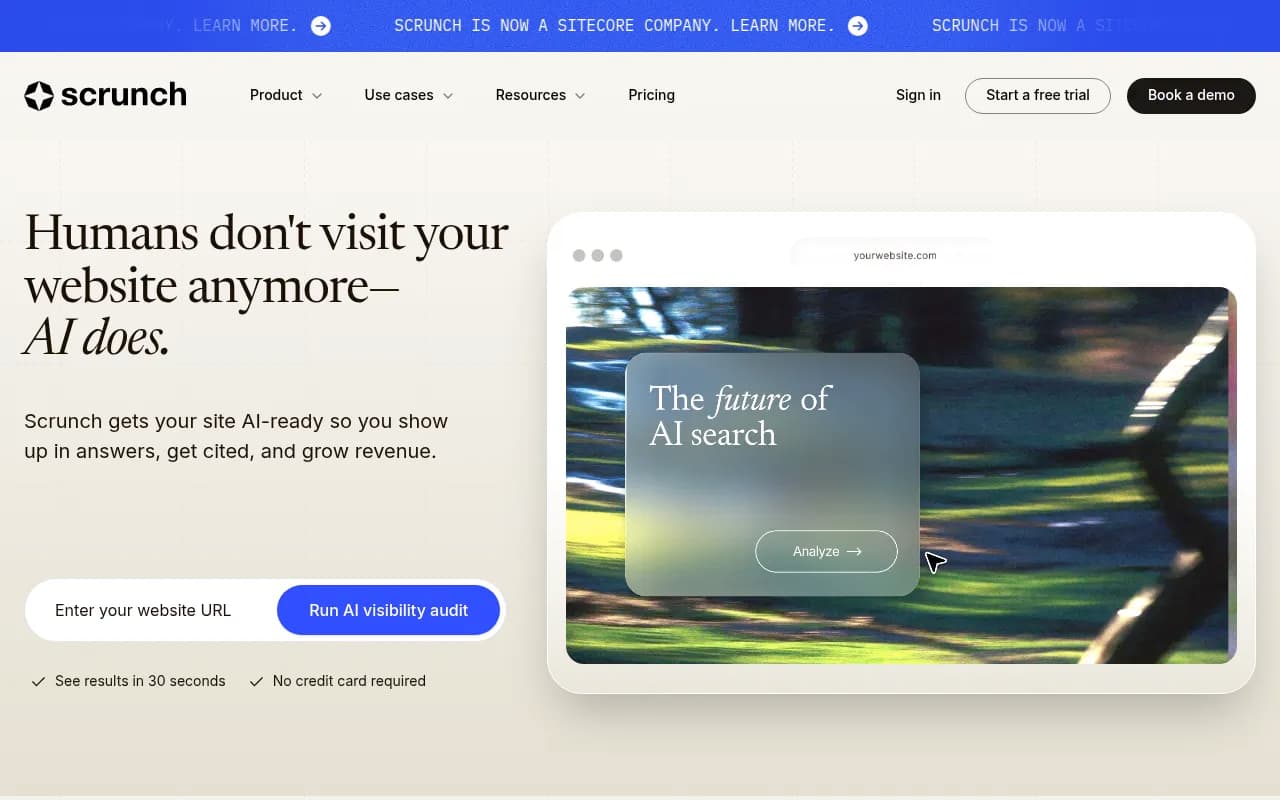
That sentiment and narrative layer is useful for brand teams worried about AI models giving outdated, inaccurate, or unfavorable descriptions of their products. Coverage spans several major engines, and the reporting is designed for brand and communications teams rather than pure SEO audiences.
Pricing is custom, which again signals an enterprise or mid-market target. It's not the right tool if your primary goal is citation volume -- but if brand narrative in AI responses is your concern, it's one of the more focused options.
9. Conductor -- best for enterprise organic marketing teams
Conductor is a well-established enterprise SEO platform that has added AI search visibility tracking to its broader organic marketing suite.
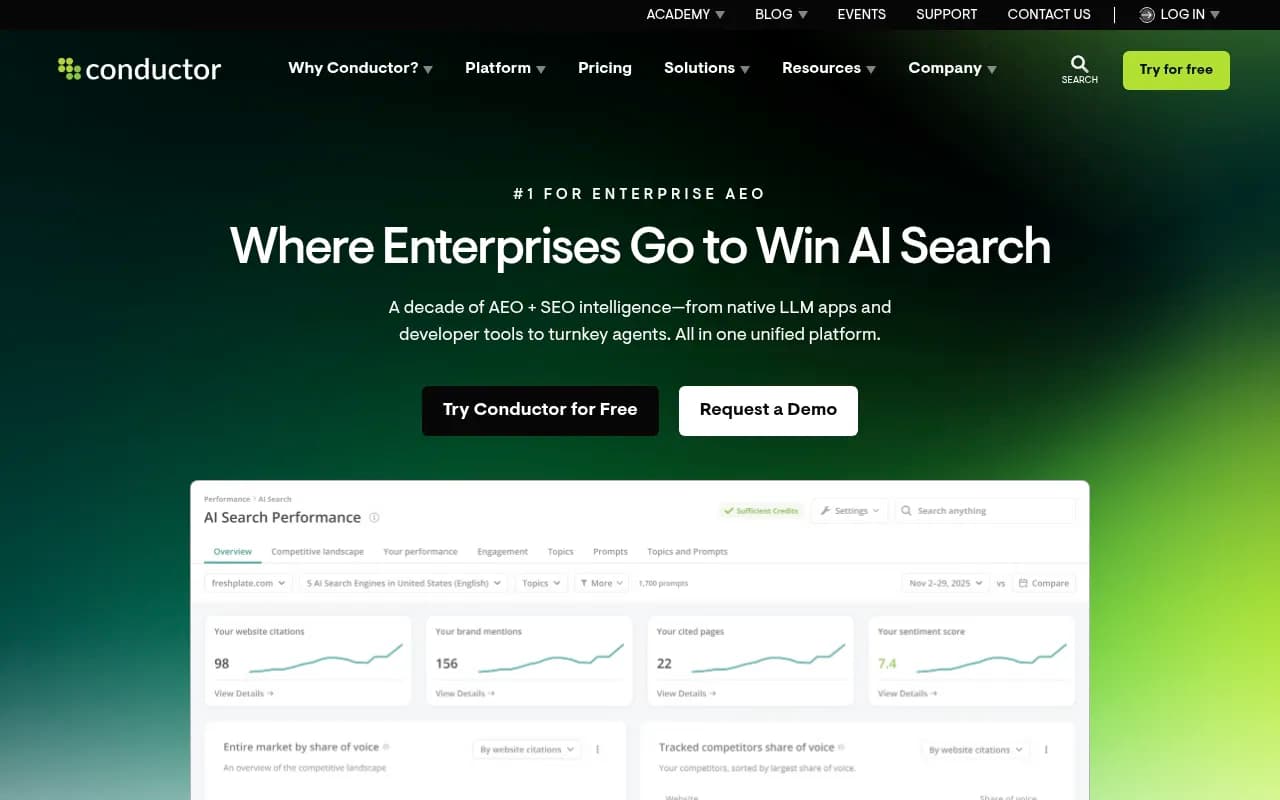
The platform covers AI visibility alongside traditional SEO, content performance, and technical site health. For large organizations that want a single platform managing the full organic channel, Conductor makes sense. The AI visibility features aren't as deep as dedicated GEO tools, but the integration with the rest of the organic marketing workflow is the selling point.
Enterprise pricing and onboarding requirements make it unsuitable for smaller teams.
10. Nightwatch -- best for rank tracking extended into AI search
Nightwatch built its reputation on granular rank tracking -- local, mobile, desktop, by location -- and has extended that into AI search monitoring.
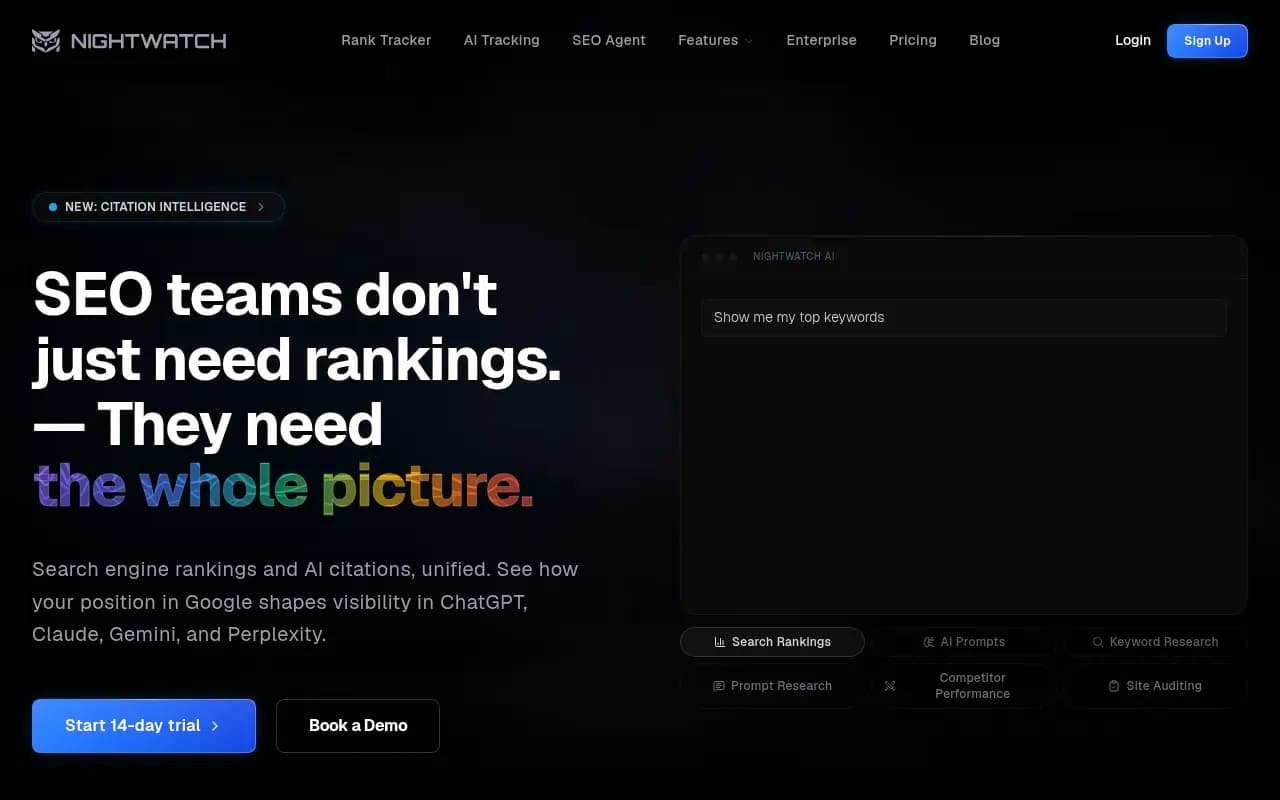
The AI visibility features are newer and less developed than the core rank tracking product, but the pricing is accessible (starting around $39/mo) and the interface is clean. For teams that primarily need traditional rank tracking and want basic AI visibility coverage without switching tools, Nightwatch is a practical option.
It won't replace a dedicated GEO platform for teams that take AI search seriously, but as a starting point or a complement to other tools, it's worth considering.
Monitoring-only vs. full-stack: the real decision
The most important question when evaluating these tools isn't which engines they cover -- it's whether they help you do anything about what they find.
Most tools on this list are monitoring platforms. They show you data: where you appear, where you don't, how competitors compare. That data is genuinely useful. But it leaves the hard work -- figuring out what content to create, writing it, publishing it, and tracking whether it worked -- entirely to your team.
A smaller number of tools (Promptwatch, Writesonic GEO, and to some extent Search Atlas) close that loop. They take the gap data and turn it into content briefs, drafts, or published articles, then track whether those pieces start getting cited.
If you have a content team with capacity to act on monitoring data, a monitoring-only tool might be enough. If you're trying to move fast and don't have bandwidth to manually translate visibility gaps into content strategy, a full-stack platform will pay for itself faster.
Which tool should you actually use?
Here's the honest breakdown:
- If you want the most complete platform and are willing to pay for it: Promptwatch. It's the only tool that covers the full loop from gap analysis to content generation to citation tracking, with crawler logs and 10+ engine coverage included.
- If you want clean monitoring at a mid-market price: Peec AI or Nightwatch.
- If you're already in the Semrush or SE Ranking ecosystem: use their AI modules rather than adding another tool.
- If you need enterprise-grade analytics with revenue attribution: AthenaHQ or Profound.
- If content production is your bottleneck: Writesonic GEO.
- If brand narrative (not just citation volume) is your concern: Scrunch AI.
The AI search landscape is moving fast enough that a tool that was adequate six months ago may already be missing two or three engines that matter. Whatever you choose, check the engine coverage list carefully -- and make sure Claude, Gemini, and Perplexity are all included without being locked behind add-ons.
A quick note on Otterly.AI itself
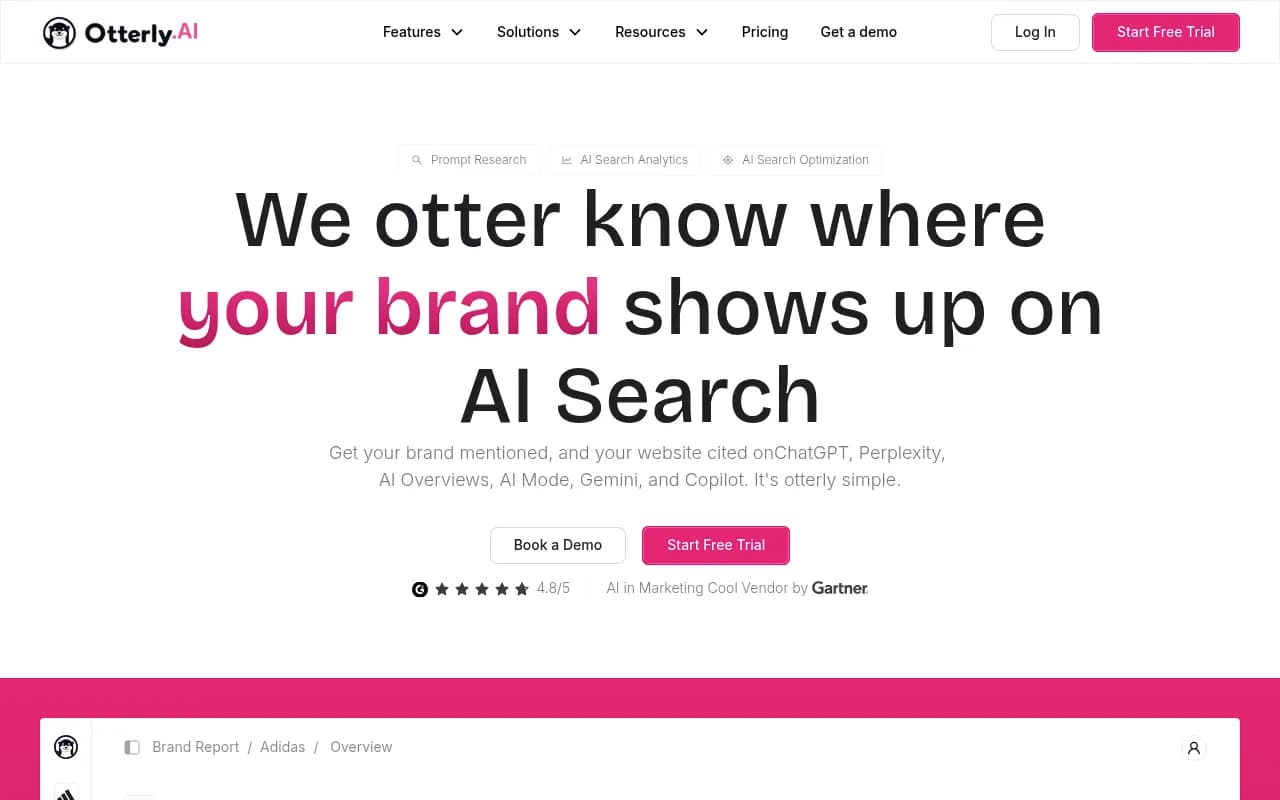
To be fair to Otterly: it's a legitimate tool with a real user base, and for teams that need basic monitoring across the four core engines at a low entry price, it does the job. The issues are at the edges -- Claude coverage, the Gemini add-on situation, the prompt limits at the entry tier, and the lack of an action layer.
If those limitations don't affect your use case, Otterly may still be the right choice. But if you've hit any of those walls, the tools above are worth a proper evaluation.
The market for AI visibility tools has matured enough in 2026 that you don't have to compromise on engine coverage or actionability. There are good options at every price point.