Key takeaways
- The real spread in this category isn't the sticker price, it's cost per 1,000 AI responses, and that spread runs from roughly $10 to $327 across tools that market themselves almost identically.
- $0 gets you a one-time check or a 7-14 day trial. Only AthenaHQ runs a genuinely free, ongoing credit-metered plan.
- At $50/month you're buying 15-25 prompts on 1-4 engines, usually with Claude, Gemini, or Google AI Mode locked behind add-ons.
- At $150/month you cross into daily multi-engine tracking with real prompt volume, but you're still capped on seats, projects, or export options.
- $500/month is where agency features (unlimited seats, multiple client workspaces, API access) and near-full engine coverage (7-9 platforms) actually show up.
- Citation behavior itself changes overnight, so cheap, infrequent sampling isn't a smaller version of the same product, it's a statistically different one.
Why price-per-response matters more than the plan name
Every vendor in this category is selling the same raw material: repeated queries against AI answer engines, logged over time. The feature pages look different, the dashboards look different, but underneath it's prompts times engines times refresh frequency. Once you convert plans to a common unit, the picture gets a lot less flattering for some "affordable" options.
I ran the numbers on a handful of plans and the cost per 1,000 AI responses ranges from about $16 (Otterly.ai Standard) to around $327 (a budget-tier plan with a small prompt allowance). That's not a rounding difference. Two products marketed almost identically as "AI visibility tracking" can differ by 20x in what you're actually paying for a single data point.
This matters because of something a 2026 academic study found when it sampled Perplexity, OpenAI search, and Gemini every ten minutes: citation rankings are unstable across samples, and single-run visibility checks give what the researchers called "a misleadingly precise picture." If your plan only checks a prompt once a week, you're not getting a smaller sample of the truth. You're getting noise dressed up as a number.
Promptwatch's own data backs this up from a different angle. Around the GPT-5.3 rollout on March 4, 2026, average citations per ChatGPT search-enabled response dropped from about 6.4 to settling at 4.7-4.9 within weeks, a roughly 27% drop in available citation slots that hit overnight and never recovered. Platform behavior changes without warning. If you're only checking monthly, you'll find out about a shift like that long after it happened and long after your content strategy should have reacted to it (Promptwatch Data, March 2026).
$0: free tiers and trials
Most "free" offers in this space aren't free plans, they're free trials with a clock running. Otterly.ai gives you 14 days, Scrunch gives you 7, Rankscale only offers a trial on its Pro tier. These are demos, not measurement tools, and they're fine for kicking tires but useless for tracking anything over time.
The one real exception is AthenaHQ, which runs a credit-metered "Essential" tier with an initial free credit allowance rather than a countdown timer. It's a working product on the free plan, not a locked demo, and it covers nine engines including ChatGPT, Perplexity, Google AI Overviews, Google AI Mode, Gemini, Claude, Microsoft Copilot, and Grok. The catch: real-world testing shows a 3,600-credit allowance burns through in about 14 days under active monitoring, so free here means "free until you actually use it."

Ahrefs also offers a free AI Visibility Checker, but it's a one-time lead-gen tool, not ongoing tracking. Good for a gut check before you commit budget, not something to build a reporting cadence around.
$50: entry-level tracking with gated engines
This tier is where most small teams start, and it buys a real product, just a narrow one. Otterly.ai Lite runs $29/month ($25 billed annually) for 15 prompts across four base engines: Google AI Overviews, ChatGPT, Perplexity, and Microsoft Copilot. Daily tracking is included, and unlimited team members are included too, which is generous at this price. But Gemini, Claude, and Google AI Mode sit behind add-ons priced $9 to $149/month each depending on tier, so your real monthly cost climbs fast if you want full coverage.

Rankscale's Essentials plan undercuts almost everyone at $20/month ($17 annual-only), the lowest published entry price I found in this category. Its Pro tier at $99/month is the first step up to daily tracking with broader coverage, around 4,800 AI responses per month.
Semrush's AI Visibility Toolkit charges $99/month per domain for 25 tracked prompts across 4 engines. That per-domain pricing is worth flagging: if you're managing multiple brands or client sites, this tier multiplies quickly in a way flat per-account pricing doesn't.
Worth noting: Peec AI restructured its pricing in August 2026, moving from flat USD pricing to geo-priced, annual-billing-preferred EUR rates, with Starter now running roughly €70-85/month. Monthly billing costs more than it used to, and the vendor no longer publishes a flat USD number, which makes comparison shopping harder than it was a year ago.

Profound used to have a $99/month self-serve Starter tier. As of its Series D in September 2026, that's gone. The only options now are a one-time free trial (10 prompts, ChatGPT only, not ongoing) or a custom-quoted Enterprise plan. If you see a guide quoting Profound at $99 or $399, it's stale.

$50 tier comparison
| Tool | Price | Prompts | Engines included | Refresh | Catch |
|---|---|---|---|---|---|
| Rankscale Essentials | $20/mo | 120 credits | 10 | Daily | Lowest published floor, limited depth per credit |
| Otterly.ai Lite | $29/mo | 15 | 4 base | Daily | Claude/Gemini/AI Mode cost extra |
| Peec AI Starter | ~€70-85/mo | Varies | Multiple | Daily | Annual billing now preferred, USD price gone |
| Semrush AI Visibility | $99/mo | 25 | 4 | Daily | Priced per domain |
| SE Visible (SE Ranking) | $79/mo | Varies | Multiple | Daily | Full suite runs higher |
$150: daily multi-engine tracking, real prompt volume
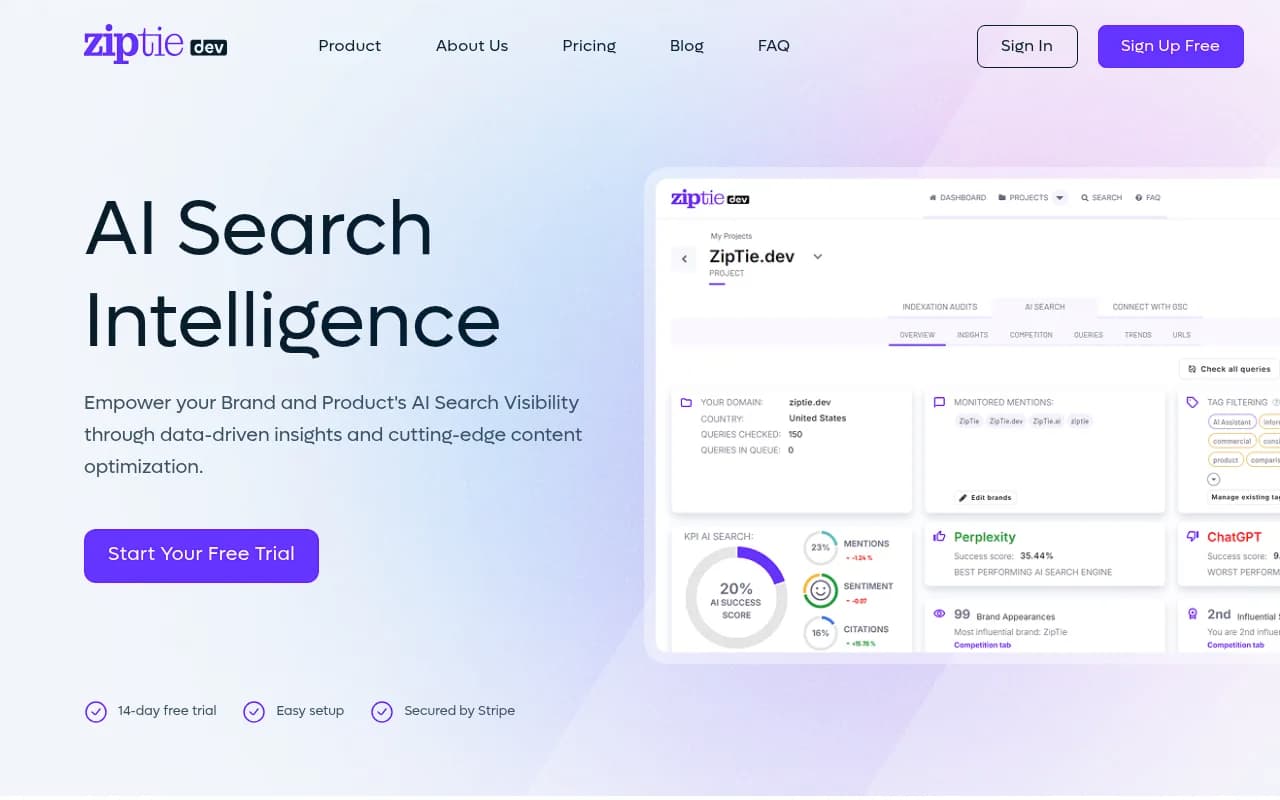
This is where the category starts to feel like an actual visibility platform rather than a sampling tool. ZipTie's Pro plan at $159/month gives you 2,000 AI Search checks a month, with a 14-day trial that includes 75 searches so you can test before committing. Its lower tiers (Basic at $69, Standard at $99) scale up gradually rather than forcing a steep jump.
Knowatoa's ladder spans this whole price range in one product: $59/month Starter (3 platforms), $199/month Growth (7 platforms), $499/month Enterprise. If you expect to grow into more engine coverage, a vendor with a gradual ladder like this avoids the awkward re-platforming that comes with outgrowing a competitor's entry tier.

Ahrefs Brand Radar deserves a specific warning here. It's sold as an add-on, not bundled with base Ahrefs plans, and single-platform coverage runs $199/month on top of a required base Ahrefs plan starting at $129/month. Want all six platforms bundled? That's $699/month on top of the base plan, pushing total cost to roughly $828/month for full coverage. The "starting price" you see in marketing is not what full AI visibility costs with Ahrefs.

SE Ranking's full AI Visibility plan runs roughly €87-188/month depending on tier, with a Growth SEO tier at $279/month if you want it bundled with traditional rank tracking.
$150 tier comparison
| Tool | Price | Checks/prompts | Engines | Notes |
|---|---|---|---|---|
| ZipTie Pro | $159/mo | 2,000 checks | Multiple | 15% off annual, gradual tier ladder |
| Knowatoa Growth | $199/mo | - | 7 platforms | Same vendor spans $59-$499 |
| SE Ranking (full AI plan) | €87-188/mo | Varies | Multiple | Can bundle with classic SEO |
| Ahrefs Brand Radar (1 platform) | $199/mo + $129 base | - | 1 | Full 6-platform bundle is $699/mo add-on |
$500: agency-grade coverage and seats
At this tier you're generally paying for scale across clients, not just engines. Scrunch AI's Agency Core plan is $500/month for 250 unique prompts across 4 engines (ChatGPT, Perplexity, Google AI Overviews, Copilot), unlimited seats, and three brand plus three pitch workspaces. Its Core (single-brand) tier at $250/month gives you half the prompts and five seats, so the jump to Agency roughly doubles both prompt volume and workspace count for the same per-seat cost.

AthenaHQ's paid Starter tier sits at $295/month, credit-based (1 credit = 1 AI response), positioned just under Scrunch's entry point. Peec AI's agency ladder runs Essential $245/month (10,000 credits, roughly 111 prompts/day, 3 client projects) up through Scale at $795/month (65,000 credits, about 722 prompts/day, 25 projects).
Ahrefs again tops the list on an all-in basis: $699/month for the 6-platform Brand Radar bundle, plus a mandatory ~$129/month base plan, landing around $828/month total. Profound's only ongoing paid option post-restructure is a custom-quoted Enterprise plan covering up to 9 engines, so there's no longer a published number to compare at this tier, just "call sales."
$500 tier comparison
| Tool | Price | Prompts/credits | Seats | Workspaces |
|---|---|---|---|---|
| Scrunch Agency Core | $500/mo | 250 prompts | Unlimited | 3 brand + 3 pitch |
| AthenaHQ Starter | $295/mo | 3,600 credits (~14 days active use) | - | - |
| Peec AI Scale (agency) | $795/mo | 65,000 credits | - | 25 projects |
| Ahrefs Brand Radar (full bundle) | $699/mo + $129 base | - | - | - |
The thing every tier hides: query fanouts
Here's a detail that most pricing pages don't mention, and it affects every tier equally. ChatGPT doesn't run one search per prompt you track, it fans out into multiple sub-queries per response. Promptwatch's data shows this averaged around 1.8-2.15 fanout queries per response through the winter of 2025-26, dropped to roughly 1.0 by April 2026, then on August 8, 2026 ChatGPT started using the site: operator at scale, jumping from 0.4% to 17% of fanout queries overnight with searches-per-response nearly doubling (Promptwatch Data).
What this means for your pricing decision: a "150 prompts/month" plan doesn't track 150 discrete AI responses, it tracks 150 prompts that themselves generate a variable, platform-controlled number of underlying search queries. Vendors that publish "query fanout" or "searches per response" metrics, rather than just a flat prompt count, are giving you a more honest picture of what you're buying.
It also explains why engine choice matters as much as plan tier. Promptwatch's analysis of average sources per response found Perplexity holds almost exactly 10 citations per answer with barely a decimal of movement day to day, making it a stable testbed where visibility changes reflect your content, not platform noise. Microsoft Copilot, by contrast, swung from under 2 sources per response to nearly 17 within a few weeks before settling back down, evidence the retrieval system there is still being rebuilt (Promptwatch Data, average sources per response). If your budget only covers one or two engines, pick based on that stability data, not just which engine has the most headlines.
What actually changes as you spend more
Across every vendor I looked at, the things that get cut at lower price points follow a pattern, roughly in this order: engine coverage goes first (Claude, Gemini, and Google AI Mode are the usual add-ons), then seats and multi-client workspaces, then export and API access, and finally sampling depth, meaning how often and how many times a prompt actually gets re-checked.
Unlimited seats is one differentiator that doesn't track neatly with price. Peec AI and Otterly.ai include unlimited team members even at their cheapest tiers, while some competitors charge $45-100/month per extra seat on top of a base plan that only includes one. If your team is larger than two or three people, check seat policy before you compare headline prices.
Crawler-level analytics, seeing which AI bots actually visited your pages and what they read, tends to show up only at $150+ tiers or not at all in this category. That matters more than it used to: Promptwatch's crawler data shows OpenAI's share of verified AI crawler requests dropped from 94.8% in early June 2026 to 79.8% by early September, meaning the crawler landscape is diversifying fast and single-engine crawler visibility is increasingly incomplete (Promptwatch Data, AI crawler traffic).
So which tier should you actually buy
If you're a solo operator or small team just trying to see whether your brand shows up in ChatGPT and AI Overviews at all, start at the $20-50 tier with a tool like Rankscale or Otterly.ai Lite, and accept that you'll add engine coverage as an add-on later. Don't bother with free trials beyond a sanity check, they're too short to show you anything about volatility.
If you're running content strategy off this data, meaning you're deciding what to publish or rewrite based on visibility scores, the $150-250 range is the realistic floor. Below that, sample sizes are too thin to distinguish real signal from the kind of noise the 2026 arXiv study flagged.
If you need crawler logs, action plans, or content generation built on top of visibility data rather than just the visibility data itself, that's a different category of spend regardless of tier name. This is also where Promptwatch sits differently than most of what's listed above: instead of just sampling prompts and reporting a score, it adds crawler log analytics (which AI bots hit your pages and what they read), citation trend tracking across Reddit and YouTube, and Content Agents that draft and publish AEO content straight to your CMS. Most tools in this piece answer "were we mentioned." Promptwatch is built to also answer "what do we fix, and who's going to do it."

If you want a managed version of this entirely, where someone else runs the tracking, writes the content, and reports back, that's a services conversation rather than a software purchase. 1001 SEO Media runs exactly that kind of GEO and AI search program for brands that don't want to own the tooling decision themselves.
For a broader look at what's out there beyond the five or six tools covered here, the directory at bestgeosoftware.com tracks a wider set of GEO platforms, and ai-rank-tools.com focuses specifically on rank tracking tools if that's the narrower problem you're solving.
Whatever you pick, convert the sticker price to cost per 1,000 AI responses before you sign an annual contract. That one calculation will tell you more than any feature comparison page the vendor publishes.