Key takeaways
- I found no solid evidence that AirOps itself causes ranking losses. The pattern in 2026 is sites publishing AI content at scale without editorial oversight, then getting hit by the March core update and spam enforcement.
- Diagnose first. Compare Search Console data before and after the March 27 to April 8 rollout, sort by absolute clicks lost, and check whether impressions held while clicks fell (an AI Overviews problem, not a ranking problem).
- Don't delete pages wholesale. Improve, consolidate, or redirect, and remove only pages with no path forward.
- Expect three to six months for real recovery. The biggest rebounds often arrive with the next core update.
- Fewer, more factual, more original pages beat high-volume output, both in Google and in AI citations.
First, the honest framing
The title of this guide is a sentence I see in forums a lot. Someone connects an AI workflow tool, ramps up to dozens of articles a month, and a few weeks later the traffic chart looks like a cliff. It is natural to blame the tool.
Here is the problem with that. AirOps is a workflow platform. It runs tasks that you design. The same platform can produce a carefully researched page with original data or a hundred near-identical pages. Google never sees the tool, only the output. And notably, AirOps' own blog warns about this exact failure mode: its piece on programmatic SEO describes a case where, after an algorithmic penalty, Google refused to rank a site's new content, even human-produced content.
So this guide treats the tool as a multiplier, not a cause. If you scaled a weak process, the tool made the weak process faster. That is still your problem to fix, and it is fixable.
What actually happened in 2026
2026 has not had one core update. It has had a string of them, and that pace is part of why so many people feel blindsided.
- March 24 to 25: a spam update, aimed at manipulative links and low-quality content.
- March 27 to April 8: the first core update of the year, which ran 12 days and 4 hours according to Lucid Media's timeline.
- May: a second core update that industry analysts described as even more disruptive.
- August: another significant update.
Because the spam update and the core update landed two days apart, a lot of sites got hit by both and cannot tell which one did the damage. SE Ranking's analysis, summarized by 253 Media, found that 80% of URLs in top-three positions changed places during the March update, and one in four top-10 pages fell out of the top 100.
Scaled content abuse is the likely culprit
Google defined scaled content abuse in its March 2024 spam policy. The policy does not ban AI content. It targets "many pages generated for the primary purpose of manipulating search rankings and not helping users." Hand-written thin content falls under the same rule.
An agency report from Digital Applied claims that sites publishing hundreds or thousands of AI pages without editorial oversight lost 50 to 80% of organic traffic within about two weeks of the March update. That is a third-party claim, not a Google statement, so treat the exact range with caution. But it matches what Lucid Media describes: affiliate review sites with thin or rewritten content, and sites with shallow topical coverage (one or two posts on a topic), took the worst of it. YMYL categories like health, finance and legal lost 20 to 35% where first-hand experience signals were missing.
What the AI-content data says
Frase, which is a competing AI content tool and so a vendor source, sampled 1 million pages from 100,000 SERPs in June 2026 and ran AI detection on 150,000 of them. Its findings:
- 5% of pages in positions 1 to 3 were classed as 100% AI-generated.
- Pure-AI content held position 1 about 9% of the time. Predominantly human-written content held it about 80% of the time.
Frase reads that as content that doesn't read as machine-written, rather than an AI penalty. I agree with that reading. The takeaway is not that AI is banned. It is that undifferentiated output loses.
Step 1: Figure out whether it is actually a ranking loss
Before touching a single page, check what kind of drop this is. SEO Hacker points out something that is increasingly common in 2026: traffic falls while rankings look fine, because AI Overviews or AI Mode resolves the query before a click happens.
In Search Console, compare impressions to clicks:
| Pattern | Likely cause | What to do |
|---|---|---|
| Impressions stable, clicks down | AI Overviews or AI Mode answering the query | Work on getting cited and on click-worthy angles, not on rewrites |
| Impressions and clicks both down, started Mar 24 to 27 | Spam or core update hit | Audit content quality page by page |
| Drop only on a subset of templated pages | Scaled or programmatic content flagged | Consolidate or remove the weakest templates |
| Gradual decline over months | Staleness or competitors improving | Refresh content and rebuild topical depth |
| Sudden drop, no update date match | Technical issue (indexing, robots, redirects) | Check crawl errors and recent site changes |
If you want a bigger-picture explainer on the different drop types, cognitiveSEO's guide to the common kinds of ranking drops is a decent reference, though I'd trust your own Search Console data over any generic checklist.
Step 2: Find the bleed
This part comes straight from the recovery checklists that Lucid Media and SEO Hacker both lean on, and it works because it forces you to look at absolute numbers.
- In Search Console, compare the 30 days before March 27 with the 30 days after April 8.
- Sort pages by clicks lost, not by percentage drop. A page that went from 3 clicks to 0 is a 100% drop and a rounding error.
- Take the top 20 pages by absolute clicks lost. That list usually holds most of your damage.
If you have a May or August hit on top of March, repeat the exercise with those windows. Stacked drops need separate diagnoses.
Step 3: Categorize every lost page
Open your list of 20 and tag each page. Lucid Media says you will see a pattern within ten minutes, and in my experience that is about right. Ask:
- Was it AI-generated, lightly edited, fully human, or mixed?
- Is it original, or does it recycle what the top ten results already say?
- Does it contain first-hand experience, data, screenshots, quotes, or anything a competitor couldn't copy in an afternoon?
- Does it overlap with another page on your own site?
If the pattern turns out to be "every lost page came out of one workflow with no human input," you have your answer, and it has nothing to do with which tool ran the workflow.
Step 4: Improve, consolidate, or remove
The instinct after a hit is to nuke everything. Resist it. Lucid Media's advice is to decide page by page, and wholesale deletion can hurt your overall site quality signals if you remove too much at once.
- Improve pages with a real topic and recovery potential. Add first-hand input: a practitioner's quote, your own data, original screenshots, a real example with numbers.
- Consolidate pages that overlap with stronger ones. Merge the best parts into the winner and 301 the rest.
- Remove only the pages with no path forward, such as near-duplicate templated pages that nobody needs.
For author signals, put a real, verifiable person on the page with credentials that fit the topic. This matters most for YMYL sites, which were hit hardest when those signals were missing.
Step 5: Change the workflow, not just the pages
Cleaning up the pages without changing how they were made means you will be back here in a year. A workflow that survives 2026 looks like this:
- Publish at a pace you can review. Razor Rank recommends this, and it is common sense. If nobody on your team can honestly read every piece before it goes live, the volume is too high. (I haven't verified Razor Rank's claim that spam policies were extended to cover AI Overviews and AI Mode against Google's own documents, so don't treat that as settled.)
- Start from research, not from a keyword. Build drafts from current SERP research and check information gain and duplication first. If your page says what the top five already say, it adds nothing.
- Add something a model can't invent. Data, experience, a point of view.
- Keep a human editor with veto power. Not a skim, a veto.
There is also a cost angle that people miss. AirOps is task-based, and third-party reviews estimate around 15,000 to 24,000 tasks per month to produce 30 articles. On the Solo tier (roughly $199 to $200 a month with 20,000 tasks per third-party reviews, so check the official pricing page), that can mean overage at $0.025 per task. Pricing pressure pushes teams toward volume, and volume is exactly what Google punished. Budget for fewer, better pieces instead.
Step 6: Wait, and don't thrash
Most of what you read about quick fixes is noise. Lucid Media puts meaningful recovery at three to six months, and the mechanics explain why:
- You make changes.
- Google recrawls, which depends on your crawl budget. Low-authority pages can take weeks.
- Google re-evaluates over rolling windows, not on a single crawl.
- The next core update lands, and that is often when the biggest recoveries show up.
One Reddit thread I read had advice that boils down to the same thing: post more genuinely helpful, thoroughly researched articles, because thin, copy-paste, quick AI posts are flooding results. Unglamorous, but true.
The quick-fix videos going around (there is a 2026 core update recovery livestream making the rounds) mostly repeat generic themes: authority, helpful content, brand trust, user engagement. Fine as a reminder, light on specifics. Your Search Console export is more useful than any of them.
Step 7: Rebuild for AI citations too
If your clicks fell while impressions held, the recovery is partly about being cited inside AI answers, not just ranking below them. AirOps claims that 40% of pages that lost AI Overview citations resurfaced after targeted optimization. That is a vendor claim, so I'd hold it loosely, but the direction is sensible.
What gets cited? Promptwatch Data has numbers for ChatGPT. In its content type report for Sep 28 to Oct 4, 2026, product pages made up 22.4% of ChatGPT citations, landing pages 16.8%, listicles 13.6%, how-tos 8.7%, documentation 7.5%, general articles 6.1%, and news 5.7%. Product and landing pages together account for 39% of citations. A generic blog post is one of the weakest bets.
Shelf life matters too. Per Promptwatch's content half-life data, news loses half its cited pages within about five weeks, while landing pages and docs stay cited for months. If your strategy was mass-producing news-style blog posts, that is a bad format to scale. Fewer, more factual pages built around your product, data and documentation hold up longer.
To track where you actually show up, you need something that checks AI answers rather than only Google positions. Tools like Promptwatch can monitor citations across ChatGPT, AI Overviews, Perplexity and others, and show which of your pages get read by AI crawlers.

There are plenty of alternatives. The GEO software directory at bestgeosoftware.com lists dozens, and the catalog here includes options like Profound, Otterly.AI and Peec AI for monitoring.



Tools worth considering for the rebuild
If you are rethinking the content process, these are the categories I would look at. None of them fixes a bad process, and every one can be misused the same way you may have misused your last tool.
| Tool | Type | Where it helps in recovery |
|---|---|---|
| Clearscope | Content optimization | Grounding rewrites in search data |
| Surfer SEO | Content optimization | On-page checks while you improve existing pages |
| MarketMuse | Content strategy | Finding shallow topical coverage |
| Frase | Content research and optimization | SERP research and duplication checks before drafting |
| NeuronWriter | NLP content optimization | Refreshing thin pages |
| Semrush | SEO suite | Position tracking and audits |
| Ahrefs | SEO suite | Backlink and traffic analysis for pruning decisions |


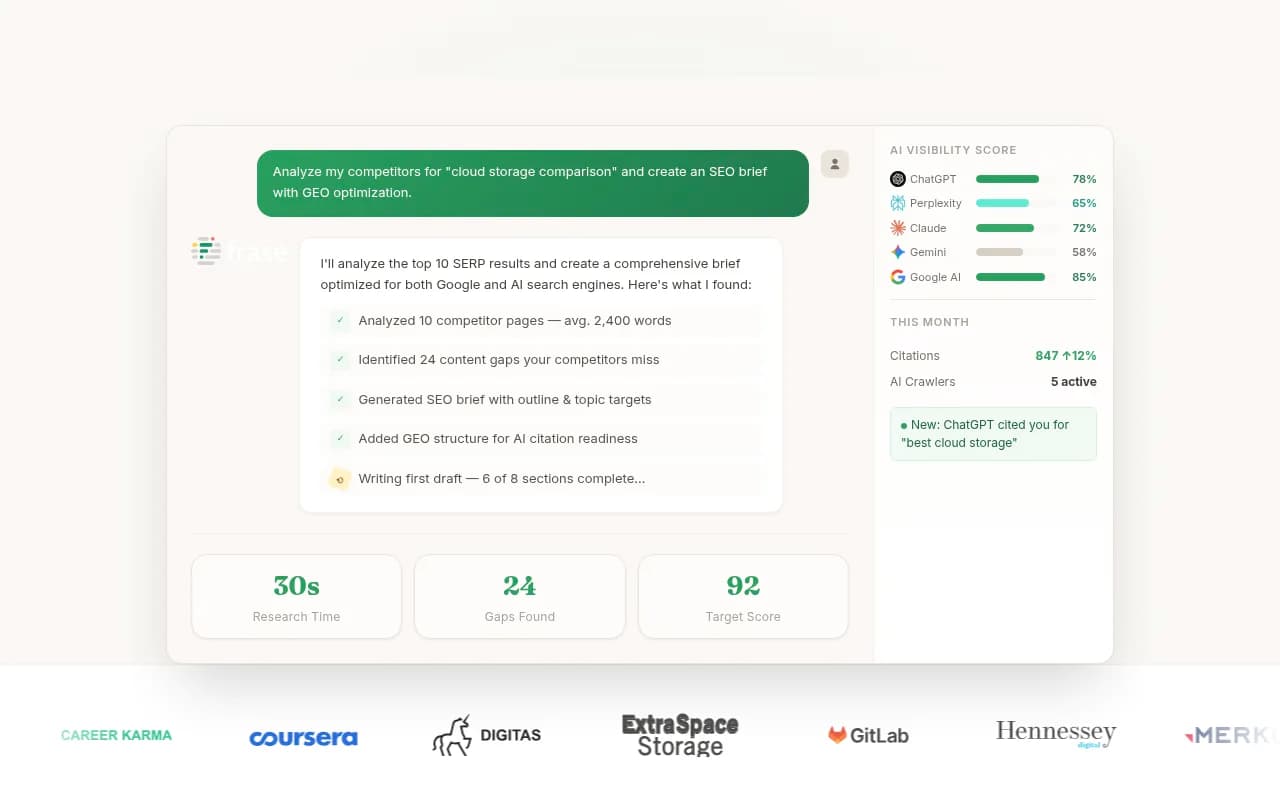
A caution about the research here: Frase's own post admitted that one statistic from AI-assisted research notes was untraceable and had to be removed. If a vendor's research workflow gets caught like that, yours can too. Verify every number you publish.
What not to do
- Don't delete a third of your site in a panic.
- Don't re-run the same workflow with a new prompt and hope.
- Don't keep publishing at full volume while you investigate. More thin pages make the problem worse.
- Don't chase every update date. If you fix quality, you fix it for all of them.
- Don't assume the tool is the problem and swap to another one that does the same thing at the same scale.
Do you actually need help?
If you have a large site, stacked drops from March and May, and no one on the team who can run the audit, an outside audit can save months. 1001 SEO Media handles SEO audits and content strategy, and the same questions apply to any agency you vet: who reads the content, and how do they prove that pages are original?
Bottom line
AirOps didn't ruin your rankings in any way I can prove. A process that produced pages faster than anyone could review them did, and Google's March 2026 enforcement made that expensive. Find the 20 pages that cost you the most clicks, sort them into improve, consolidate and remove, slow your publishing to the speed of your editors, and then give it a full quarter before you judge the result.