Key takeaways
- Most AI visibility platforms are monitoring dashboards -- they show you data but don't help you act on it. A small number go further and help you close the gaps.
- For product category tracking specifically, you need a platform that lets you segment prompts by category, track multiple AI models simultaneously, and surface which competitors are winning for category-level queries.
- Promptwatch is the only platform in 2026 rated as a leader across all evaluation categories, largely because it combines monitoring with content gap analysis and AI content generation.
- Enterprise teams with large budgets should look at Profound. Teams that want affordable monitoring can start with Otterly.AI or Peec AI. Agencies managing multiple brands should evaluate Promptwatch or Search Party.
- Tracking AI visibility across product categories requires more than brand monitoring -- you need prompt-level data, competitor heatmaps, and the ability to act on what you find.
If you sell across multiple product categories, you already know that AI search has changed the game. When someone asks ChatGPT "what's the best noise-cancelling headphone under $200" or "which project management tool works best for remote teams," they're not getting a list of links. They're getting a recommendation. And if your brand isn't in that recommendation, you don't exist for that query.
The problem is that most AI visibility tools were built to track brand mentions, not product category visibility. There's a real difference. Brand monitoring tells you how often "Acme Corp" shows up in AI responses. Category tracking tells you whether you're being recommended when someone asks about the specific type of product you sell -- and who's beating you for those queries.
This guide covers the platforms that are actually worth your time in 2026, with a focus on which ones handle product category tracking well.
Why product category tracking is harder than brand monitoring
Brand monitoring is relatively simple: run your brand name through a set of prompts, count the mentions, track sentiment. Most tools can do this.
Category tracking is messier. You need to:
- Build a library of category-level prompts ("best CRM for small business," "top accounting software for freelancers," "recommended ergonomic chairs under $500")
- Run those prompts across multiple AI models, because ChatGPT and Perplexity often give different answers
- Track which competitors appear in those responses, not just whether you do
- Understand why you're missing from certain responses -- is it a content gap, a citation problem, or a domain authority issue?
- Monitor changes over time as AI models update their training data and retrieval behavior
Very few platforms handle all of this. Most stop at step two.
The platforms worth knowing in 2026
Promptwatch -- best overall for category tracking and optimization
Promptwatch is the platform I'd recommend first if you're serious about product category visibility. It monitors 10 AI models (ChatGPT, Perplexity, Claude, Gemini, Grok, DeepSeek, Copilot, Meta AI, Google AI Overviews, and Google AI Mode), which matters because category recommendations vary significantly between models.
What separates it from most competitors is the Answer Gap Analysis feature. It shows you exactly which category-level prompts your competitors are appearing in but you're not -- and then helps you understand what content is missing from your site. That's not just monitoring; it's a diagnosis.
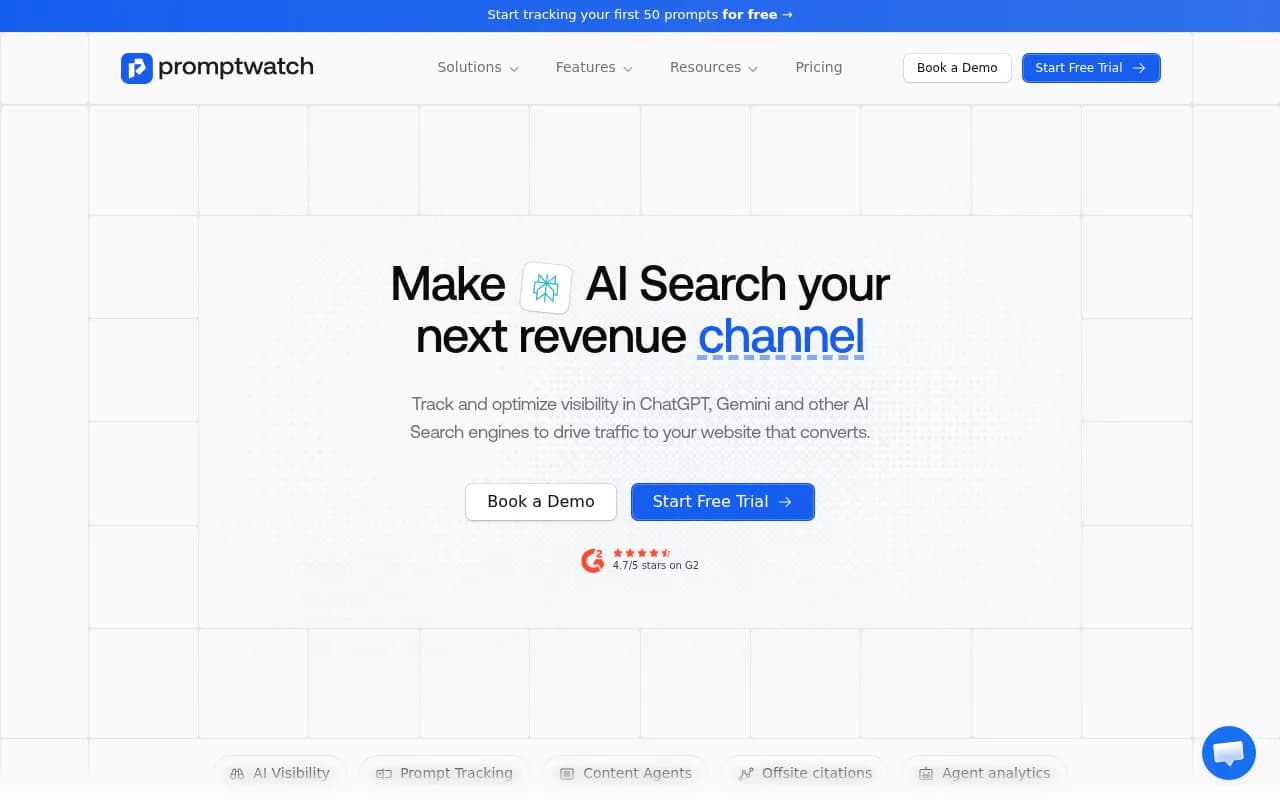
The Content Agents feature takes it further. Once you know which category prompts you're missing, you can generate content specifically engineered to fill those gaps -- articles, comparisons, listicles -- grounded in real prompt data and competitor analysis. Most platforms leave you to figure out the "now what" yourself.
For product category tracking specifically, the competitor heatmaps are genuinely useful. You can see, across a grid of prompts and AI models, who's winning for each category query. If you're a mattress brand and you want to know who's dominating "best mattress for back pain" across ChatGPT, Perplexity, and Gemini, that view gives you the answer at a glance.
Promptwatch also tracks AI crawler logs -- real-time data on when ChatGPT's crawler, Perplexity's bot, and others are hitting your pages, which pages they're reading, and whether those pages are actually getting cited. That feedback loop is something most competitors don't offer at all.
Pricing starts at $99/month for one site and 50 prompts, with the Professional plan at $249/month covering 150 prompts and crawler logs.
Profound -- best for enterprise teams with large budgets
Profound is a solid enterprise-grade platform with strong analytics and a clean interface. It handles multi-model monitoring well and has good prompt management features for teams running large prompt libraries across product categories.
The main limitation is price -- Profound sits at a higher price point than most alternatives, and some of the features that Promptwatch includes by default (content generation, crawler logs) require additional setup or aren't available. For a large enterprise team that just needs monitoring and reporting, Profound is a reasonable choice. For teams that want to act on what they find, it's less complete.
Peec AI -- good for marketing teams that want clean data
Peec AI is built for marketing teams that want visibility, position tracking, sentiment analysis, and source data without a steep learning curve. The interface is clean and the data is organized well.
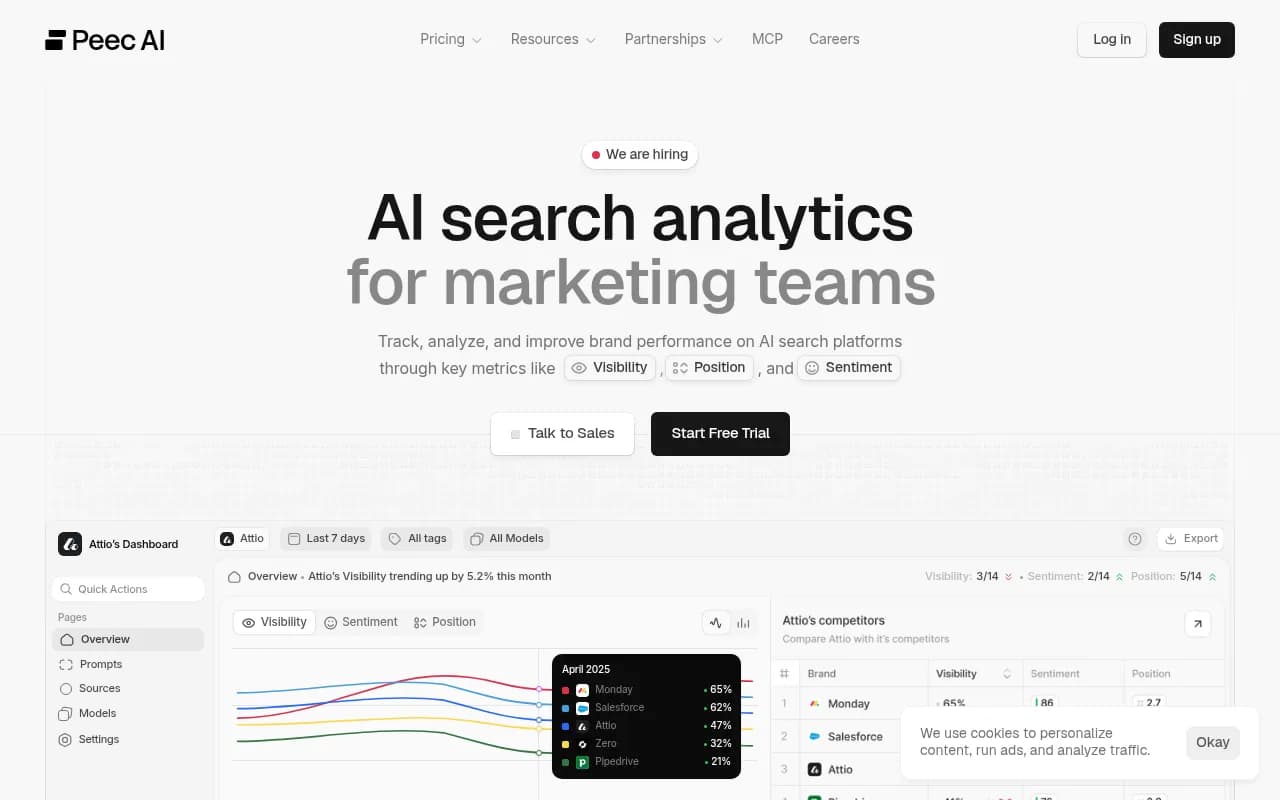
For product category tracking, Peec AI lets you monitor specific prompts and track which sources AI models are citing. It's genuinely useful for understanding the citation landscape in your category. The gap is that it's primarily a monitoring tool -- there's no content generation or structured gap analysis to help you close the visibility gaps you find.
Otterly.AI -- best budget option for smaller teams
Otterly.AI is the most accessible entry point in this space. It's affordable, covers the major AI models, and gives you brand and prompt monitoring without a complicated setup.
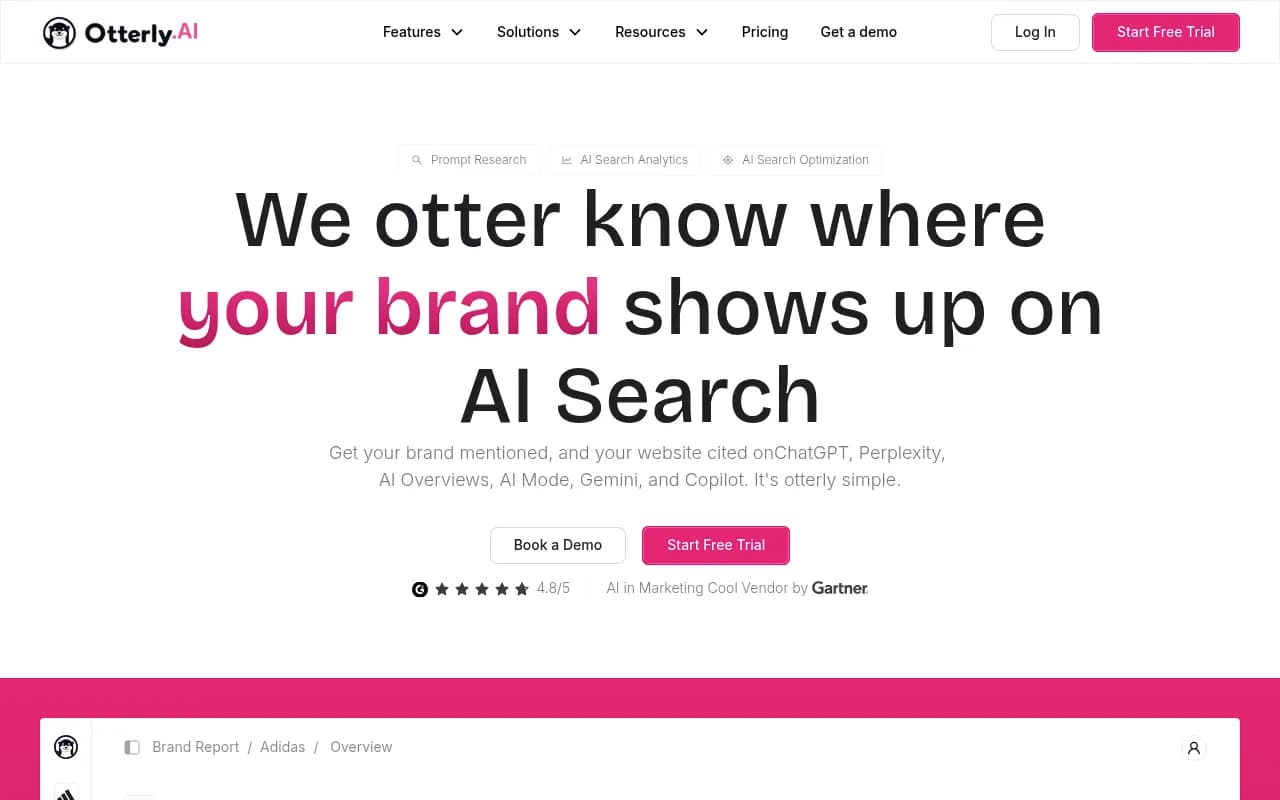
The tradeoff is depth. Otterly.AI doesn't have crawler logs, content generation, or detailed competitor heatmaps. For a small team that wants to start tracking AI visibility across a handful of product categories without a big investment, it's a reasonable starting point. For teams that need to act on the data, you'll hit the ceiling quickly.
AthenaHQ -- monitoring-focused with good prompt management
AthenaHQ has a clean approach to prompt management and lets you organize queries by category, which is useful for product category tracking. The monitoring data is solid.
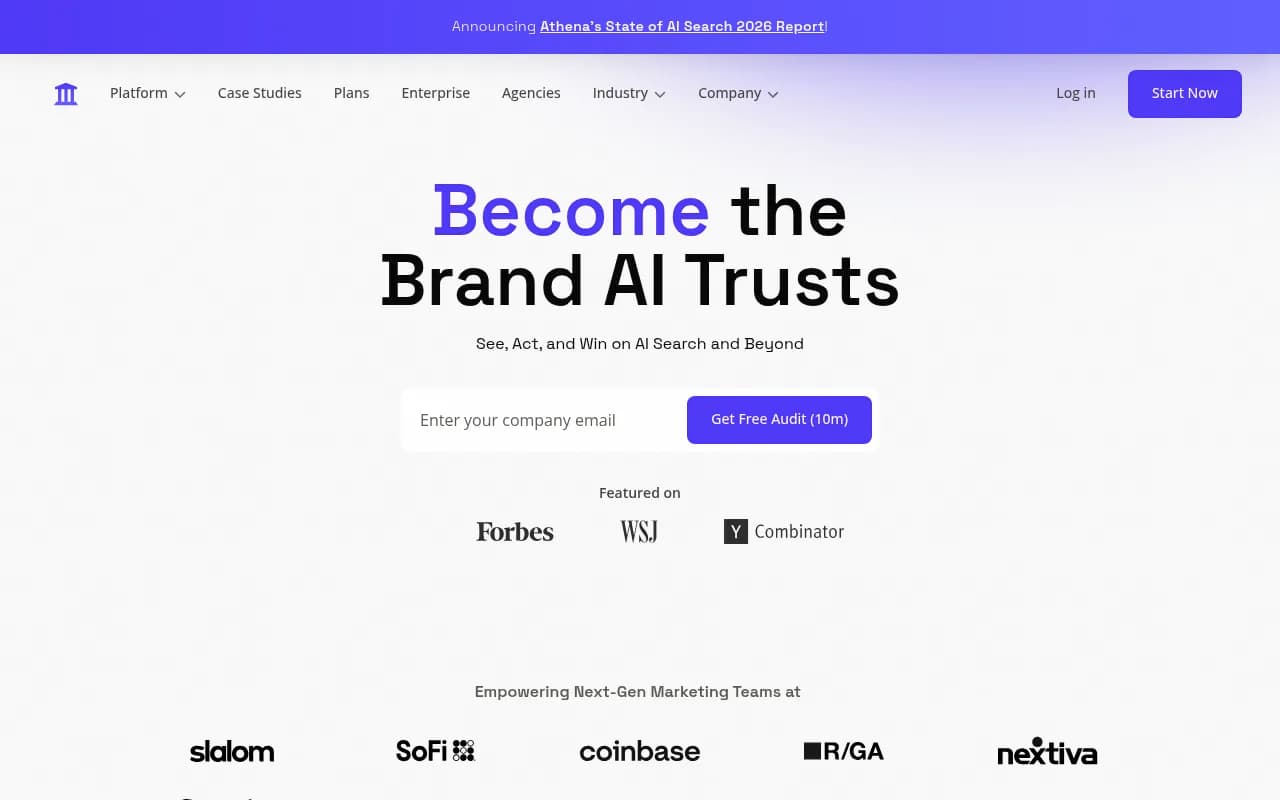
Like most monitoring-only platforms, AthenaHQ doesn't help you do anything with what you find. It's a tracker, not an optimizer. That's fine if you have a separate content team that can take the data and run with it, but if you're looking for an end-to-end workflow, it's not there.
Ahrefs Brand Radar -- familiar tool, limited AI depth
If you're already an Ahrefs user, Brand Radar gives you a way to see AI visibility data alongside your existing SEO data. That integration is genuinely convenient.
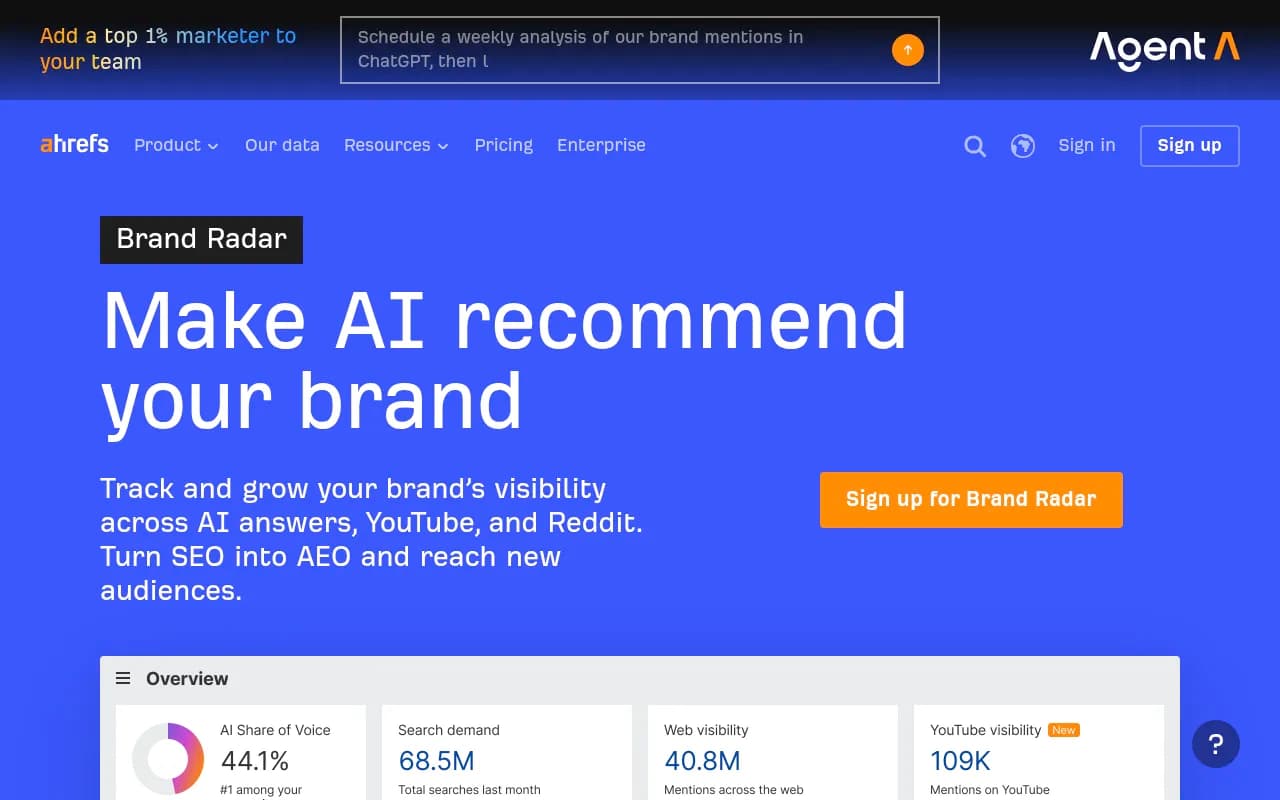
The limitations are real though. Brand Radar uses fixed prompts, which means you can't build a custom prompt library for your specific product categories. There's no AI traffic attribution, no content generation, and no crawler logs. It's a useful add-on for existing Ahrefs customers, not a primary AI visibility tool.
Semrush AI visibility toolkit -- broad but shallow
Semrush has added AI visibility features to its platform, and for teams already paying for Semrush, it's worth exploring. The integration with existing keyword and competitor data is a plus.
The issue is similar to Ahrefs: fixed prompts, no custom prompt libraries for category tracking, and no content generation. Semrush is a traditional SEO platform that has added AI monitoring features. It's not built around AI visibility as a core use case.
SE Ranking Visible -- solid mid-market option
SE Ranking's dedicated AI visibility product covers the main AI models and gives you prompt tracking with reasonable depth. It's a mid-market option that sits between the budget tools and the enterprise platforms.
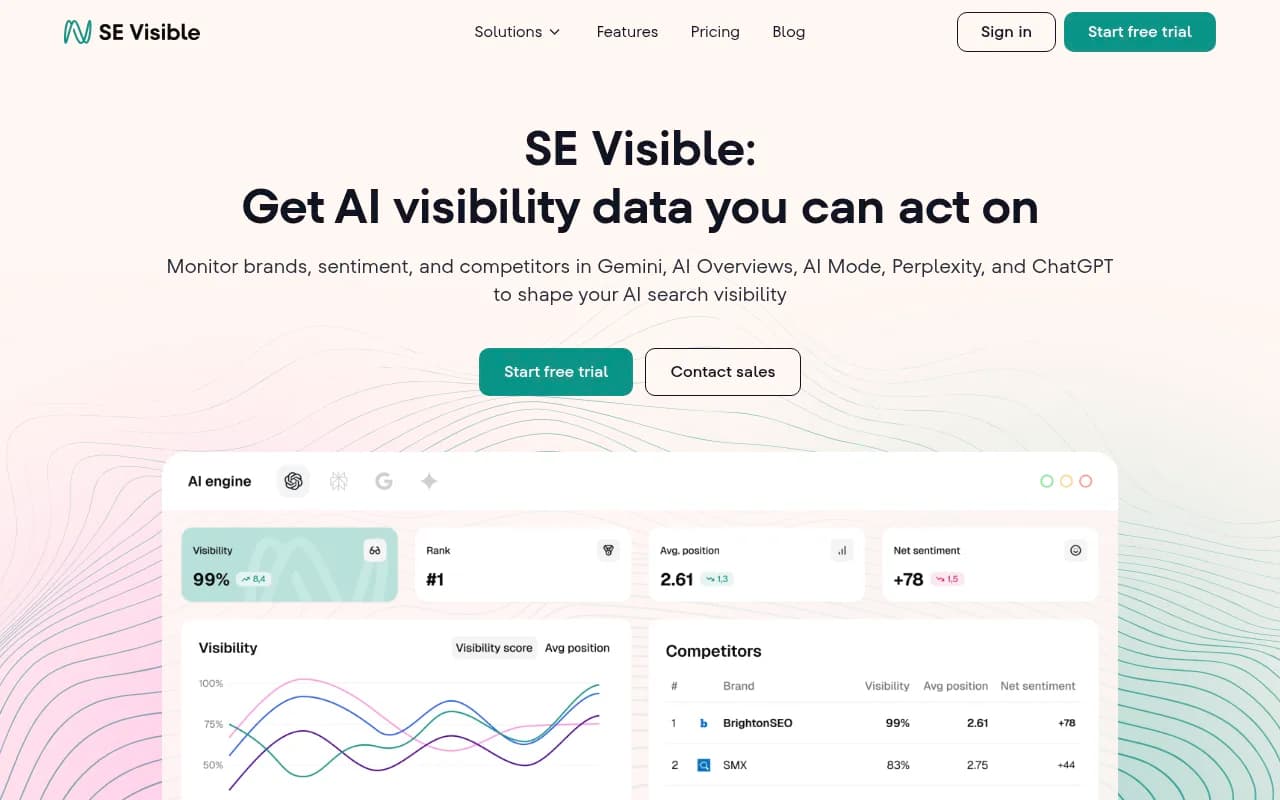
For product category tracking, it handles custom prompts reasonably well. The gap analysis features are less developed than Promptwatch's, and there's no content generation, but the monitoring data is reliable.
Search Party -- agency-focused with multi-client management
Search Party is built for agencies managing AI visibility across multiple clients. The multi-client dashboard and reporting features are its strongest points.
For product category tracking within a single brand, it's less specialized. Prompt metrics and gap analysis are limited compared to Promptwatch. For agencies that need to show clients AI visibility data across multiple brands, it's worth evaluating.
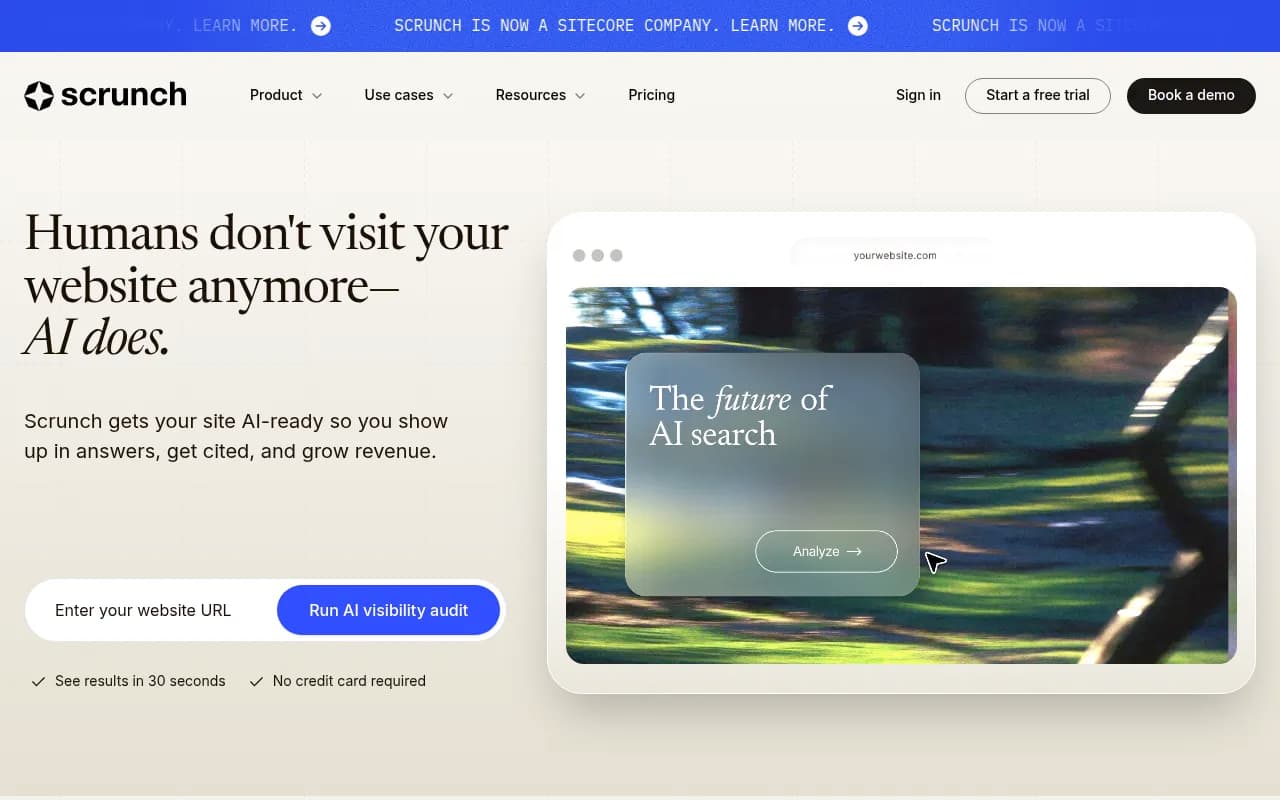
Scrunch AI -- good for brand and agency monitoring
Scrunch AI covers brand monitoring across AI models with a focus on agencies. It has reasonable depth for monitoring but, like most competitors, stops short of helping you act on the data.
Feature comparison across platforms
| Platform | Custom prompts | Multi-model tracking | Competitor heatmaps | Content generation | Crawler logs | AI traffic attribution | Pricing (starting) |
|---|---|---|---|---|---|---|---|
| Promptwatch | Yes | 10 models | Yes | Yes | Yes | Yes | $99/mo |
| Profound | Yes | Multiple | Limited | No | No | No | Higher |
| Peec AI | Yes | Multiple | Limited | No | No | No | Mid-range |
| Otterly.AI | Limited | Multiple | No | No | No | No | Low |
| AthenaHQ | Yes | Multiple | No | No | No | No | Mid-range |
| Ahrefs Brand Radar | Fixed only | Multiple | No | No | No | No | Add-on |
| Semrush AI Toolkit | Fixed only | Multiple | No | No | No | No | Add-on |
| SE Ranking Visible | Yes | Multiple | No | No | No | No | Mid-range |
| Search Party | Limited | Multiple | No | No | No | No | Mid-range |
| Scrunch AI | Yes | Multiple | No | No | No | No | Mid-range |
What to actually look for when evaluating these platforms
Custom prompt libraries
For product category tracking, you need to build your own prompt library. "Best [product type] for [use case]" queries are the ones driving purchase decisions in AI search. Any platform that locks you into fixed prompts is going to miss most of what matters for your specific categories.
Multi-model coverage
ChatGPT and Perplexity often give different recommendations for the same product category query. Google AI Overviews behaves differently again. If you're only tracking one model, you're missing a significant portion of AI search traffic. Look for platforms that cover at least 5-6 models, and ideally more.
Competitor visibility, not just your own
Knowing you appear in 30% of category queries is useful. Knowing that your top competitor appears in 70% of those same queries -- and seeing exactly which prompts they're winning -- is actionable. Competitor heatmaps and share-of-voice data are what turn monitoring into strategy.
The gap between data and action
This is the biggest differentiator in 2026. Most platforms show you where you're invisible. Very few help you understand why, and fewer still help you fix it. If you're evaluating platforms, ask specifically: "After I find a visibility gap, what does your platform help me do next?" The answer will tell you a lot.
Crawler and citation data
Understanding which of your pages AI models are actually reading -- and whether those reads are turning into citations -- is a feedback loop that most platforms don't offer. This data matters especially for product category pages, where you want to know if your category landing pages are being crawled and cited or ignored entirely.
How to approach product category tracking in practice
Start by mapping your product categories to the types of queries your potential customers are actually asking AI models. Think in terms of:
- Comparison queries: "X vs Y for [use case]"
- Best-of queries: "best [product type] for [persona/use case]"
- Recommendation queries: "what [product type] should I buy if [condition]"
- Problem-solution queries: "how do I solve [problem] -- [product category]"
Build a prompt library that covers these query types for each of your product categories. Then run them across multiple AI models and see where you stand.
The gaps you find -- prompts where competitors appear but you don't -- are your content roadmap. Each gap represents a piece of content your site is missing that AI models want to answer but can't find on your domain.
Tools like Promptwatch automate this process with Answer Gap Analysis, but even if you're doing it manually, the logic is the same: find the gaps, create the content, track whether it starts getting cited.
Which platform fits which situation
If you're a marketing team at a mid-size brand managing 2-5 product categories and you want a full workflow from monitoring to content creation, Promptwatch is the strongest choice in 2026. The combination of custom prompt tracking, competitor heatmaps, content gap analysis, and AI content generation covers the full cycle.
If you're at an enterprise with a large budget and a dedicated analytics team, Profound is worth evaluating alongside Promptwatch -- the analytics depth is strong, though you'll need to supplement with separate content tools.
If you're just getting started and want to understand what AI visibility data looks like before committing to a full platform, Otterly.AI or Peec AI are reasonable starting points. Expect to outgrow them.
If you're an agency managing multiple clients, Search Party's multi-client features are worth a look, though Promptwatch's agency and enterprise tiers cover this use case too.
The honest reality is that most platforms in this space are still primarily monitoring tools. The market is moving toward optimization -- find gaps, fix them, track results -- but only a few platforms have actually built that workflow end to end. That gap is worth paying attention to when you're making your decision.