Key takeaways
- Most AI visibility tools are built around branded query tracking -- they tell you how often your brand name appears in AI answers, not whether you show up in category-level or "best of" searches.
- Non-branded query tracking is where the real discovery opportunity lives: prompts like "best CRM for small teams" or "what's the top project management tool" are where undecided buyers are.
- A handful of platforms go beyond brand monitoring to cover prompt intelligence, answer gap analysis, and category-level visibility -- but most monitoring-only tools stop well short of this.
- The best platforms in 2026 combine non-branded prompt tracking with content gap analysis and actual content generation, so you can act on what you find.
- If you're only tracking your brand name, you're measuring retention, not growth.
Why "brand mention tracking" misses the point
There's a version of AI visibility tracking that's basically a vanity metric machine. You set up your brand name, the tool queries ChatGPT and Perplexity every day, and you get a dashboard showing how often "your brand" appears in responses. The number goes up, you feel good. The number goes down, you panic.
The problem: that's not where most of your potential customers are.
When someone already knows your brand and types it into an AI search engine, you've already won that person. What you haven't won -- and what most tools don't help you measure -- is the much larger pool of people asking non-branded questions. Things like:
- "What's the best tool for tracking AI search visibility?"
- "Compare Perplexity vs Google AI Mode for research"
- "Which platforms do marketing agencies use for GEO?"
These are the prompts where your competitors are either getting cited or you are. And if you don't know which prompts exist, which ones have volume, and whether you're appearing in the answers, you're flying blind on the part of the funnel that actually drives new customer acquisition.
This guide breaks down which tools in 2026 genuinely support non-branded query tracking -- and which ones are mostly just brand mention counters dressed up with nice charts.
What non-branded query tracking actually requires
Before getting into specific tools, it's worth being precise about what this capability actually involves. "Non-branded tracking" isn't a single feature -- it's a cluster of things that need to work together:
Prompt discovery and volume data. You need to know which non-branded prompts exist in your category, how often real users are asking them, and which ones are worth targeting. Without volume data, you're just guessing at prompts.
Flexible prompt configuration. The tool needs to let you track arbitrary prompts -- not just your brand name. Some tools lock you into brand-centric query structures.
Competitor visibility mapping. For non-branded queries, the question isn't just "do I appear?" -- it's "who appears, and why?" You need to see which competitors are getting cited for category-level prompts.
Answer gap analysis. Once you know which prompts your competitors rank for and you don't, you need to understand what content is driving those citations -- so you can create something better.
Content generation or briefs. Knowing the gap is step one. Closing it requires actually publishing content that AI models will want to cite. The best platforms help you do that.
Most tools in this space handle the first two reasonably well. Very few handle all five.
The tools that actually go beyond brand tracking
Promptwatch
Promptwatch is the most complete platform for non-branded query tracking in 2026, and the reason is the full loop it runs: find gaps, create content, track results.
The Answer Gap Analysis feature is specifically built for non-branded discovery. It shows you which prompts competitors are visible for that you're not -- not just brand mentions, but category queries, comparison prompts, and "best of" questions. You see the specific content gaps your site has relative to what AI models are already surfacing.
What separates it from most competitors is what happens after you find the gap. Content Agents generate articles, listicles, and comparisons grounded in real prompt data, citation analysis, and competitor research. This isn't generic content -- it's built around the specific prompts where you're invisible.
Prompt Intelligence adds volume estimates and difficulty scores for each prompt, plus query fan-outs that show how one non-branded question branches into sub-queries. That's how you prioritize: go after high-volume, winnable prompts first instead of tracking everything and acting on nothing.
The platform covers 10 AI models (ChatGPT, Perplexity, Claude, Gemini, Google AI Overviews, Google AI Mode, Grok, DeepSeek, Copilot, Meta AI) and tracks real user-facing responses, not just API outputs -- which matters because the two can differ meaningfully.
Profound
Profound was one of the first serious players in AI visibility tracking, and it has some genuinely differentiated data. Its real-user prompt volume data -- sourced from actual user behavior rather than fabricated queries -- is one of the better approaches to prompt discovery in the market.
For non-branded tracking, Profound lets you configure custom prompts beyond your brand name, and its front-end response capture (tracking what users actually see, not just API responses) is valuable for category-level queries where the answer format matters.
The main friction: pricing scales steeply with model coverage. The Starter plan at $99/mo only covers ChatGPT. Getting Perplexity and Google AI Overviews requires the $399/mo plan. Full model coverage (Claude, Gemini, Grok, etc.) is enterprise-only with unpublished pricing. For teams that want to track non-branded queries across multiple AI engines without a large budget, that's a real constraint.
Ahrefs Brand Radar
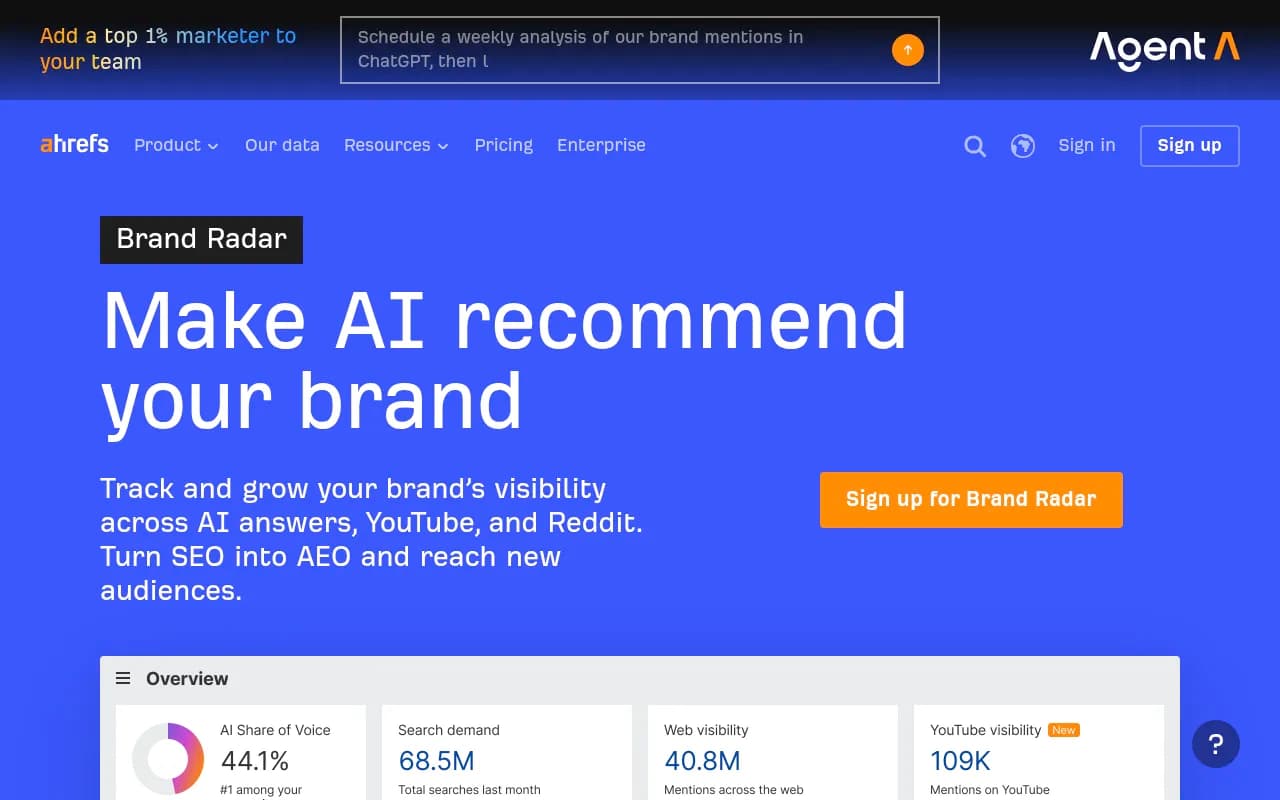
Ahrefs Brand Radar takes a different approach to the data problem that most GEO tools ignore. Rather than fabricating prompts, it sources its 243M+ prompts from real search data -- specifically "People Also Ask" questions with measurable search volume. That means the non-branded queries it tracks correspond to things real people actually asked, not hypothetical scenarios.
For category-level visibility, this is meaningful. You're not just tracking whether you appear in some tool's invented prompt -- you're tracking prompts with proven demand.
The fixed-prompt structure is a limitation, though. You can't freely configure arbitrary non-branded queries the way you can in some other platforms. And there's no content generation or gap analysis built in -- Brand Radar is a monitoring tool, not an optimization one.
Pricing is more accessible than Profound for multi-model coverage: $699/mo covers all 6 AI indexes plus 2,500 custom prompt checks.
Peec AI
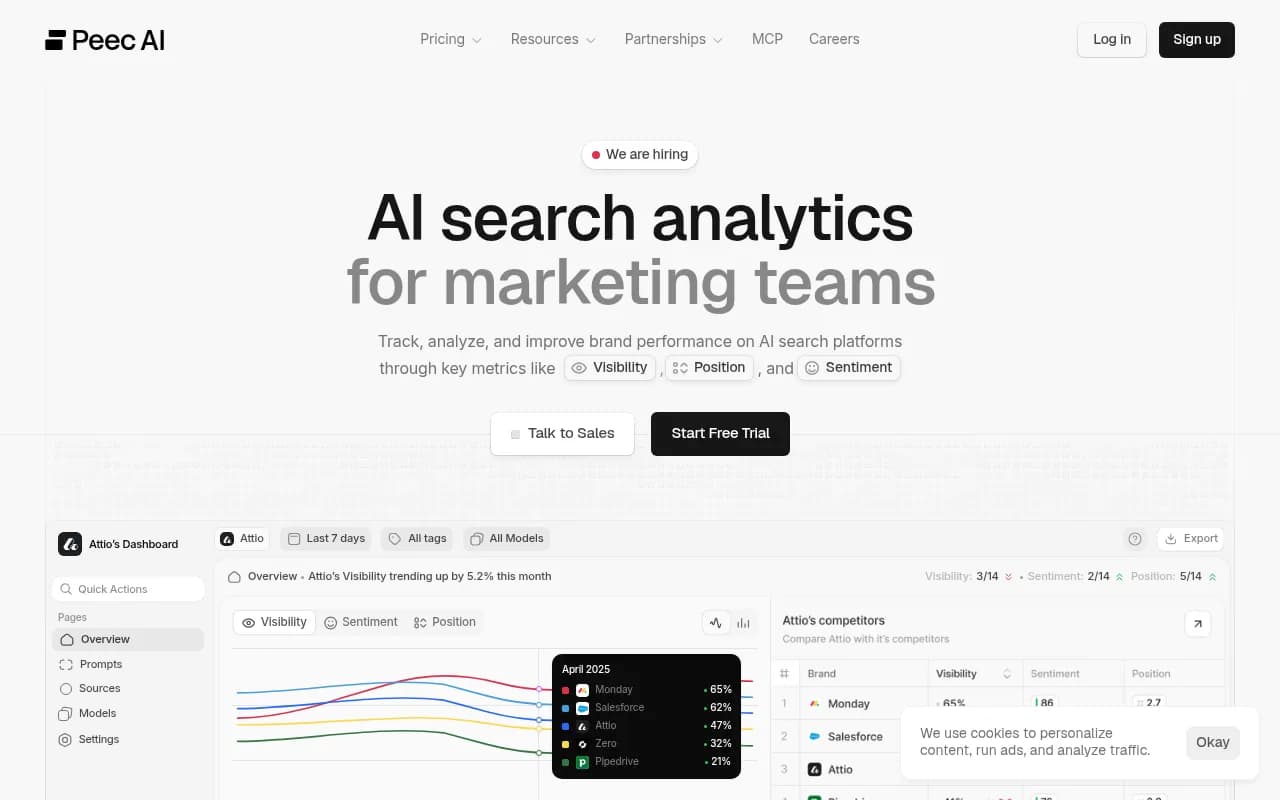
Peec AI covers non-branded prompt tracking with a reasonably clean interface and supports custom prompt configuration. It's one of the more affordable options for teams that want to go beyond brand monitoring without committing to enterprise pricing.
The platform tracks visibility across the main AI engines and surfaces competitor comparisons for category-level queries. The "smart suggestions" feature helps with prompt discovery -- useful if you're not sure which non-branded queries to start with.
What it doesn't have: content generation, crawler logs, or deep prompt volume data. It's a monitoring tool that shows you the picture but doesn't help you change it.
Otterly.AI
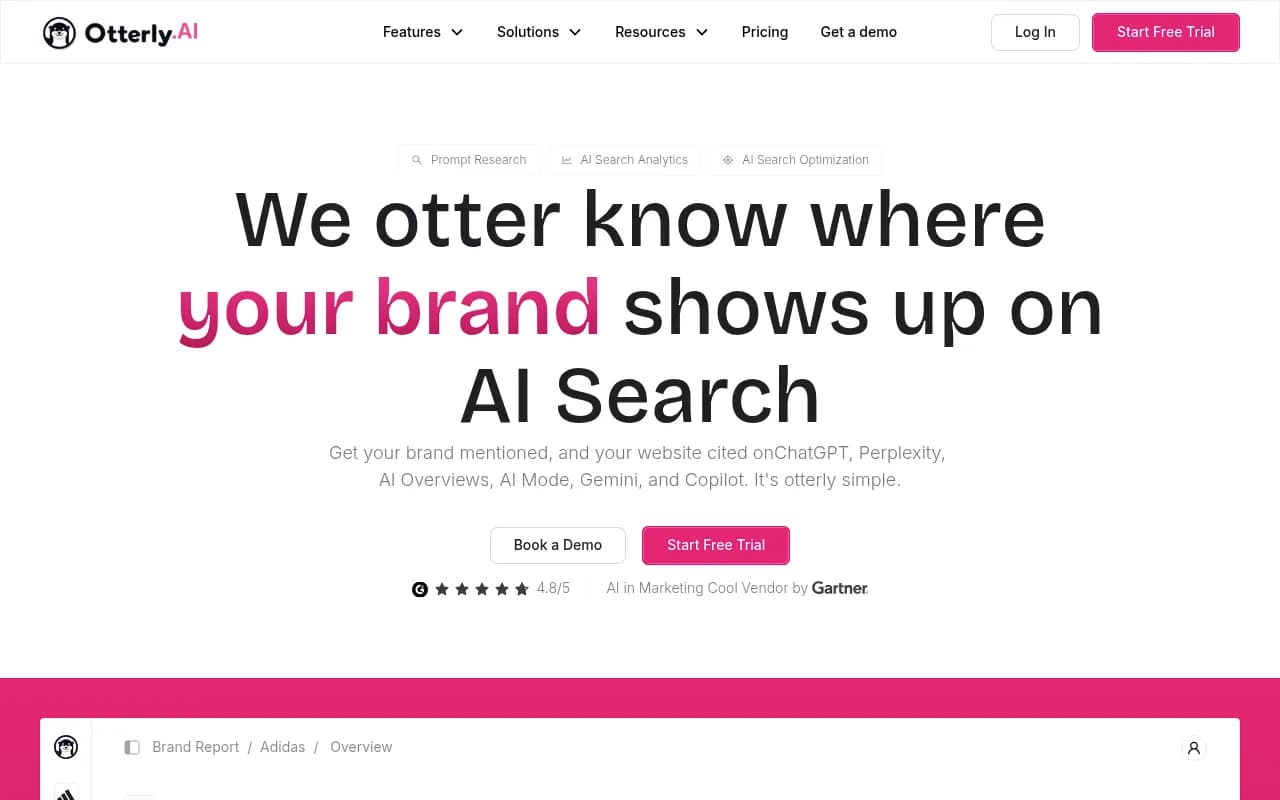
Otterly.AI is one of the more accessible entry points for AI visibility monitoring, and it does support custom prompt tracking beyond brand names. For smaller teams or agencies that want to set up non-branded query monitoring without a large investment, it's a reasonable starting point.
The limitations are real, though. No crawler logs, no visitor analytics, no content generation. Otterly shows you where you stand -- it doesn't help you move.
Scrunch AI
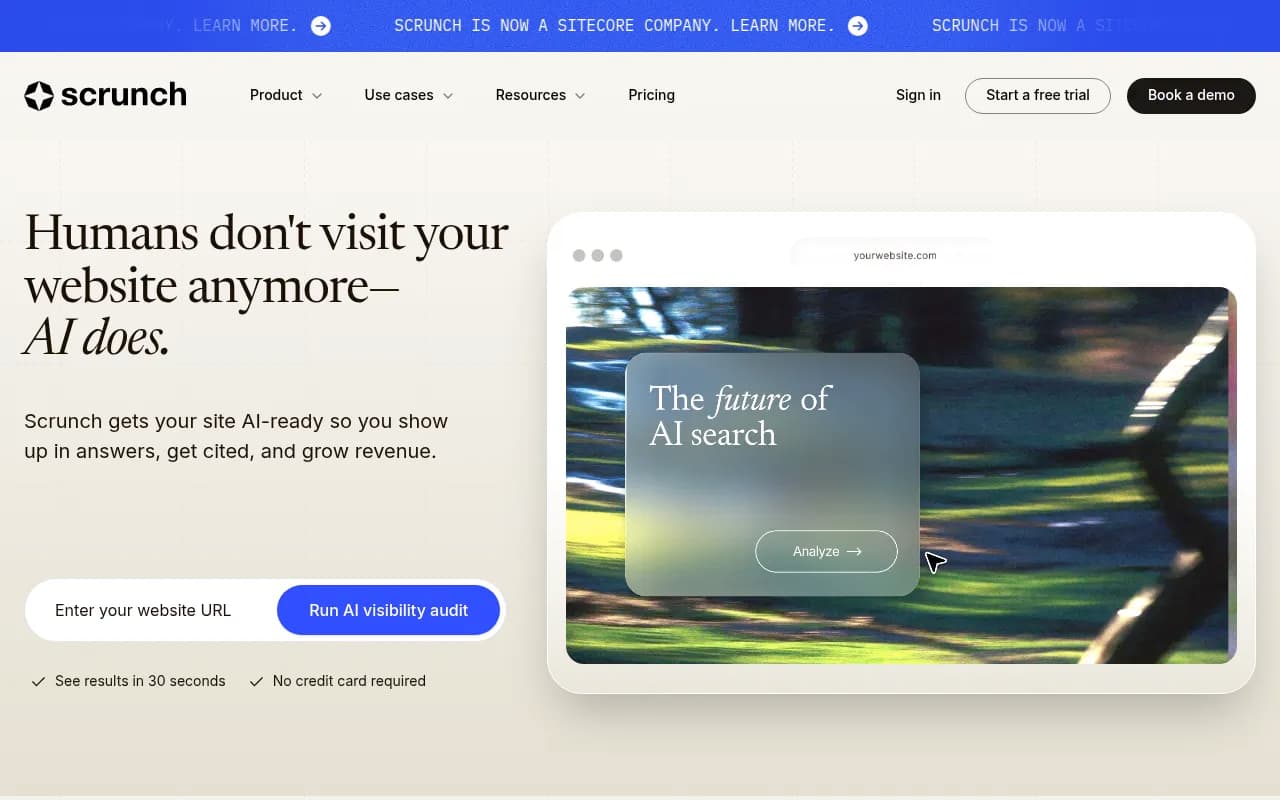
Scrunch AI provides solid visibility monitoring across generative platforms including ChatGPT, Perplexity, and Google AI Overviews. It supports custom prompt configuration, so non-branded query tracking is possible.
Like most monitoring-focused tools, Scrunch stops at the dashboard. You get the data, you interpret it yourself, and you figure out what to do about it on your own. For teams with strong in-house content capabilities, that's fine. For teams that need the full loop, it's a gap.
Semrush AI Visibility Toolkit
Semrush's AI Visibility Toolkit benefits from being part of a much larger SEO platform. For teams already in the Semrush ecosystem, adding AI visibility tracking to an existing workflow is relatively low-friction.
For non-branded queries specifically, the main limitation is that Semrush uses fixed prompts rather than fully configurable ones. You're tracking visibility for the prompts Semrush has decided to track, not necessarily the category queries most relevant to your specific market position. There's also no AI traffic attribution connecting visibility to actual revenue.
SE Ranking
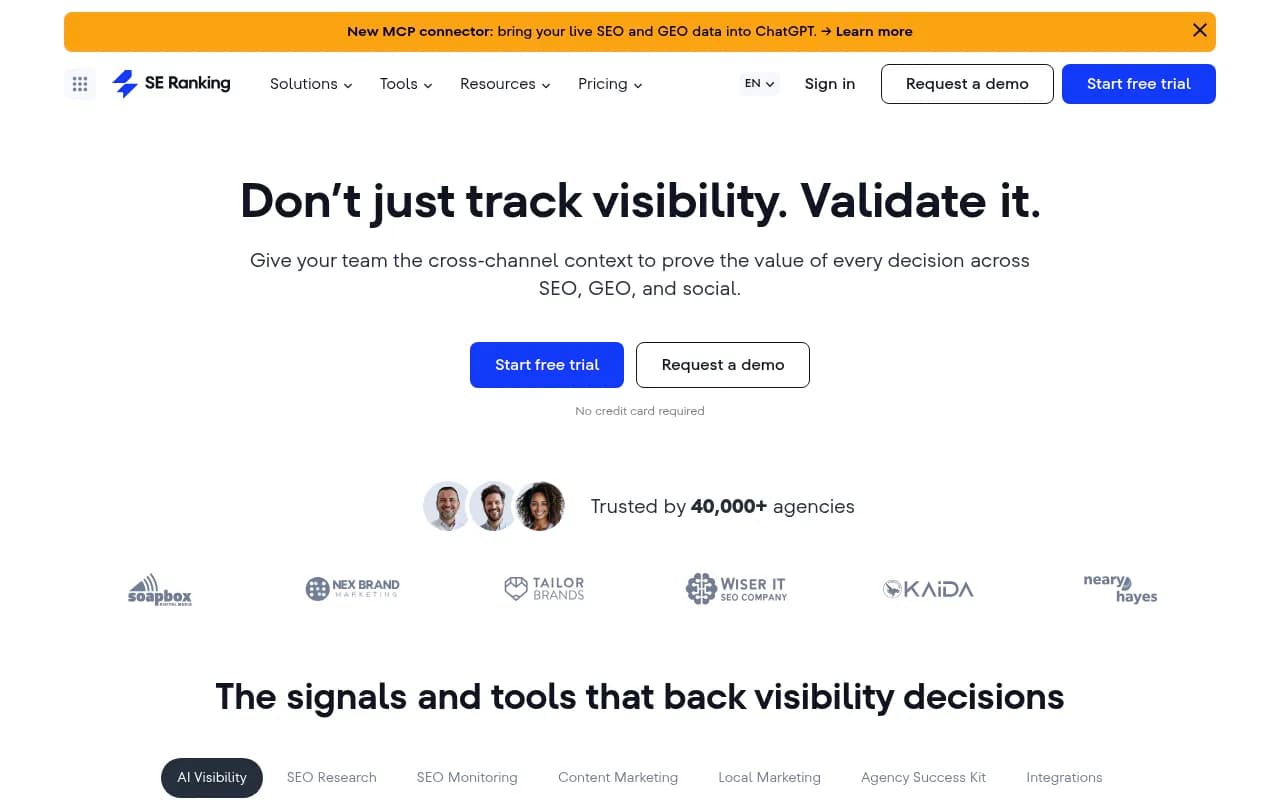
SE Ranking has been building out its GEO capabilities and now offers AI visibility tracking alongside its traditional SEO toolset. Custom prompt configuration is supported, and the pricing is competitive for what you get.
For non-branded query tracking, SE Ranking works -- it's not the deepest implementation, but it covers the basics and integrates with the rest of the SE Ranking workflow for teams that use it.
AthenaHQ
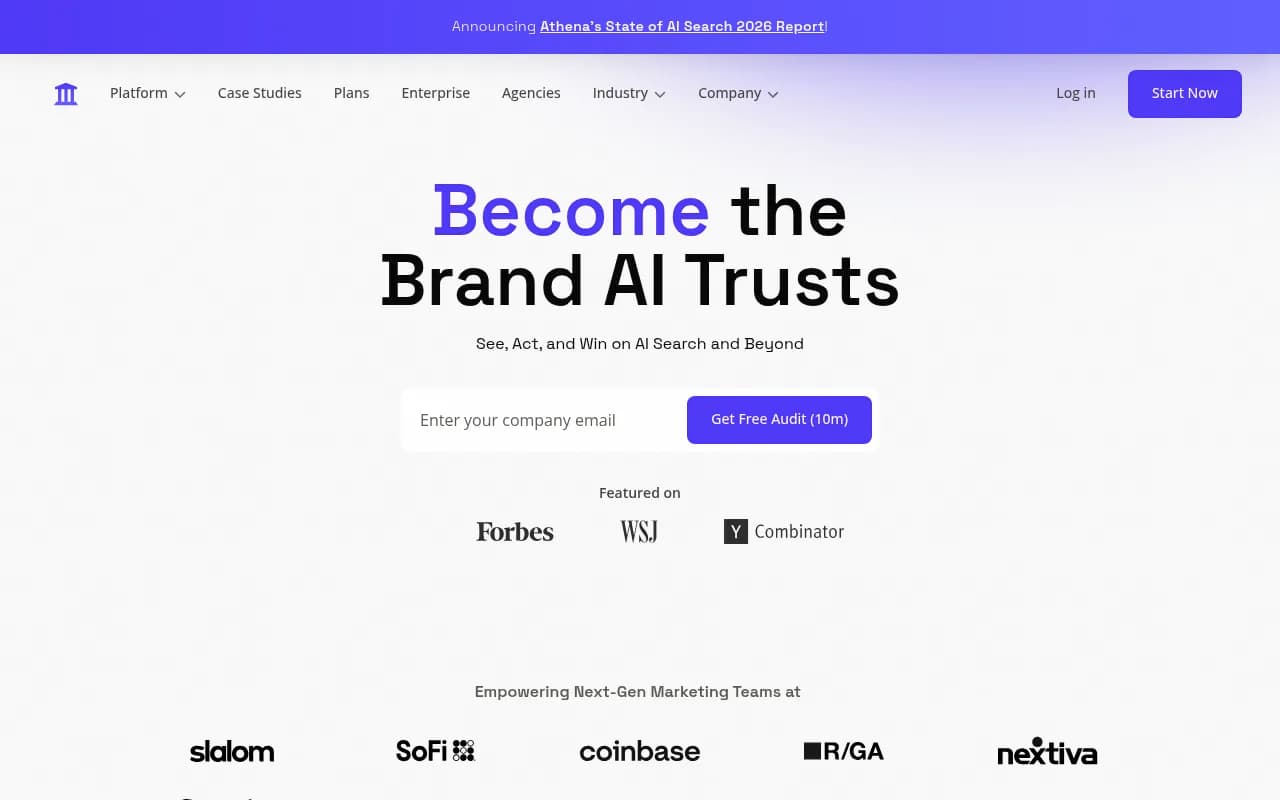
AthenaHQ is monitoring-focused with a clean interface and good model coverage. It supports non-branded prompt tracking and gives you competitor visibility comparisons for category-level queries.
The gap is on the action side -- AthenaHQ doesn't have content optimization or generation capabilities, so the workflow after finding a gap is entirely manual.
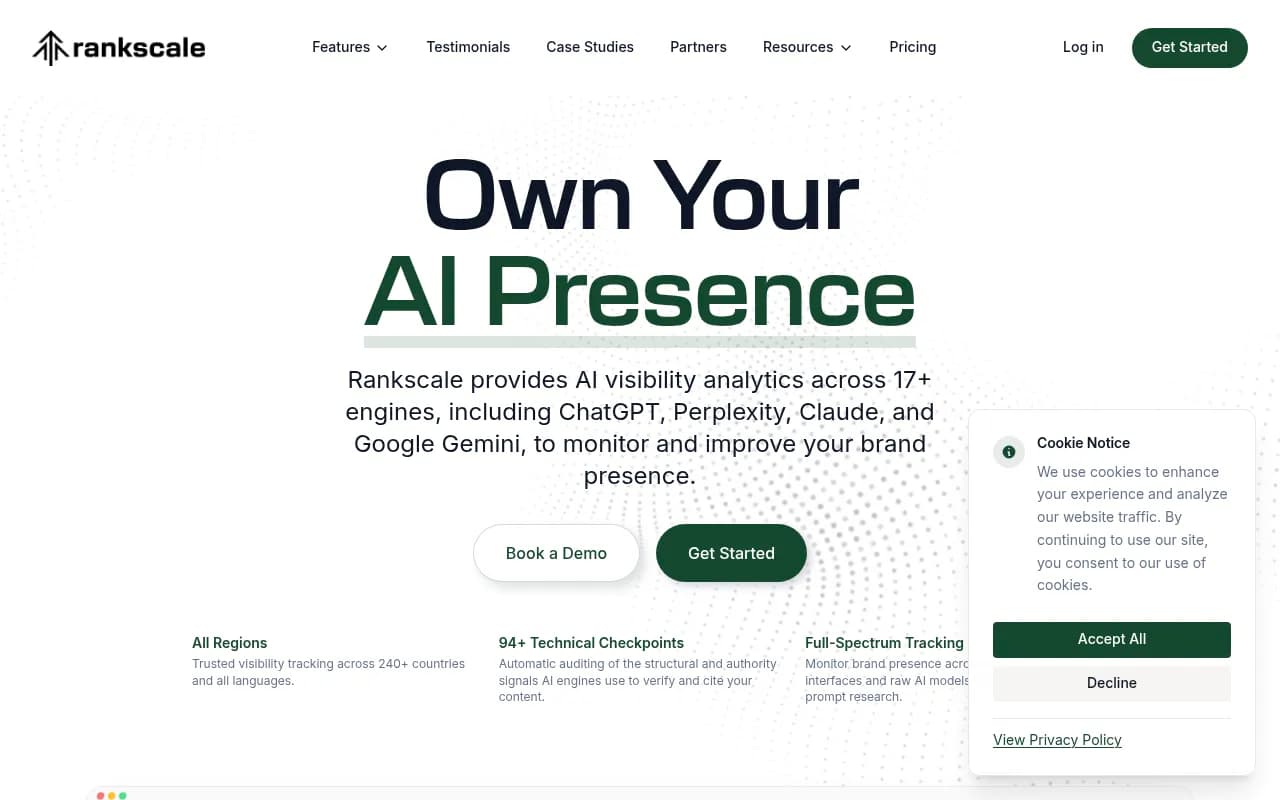
Rankscale
Rankscale is a more focused tool for AI search rank tracking. It supports custom prompts and covers the main AI engines. For teams that want straightforward non-branded query monitoring without a lot of extra features, it's worth evaluating.
How the tools compare
Here's a direct comparison across the capabilities that matter most for non-branded query tracking:
| Tool | Custom non-branded prompts | Prompt volume data | Competitor visibility | Answer gap analysis | Content generation | Crawler logs |
|---|---|---|---|---|---|---|
| Promptwatch | Yes | Yes (with difficulty scores) | Yes (heatmaps) | Yes | Yes (Content Agents) | Yes |
| Profound | Yes | Yes (real-user data) | Yes | Limited | No | No |
| Ahrefs Brand Radar | Limited (fixed + custom) | Yes (search-based) | Yes | No | No | No |
| Peec AI | Yes | Limited | Yes | No | No | No |
| Otterly.AI | Yes | No | Basic | No | No | No |
| Scrunch AI | Yes | No | Yes | No | No | No |
| Semrush AI Toolkit | Limited (fixed prompts) | No | Yes | No | No | No |
| SE Ranking | Yes | No | Basic | No | No | No |
| AthenaHQ | Yes | No | Yes | No | No | No |
| Rankscale | Yes | No | Basic | No | No | No |
The pattern is clear: most tools handle the "track" part of non-branded query monitoring. Very few handle the "act on it" part.
The gap most teams don't notice until it's too late
Here's something worth sitting with. If you're only tracking branded queries, you're essentially measuring how well you retain people who already know you. That's useful -- brand sentiment and share of voice in AI answers matters -- but it's not growth.
Non-branded queries are where new customers form opinions. When someone asks Perplexity "what's the best AI visibility platform for agencies," they haven't decided yet. If your brand appears in that answer, you're in the consideration set. If it doesn't, you're not -- and you might not even know you're missing.
The tools that support non-branded query tracking well give you a window into that discovery process. The ones that go further -- showing you which specific content gaps are causing you to miss those citations, then helping you close those gaps -- are the ones that turn visibility data into actual business impact.
Most of the market is still at step one. A few platforms are at step three.
What to look for when choosing
If you're evaluating tools specifically for non-branded query coverage, here's a practical checklist:
Prompt flexibility. Can you enter any prompt you want, or are you constrained to brand-centric query structures? Fixed-prompt tools (like Semrush's current implementation) limit your ability to track the specific category queries relevant to your market.
Volume and difficulty data. Knowing you're invisible for a prompt is only useful if you know whether that prompt has real traffic behind it. Tools with volume estimates help you prioritize. Without this, you're tracking everything equally and acting on nothing strategically.
Competitor citation mapping. For non-branded queries, you need to see who's getting cited and why -- not just whether you appear. Competitor heatmaps and source analysis are the features to look for.
Answer gap analysis. The best tools don't just show you where you're missing -- they show you what content is driving competitor citations so you know what to build.
Content generation. If the tool can help you create the content that closes the gap, you're looking at a platform that actually accelerates your GEO program rather than just measuring it.
Real response capture. Some tools query AI engines via API; others capture what users actually see in the interface. For non-branded queries where AI shopping recommendations, featured sources, and response formats vary, real-interface capture gives you more accurate data.
The bottom line
The AI visibility tool market in 2026 has a lot of options, and most of them do branded query tracking reasonably well. Non-branded query tracking -- the prompts where your potential customers are actually making decisions -- is where the field thins out fast.
Platforms like Promptwatch, Profound, and Ahrefs Brand Radar have the most serious approaches to prompt discovery and category-level visibility. Of those, Promptwatch is the only one that closes the full loop from gap identification to content creation to result tracking.
If you're just starting out and want affordable monitoring, Otterly.AI or Peec AI get you moving. If you're already in the Ahrefs or Semrush ecosystem, their AI visibility add-ons are convenient starting points. But if non-branded query visibility is a strategic priority -- not just a metric to report -- you need a platform that helps you act on what you find, not just see it.