Key takeaways
- BrightEdge, Conductor, seoClarity, and Botify all handle traditional enterprise SEO well -- but their AI search visibility capabilities vary significantly.
- Conductor ranked BrightEdge seventh in its own 2026 enterprise SEO comparison, citing limitations in AI search features.
- Botify's strength is technical crawl intelligence at scale; it's not primarily an AI visibility tool.
- seoClarity has moved fastest on AI search optimization, with dedicated AI search tracking and content gap tools built into its platform.
- For brands that need to track and act on AI citation gaps -- not just monitor rankings -- a dedicated GEO platform like Promptwatch fills the gap these enterprise suites leave open.
Enterprise SEO used to be a fairly contained problem: track rankings, fix technical issues, build content, measure organic traffic. The platforms built to solve that problem -- BrightEdge, Conductor, seoClarity, Botify -- are genuinely good at it.
But search has fractured. Google still processes around 16.4 billion searches per day, so traditional SEO isn't going anywhere. At the same time, a growing share of discovery now happens inside AI-generated answers: ChatGPT, Perplexity, Google AI Overviews, Claude, Gemini. Users get synthesized answers without clicking. Brands either get cited or they don't.
The question for enterprise teams in 2026 isn't "which platform is best for SEO?" -- it's "which platform actually helps us show up in both traditional search and AI-generated answers?" Those are different problems, and the platforms below solve them to very different degrees.
How these platforms were evaluated
This comparison focuses on four dimensions:
- Core enterprise SEO capabilities (rank tracking, technical auditing, content optimization, reporting)
- AI search visibility features (monitoring AI citations, tracking brand mentions in LLM outputs)
- Content optimization for AI (tools that help you create content that AI models will cite)
- Pricing and accessibility
The four platforms in the title -- BrightEdge, Conductor, seoClarity, Botify -- are the ones most commonly shortlisted by enterprise SEO teams. Semrush Enterprise and Ahrefs appear as relevant comparisons where they add context.
The platforms, ranked
1. seoClarity -- best overall for AI search optimization
seoClarity has made the clearest pivot toward AI search among the legacy enterprise platforms. Its dedicated AI Search Optimization module tracks brand visibility across AI-generated answers, not just traditional SERPs. The platform includes answer box opportunity tracking, content gap analysis tied to AI responses, and an AI content writer that generates briefs grounded in real search data.
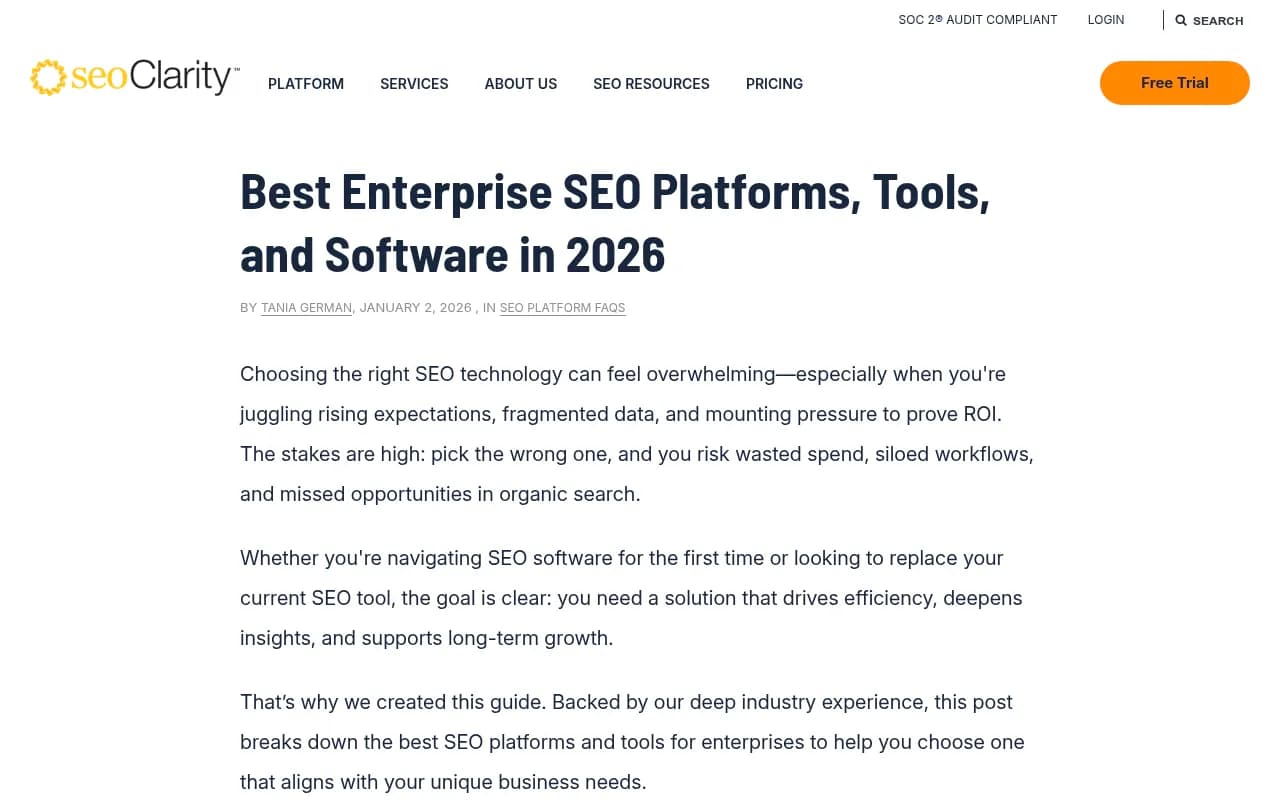
What makes seoClarity stand out is that it doesn't treat AI search as a bolt-on. The Research Grid, which maps keyword clusters to content opportunities, now surfaces AI-specific gaps alongside traditional SERP data. Log file analysis and segmentation tools remain strong for large-site technical work.
Pricing is custom enterprise, which means you'll need to talk to sales. That's a friction point for smaller teams, but it's standard at this tier.
Where seoClarity falls short: the AI search monitoring is still relatively new, and the depth of citation-level tracking -- which specific pages are being cited in which AI models, and why -- isn't as granular as purpose-built GEO platforms.
2. Conductor -- best for content-driven enterprise teams
Conductor positions itself as an "enterprise AEO platform" in 2026, which is a meaningful shift from its earlier identity as a content intelligence tool. The platform covers keyword research, content optimization, technical auditing, and reporting, with a workflow layer designed for large teams that need to coordinate across content, SEO, and web teams.
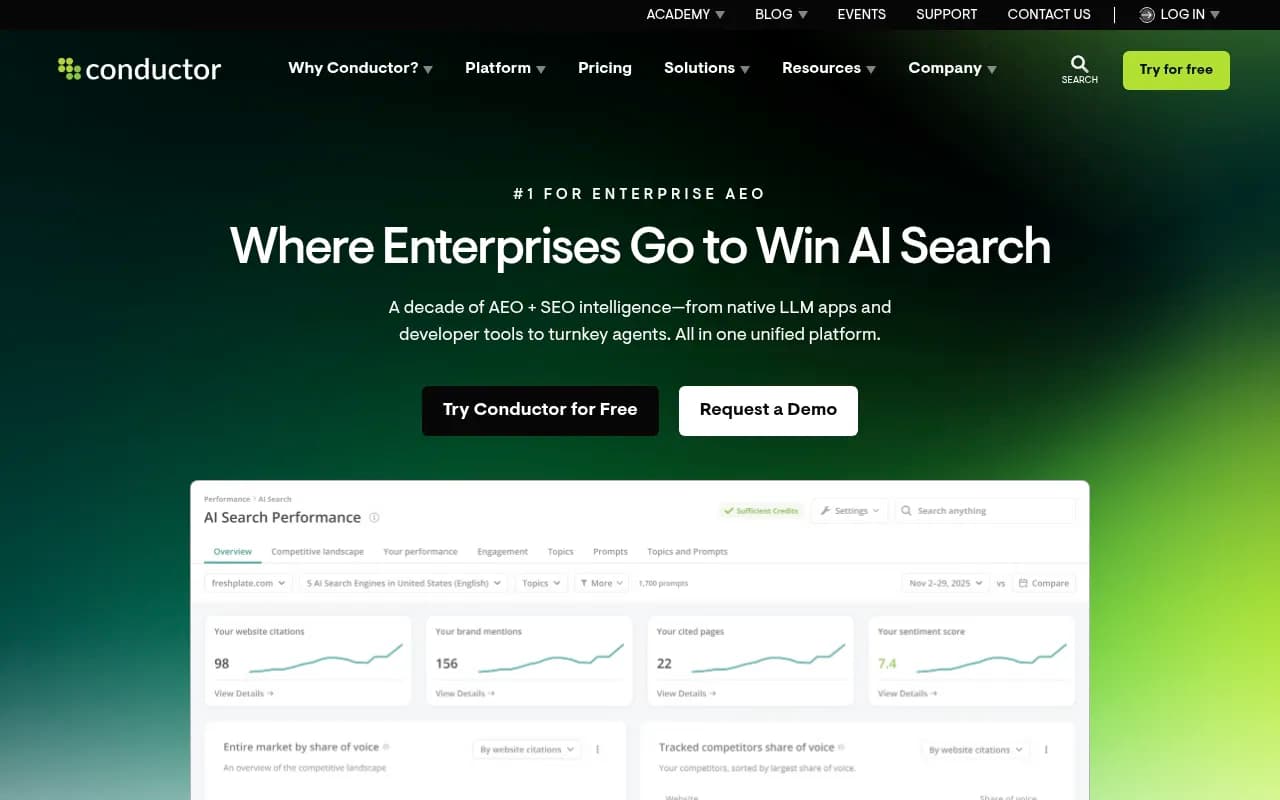
Its AI search features have improved, but the honest assessment is that Conductor is still primarily a content operations platform with AI search monitoring added on. It's excellent for teams that produce a lot of content and need to manage that production at scale. It's less useful if your primary need is understanding why AI models are or aren't citing your brand.
Pricing runs from roughly $26,800 to $150,000+ per year depending on scale, which puts it at the higher end of this category.
One thing worth noting: Conductor's own 2026 enterprise SEO ranking placed BrightEdge seventh. That's a competitor ranking a competitor, so take it with appropriate skepticism -- but the underlying critique (that BrightEdge's AI search features lag) is consistent with what practitioners report.
3. Botify -- best for technical SEO at scale
Botify is a different kind of tool from the others here. Its core value is crawl intelligence: understanding how search engines (and increasingly, AI crawlers) actually navigate your site, what they find, what they skip, and where indexing breaks down.
For large sites -- e-commerce with millions of SKUs, publishers with deep content archives, enterprises with complex URL structures -- Botify's crawl data is genuinely hard to replicate. Its log file analysis shows exactly which pages Googlebot and other crawlers are visiting, how often, and whether those visits are translating into indexing.
Where Botify fits less well: if you need keyword research, content optimization, or AI citation tracking, Botify isn't the right primary tool. It's a technical foundation, not a full SEO suite. Most enterprise teams that use Botify pair it with another platform for content and keyword work.
Pricing is custom enterprise. Expect it to be significant.
4. BrightEdge -- established but falling behind on AI search
BrightEdge has been an enterprise SEO staple for over a decade. Its keyword tracking, competitive analysis, and reporting capabilities are mature and reliable. The BrightEdge Autopilot and Copilot features add AI-assisted recommendations to the workflow.
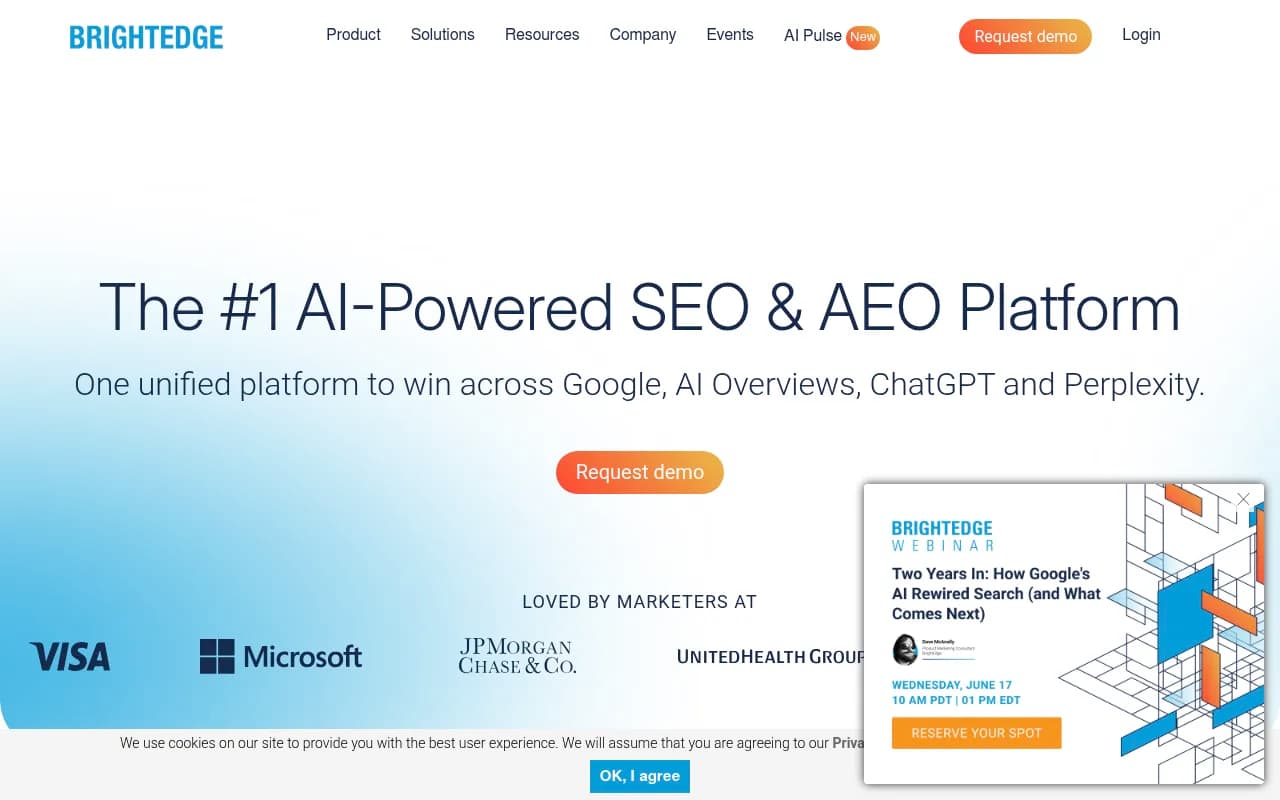
But the honest picture in 2026 is that BrightEdge has been slower to adapt to AI search than its competitors. Conductor's own ranking placed it seventh. Practitioners on forums like r/bigseo have noted that BrightEdge's AI search visibility features feel like additions rather than core capabilities.
Ahrefs research found that branded web mentions correlate far more strongly with AI citation than content volume or link count (0.664 vs 0.218 correlation). BrightEdge's toolset is built around content and links -- the things that matter less for AI visibility. That's not a fatal flaw, but it's a real gap for teams that need to win in AI-generated answers.
BrightEdge doesn't publish pricing publicly. Enterprise contracts typically run into the tens of thousands annually.
Feature comparison table
| Platform | Rank tracking | Technical auditing | AI citation monitoring | Content generation | Log file analysis | Pricing model |
|---|---|---|---|---|---|---|
| seoClarity | Strong | Strong | Dedicated module | AI content writer | Yes | Custom enterprise |
| Conductor | Strong | Good | Growing | Content briefs | Limited | $26.8K--$150K+/yr |
| Botify | Limited | Best-in-class | Limited | No | Best-in-class | Custom enterprise |
| BrightEdge | Strong | Strong | Basic | AI-assisted | Limited | Custom enterprise |
| Semrush Enterprise | Strong | Strong | Growing | Yes | Limited | From $139.95/mo |
The gap these platforms share
Here's the thing none of the platforms above fully solve: they tell you where you're visible (or not), but they don't close the loop on why AI models are citing competitors instead of you, or give you a clear path to fix it.
Ahrefs' research is instructive here. Branded web mentions -- the kind that come from digital PR, third-party listicles, Reddit discussions, and earned media -- correlate much more strongly with AI citation than traditional SEO signals. That means the work that actually moves AI visibility often happens off your own site: getting mentioned in the right places, in the right context, so AI models have reasons to cite you.
Traditional enterprise SEO platforms weren't built to track that. They track your site's performance in search. AI visibility is partly about what the rest of the web says about you.
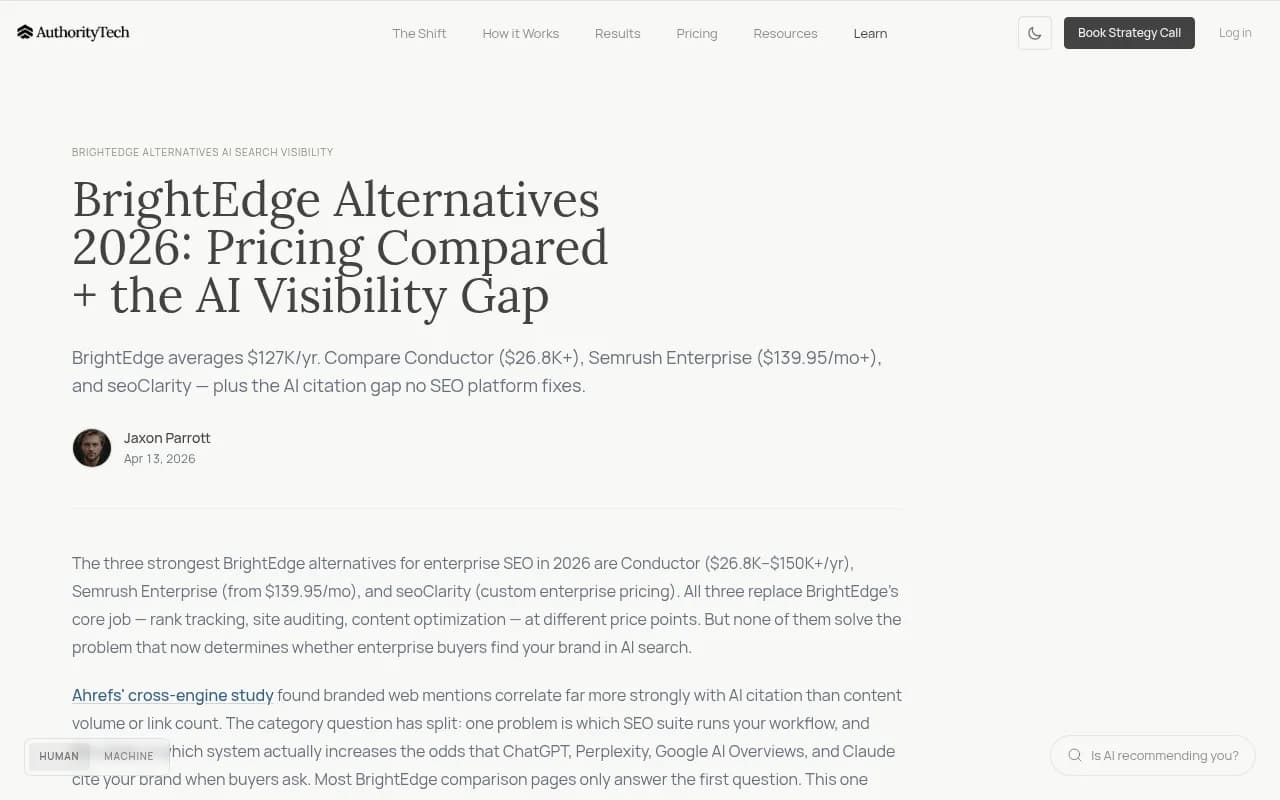
This is where dedicated GEO platforms fill a real gap. Promptwatch tracks how your brand appears across 10 AI models -- ChatGPT, Perplexity, Google AI Overviews, Claude, Gemini, Grok, DeepSeek, Copilot, Meta AI, and Mistral -- and shows you exactly which prompts competitors are visible for that you're not. It also tracks offsite citations: which Reddit threads, YouTube videos, third-party listicles, and external pages are driving AI visibility for your category.
The distinction matters: enterprise SEO platforms optimize your site for search engines. GEO platforms optimize your brand's presence across AI-generated answers, which requires a different kind of data and a different kind of action.
How to think about your stack in 2026
Most enterprise teams don't need to choose between these categories -- they need both. The practical question is which combination makes sense for your situation.
If your primary concern is traditional SEO at scale -- ranking pages, fixing technical issues, managing content production across a large team -- one of the four platforms above is the right foundation. seoClarity or Conductor for content-heavy teams, Botify for technically complex sites, BrightEdge if you're already embedded in its ecosystem.
If you're also trying to win in AI search -- and most enterprise marketing teams should be, given how quickly AI-generated answers are eating into click-through rates -- you need something that tracks citation behavior at the model level, identifies the specific gaps in your AI presence, and helps you create content that AI models will actually cite.
Those are two different tools solving two different problems. The enterprise SEO platforms are catching up on AI search, but they're not there yet.
When to add a dedicated GEO platform
A few signals that you need dedicated AI visibility tracking alongside your enterprise SEO platform:
- You're seeing organic traffic decline even when rankings hold steady (AI answers are intercepting clicks)
- Competitors are appearing in ChatGPT or Perplexity answers for your category, and you're not
- You don't know which of your pages are being cited by AI models, or how often
- Your content team is creating content without knowing whether AI models are finding it
Tools like Promptwatch, Profound, or AthenaHQ are built specifically for this. They're not replacements for enterprise SEO platforms -- they're additions that cover the AI search layer those platforms don't fully address.
Semrush and Ahrefs: worth mentioning
Both Semrush Enterprise and Ahrefs have made moves into AI search visibility, and both deserve mention in any honest enterprise SEO comparison.
Semrush's AI Visibility Toolkit tracks brand mentions in AI-generated answers and is available at a much lower entry price than the dedicated enterprise platforms. For teams that are already in the Semrush ecosystem, it's a reasonable starting point for AI visibility monitoring.
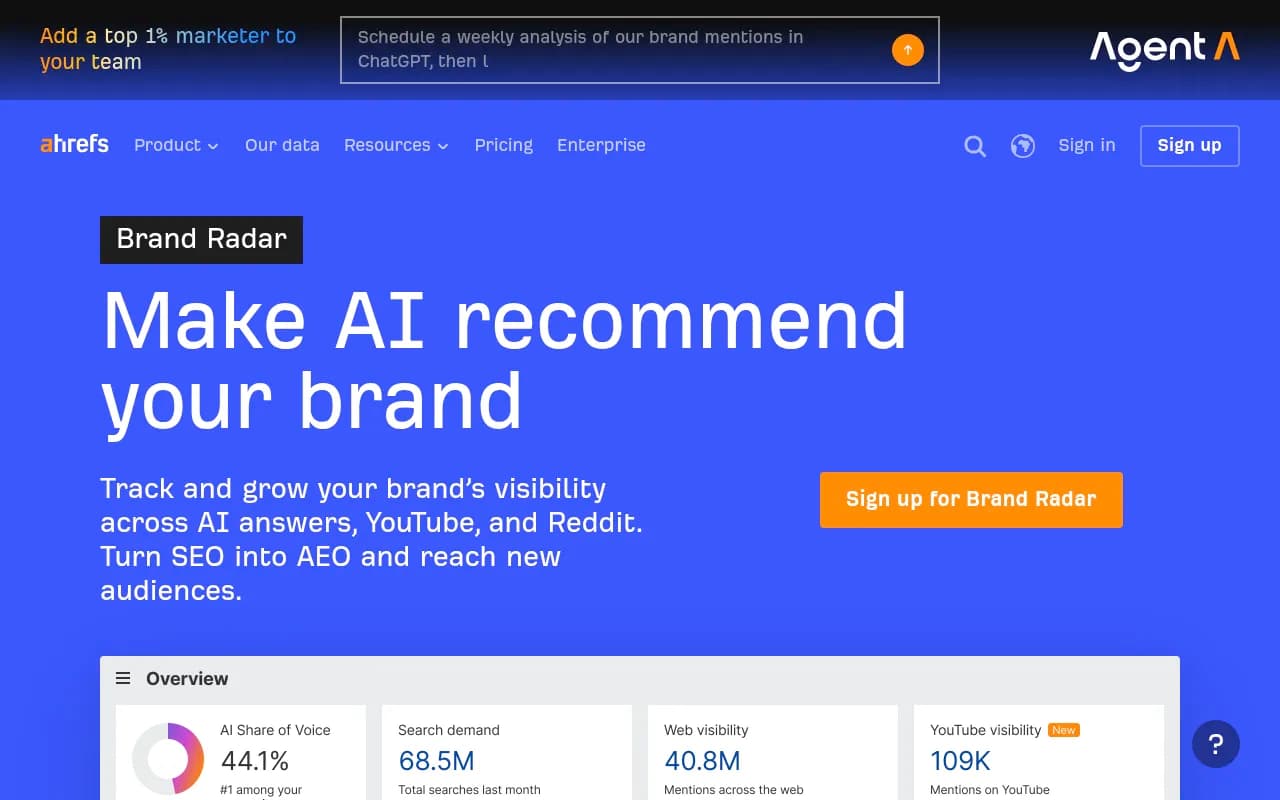
Ahrefs Brand Radar tracks brand mentions across AI search engines and is backed by Ahrefs' substantial link and content database. The limitation, as noted in their own research, is that the signals that predict AI citation (branded web mentions, earned media) are different from the signals Ahrefs was built to track (backlinks, keyword rankings).
Neither is a full GEO platform, but both are more accessible than the custom-priced enterprise tools for teams that are just starting to think about AI search visibility.
The bottom line
Enterprise SEO platforms are not going away. The work they do -- technical auditing, rank tracking, content optimization, workflow coordination -- remains essential. Google still drives the majority of search traffic, and the fundamentals of SEO still determine whether AI models have good content to cite in the first place.
But the category has split. Traditional enterprise SEO and AI search visibility are now distinct problems that require distinct tools. seoClarity has made the most progress on bridging that gap among the legacy platforms. Conductor is catching up. Botify and BrightEdge are stronger on their traditional strengths than on AI search.
For enterprise teams that need to win in both traditional search and AI-generated answers, the most practical approach in 2026 is a foundation enterprise SEO platform paired with a dedicated AI visibility tool. The platforms that try to do everything often do the AI search piece at a level that's good enough for reporting but not good enough for actually improving your citation rate.
That's the gap worth closing.