Key takeaways
- Google Search Console, Ahrefs Webmaster Tools, Screaming Frog's free crawler, and a free chatbot tier cover most of a small site's SEO work at zero cost.
- "Free" means three different things: free forever, freemium with hard caps, and a time-limited trial. Most roundups blur them together.
- Free tiers run out in predictable places: competitor data, historical data, crawl limits, daily search caps, and anything involving AI search tracking at scale.
- AI search visibility is where free tools are thinnest. A free scan tells you where you stand once; it won't show you trends, crawler activity, or what to fix.
- Treat vendor-written "best of" lists with some suspicion. Several of the sources behind this guide sell the products they rank, and I've tried to flag that where it matters.
What "free" actually means in SEO tools
Before the list, a quick bit of honesty. When a tool says it is free, it usually falls into one of three buckets.
Free forever means you can use it indefinitely with no card. Google Search Console is the clean example. Freemium means a permanent free plan with hard limits on projects, queries, or pages. Free trial means full access for 7 to 30 days, then a paywall. A trial is a demo, not a free tool, and it's worth planning around that.
I'd also note that the claim you'll see repeated, that free tools deliver roughly 80% of premium output at 5% of the cost, comes from a secondary citation in a vendor blog. It's a nice line, not a measured result. The reality depends on what you're trying to do and how big your site is.
The free stack by job
| Job | Free option | Where it runs out |
|---|---|---|
| Search performance data | Google Search Console | 16 months of history, no competitor data |
| Backlinks and site health | Ahrefs Webmaster Tools | Only sites you verify |
| Technical crawling | Screaming Frog free | 500 URL crawl cap |
| Ideation and outlines | ChatGPT, Claude, Perplexity free tiers | Message limits, no live SEO data |
| Question research | AlsoAsked free | Few searches per day |
| Keyword ideas | Google Keyword Planner, Ubersuggest free | Ranges instead of exact volumes, daily caps |
| On-page audit | AIOSEO Analyzer | Single page at a time |
| AI visibility check | Free scans from several vendors | One-off snapshot, no trend tracking |
Please verify limits on each vendor's pricing page before you build a workflow around them. Free tiers change often, and I couldn't independently confirm every figure quoted in the source roundups.
Free tools that are actually free
Google Search Console
This is the most important free SEO tool, full stop. It gives you first-party query and page data, Core Web Vitals, index coverage, crawl stats, and manual action alerts. No third-party tool can match its accuracy because the data comes from Google itself.
Where it runs out: about 16 months of history, no competitor view, and no keyword discovery beyond what you already rank for. It also says nothing about ChatGPT or Perplexity. A useful trick is exporting your query data and asking a chatbot to cluster it by intent or flag pages sitting at positions 8 to 15.
Ahrefs Webmaster Tools
Ahrefs gives verified site owners a free site audit and backlink report for their own domain. That's a real product, not a teaser. If you can only add one tool after Search Console, I'd pick this one.
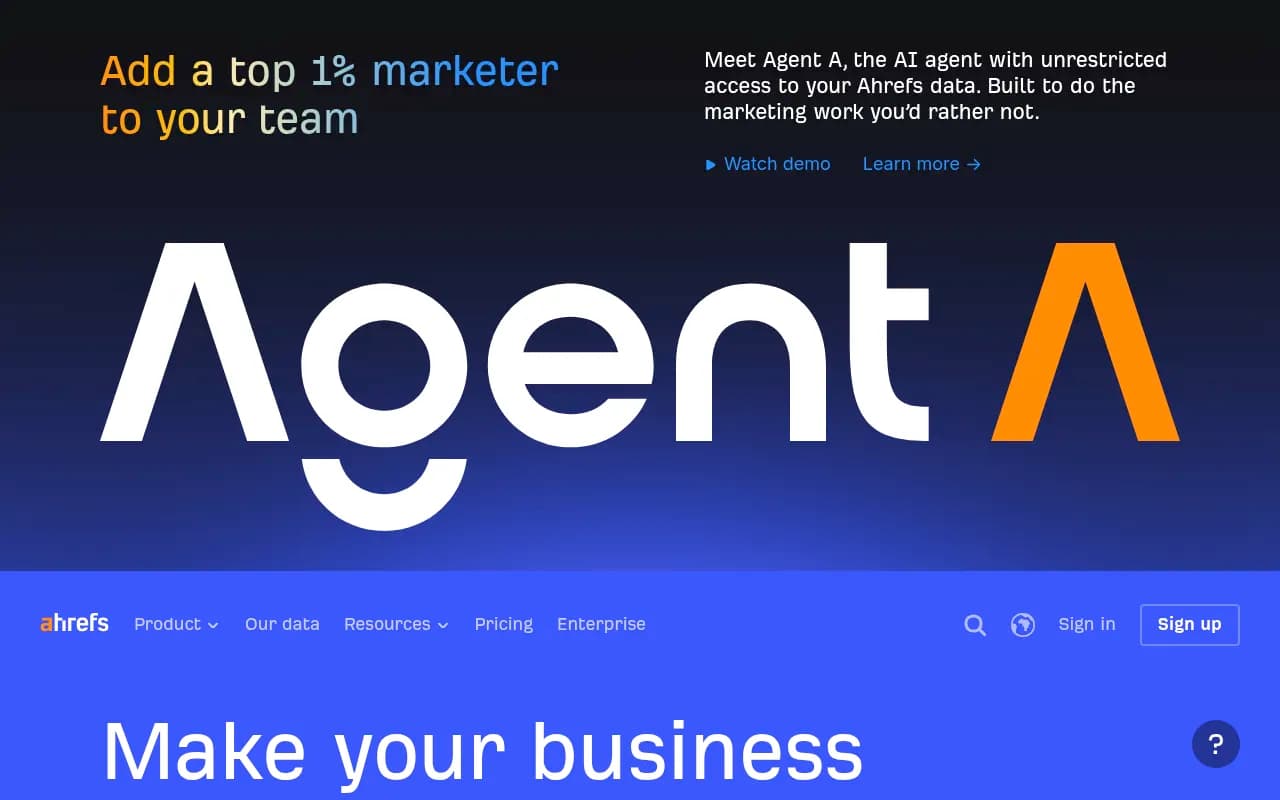
Where it runs out: you can only look at sites you own. Competitor backlinks, keyword explorer, and SERP analysis sit behind paid plans, which the research I reviewed puts from around $108 a month for the entry tier. Check the current price before budgeting.
Screaming Frog SEO Spider
The free version of Screaming Frog crawls up to 500 URLs. For a small business site or a blog, that's plenty to find broken links, missing titles, redirect chains, and duplicate content. Zapier lists it as its pick for technical SEO, with paid licences around $279 a year.
Where it runs out: the 500 URL ceiling, and no scheduled crawls or saved configurations in the free build. Once you pass a few hundred pages, you'll hit it quickly.
Free chatbot tiers
ChatGPT, Claude, and Perplexity all have free plans good for outlines, title variations, schema drafts, and summarizing a messy spreadsheet. Stackmatix's roundup names ChatGPT's free tier as running on GPT-4o Mini, though model names shift constantly, so don't take that as current.
Where it runs out: usage caps, and the bigger problem that a chatbot doesn't know your SERP. It will happily invent search volumes. Use it for thinking and drafting, and pull the numbers from Search Console or Keyword Planner.
AlsoAsked and Google Keyword Planner
AlsoAsked shows People Also Ask trees, which are great for building FAQ sections and content clusters. The free allowance is small, the research I saw says three searches a day. Keyword Planner is free with a Google Ads account but gives volume ranges unless you're running ads.
AIOSEO Analyzer and seo.ai's free tools
AIOSEO's analyzer needs no login and returns an on-page audit in seconds. seo.ai bundles dozens of small free utilities. They're convenient for quick checks. I wouldn't build a process on them, because each handles one page or one task at a time.
Free trials and freemium tools worth knowing
These are not free forever, but they're good for a short, focused evaluation.
| Tool | Type | Notes |
|---|---|---|
| Semrush | 7-day trial, card required | Deepest data, also sells an AI visibility add-on |
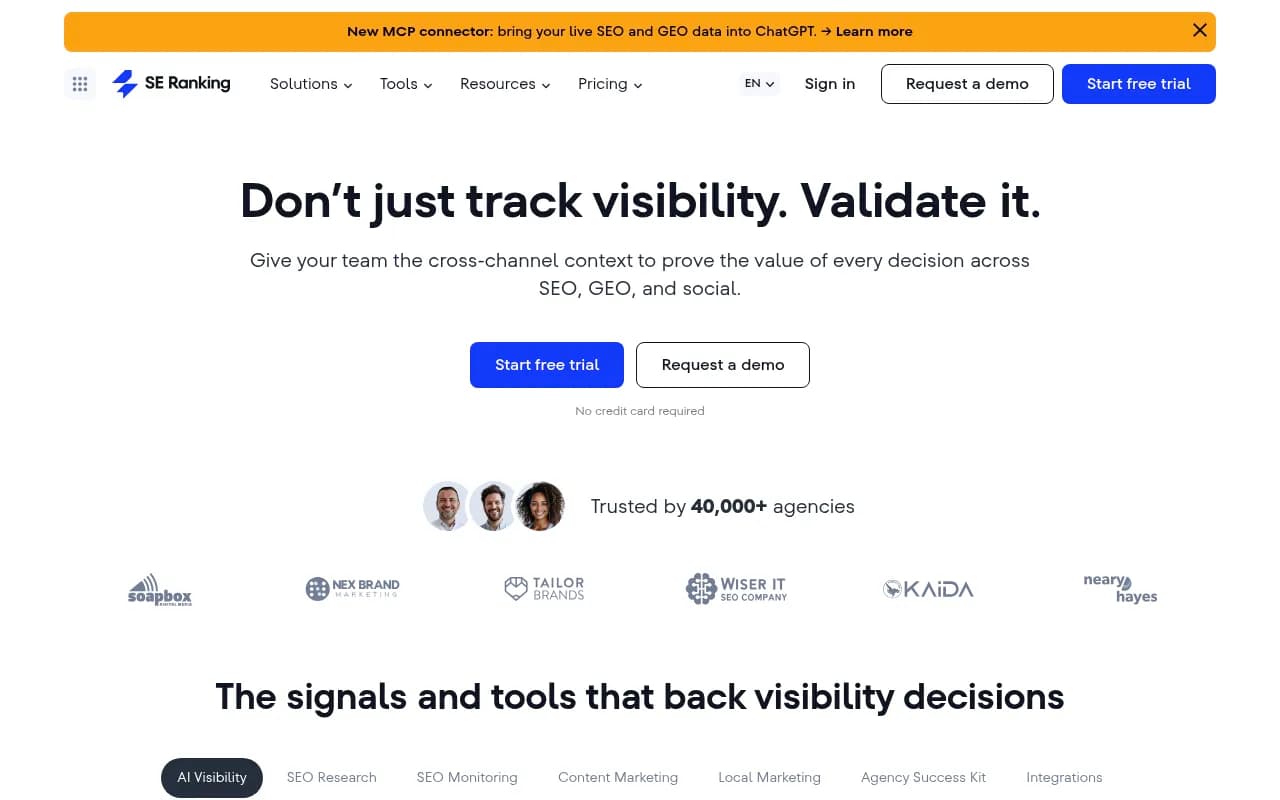
| SE Ranking | 14-day trial, no card | Handy for a clean test run |
| Moz Pro | 30-day trial | Longest trial in the group |
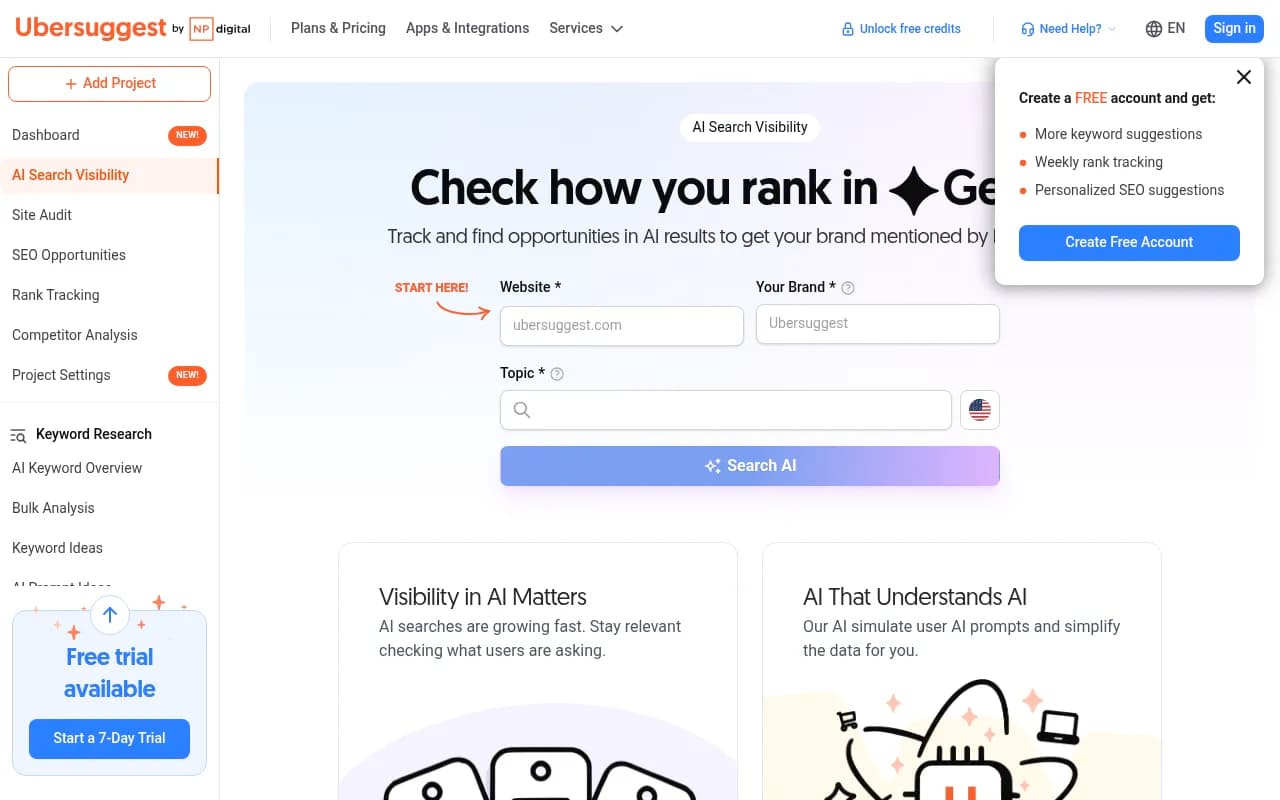
| Ubersuggest | Free version plus trial | Daily limits on the free plan |
| Surfer SEO | Free SERP tools, 7-day money-back | Content scoring and an AI tracker |
A practical tip: line up your trials so you evaluate one tool against one real task, like auditing a specific section of your site, rather than poking around the dashboard for a week. Seven days goes fast.
The AI search gap in free tools
This is where most free stacks fall apart. Everything above helps you rank in Google. None of it tells you whether ChatGPT, Perplexity, or Google AI Overviews mention you, cite you, or can even read your pages.
That gap matters because the sources AI engines use look different from classic SERPs. According to Promptwatch Data's average sources per response report, ChatGPT cites about 5 sources per web-search answer, while Google AI Overviews and Perplexity cite roughly 10. And in Promptwatch's software citation data for Sep 28 to Oct 4, 2026, docs and help centers earned the largest share of ChatGPT's software citations, with review sites like G2 and Capterra collectively outpacing any single vendor. None of that shows up in Search Console.
What free AI visibility checks give you
Several vendors offer a free scan: xSeek's instant audit, Semrush's AI Search Visibility Checker, AIVO's free snapshot, and Promptwatch's no-login AI Visibility Report. They're good for a first reading. Run one before you spend anything.
What they don't give you is history. AI answers vary from run to run, so one snapshot is closer to a coin flip than a measurement. You also can't see which prompts matter, which pages got cited, or whether a change you made helped.
Free tools that help with AI readiness
Some pieces are genuinely free and useful:
- Check your robots.txt and make sure you aren't blocking AI crawlers you actually want visiting.
- Review server logs yourself if you have access, looking for GPTBot, OAI-SearchBot, ClaudeBot, and PerplexityBot.
- Use a free LLMs.txt generator, but don't expect miracles. Promptwatch's markdown report found markdown files make up just 0.05% of AI search citations, so it's a nice-to-have rather than a lever.
- Ask each chatbot your top ten buying-intent questions by hand and log what comes back in a spreadsheet.
The manual approach works for about a month. Then the spreadsheet gets stale and you stop updating it.
Where paid AI visibility tools start to make sense
The signal to upgrade is simple: you've confirmed AI search matters for your business and you need repeatable data rather than anecdotes.
Promptwatch is the one I'd look at first, mostly because it goes past tracking. It monitors real ChatGPT, AI Overviews, Perplexity, and Gemini interfaces, shows IP-verified AI crawler logs, and has a content agent that helps fix gaps. It has a free Explore plan (1 project, 10 prompts, ChatGPT only) and paid plans from $95 a month. Confirm current pricing at promptwatch.com/pricing.

Other options depend on your situation:
| Tool | Starting point | Fits when |
|---|---|---|
| Otterly.AI | Around $29/mo | You want basic prompt monitoring on a tight budget |
| Peec AI | Around 85 EUR/mo | Agencies managing several clients |
| Rankscale | Around $19/mo | Cheapest way to start tracking |
| Semrush AI toolkit | Around $99/mo add-on | You already live in Semrush |
| Ahrefs Brand Radar | Around $129/mo | You already pay for Ahrefs |
Prices come from the Otterly.AI comparison and may be stale. Otterly is itself a vendor, so weigh its rankings accordingly.



If you want to browse more options, the GEO software directory at bestgeosoftware.com lists many of them side by side.
How the free tiers fail in practice
A few patterns come up repeatedly.
The volume problem. Free keyword tools give you ranges or a handful of lookups. You can work around it, but you'll spend more time on research than you should.
The scale problem. A 500 URL crawl cap or a 10-prompt tracker is fine for a brochure site and useless for an ecommerce catalog.
The context problem. A free tool gives you a number with no way to act on it. Knowing your AI visibility is low is a diagnosis without a treatment.
The trial trap. Seven days is not enough to learn a platform, set up integrations, and see a result. If you start a trial, have your data connected and your question ready first.
A sensible free-first plan
- Verify your site in Google Search Console and Ahrefs Webmaster Tools this week.
- Run a Screaming Frog crawl and fix broken links, missing titles, and redirect chains.
- Use a free chatbot to draft briefs, but source your numbers from Search Console.
- Run one free AI visibility scan and manually test your ten most valuable prompts.
- Check your robots.txt and, if you can, your server logs for AI crawlers.
- After 30 to 60 days, decide whether the gaps you found justify paying for rank data, content tooling, or AI visibility tracking.
If you'd rather hand parts of this to specialists, an agency such as 1001 SEO Media handles technical SEO and AI search work, and uses Promptwatch for GEO tracking. That's a hiring decision, though, not a tool decision, and plenty of small sites do fine on the free stack for a long time.
Bottom line
Free tools can run a real SEO program for a small site. Search Console, Ahrefs Webmaster Tools, Screaming Frog, and a chatbot cover the fundamentals. Where they stop is competitive data, scale, and anything about AI search beyond a one-off snapshot. Start free, find the specific limit you keep hitting, and pay only for the tool that removes that limit.