Key takeaways
- Surfer SEO, Frase and NEURONwriter each have an official MCP server. I could not find an official one from Clearscope, though that comes mainly from a competitor's comparison, so check Clearscope directly.
- Frase's server is the broadest on the full content lifecycle (research, brief, write, score, publish, monitor). Surfer's is the most detailed on Content Editor control but is still in Beta.
- NEURONwriter's MCP is narrower and cheaper to run: scoring and recommendations don't use up your limits.
- Plan limits still apply through MCP. An agent can't create more Content Editors than your Surfer plan allows.
- Most content-optimization MCP servers don't measure whether AI engines cite the result. That needs a separate AI visibility tool.
What an MCP server changes for content optimization
MCP (Model Context Protocol) lets an AI client such as Claude, ChatGPT or Cursor call tools in another product. For content tools, that means you stop clicking through an editor and start typing things like "create a Content Editor for this keyword, show me the missing terms, rewrite the intro, re-score it."
I think this is useful but easy to oversell. The scoring still comes from the vendor's engine. The agent just drives the interface for you. What you gain is speed on repetitive work (briefs, audits, batch rescoring) and the ability to chain steps in one conversation. What you give up is the visual feel of the editor, which a lot of writers actually like.
A caveat on sources. Some of what follows comes from vendor docs and announcements, and one comparison is published by Frase itself. I flag where that matters.
Quick comparison
| Tool | Official MCP | Status | Plan requirement | Strongest at |
|---|---|---|---|---|
| Surfer SEO | Yes | Beta, announced Aug 11, 2026 | Pro, Peace of Mind, Enterprise or AI Search Analytics (also works on a trial account) | Content Editor control, AI Tracker data |
| Frase | Yes | Read-write, full lifecycle | Frase says all plans include agent access (confirm on the pricing page) | Research to publish to monitor in one loop |
| NEURONwriter | Yes | Live, roadmap expanding | Gold plan or above | Cheap scoring and recommendations |
| Clearscope | Not found | Per Frase's comparison, no first-party agent integration | n/a | Editorial quality, no agent route yet |
Starting prices from comparison posts: Clearscope $129/mo, Frase $49 to $299/mo, NEURONwriter $19 to $97/mo billed annually. Surfer's plans have been reported from $59 to $359/mo plus a $999 Enterprise tier, though older posts quote $49. Pricing moves often, so verify before buying.
Surfer SEO MCP
Surfer SEO announced its official MCP server on August 11, 2026. It builds on the June 2026 API overhaul, which Surfer itself called the foundation for Surfer MCP and its coming agentic experience.

What the agent can do
The tool list is long, and it is the most granular of the three:
- Create and fetch Content Editors with keyword, location, device, secondary keywords, templates, custom voices and instructions
- Pull SEO guidelines, or only the missing terms and facts
- Include or exclude SERP competitors and recalculate
- Fetch and regenerate outlines, or generate a full Surfer AI article with optional outline review
- Read and update content as Markdown or HTML, then re-score for SEO, AI Search and total score
- Run Auto-Optimize and check its status
- Create shareable permalinks
There are also AI Tracker tools: visibility summaries per model (mention rate, position, presence score), daily trends, tracked prompts by topic, cited sources by domain or URL, brands mentioned and mention gaps. Content Audit pages and Topical Map ideas are exposed too. AI Tracker visibility recommendations are still marked as coming soon.
Six built-in skills package common jobs into a single request: surfer-content-recommendations, surfer-create-content-brief, surfer-create-outline, surfer-manage-content-templates, surfer-optimize-content and surfer-write-article. A walkthrough shows a finished article going to WordPress as a draft straight from chat.
Limits to know about
- It is Beta. The August announcement described a gradual rollout with early access by email request. The docs page dated October 16, 2026 lists plan requirements, so access may have widened since.
- Plan limits apply. If your plan caps Content Editors, the agent hits the same cap.
- Surfer says a fuller agentic experience is in progress with no dates.
Developer documentation lives at devs.surferseo.com/mcp/overview, and user docs at docs.surferseo.com.
Frase MCP
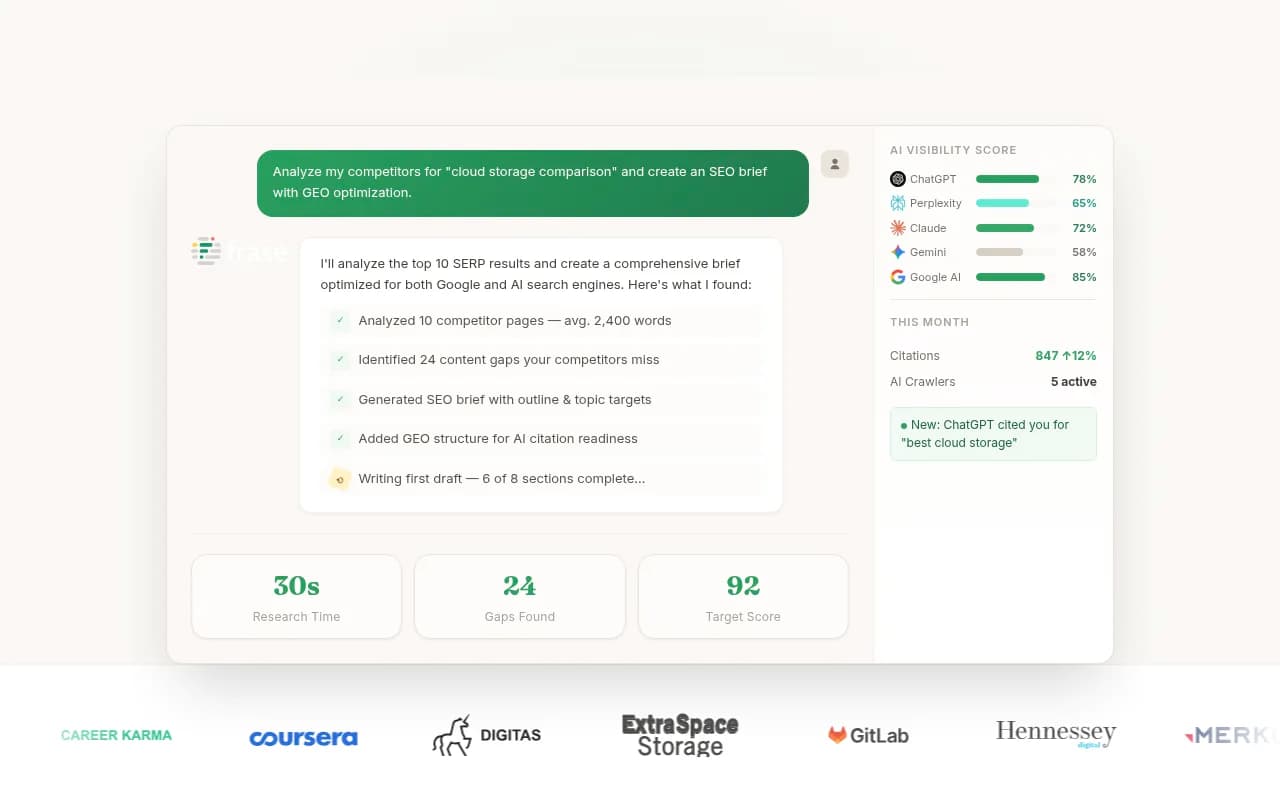
Frase describes its server as read-write across the full content lifecycle. Per its own guide to MCP servers for SEO (published March 2026, updated September 2026), the capabilities include keyword, SERP, question and content gap research, briefs with target scores, AI writing with brand voice, dual SEO and GEO scoring with auto-optimize, publishing to Frase's CMS, WordPress, Webflow, Wix and Sanity, AI visibility tracking across ChatGPT, Perplexity, Claude and Gemini, and Content Guard for decay and ranking recovery.
Setup routes
Frase documents three ways in:
- Claude Directory: the fastest. Click Connect, pick your Frase account, no API key. Claude asks permission the first time it uses each tool and checks before publishing.
- Claude Code: add the server with the command below, using the key from Settings, then API Keys in Frase.
- ChatGPT and Cursor: ChatGPT uses "Connect in ChatGPT" under Settings, then API Keys. Cursor uses the npm package
@frase/mcp-serverplus the connectornext.frase.io/api/mcp.
claude mcp add frase -- npx -y @frase/mcp-server --api-key sk_live_...
A good first test prompt is "List my connected Frase sites." The docs also suggest starting with low-stakes read requests, such as top content opportunities, before asking for anything that creates or publishes. One example asks for pages ranking in positions 4 to 10, which draws on Search Console data. That is a smart place to start: quick wins, nothing gets written.
How to read the claims
Frase's blog says every plan includes full AI agent access. It also publishes the comparison that says Clearscope has no MCP server. Both are vendor statements. Treat them as leads to verify, not settled facts.
NEURONwriter MCP
NeuronWriter has an official server that connects to your account without pasted passwords or API keys. Access comes with the Gold plan or above.
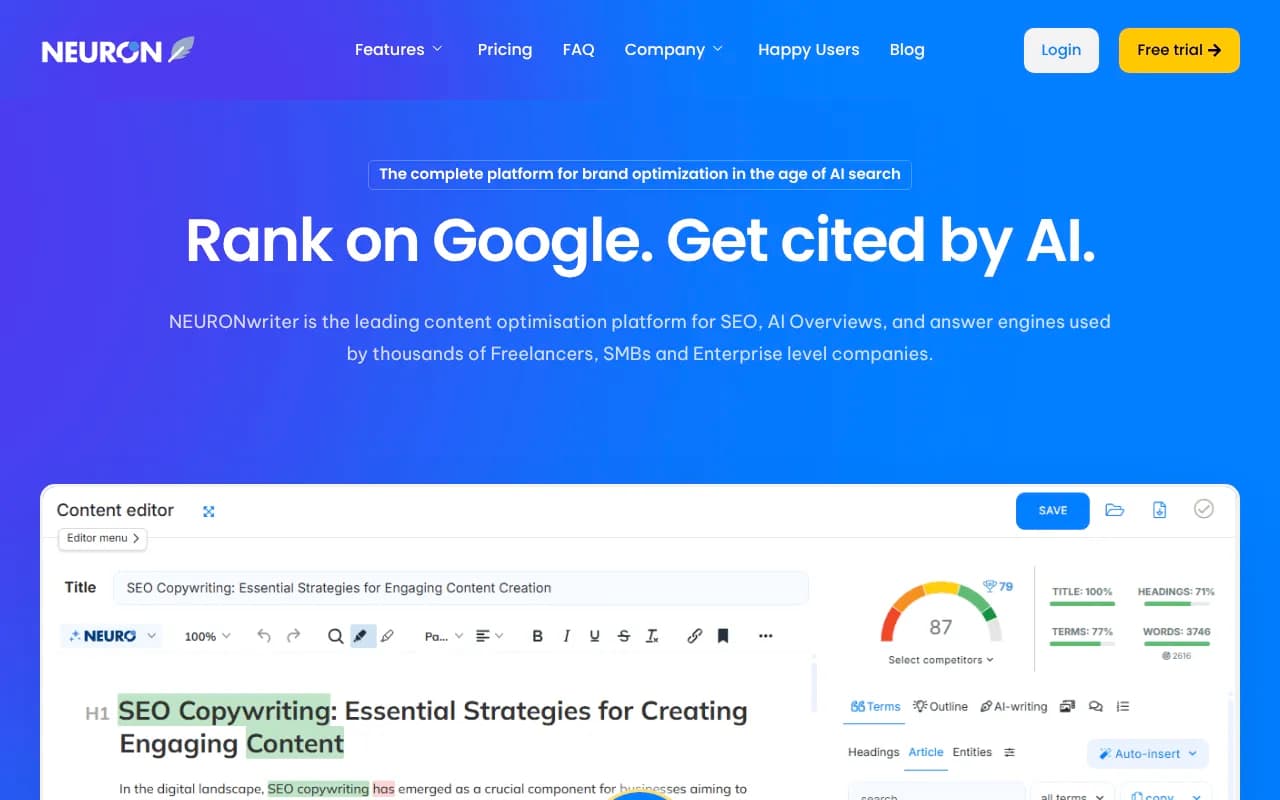
It is designed for content preparation, research and scoring. Fetching recommendations, scoring drafts, reading competitor content and updating tags are free and don't consume your limits. Imported content is saved as a new version in the NEURONwriter editor, which is a sensible safety net when an agent is doing the writing.
The roadmap lists automated content audits, competitor intelligence, CMS commands and brand voice controls over the next several months. That is a promise, not a feature, so don't buy for it yet.
If you're on the lifetime-deal API, there is an unofficial GitHub server (softreviewed/neuronwriter-mcp-server) exposing get_content and evaluate_content, and Composio offers a hosted Neuronwriter toolkit. Both are third-party, so review the code and permissions before connecting a real account.
Clearscope and MCP
Clearscope is the one I'd put an asterisk on. Frase's comparison says it has no official MCP server or first-party agent integration, and my own search turned up nothing official either. Absence of evidence isn't proof, so check Clearscope's site and ask their support before ruling it out.

That said, Clearscope is still the pick many editorial teams prefer. One 2026 comparison calls its data cleaner than Frase's and its Content Grade more reflective of actual SERP performance, with a higher price tag. Rankability's agency comparison names it the best premium editor. If your writers live in the editor and nobody needs an agent to drive it, the missing MCP matters less than you'd think.
Other options worth knowing
I could not verify MCP status for MarketMuse, Semrush, Ahrefs or Content Harmony, so I won't claim either way. Ask each vendor. A few related tools from the catalog:
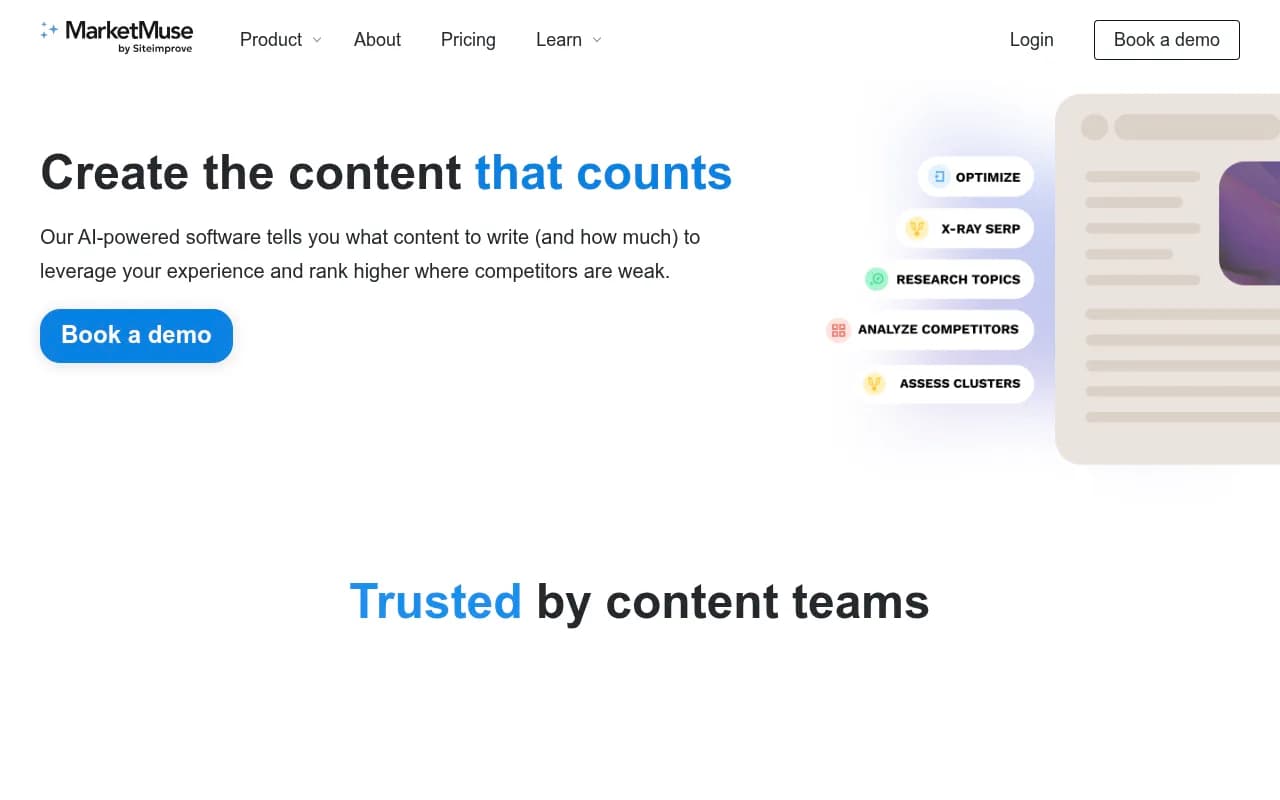
- MarketMuse for content strategy and planning
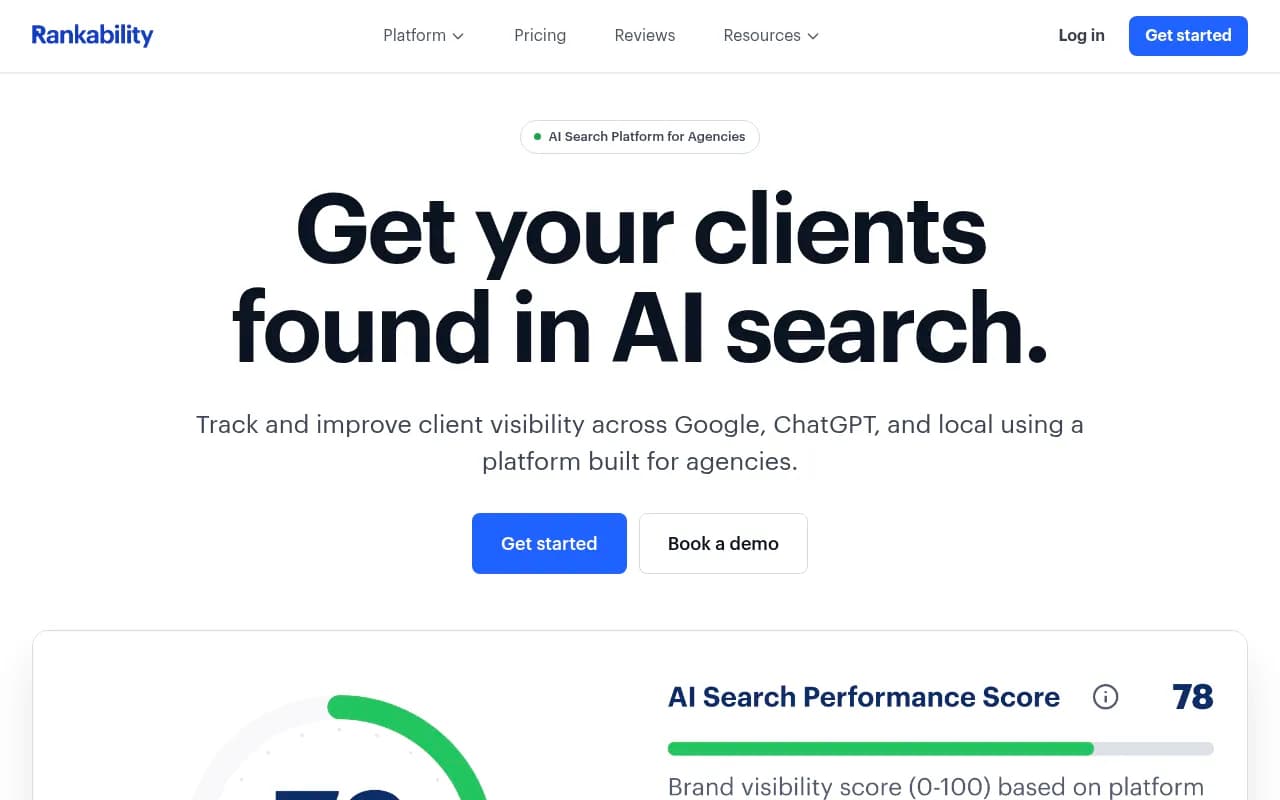
- Rankability, which says all paid plans include API and MCP access and targets agencies
- Machined.ai for clustering and topical authority rather than page scoring
- SE Ranking if you want one broader SEO stack

For wider browsing, the directory at surferstack.com lists content optimization tools with reviews and alternatives.
Which one should you pick?
| If you need | Choose | Why |
|---|---|---|
| Fine control of an optimization editor from an agent | Surfer | Deepest Content Editor toolset, plus AI Tracker data, but Beta |
| One loop from research to publish to decay monitoring | Frase | Widest lifecycle coverage, simple Claude setup |
| Cheap scoring and recommendations in an agent | NEURONwriter | Reads and scoring don't use limits |
| Premium editorial quality, no agent needed | Clearscope | Strong editor, no verified MCP |
| Agency reporting plus MCP | Rankability | MCP included on paid plans per its pricing page |
My take
If I were starting today with an agent-first workflow, I'd trial Frase through the Claude Directory because setup takes minutes and you can test read-only prompts first. If I already paid for Surfer Pro, I'd turn on the MCP and use the optimize and brief skills before committing to anything new. NEURONwriter is the budget experiment.
Practical tips for using these servers
- Start read-only. Ask for opportunities, missing terms or audits before letting an agent create or publish anything.
- Keep a human approval step before publish. Both Frase's Claude flow and NEURONwriter's versioning support this.
- Watch usage. Plan limits and credits still apply, and an agent can burn through them faster than you click.
- Don't chase the score. A 90 in any editor says the page resembles what ranks. It doesn't say the page is good.
- Pin down the brand voice and facts first, using Surfer's custom voices and brand knowledge or Frase's brand voice, so the agent doesn't improvise.
What MCP optimization servers still don't tell you
Surfer's AI Tracker tools and Frase's visibility tracking cover some of this, but optimization tools mostly score a draft against the SERP. They rarely show whether AI crawlers actually read the page, which pages get cited, or what traffic AI engines send you. For that you want a dedicated platform. Promptwatch pairs prompt tracking with AI crawler logs, citation data and traffic attribution, and has its own hosted MCP server, so the same agent that rewrites a page can check whether it got cited.

The research behind this matters. Promptwatch's data from Sep 28 to Oct 4, 2026 shows product pages as the most cited content type in ChatGPT at 22.4% of citations (ChatGPT citation share by content type), and landing pages and docs stay cited longest while news loses half its pages within 36 days (content half-life report). So page type and refresh cadence deserve attention alongside the on-page score. For a wider list of tools in that category, see the GEO software directory at bestgeosoftware.com.
Checklist before you connect an MCP server
- Confirm your plan includes MCP access today, not at launch.
- Check whether limits (editors, articles, credits) are shared with the web app.
- Test with read-only prompts on a non-critical project.
- Decide who approves publishing and where drafts land.
- Revisit pricing quarterly. Every figure in this guide came from comparison posts and vendor pages that change often.
The gap that will matter most in 2026 isn't which editor has the nicest score. It's which vendor lets your agent both change a page and prove what happened afterward.