Key takeaways
- Ranketta is built for e-commerce, with product and SKU-level tracking, catalog enrichment and content generation. If you sell services, SaaS or content, you are paying for a narrow angle you may not use.
- The useful question is not "which tool has a writer" but "which tool writes from my visibility gaps and then checks whether the page got crawled, cited and clicked."
- Promptwatch is the strongest all-round pick when you want monitoring, content creation, CMS publishing and measurement in one loop. Writesonic GEO, Scrunch, Profound and AthenaHQ are credible alternatives with different trade-offs.
- Several comparison pages in this space are written by vendors who rank themselves first, including Ranketta's own. Verify pricing and features on each vendor's site before you buy.
What Ranketta does, and why people look elsewhere
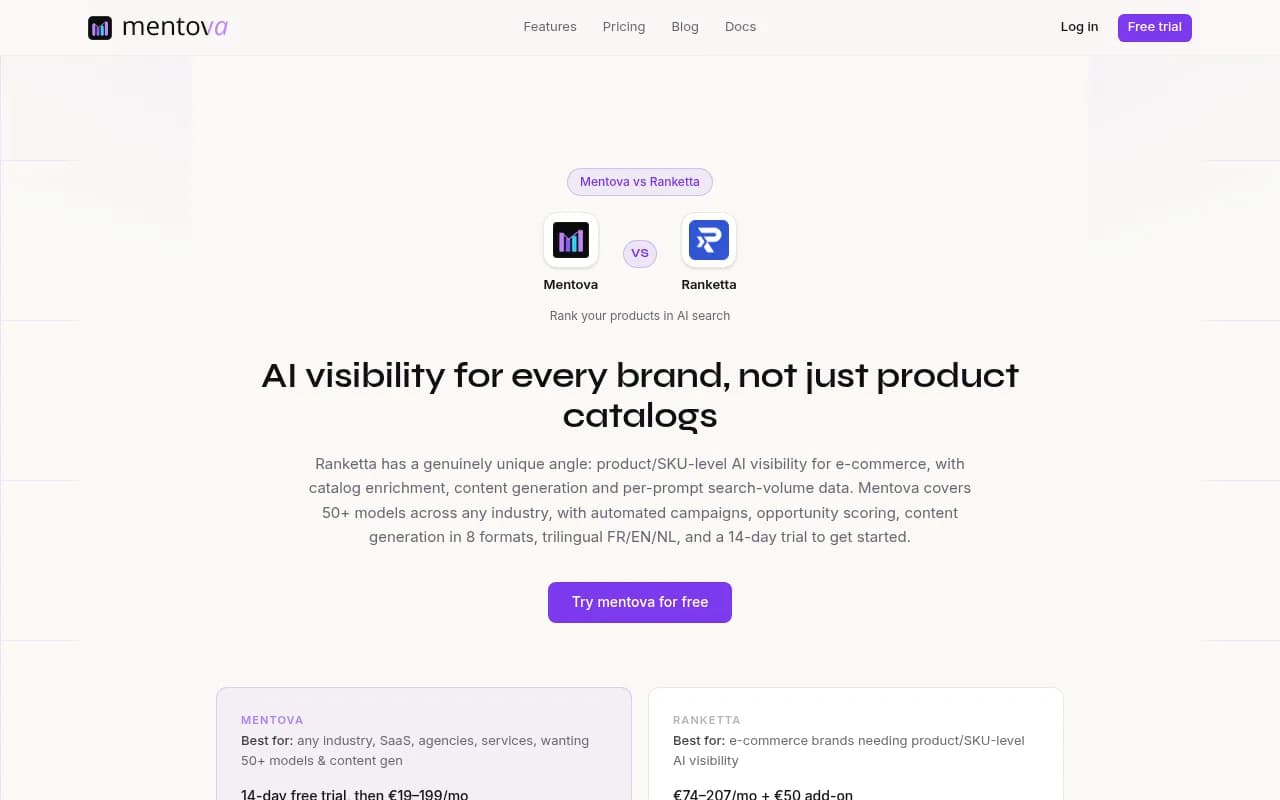
Ranketta tracks how individual products get recommended in AI search. It adds catalog enrichment, content generation (listicles, comparisons, guides, FAQs), prompt research with search volumes, and a few integrations. According to Mentova's comparison page, plans run roughly EUR 74 to EUR 207 per month plus a EUR 50 catalog add-on, there is no free plan, and the engine list is narrow (five engines, no Claude, Copilot or Grok). Mentova is a competitor, so treat those figures as a starting point and confirm them on Ranketta's own site.
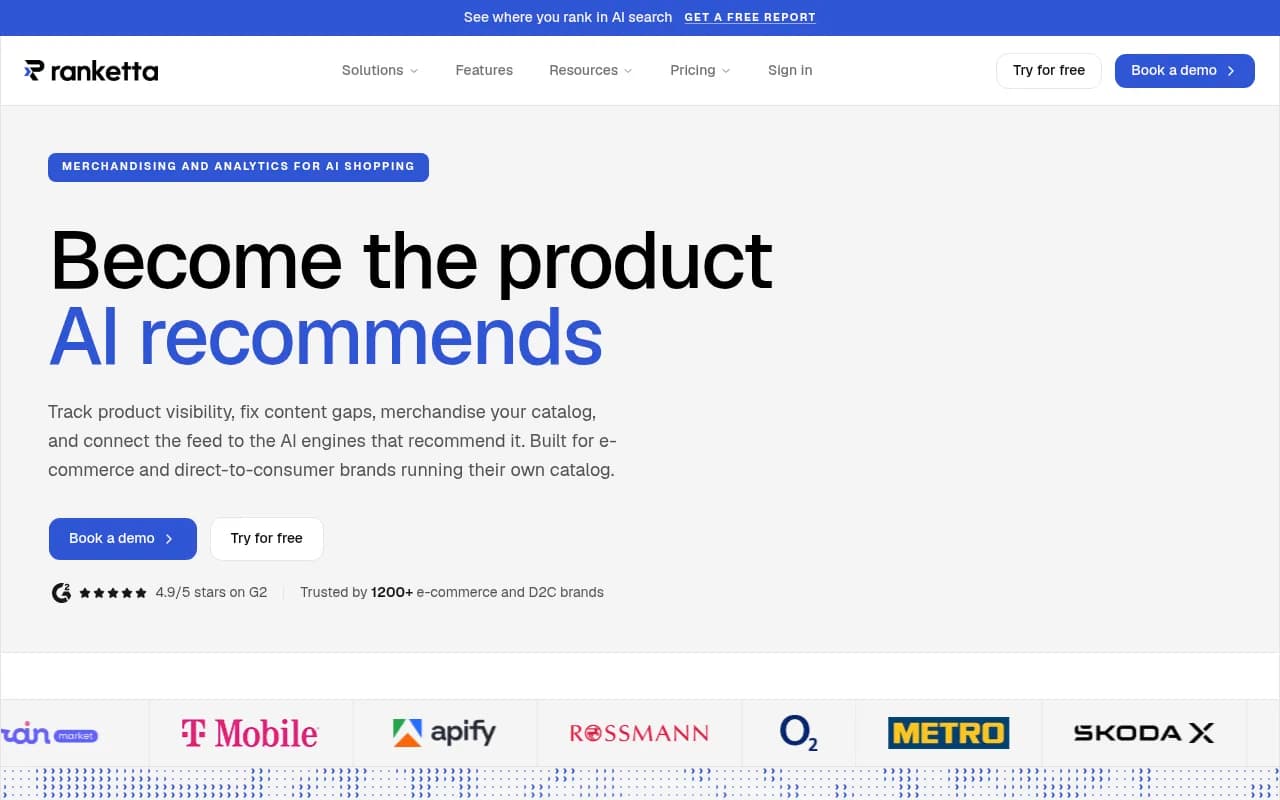
That product-level focus is a real strength for Shopify and marketplace brands. It is also the main reason people leave. Typical reasons:
- You are not an e-commerce brand, so SKU-level tracking is wasted money.
- You want more engines tracked, including Claude, Copilot, Grok and Google AI Mode.
- You want content generation tied to measurement, not just a writer bolted onto a dashboard.
- You need crawler data or traffic attribution to see whether published content works.
A note on sources. Ranketta's blog ranks itself first among Profound alternatives. The Dageno article names Dageno as the best Ranketta alternative. The Mentova and ecentic pages are also vendor-written. Nobody in this category is a neutral referee, so I have leaned on what each product is documented to do and flagged where I could not verify details.
What good built-in content generation looks like
Most tools in this space now claim a content feature. They are not equal. A generic AI writer inside a tracking dashboard is just a writer. What you want is content grounded in the prompts and citations you are losing.
Promptwatch Data gives a useful yardstick. In its analysis of which content types ChatGPT cites (Sep 28 to Oct 4, 2026), product pages made up 22.4% of classified citations and landing pages 16.8%. Listicles were 13.6%, documentation 7.5%, how-tos 8.7%, comparisons 5.9%. For commercial prompts, product pages, landing pages, listicles and comparisons added up to almost 70% of citations.
So a content generator that only produces blog posts is aimed at the wrong target. Check that it can handle:
- Product and landing page copy
- Comparison pages and listicles
- FAQs and how-tos
- Refreshes of existing pages, not just net-new articles
Headings matter too. Promptwatch's ChatGPT query fanout data shows average query length falling from about 117 characters in December to about 53 from April. Short, keyword-style headings with the entity and category first line up better with what ChatGPT searches. If a tool's drafts come out with long, clever headings, you will be editing them by hand.
Comparison table
| Tool | Tracks AI visibility | Built-in content generation | CMS publishing | Measures results after publishing | Best for |
|---|---|---|---|---|---|
| Ranketta | Yes, product/SKU level | Yes, plus catalog enrichment | Feed exports (Merchant Center, Amazon, Heureka) | Limited, per vendor | E-commerce product data |
| Promptwatch | Yes, real UIs across many engines | Yes, Content Agent and on-demand articles | WordPress, Webflow, Framer | Crawler logs, page tracking, visitor analytics | Teams that want the full loop |
| Writesonic GEO | Yes | Yes | Varies | Lighter | Writers who want GEO added to a content tool |
| AthenaHQ | Yes | Yes, with Shopify publishing per Ranketta's page | Shopify | Varies | Shopify content teams |
| Profound | Yes, up to nine engines on Enterprise | Yes, AI Marketer and Agents | Connected CMSes | Yes | Large enterprise brands |
| Scrunch | Yes | Agent-ready pages | Varies | Varies | Brands and agencies |
| Mentova | Yes, 50+ models | Yes, 8 formats | Not verified | Limited | Budget-minded multi-industry teams |
Pricing changes often. Confirm every figure on the vendor's own page.
Best Ranketta alternatives with built-in content generation
Promptwatch
Promptwatch is the one I would look at first if the reason you are leaving Ranketta is that you want more than a dashboard with a writer attached. It tracks how ChatGPT, Gemini, Claude, Perplexity, Google AI Overviews, Google AI Mode, Copilot and others mention and cite your brand, collected from the real interfaces rather than only APIs.

The content side is where it differs from most. Content gap analysis maps your pages against the prompts AI answers. The Content Agent plans, writes and publishes to WordPress, Webflow or Framer on a schedule you control, with a review inbox or fully hands-off. You can also write a single article from a tracked prompt, using its query fan-outs and the competitor pages AI already cites. Content Refresh gives git-diff-style updates for existing pages.
Then it checks the work. IP-verified AI crawler logs show whether bots read the new page, Page Tracker shows whether AI cites it, and visitor analytics show traffic and conversions. Underperformers come back as actions on the Action Board. That write, publish, measure, improve loop is the gap in most tools on this list.
The Content Agent starts on the Business plan at $579/month. Essential ($95/month) and Professional ($245/month) include monitoring and on-demand article credits on Professional, but not the automated agent. If you only sell products and want feed-level fixes, Ranketta's catalog angle is still more specific. Promptwatch does have ChatGPT Shopping tracking on Business and Enterprise.
Crisp is a concrete example: it reported 2x higher conversion rates from AI traffic versus traditional channels and scaled to 5 to 10 articles per day (case study). Pricing is on promptwatch.com/pricing, and there is a 7-day free trial on monthly plans plus a free AI visibility report.
Writesonic GEO
Writesonic started as a writing tool and added AI search monitoring, so the content side is the mature half. It suits teams who already think in terms of drafting and want visibility tracking nearby.
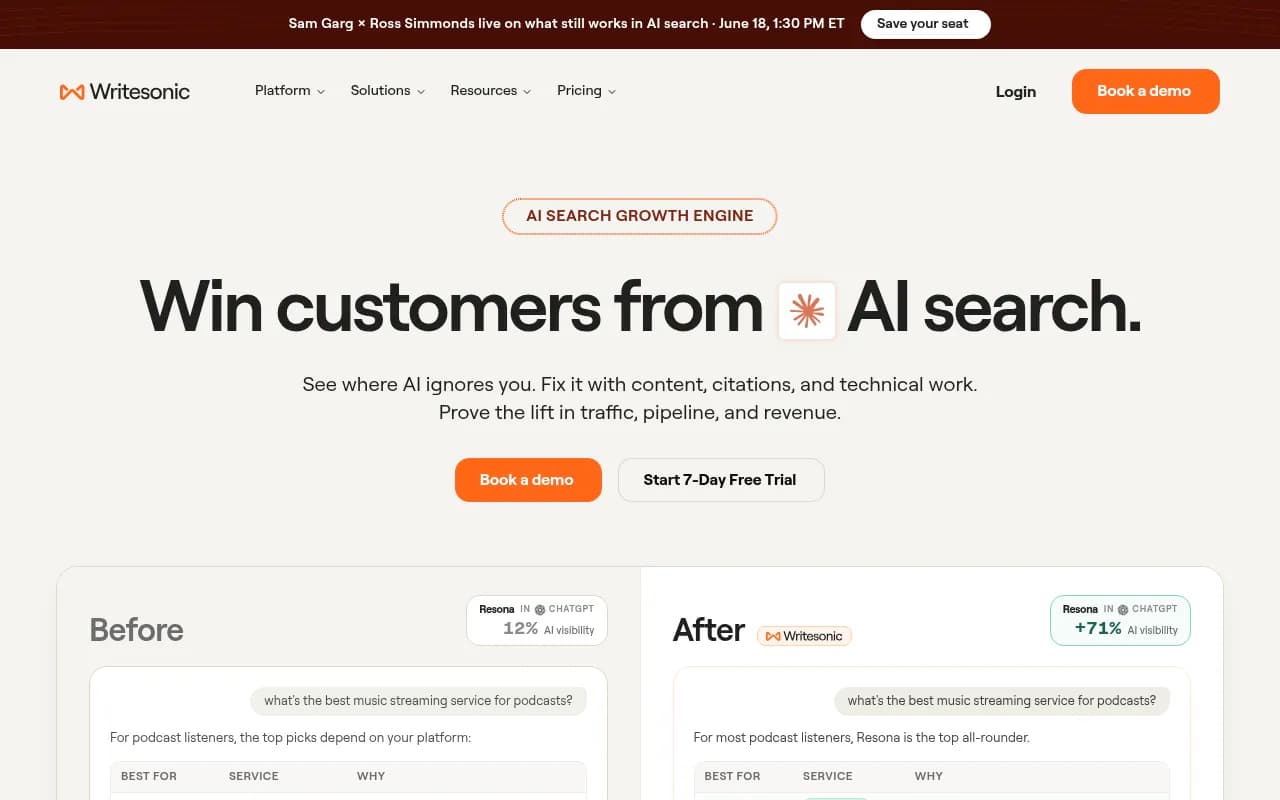
The trade-off is depth on the monitoring side. If you need crawler logs, per-page citation tracking or detailed attribution, check carefully what is included.
AthenaHQ
Per Ranketta's own comparison, AthenaHQ writes product copy and publishes approved changes back into Shopify. That makes it a natural fit for Shopify content teams who find Ranketta's feed-level focus too narrow.

I could not verify its current pricing or engine list from the research available, so check that before shortlisting. Our Promptwatch vs AthenaHQ page covers how they differ.
Profound
Profound is the enterprise option. Ranketta's page reports about 4.5/5 on G2 from 1,100+ reviews, up to nine engines on Enterprise, and AI Marketer and Agents that draft and publish content with human review steps. The catch noted in the same page: brands now get a 7-day trial of 50 prompts or a custom Enterprise contract, and shopping insights cover ChatGPT on Enterprise only.

It is strong if you have a large team and budget. For smaller teams the pricing model is the obstacle. See Promptwatch vs Profound for a head-to-head.
Scrunch
Scrunch pairs monitoring with agent-ready pages for your site, which is a different take on content: it serves AI crawlers a cleaner version of your pages rather than only writing new ones.

It is worth a look if your problem is how AI reads your existing site. If you need a pipeline of net-new articles, look at the others first.
Mentova
Mentova is not in our catalog, so I will keep this short. Its own page says it covers 50+ models, offers content generation in eight formats, trilingual FR/EN/NL support, and a 14-day trial then EUR 19 to EUR 199 per month. It says it does not do SKU-level tracking and has no AI crawler analytics. Those are vendor claims, and the comparison page is where Mentova positions itself against Ranketta.
Dageno AI
Dageno's article calls it the best Ranketta alternative for a workflow that connects visibility monitoring, GEO strategy, content generation, competitive intelligence and attribution. Again, vendor-authored, so take the superlative lightly and test the product.
Dedicated content tools to pair with a tracker
Sometimes the right answer is a tracker plus a stronger writer. AirOps builds content workflows aimed at search visibility, and Jasper and Copy.ai are general marketing writers.

The problem with this route is that the writer has no idea which prompts you are losing or which pages AI cites. You supply that context manually. It works, but it is the opposite of a closed loop.
How to choose
If you sell physical products
Keep Ranketta on the shortlist. Product-level tracking and feed fixes are what it does best. Add AthenaHQ if you want Shopify publishing, and look at Alhena AI and Yotpo Discover, which are built for ecommerce catalogs.
Yotpo Discover
If you sell services or SaaS
SKU-level tracking does nothing for you. Pick a platform that handles prompts, citations and topics across industries, and judge it on how the content tool uses that data. Promptwatch, Profound and Writesonic GEO are the practical candidates.
If you are an agency
You need unlimited projects and client reporting more than a fancy writer. Promptwatch's agency plans (Kick-off $199/month, Growth $399, Scale $799) include unlimited projects and seats, but not the Content Agent or AEO articles. Agencies that want content generation go to Enterprise. Check that against your needs, and see the agency solutions page.
If budget is the constraint
Entry-level trackers are cheaper but rarely write anything. Otterly.AI is a lightweight monitor, and several tools in the directory are low-cost. If you want to browse more, the GEO software directory at bestgeosoftware.com lists dozens.

A short checklist before you buy
- Ask to generate a product page, a comparison and an FAQ, not just a blog post. Citation data says those are what get cited.
- Check whether the draft starts from a tracked prompt and its competing cited pages, or from a blank box.
- Look at the headings. Short, keyword-like H2s beat long clever ones.
- Confirm how publishing works. Direct CMS push with draft or live options saves real time.
- Ask how you will know it worked: crawl data, citation tracking, traffic.
- Ask which engines are tracked and whether the data comes from real interfaces or APIs.
- Get the current price in writing. Most numbers floating around comparison pages are stale or vendor-supplied.
The bottom line
Ranketta is a sensible choice for a very specific job: fixing product data for AI shopping engines. For anyone else, the better question is whether a content feature is wired into your visibility data and your measurement. If you want that loop in one product, start with Promptwatch's free report or trial and compare its output against whichever alternative you are also testing. Run the same three prompts through each tool, publish one piece from each, and see which page gets crawled and cited first.