Key takeaways
- Google sets no numeric monthly cap on AI-written articles. Its spam policy targets scaled content made mainly to manipulate rankings, "no matter how it's created."
- The real limit is how many articles your team can fact-check, edit and keep current. That number is usually far lower than what a tool can generate.
- Graphite's 2026 research found 86% of Google-ranking articles are human-written, and 82% of articles cited by ChatGPT and Perplexity are too. Unedited AI output mostly doesn't get through.
- Treat sudden publishing spikes as a risk factor, not a proven rule. The "5 to 200 articles a week" warnings come from vendor blogs, not Google.
- Start small, watch indexing, impressions and AI citations for 4 to 6 weeks, then raise volume only if the signals hold.
The honest answer: there is no magic number
People want a figure. 20 a month? 100? 12,000? I looked for an authoritative one and there isn't one. Google doesn't publish a threshold, and the "under 30% AI is fine, over 50% is too much" line you see on Quora is one person's opinion with nothing behind it.
What exists is a policy and a pile of anecdotes. The policy is clear enough. The anecdotes are useful mostly as warnings.
So the better question is: how many articles can you publish that each deserve to exist? That number depends on your editors, your subject-matter access, and how much original information you can add per piece. Volume is a symptom. Quality control capacity is the cause.
What Google actually says
Google's spam policies define scaled content abuse as generating many pages "for the primary purpose of manipulating search rankings and not helping users." It covers large amounts of unoriginal, low-value content, no matter how it's created.
Two details matter here.
- The March 2024 update widened the policy. Before that it targeted automation specifically. Now it applies whether automation, humans or a mix produce the pages. A content farm of underpaid humans copying each other is in scope too. Google's announcement is on the Google blog.
- The test is intent and value. Raw count isn't the trigger. A site publishing 300 genuinely useful pages is fine. A site publishing 30 thin rewrites of competitors' pages is not.
The usual summary, repeated by sources like Razor Rank, is that AI content isn't penalized just because a machine helped write it. That's right as far as it goes, but it skips the second half: it's also not protected.
What the data says about AI content performance
Graphite's research is the best dataset I found. They sampled 55.4k articles from Common Crawl and ran detection with three tools (Pangram, GPTZero and Copyleaks).
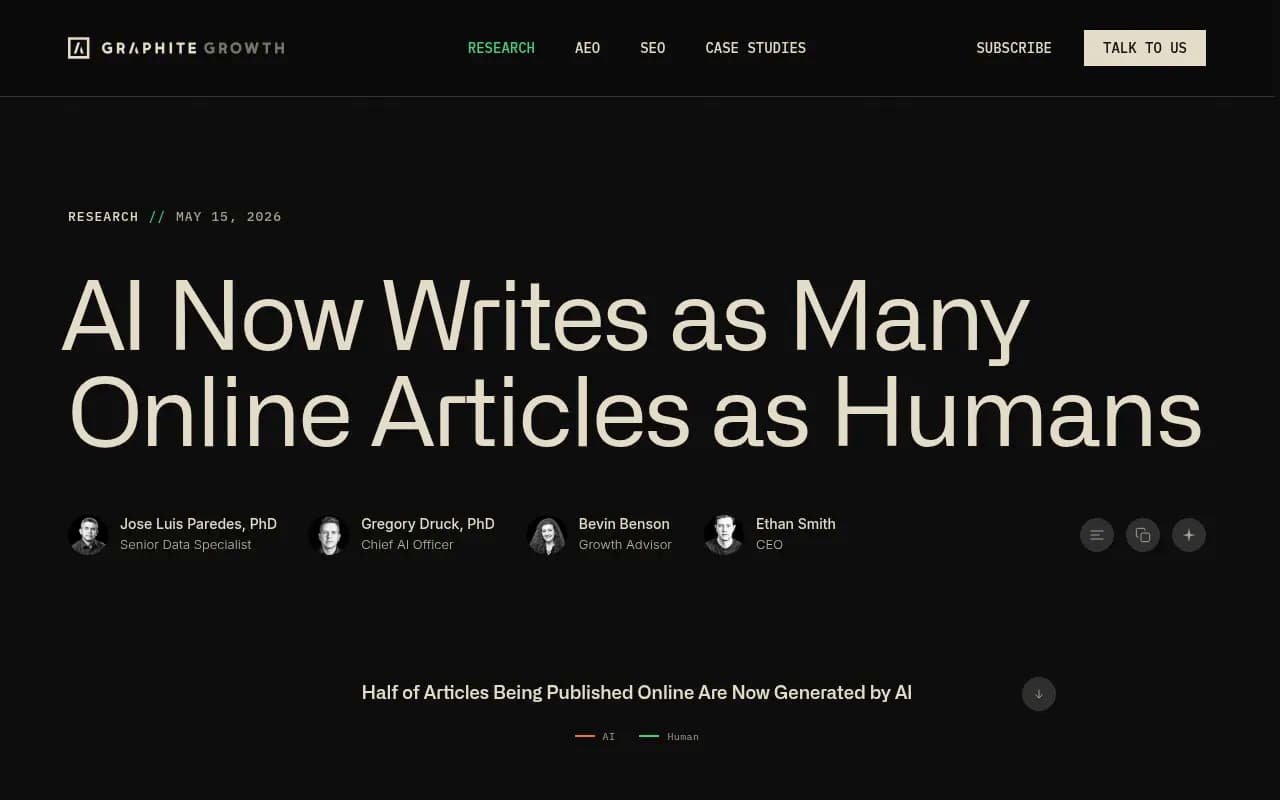
Their findings, in a table:
| Measure | AI-generated | Human-written |
|---|---|---|
| Share of new articles online (2026-Q1) | 49.94% | 50.06% |
| Articles ranking in Google | 14% | 86% |
| Google position 1 results | 7.7% | 92.3% |
| Articles cited by ChatGPT and Perplexity | 18% | 82% |
See Graphite's full study and the search and LLM follow-up.
Half the web is AI-written, yet it makes up a small slice of what ranks and a smaller slice of what gets cited. The share creeps up to about 16% by position 20 and thins out near the top.
There are real caveats. The study is correlational. Graphite also says it didn't test heavily human-edited AI-assisted content and suspects it may do fine. So the lesson isn't "AI loses." It's that mass-produced, lightly edited AI output rarely reaches the positions that matter.
Pew Research's 2026 analysis of the web points the same direction on prevalence. AI-style vocabulary and punctuation patterns kept rising through January 2026 across .com and .org domains. Readers are noticing too, which is its own quality signal, just not one Google measures directly. See Pew's write-up.
What happens when people go big
The famous case is the Reddit thread about posting 12,000 AI articles in a month. It reports a spike of around 30,000 daily page views, then a decline. It's anecdotal, one poster, no verification. But the shape of the story shows up again and again: a quick bump, then erosion.
A vendor blog (digitalapplied.com) goes further and claims that after the March 2026 core update, sites publishing hundreds or thousands of AI pages with no editorial oversight lost 50 to 80% of traffic. It also names "anomalously rapid publication velocity relative to site age" as a detection signal, and says going from 5 to 200 articles a week is something Google "will notice."
I'd treat all of that carefully. I couldn't verify any of it against Google, and vendors selling recovery services have an incentive to sound alarming. Velocity is plausibly a risk factor, because a brand-new domain with 2,000 pages looks odd. But nobody outside Google can tell you where the line is.
Why volume itself is a weak lever
Even ignoring penalties, more pages doesn't mean more outcomes. Promptwatch Data tracked every page ChatGPT cited on July 6, 2026 for 90 days, and found content decays at very different speeds. In the content half-life report:
| Content type | Still cited at day 30 | Still cited at day 60 |
|---|---|---|
| Landing pages | 78% | 69% |
| Docs | 76% | 67% |
| Comparisons | 72% | 63% |
| Listicles | n/a | 60% |
| Product pages, reviews, how-tos | n/a | 55% |
| News | about half gone by day 36 | 41% |
The report doesn't talk about publishing volume, so this next part is my inference. If pages decay and need upkeep, a library of 400 unmaintained AI articles is a liability. A smaller set kept accurate probably earns more than a big set that quietly rots. Promptwatch's own advice is to treat landing pages, docs and pricing pages as long-term assets and put lasting effort into comparisons and listicles.
Find your real ceiling: the review capacity method
Here's how I'd calculate a sensible monthly number. It's crude, but it's grounded in the thing that actually breaks.
Step 1: Count review hours
How many hours per month can a qualified person spend on editing and fact-checking? Be honest. Say it's 40.
Step 2: Set a minimum time per article
A decent AI-assisted piece needs, at minimum, a fact-check of every claim and statistic, a rewrite of generic passages, an added original element (data, a quote, an example, a screenshot), and a link check. That's rarely under 90 minutes. For technical or health topics, it's much more.
Step 3: Divide
40 hours at 1.5 hours each is about 26 articles a month. That's your ceiling with one part-time editor. Not 260.
Step 4: Reserve 20 to 30% for upkeep
Set aside part of that time to refresh older pages. Then your new-article number drops to roughly 18 to 20. Refreshing existing content with AI help, while a human checks the changes, is one place AI-assisted work tends to hold up well.
Neil Patel's often-shared stat that AI writes an article in 16 minutes while a human needs 69 is true for first drafts. It says nothing about the review step, which is where quality is decided.

Rough monthly ranges by team setup
These are my working estimates, not industry standards. Use them as starting points.
| Setup | Sensible AI-assisted articles per month | Main risk |
|---|---|---|
| Solo founder, no editor | 4 to 8 | Thin, generic posts |
| One part-time editor | 15 to 25 | Review shortcuts |
| Small content team with SMEs | 30 to 60 | Topic overlap, cannibalization |
| Agency with full editorial process | 60 to 120 per brand | Template sameness across pages |
| Fully automated, no review | Any number | Scaled content abuse exposure |
A brand-new domain should stay at the low end of its range for the first couple of months. Ramp gradually instead of jumping.
Warning signs your quality signals are breaking
Watch these weekly, not quarterly.
- Rising share of URLs showing "Crawled, currently not indexed" or "Discovered, currently not indexed" in Search Console.
- Impressions flat or falling while page count climbs.
- Average time on page and scroll depth dropping on new posts.
- New articles getting zero AI citations after 6 to 8 weeks.
- Many pages targeting near-identical queries.
- Editors skimming instead of reading.
If two or three of these appear together, pause new publishing and fix the backlog. The vendor advice to pause batch publishing first is sensible even if their traffic numbers aren't verified.
What keeps AI-assisted content safe
The common thread in what survives: someone accountable is behind each page.
- Real bylines with relevant expertise, and a bio page that backs it up.
- Original information per article. A proprietary number, a tested process, a customer quote, your own screenshot.
- Fact-checking against primary sources, not against another AI answer.
- Distinct page purposes, so your articles don't compete with each other.
- Honest updates, with changed dates only when content changed.
- Cutting or merging pages that never performed.
You can also lean on tooling for the checkable parts. Content optimization tools like Surfer SEO and Clearscope help with coverage and structure, though they don't verify facts.


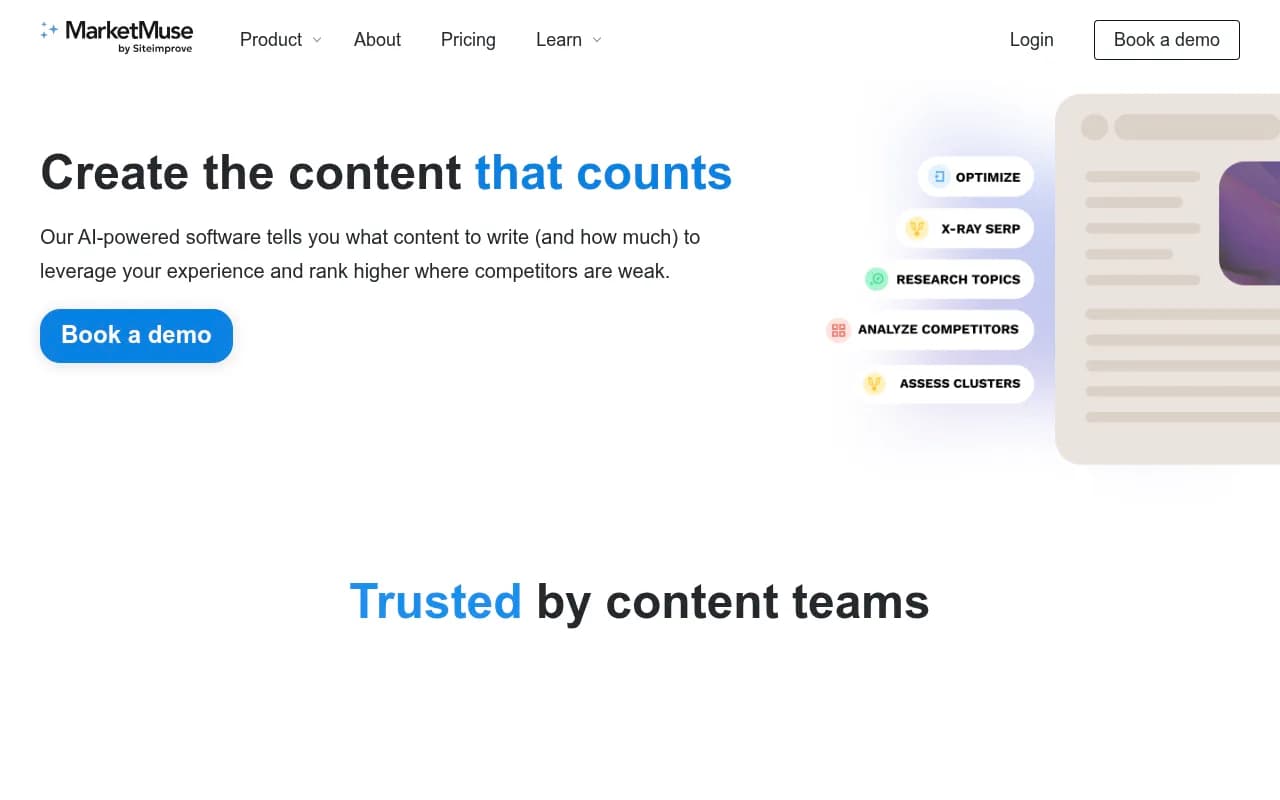
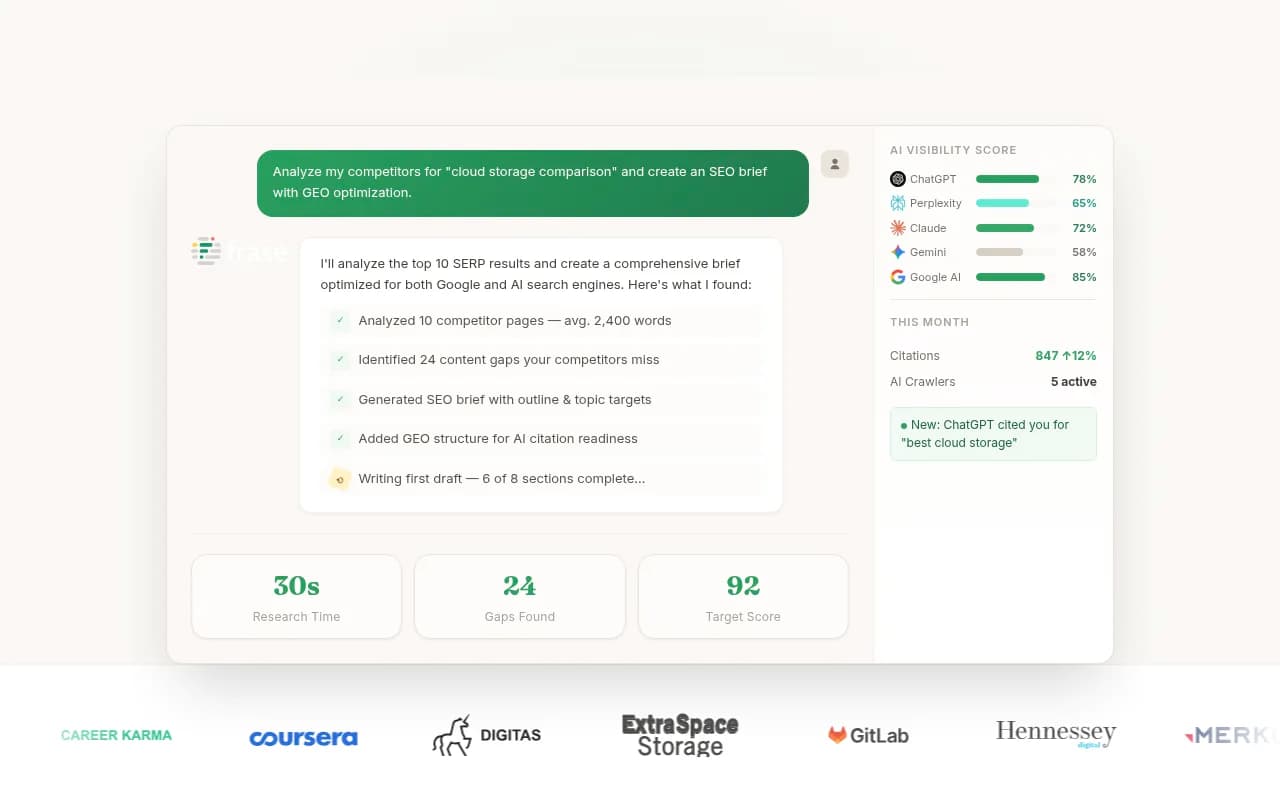
For planning and briefs, MarketMuse and Frase are built around the research step, which is where AI drafts are weakest.
A note on bulk generators
The catalog is full of tools that promise bulk publishing: Article Forge, Autoblogging.ai, SEO Writing AI, AutoPublish and others. They can produce volume. That's not the same as producing something you should publish. If you use one, treat the output as a rough draft queue feeding your review process, and cap it at your review capacity from the section above.


Higher-control writing platforms such as Writer, which adds brand and style rules, suit teams that want guardrails baked into drafting.

Measuring whether it's working, including in AI search
Google isn't the only place quality shows up now. Graphite found 82% of pages cited by ChatGPT and Perplexity are human-written, so citation tracking is a useful second test of whether your AI-assisted pages are trusted.
Tools like Promptwatch can show which of your pages get cited in AI answers and whether AI crawlers are even reading new posts, which helps you tell a rollout that's landing from one that's just piling up.

If you'd rather compare options, the GEO software directory at bestgeosoftware.com lists a lot of them. Pair that with Search Console data and you have both sides: classic indexing and AI citations.
For context on how AI engines pick sources, Promptwatch's data shows almost half of ChatGPT responses cite 10 or more unique domains (Sep 28 to Oct 4, 2026), so there's room to be one of many sources, but only if the page offers something distinct. Product pages, for instance, were 22.4% of ChatGPT citations in the same week, a reminder that content type matters as much as count.
A 90-day rollout plan
- Weeks 1 to 2: audit existing content. Merge or remove thin pages. Set your review capacity number.
- Weeks 3 to 6: publish at 50% of your ceiling. Track indexing rate, impressions and engagement per article.
- Weeks 7 to 10: if indexing stays healthy (most new URLs indexed within a couple of weeks) raise to 75%.
- Weeks 11 to 13: reach full ceiling only if new pages earn impressions and some get cited. Otherwise hold and improve quality.
- Ongoing: spend a quarter of editorial time refreshing older pages.
If you want outside help setting this up, an SEO agency such as 1001 SEO Media covers content strategy and production with senior review, but the framework above works in-house too.
Bottom line
There's no monthly number that makes AI content safe or unsafe. Google says the test is value to users, and the Graphite data suggests unreviewed AI output rarely ranks or gets cited. Pick a volume your editors can genuinely stand behind, ramp slowly, and let indexing and citation data tell you when to go higher. For most teams that's somewhere between 10 and 60 articles a month, not hundreds.