Key takeaways
- Most AI visibility platforms track 4-6 LLMs. Only a handful cover all 10 major models (ChatGPT, Claude, Gemini, Perplexity, Grok, DeepSeek, Mistral, Copilot, Meta AI, Google AI Mode).
- Coverage breadth matters less than what you do with the data. Monitoring-only tools show you gaps but leave you to fix them yourself.
- The platforms that combine tracking, content gap analysis, and content generation give you an actual optimization loop -- not just a dashboard.
- Pricing ranges from ~$49/month for basic monitoring to $500+/month for enterprise-grade analytics. Most teams land somewhere in the $99-$300 range.
- If you're serious about improving your AI visibility (not just watching it), look for platforms that go beyond monitoring to help you create content that gets cited.
Why full LLM coverage actually matters
A year ago, most brands only cared about ChatGPT and Google AI Overviews. That made sense -- those were the platforms with real user volume.
But the landscape shifted fast. Perplexity crossed 100 million monthly users. Grok got embedded into X's search. DeepSeek surprised everyone with its rapid adoption. Meta AI is now the default assistant across Instagram, WhatsApp, and Facebook. Mistral is quietly powering a growing slice of European enterprise AI.
The result: if your visibility platform only tracks 5 or 6 models, you're flying blind on a meaningful portion of the AI search market. A competitor could be dominating Perplexity and Grok recommendations while your dashboard shows you a perfectly healthy ChatGPT score.
That's the core problem this guide addresses. Which platforms actually track all 10 major LLMs, what do they do with that data, and which ones are worth paying for?
The 10 LLMs worth tracking in 2026
Before comparing platforms, it's worth being clear about which models matter and why:
- ChatGPT (OpenAI) -- still the largest AI search surface by user volume, with 800M+ weekly users
- Google AI Overviews -- embedded in Google Search, reaches billions of existing search users
- Google AI Mode -- Google's newer conversational search interface, growing fast
- Gemini -- Google's standalone AI assistant, tightly integrated with Workspace
- Perplexity -- the most citation-heavy model; brands that appear here get direct source links
- Claude (Anthropic) -- popular with professional and developer audiences
- Copilot (Microsoft) -- integrated into Windows, Edge, and Microsoft 365
- Grok (xAI) -- embedded in X (Twitter), with real-time web access
- Meta AI -- default assistant across Facebook, Instagram, WhatsApp, Messenger
- DeepSeek -- rapidly growing, especially in Asia-Pacific markets
- Mistral -- gaining traction in European enterprise and developer communities
Not every platform tracks all of these. Most cover the first five or six. The gap matters more as user behavior fragments across models.
How to evaluate these platforms
There are three things worth checking before you commit to any tool:
1. Which models does it actually query? Some platforms claim broad coverage but use API outputs rather than real user-facing interfaces. API responses and actual user-facing answers can differ -- especially for shopping recommendations and local results.
2. Does it help you act, or just watch? A lot of tools are monitoring dashboards. They show you your share of voice, your citation count, your sentiment score. That's useful context. But if the tool stops there, you still have to figure out what to write, brief it yourself, and publish it yourself. The more useful platforms close that loop.
3. What does the data actually look like? Prompt volume estimates, difficulty scores, competitor heatmaps, page-level citation tracking -- these details separate platforms that give you actionable intelligence from ones that give you pretty charts.
The platforms worth knowing about
Promptwatch -- the full optimization loop
Promptwatch is the platform that goes furthest beyond monitoring. It tracks 10 AI models (ChatGPT, Perplexity, Google AI Overviews, Google AI Mode, Claude, Gemini, Meta AI, DeepSeek, Grok, Mistral, Copilot) and pairs that coverage with tools that actually help you improve your visibility.
The core difference from most competitors: Promptwatch runs an action loop. Answer Gap Analysis shows you which prompts competitors rank for that you don't -- not as a vague summary, but as specific questions and topics your site isn't answering. Content Agents then generate articles, listicles, and comparisons grounded in that prompt data. And page-level tracking shows you when those new pages get crawled, cited, and start driving traffic.
It also has AI Crawler Logs -- real-time logs of when ChatGPT, Claude, Perplexity and others crawl your site, which pages they read, and what errors they hit. Most competitors don't have this at all.
Used by 1,480+ brands including Booking.com, Center Parcs, and Everflow. Pricing starts at $99/month.

Scrunch AI -- enterprise monitoring depth
Scrunch AI is a strong choice for enterprise teams that need SOC 2 compliance, detailed prompt-level segmentation, and governance-grade reporting. It tracks ChatGPT, Claude, Perplexity, Gemini, Google AI Overviews, Google AI Mode, and Meta AI -- solid coverage, though it misses Grok, DeepSeek, Mistral, and Copilot.
The platform's strength is in filtering: you can tag prompts by persona, funnel stage, and location, then slice your share-of-voice data accordingly. It has raised $19M and serves 500+ brands including Lenovo. Pricing starts at $300/month with no free trial.
The honest trade-off: it's primarily a monitoring tool. You get excellent data but not much help acting on it.
Otterly.AI -- affordable entry point
Otterly.AI covers ChatGPT, Google AI Overviews, Perplexity, Google AI Mode, Gemini, and Microsoft Copilot. Six models, not ten -- Grok, DeepSeek, Mistral, and Meta AI are missing. But for teams that mainly care about the Google and OpenAI ecosystems, the coverage is reasonable.
It's the most accessible option on price, with plans starting well below $100/month. Setup is fast and the interface is clean. The limitation is depth: Otterly.AI is a monitoring tool, not an optimization platform. You'll see your mentions and citations, but you won't get content recommendations or gap analysis.
Profound -- enterprise analytics
Profound targets enterprise marketing and strategy teams with detailed analytics on AI search behavior. It covers the major models and has strong reporting features. Pricing is on the higher end, and like Scrunch, it's primarily a monitoring and analytics platform rather than an optimization one. Good fit for large teams that need executive-level reporting.
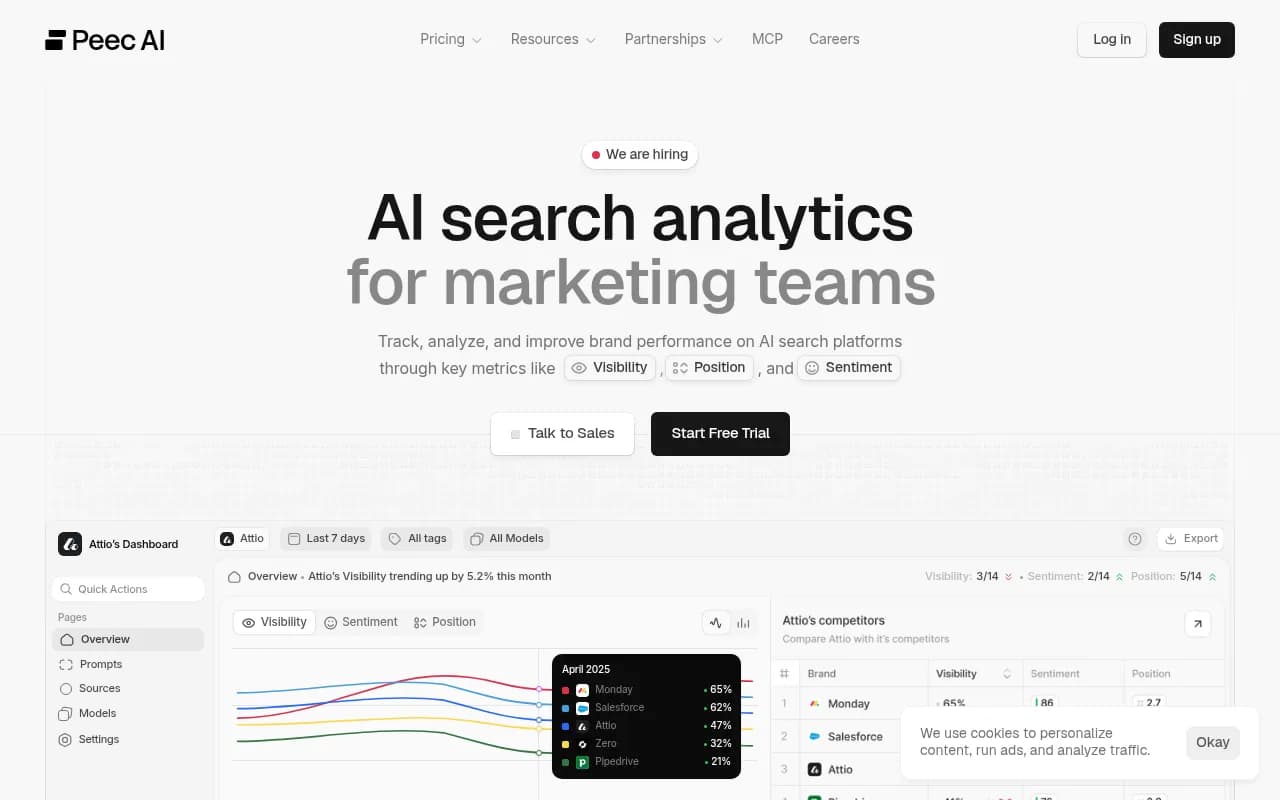
Peec AI -- smart suggestions with monitoring
Peec AI sits in the middle ground: it monitors your brand across major AI models and adds some recommendation features to help you understand what to improve. Coverage is solid for the core models. It's a reasonable option for teams that want more than raw data but aren't ready to invest in a full optimization platform.
AthenaHQ -- monitoring focused
AthenaHQ covers the major LLMs and provides clean visibility dashboards. It's monitoring-focused, which means you'll get good data on your brand mentions, sentiment, and competitor share of voice. What it doesn't do is help you generate or optimize content based on that data. Worth considering if you have a content team that can act on the insights independently.
Search Party -- agency-oriented tracking
Search Party is built with agencies in mind -- multi-client management, white-label reporting, and team workflows. Coverage spans the main models. The trade-off is that prompt metrics and content gap analysis are limited compared to platforms like Promptwatch. Good for agencies that need clean client reporting more than deep optimization tools.
Rankscale -- rank tracking for AI
Rankscale approaches AI visibility from a rank-tracking angle, which makes it familiar for SEO teams. It monitors how your brand and pages appear across AI search results and tracks changes over time. Useful for teams that want to apply traditional rank-tracking logic to AI search.
SE Ranking -- traditional SEO plus AI
SE Ranking has added AI visibility tracking to its existing SEO platform. If you're already using SE Ranking for keyword tracking and site audits, the AI visibility layer is a convenient addition. Coverage is growing but not yet as deep as dedicated AI visibility platforms.
Semrush AI Visibility Toolkit -- familiar but limited
Semrush has added AI visibility features to its platform. The advantage is that millions of SEO teams already use Semrush, so there's no new tool to learn. The limitation is that Semrush uses fixed prompts rather than letting you define your own, and it lacks AI traffic attribution. Fine as a starting point, but not a replacement for a dedicated GEO platform.
Ahrefs Brand Radar -- basic AI brand tracking
Ahrefs Brand Radar tracks your brand across AI search engines and integrates with Ahrefs' existing backlink and keyword data. Like Semrush, it uses fixed prompts, which limits how precisely you can track the queries that matter to your specific business. No AI traffic attribution.
LLM coverage comparison table
This is the most important table to check before choosing a platform. Coverage claims vary -- some tools list a model as "supported" when they only query it occasionally or via API rather than the live user interface.
| Platform | ChatGPT | Gemini | Google AI Overviews | Google AI Mode | Perplexity | Claude | Copilot | Grok | Meta AI | DeepSeek | Mistral |
|---|---|---|---|---|---|---|---|---|---|---|---|
| Promptwatch | Yes | Yes | Yes | Yes | Yes | Yes | Yes | Yes | Yes | Yes | Yes |
| Scrunch AI | Yes | Yes | Yes | Yes | Yes | Yes | No | No | Yes | No | No |
| Otterly.AI | Yes | Yes | Yes | Yes | Yes | No | Yes | No | No | No | No |
| Profound | Yes | Yes | Yes | Yes | Yes | Yes | Yes | No | No | No | No |
| Peec AI | Yes | Yes | Yes | Yes | Yes | Yes | No | No | No | No | No |
| AthenaHQ | Yes | Yes | Yes | Yes | Yes | Yes | No | No | No | No | No |
| Search Party | Yes | Yes | Yes | Yes | Yes | No | No | No | No | No | No |
| Semrush | Yes | Yes | Yes | No | Yes | No | No | No | No | No | No |
| Ahrefs Brand Radar | Yes | Yes | Yes | No | Yes | No | No | No | No | No | No |
Note: Coverage expands regularly as platforms add new models. Check each tool's current documentation for the latest model list.
Feature comparison: beyond coverage
Coverage is table stakes. Here's how the platforms compare on the features that actually help you improve your visibility:
| Feature | Promptwatch | Scrunch AI | Otterly.AI | Profound | Peec AI |
|---|---|---|---|---|---|
| Brand mention tracking | Yes | Yes | Yes | Yes | Yes |
| Competitor share of voice | Yes | Yes | Yes | Yes | Yes |
| Prompt volume / difficulty | Yes | No | No | Partial | No |
| Content gap analysis | Yes | No | No | No | Partial |
| AI content generation | Yes | No | No | No | No |
| AI crawler logs | Yes | No | No | No | No |
| Page-level citation tracking | Yes | Partial | No | Partial | No |
| Reddit / YouTube insights | Yes | No | No | No | No |
| ChatGPT Shopping tracking | Yes | No | No | No | No |
| Traffic attribution | Yes | Partial | No | No | No |
| Free trial | Yes | No | Yes | No | Yes |
| Starting price | $99/mo | $300/mo | ~$49/mo | Custom | ~$79/mo |
Which platform should you choose?
The right answer depends on what you actually need:
If you want to monitor and optimize -- Promptwatch is the clearest choice. It's the only platform that covers all 10 major LLMs and gives you tools to act on what you find: content gap analysis, AI content generation, crawler logs, and traffic attribution. The $99/month entry tier is reasonable for a single site with 50 prompts.
If you need enterprise governance -- Scrunch AI's SOC 2 compliance, per-prompt segmentation, and GA4 integration make it the right fit for large organizations with strict data requirements. Budget for $300/month minimum.
If you're just starting out and want to see what AI says about your brand -- Otterly.AI is a low-friction entry point. You won't get deep optimization tools, but you'll get a clear picture of your ChatGPT, Gemini, and Perplexity presence for a fraction of the cost.
If you're an agency managing multiple clients -- Search Party's multi-client workflows are worth a look, though you'll want to supplement it with a tool that has stronger content gap analysis.
If you're already in the Semrush or Ahrefs ecosystem -- the AI visibility add-ons are convenient, but treat them as a starting point rather than a complete solution. Fixed prompts and no traffic attribution are real limitations.
What to watch for in the second half of 2026
A few trends worth tracking as you evaluate platforms:
Real-interface vs. API monitoring will become a bigger differentiator. User-facing AI answers -- especially for shopping, local, and product queries -- often differ from what you get through an API. Platforms that query the actual user interface give you more accurate data.
AI crawler logs are becoming essential. As AI models crawl the web more aggressively, knowing which pages they're reading (and which they're ignoring) is as important as knowing which pages they're citing. This is still a feature gap for most platforms.
Content generation tied to prompt data is the next frontier. The platforms that connect gap analysis directly to content creation -- rather than leaving you to brief a writer separately -- will save significant time as the volume of AI-optimized content needed keeps growing.
Model fragmentation will continue. Grok, DeepSeek, and Mistral are all growing. Any platform that doesn't have a roadmap for expanding model coverage is going to fall behind.
The bottom line
Most AI visibility platforms were built for a world where ChatGPT and Google AI Overviews were the only games in town. That world is gone. If your platform doesn't cover Grok, DeepSeek, Meta AI, and Mistral, you're missing real user behavior.
But coverage alone isn't the point. The platforms that will matter in 2026 are the ones that help you close the loop: find where you're invisible, understand why, create content that fixes it, and track whether it worked. Monitoring dashboards are useful. Optimization platforms are what move the needle.