Key takeaways
- Link building in 2026 has two jobs: earning links that help Google rankings, and earning placements in the pages AI engines cite. The tool stack needs to cover both.
- Outreach and prospecting tools (Respona, Semrush, Ahrefs) do the groundwork. AI visibility tools tell you whether the placements are working.
- Per Promptwatch Data (Sep 28 to Oct 4, 2026), listicles, comparisons and how-tos earn about 28% of ChatGPT citations, so "best of" roundups are a concrete link target.
- News placements fade fast. Evergreen listicles and product pages keep their citations much longer.
- No tool replaces a good pitch. Software finds prospects and tracks results. A human still has to have something worth linking to.
What changed about link building
Link building used to have one scoreboard: rankings. You earned a link, you watched a keyword move, you moved on. That still matters. But there is now a second scoreboard, which is whether ChatGPT, Perplexity, Gemini and Google's AI features name your brand when someone asks a buying question.
The two overlap. AI engines pull from pages that already rank and already have authority, so a placement on a trusted site helps both. But they are not identical. A link in a footer of a low-quality guest post may do little for either. A mention inside a well-known "best tools for X" roundup can do a lot for AI answers even if the link is nofollow.
That changes how I would pick tools. You still need prospecting, outreach and link monitoring. You also need something that shows which pages AI engines actually cite in your category, so you know where to aim.
Where to aim: what AI engines cite
Before choosing software, decide what kind of placement you want. Promptwatch's ChatGPT citation share by content type report (Sep 28 to Oct 4, 2026) gives a useful picture:
- Product pages: 22.4% of classified citations
- Landing pages: 16.8%
- Listicles: 13.6%
- How-tos: 8.7%
- Comparisons: 5.9%
- News: 5.7%
For commercial prompts, product pages, landing pages, listicles and comparisons make up almost 70% of citations. Listicles, comparisons and how-tos together are about 28% of everything ChatGPT cites. That is the practical target for outreach: get into the roundups and comparison articles that already get cited for your category.
There is also a timing point. In Promptwatch's content half-life study, news pages lost half their citations within about 36 days, while landing pages and docs kept most of theirs for months. A digital PR campaign that lands a news story is useful, but its AI citation value decays quickly. Evergreen listicle placements last longer.
One more caution. Reddit's share of ChatGPT citations fell from about 4% to 0.5% in mid-August 2026, according to Promptwatch's Reddit data. And in the week of Sep 28 to Oct 4, ChatGPT drew only 0.46% of its citations from social platforms while Google AI Overviews drew 12.2% (social citations report). Platforms change their behavior without warning, so don't build a strategy on one channel.
The tool categories you actually need
A working stack usually has five parts:
- Backlink research and competitor gap analysis
- Prospecting and outreach
- Digital PR and journalist requests
- Link monitoring
- AI visibility tracking and citation analysis
Here is how the main options compare.
| Tool | Main job | Best for |
|---|---|---|
| Semrush | Backlink analysis, outreach, AI PR tooling | Teams that want one suite |
| Ahrefs | Backlink index, competitor link gaps | Research-heavy link builders |
| Respona | Outreach and prospecting | Agencies and in-house outreach |
| Search Atlas | All-in-one SEO platform with link tools | Small teams wanting one login |
| Wellows | AI citation tracking with outreach | Targeting pages AI already cites |
| CrowdReply | Placements on trusted community pages | Getting into discussion threads |
| Otter PR | Done-for-you PR placements | Brands without a PR team |
| Promptwatch | AI citation tracking and content gaps | Measuring whether links lead to AI visibility |
Backlink research tools
Semrush
Semrush is the broad option. Backlink analytics, a link building workflow and, according to Position Digital's roundup, an AI PR Toolkit aimed at placements in outlets AI engines already cite. That roundup lists it from $149/month, but I haven't verified current pricing, so check Semrush directly. It suits teams that already live in Semrush and want link building next to keyword and audit data.
There is also a separate Semrush AI Visibility Toolkit for tracking brand presence in AI answers.
Ahrefs
Ahrefs is still where many link builders go for backlink data and competitor link gaps. Find the sites linking to three competitors but not to you, and you have a prospect list in about ten minutes. Brand Radar adds tracking across AI search engines.

Search Atlas
Search Atlas bundles AI and traditional SEO in one platform. It makes more sense for small teams than for specialists who already have a favorite backlink index.
Outreach and prospecting tools
Respona
Respona is built around outreach: finding prospects, personalizing emails with AI and managing follow-ups. It also pitches itself around AI visibility outreach, meaning you can target pages that AI engines already cite. If your plan is "get into the roundups ChatGPT uses," this is a natural fit.
Wellows
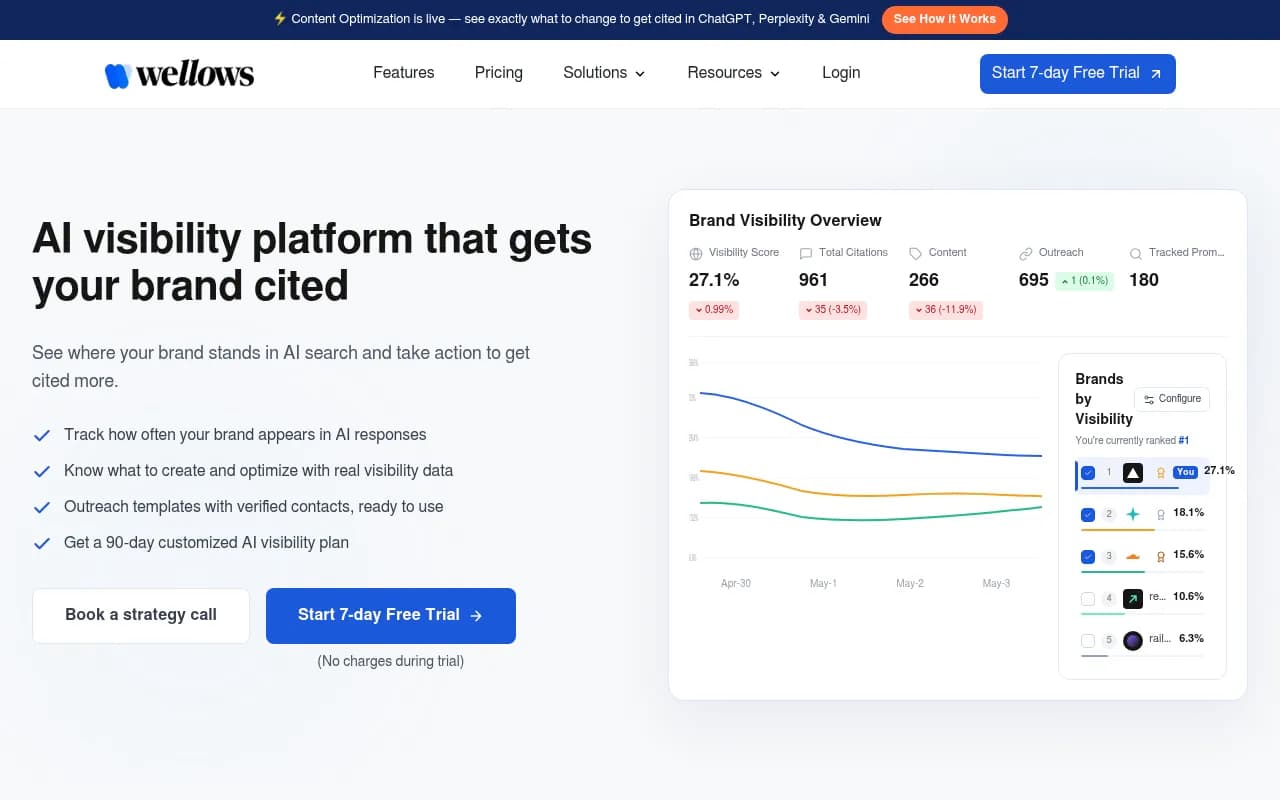
Wellows combines AI citation tracking with outreach tools. The idea is simple: see which pages get cited for your prompts, then reach out to the owners of those pages.
CrowdReply
CrowdReply focuses on getting cited on pages AI already trusts, often community and discussion pages. Given how volatile Reddit citations have been, I would treat this as one tactic among several, not the core of a program.

Outrank and SEO.AI
Both tools bundle automated content with backlinks. They are tempting if you want hands-off. I would be careful. Automated link exchanges and bulk placements are exactly what Google's spam policies target, and AI engines don't care about links from junk sites. Review any placements manually before you trust them.


Digital PR tools and services
Digital PR is where AI visibility gains tend to be largest, because journalists and editors write the "best of" articles that models cite. Position Digital's guide lists tools like MentionMatch for answering journalist requests, Alertmouse for turning unlinked brand mentions into links, and BuzzSumo (per LLMrefs) for PR research. I haven't tested these, so treat them as starting points to evaluate.
If you don't have a PR team, a managed service is another route. Otter PR sells guaranteed placements, though you should read what the guarantee actually covers before signing.

The free and low-cost approach still works well: respond to journalist requests quickly, publish original data, and make your claims easy to quote. Original research is the strongest asset in digital PR because it gives writers a reason to link.
Link monitoring
Links break and pages get edited. Linkody (recommended by Position Digital for agencies that need to prove links are still live) and the monitoring inside Ahrefs and Semrush all cover this. Check live status monthly at least. A placement you paid for that vanished in week three is a common and annoying surprise.
Measuring whether it worked
This is where most link building reports fall short. They count links and domain ratings. They don't show whether AI engines started citing you.
Tools like Promptwatch can help here. It tracks which pages and domains AI engines cite for your prompts, lets you watch specific URLs (yours or third-party placements) and see which prompts cite them, and picks up brand mentions on third-party pages even without a link. Its crawler logs also show whether AI bots are reading your pages. That closes the loop: run a campaign, then check whether the placement shows up in citations for the prompts you care about.

Other trackers worth a look if you prefer a different interface:
| Tool | Angle |
|---|---|
| Peec AI | Visibility tracking with suggestions |
| Profound | Enterprise AI search analytics |
| Otterly.AI | Affordable monitoring |
| LLMrefs | Query insights for citation optimization |
| AmICited | Tracks how AI engines cite your brand |
| MentionBird | Shows which sources AI engines cite |



MentionBird
Most of these are monitoring-first. If you want to go from "this competitor is cited and we aren't" to a content plan and published pages, check whether the tool also handles content gaps and publishing, not only tracking. For more options, the GEO software directory lists a wide range.
A simple workflow
- Pick 20 to 50 prompts your buyers would actually ask.
- Track which domains and pages get cited for them.
- Mark the listicles, comparisons and how-tos that appear repeatedly.
- Pull the contact details for those authors and publishers, using Respona, Hunter or Semrush.
- Pitch something specific: a data point, a correction, a missing option with proof.
- Monitor the links for liveness and the placements for citations over the next 4 to 8 weeks.
- Feed results back. Drop the pitch angles that never convert.
Your own pages matter too. Product and landing pages are the most cited types in ChatGPT, so a link to a weak product page wastes the placement. Fix the destination first, and consider publishing your own comparison page.
How to choose
| If you are | Start with |
|---|---|
| Solo founder or small team | Search Atlas or Respona, plus a free AI visibility scan |
| In-house SEO already on Semrush | Semrush link tools and its AI toolkit |
| Agency | Ahrefs or Semrush, Respona, link monitoring, a citation tracker with client reporting |
| Brand with PR budget but no team | A managed service such as Otter PR, plus citation tracking to verify results |
If you would rather hand this off, an SEO and GEO agency like 1001 SEO Media runs digital PR and link building alongside AI search work.
Mistakes to avoid
- Chasing domain rating alone. Promptwatch's August 2026 data found sites with domain rank 46 to 75 earned almost half of ChatGPT citations, while DR 91 to 100 fell to about 3% (report). Relevance beats raw authority.
- Buying links in bulk with automation and no review.
- Treating a single news hit as a lasting asset, given the 36-day half-life.
- Never checking whether placements led to citations.
- Betting everything on one platform, like Reddit.
Bottom line
Pick one tool for research, one for outreach, one for monitoring, and one for AI citation tracking. That's enough. Aim at the listicles and comparisons AI engines already cite, make sure the page you link to deserves it, and check results after a month. For more tools in adjacent categories, SurferStack has reviews and comparisons.