Key takeaways
- A monitoring-only tool answers "was I mentioned?" and stops. The tools worth switching to also plan, draft, and push content to your CMS, then check whether it got crawled and cited.
- "Execution" is a spectrum. Many tools recommend, some draft, and only a few publish directly to WordPress, Webflow, Framer, Sanity, Wix, or Shopify.
- Judge a tool on the formats it can ship. Product pages and landing pages are about 39% of ChatGPT citations, so a blog-post-only writer misses most of the surface.
- Published pages decay. A fix without a refresh loop is half a fix.
- Verify vendor pricing yourself. Several comparison guides online are written by the vendors being compared.
Why monitoring alone stopped being enough
I've watched a lot of teams buy an AI visibility dashboard, stare at it for a month, and then do nothing. The chart says your share of voice is 4%. Competitors are at 22%. Great. Now what?
That gap between insight and action is the whole story here. Prompt trackers are good at the first part: they run questions across ChatGPT, Perplexity, Gemini, and Google AI, and report who got named. The work that actually moves the number (writing the missing page, fixing a crawl error, refreshing a stale comparison) happens somewhere else, usually in a backlog nobody owns.
So a newer category has appeared: platforms that carry the finding through to a published page. This guide covers which ones do that, how far each one goes, and how to tell marketing from reality.

What "publishing the fix" actually means
The 3RD buyer's guide frames execution as five levels, and I think the framing is useful even though 3RD is a vendor ranking its own category. Roughly:
- Monitor: report mentions and citations.
- Recommend: say what to do.
- Plan: turn recommendations into prioritized tasks with owners.
- Draft: write the content in your brand voice.
- Publish: push it live, ideally with an approval step, then track the result.
Most products sit at level 2 or 3. Peec AI, for example, gives a prioritized action list with evidence, but you edit, export, and publish yourself. Semrush's AI Visibility Toolkit and Otterly.AI sit around level 2 or 3, with scores, audits, and content briefs. That's genuinely useful, but it's still a to-do list handed back to you.
The tools in this guide mostly live at levels 4 and 5.
What to look for before you switch
It should cover the formats AI actually cites
Promptwatch's data on which content types ChatGPT cites (Sep 28 to Oct 4, 2026) is a good filter for any content-generation claim. Product pages made up 22.4% of classified citations and landing pages 16.8%. Editorial formats added up to about 43%: listicles at 13.6%, how-to guides at 8.7%, comparisons at 5.9%, news at 5.7%.
For commercial prompts like "best CRM for small businesses," product pages, landing pages, listicles, and comparisons made up almost 70% of citations. If a tool only spits out 1,500-word blog posts, it's aimed at a minority of what AI cites. Ask whether it can produce comparisons, listicles, and landing-page copy, and whether it understands prompt intent.
It should come with a refresh loop
Content doesn't stay cited. In Promptwatch's content half-life study, pages ChatGPT cited on July 6, 2026 were tracked for 90 days. Landing pages and docs held up best (78% and 76% still cited after 30 days). Product pages, reviews, and how-tos had half-lives of roughly 74 to 77 days. News lost half its pages within 36 days.
The takeaway: publishing once and walking away is a slow leak. The better platforms flag underperforming pages and queue updates.
It should publish to your actual CMS
"Export to Google Doc" is not publishing. Check the integration list against what you run. Frase lists WordPress, Sanity, Webflow, Wix, and its own CMS. AthenaHQ's content agent publishes to Shopify. 3RD currently pushes drafts to HubSpot in beta, so you still do the final publish.
It should close the loop on results
The point of shipping a page is to find out whether AI crawled it, cited it, and sent anyone to your site. Tools that only generate content leave you guessing. Look for crawler logs, citation tracking per page, and AI traffic attribution.
The alternatives worth a look
Promptwatch
Promptwatch is the one I'd put first for teams that want the whole loop in one place. Its Content Agent plans, writes, and publishes against your visibility gaps, with a publishing calendar, monthly budget, and a review inbox where you approve, edit, or decline drafts (or run it hands-off). It publishes to WordPress, Webflow, and Framer, writes in the prompt's language, and works from a Brand Book and Knowledge Base so output stays on-brand.
What separates it from a plain writer is what happens around the content. Gap analysis maps your pages against the prompts AI answers. IP-verified AI crawler logs show whether GPTBot or ClaudeBot actually read the new page. Citation tracking and visitor analytics show whether it got cited and drove traffic, and underperformers come back as items on the Action Board. Business is the plan with the automated Content Agent, at $579/mo. Check promptwatch.com/pricing before you commit.

Frase
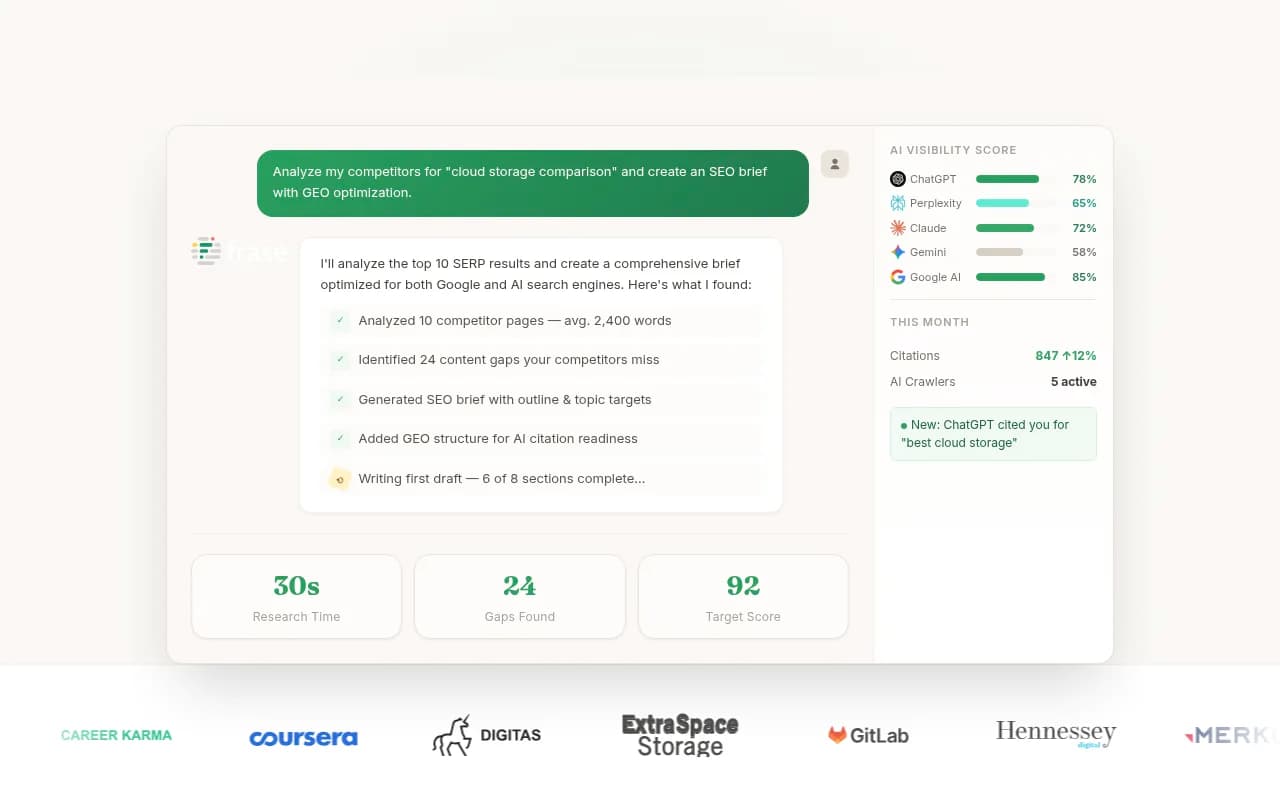
Frase is the most direct "monitoring that ends in a published fix" pitch. It checks ChatGPT, Perplexity, Claude, Gemini, and Google AI daily, alerts you when citations move, then researches the page, drafts the replacement, scores it for Google (SEO score) and AI answers (GEO score), and publishes to your CMS. Its Content Guard also watches live pages for ranking and traffic decay. It also exposes an MCP server and API for agent workflows. A note of caution: the most detailed comparison I found of Frase is on Frase's own blog, which ranks Frase first. It's a legitimate product, but test it yourself.
AthenaHQ
AthenaHQ tracks the major AI platforms, recommends fixes through an action center, and has a content agent that publishes to Shopify. That makes it a reasonable fit for ecommerce teams already living in Shopify, less obviously for everyone else.

KIME
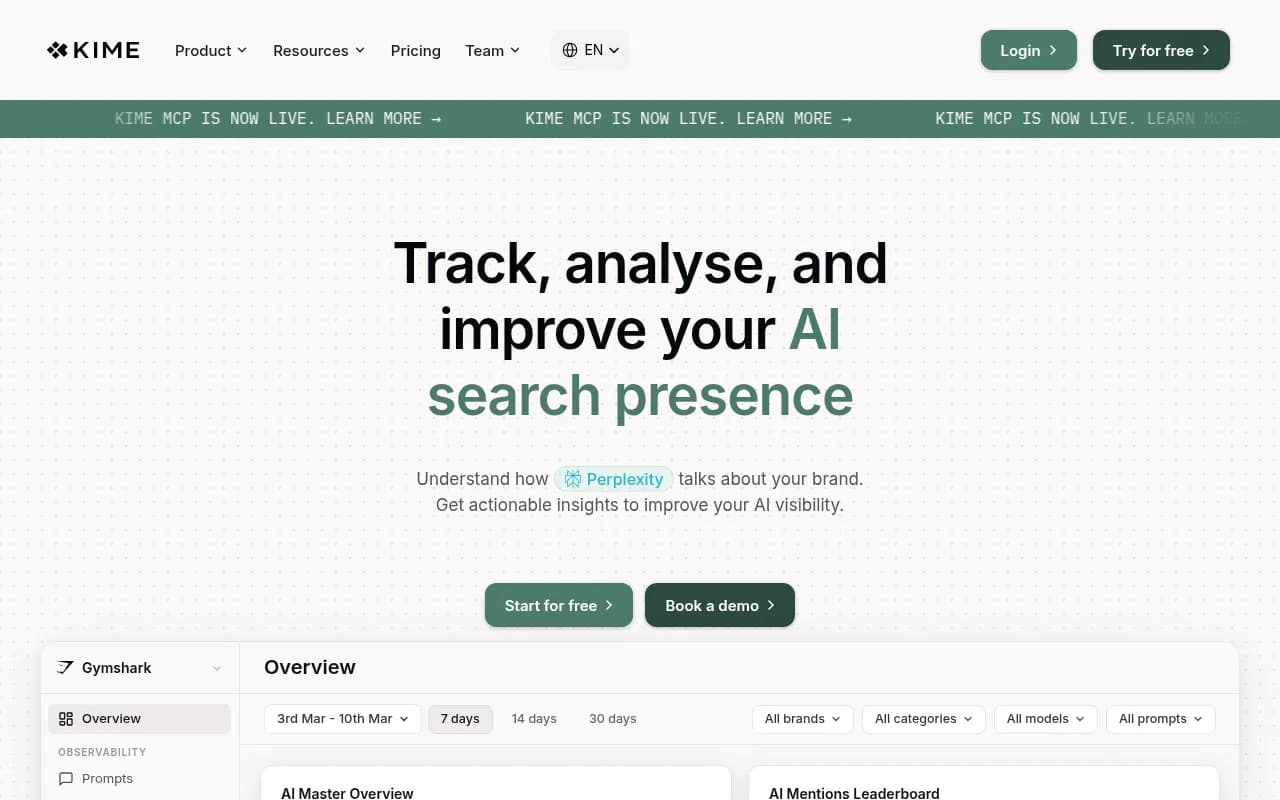
KIME's pitch is turning a visibility gap into an automated task, an outreach email, or a published page without leaving the platform, through its Agentic Workforce Execution layer, an MCP server, and a full API. It's an agent-first approach, and also a vendor-written ranking in the source I found, so treat the "best overall" label with salt.
Profound
Profound is the enterprise name most people know, with broad engine coverage (ChatGPT, Perplexity, Claude, Gemini, Copilot, Meta AI, Grok, DeepSeek, and AI Overviews) and an agency mode with pitch environments. It goes beyond raw monitoring, but it's priced for enterprise and I'd check carefully how much of the publishing step is automated versus advisory.

Scrunch
Scrunch is one of the few tools trying to influence outcomes rather than only report them, including agent-ready pages for your site. If your problem is partly how AI agents read your site, it's worth a demo.

Writesonic GEO
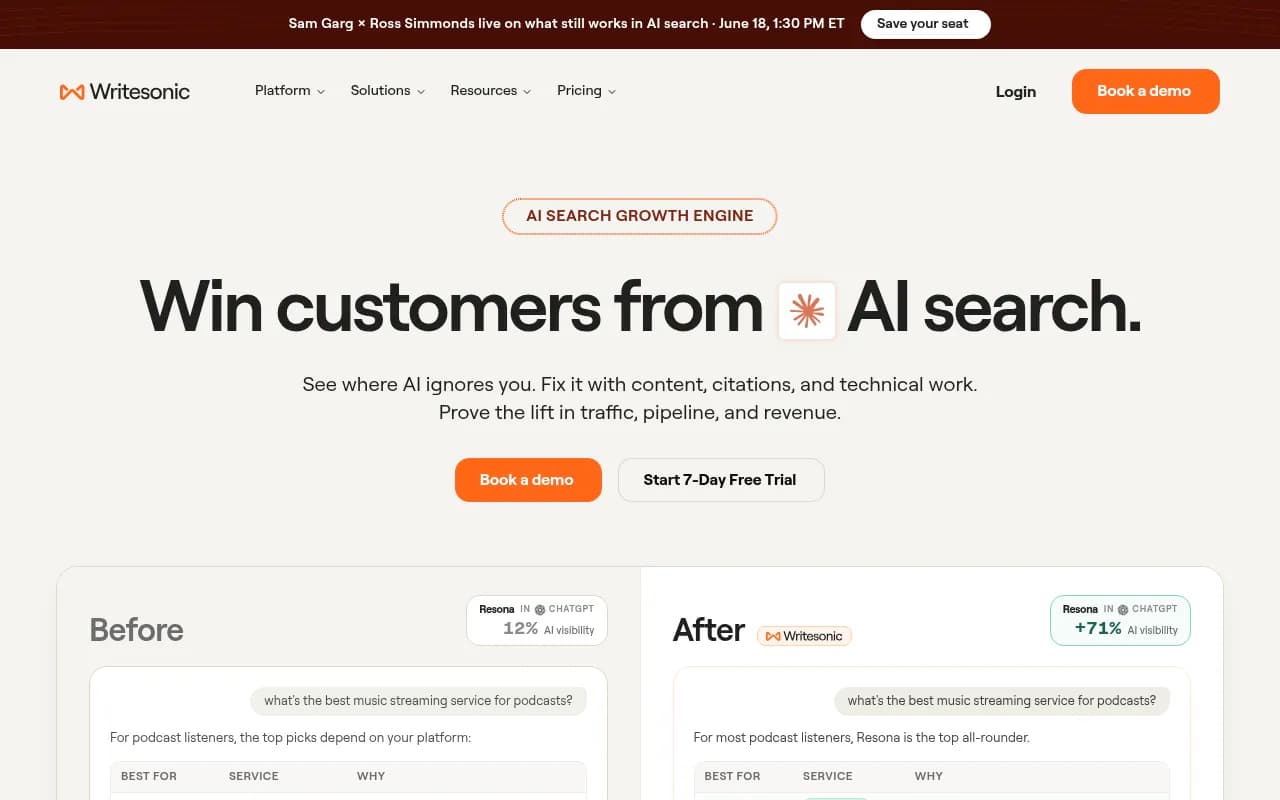
Writesonic pairs AI visibility monitoring with GEO content generation. It's a lower-friction pick for teams that already use Writesonic for writing and want tracking bolted on.
Relixir and Siftly
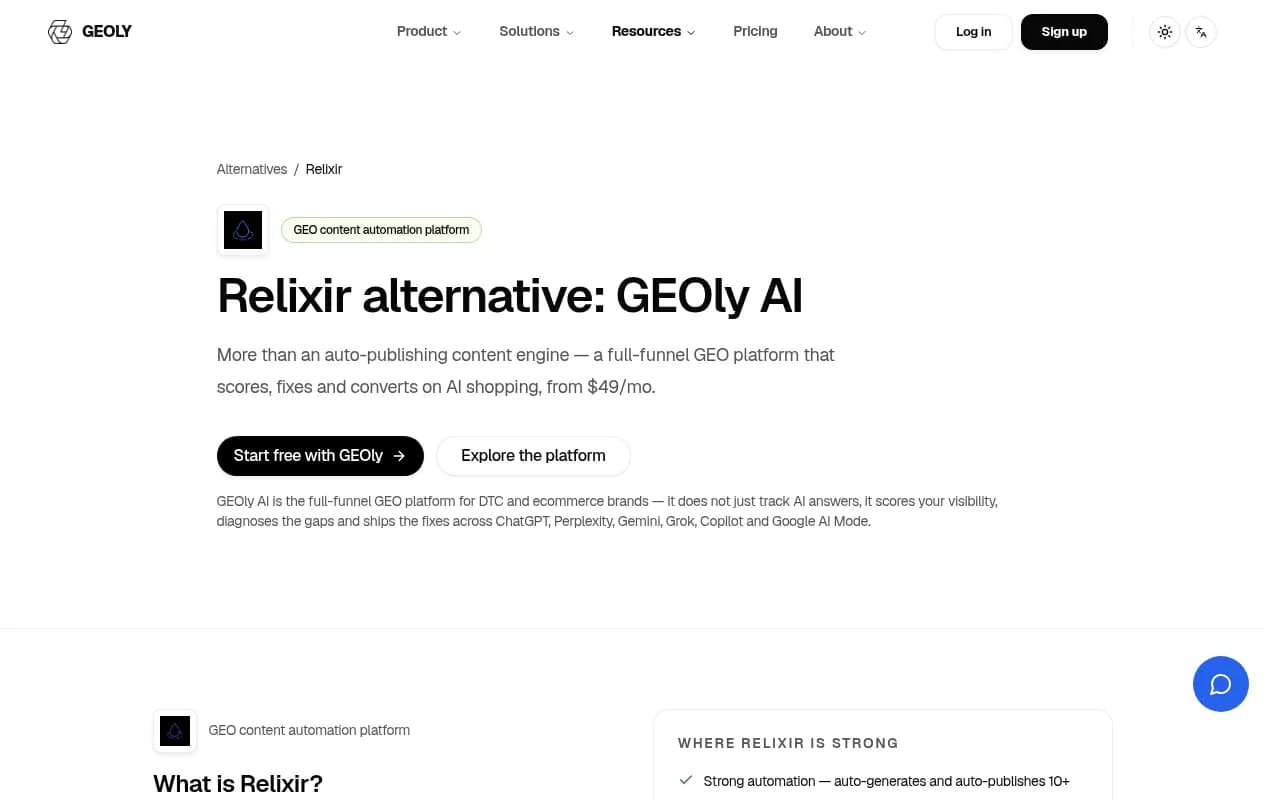
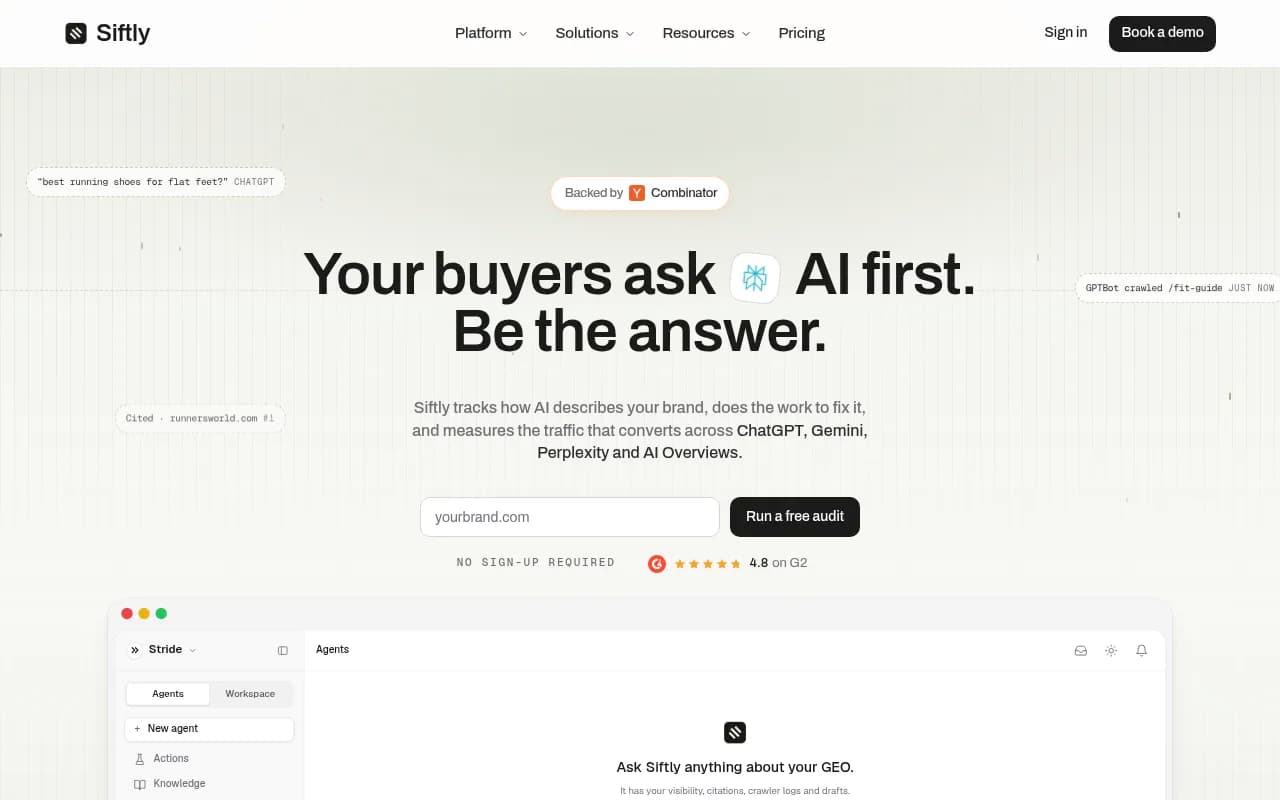
Both are smaller GEO content-automation plays: Relixir focuses on automating content for AI search visibility, and Siftly tracks mentions and generates GEO-optimized content. Newer vendors, so validate publishing integrations and output quality in a trial.
Where the monitoring-first tools still fit
Not everyone needs execution software. If you have a strong content team and just need a scoreboard, a cheaper tracker is a sensible buy.
- Peec AI offers prioritized actions and content optimization suggestions you edit and export yourself.

- Otterly.AI is low-cost monitoring with a GEO audit and content briefs.

- Semrush's AI Visibility Toolkit adds AI Visibility Score, share of voice, and an AI search audit inside an SEO suite you may already pay for.
For more options by category, the GEO software directory at bestgeosoftware.com and the agentic SEO tools list at agenticseotools.com are good places to keep browsing.
Side-by-side comparison
Prices and features below come from vendor pages and vendor-adjacent guides. Re-verify before buying.
| Tool | Highest level | Publishes to CMS | Closes the loop (crawl, citation, traffic) | Notes |
|---|---|---|---|---|
| Promptwatch | Publish, with review inbox or hands-off | WordPress, Webflow, Framer | Crawler logs, citations, visitor analytics, Action Board | Automated Content Agent on Business ($579/mo) |
| Frase | Publish | WordPress, Sanity, Webflow, Wix, FraseCMS | Alerts, citation share, AI crawler log | SEO and GEO scoring, Content Guard decay watch |
| AthenaHQ | Publish (Shopify) | Shopify | Action center | Best for Shopify stores |
| KIME | Publish via agents | Via platform and API | Task automation, MCP | Agent-first |
| 3RD | Draft (plus Plan) | HubSpot drafts (beta) | Playbooks, reports | From EUR 99/mo, you publish |
| Peec AI | Recommend and plan | No | Actions with owners and due dates | From EUR 85/mo |
| Semrush AI Visibility | Recommend | No | Score, share of voice, audit | $99/mo for 25 prompts |
| Otterly.AI | Recommend, with briefs | No | GEO audit, crawlability | From $29/mo |
How to test execution claims in a free trial
Every vendor says "agentic" now. A few quick tests separate real from rhetorical.
- Pick one real gap. Choose a prompt where a competitor is cited and you aren't, and ask the tool to fix it end to end.
- Check the output format. Did it produce a comparison page or a landing page, or only a generic article?
- Publish to a staging collection. Confirm the CMS integration writes fields correctly (title, slug, schema, images) rather than dumping raw text.
- Look for an approval step. Autonomous publishing without a review inbox is a brand risk.
- Ask how it knows the page worked. You want crawler data and per-page citation tracking, not a promise.
- Ask about refresh. What happens at day 60 when the page starts decaying?
Which one should you pick
If you want one platform that finds the gap, writes the page, publishes it, and then shows you whether AI crawled and cited it, start with Promptwatch and run the six-step test above. If you live in Shopify, add AthenaHQ to the shortlist. If your team is small and SEO-heavy and wants scoring plus publishing in a writer-style interface, try Frase. If you already have writers and only need a scoreboard, Peec AI or Otterly.AI will do and cost less.
The one thing I'd avoid: paying for a dashboard and calling the job done. A visibility score that never turns into a published page is just a number you check on Mondays.
For more reading on how AI picks sources, Promptwatch's data hub has current citation research you can use when planning what to publish.