Key takeaways
- A single user prompt triggers 8–10 parallel sub-queries inside AI search engines -- and 95% of those sub-queries show zero monthly search volume in traditional keyword tools, making them invisible to standard SEO audits.
- Your competitors may be winning citations across the full fan-out tree while your content only satisfies the root query -- this guide shows you how to map that gap systematically.
- The audit has five stages: reconstruct the fan-out tree, map competitor coverage, identify your own coverage, find the gaps, and create content that fills them.
- Tools like Promptwatch surface fan-out sub-queries with volume estimates and difficulty scores, so you can prioritize which gaps are worth chasing.
- This isn't just a content exercise -- it's a structural competitive advantage, because most brands still optimize for single keywords while AI models evaluate dozens of angles simultaneously.
Why your keyword rankings don't explain your AI visibility problem
You've probably noticed the disconnect by now. Rankings are holding. Traffic is down. And when you ask ChatGPT or Perplexity about your category, a competitor gets mentioned and you don't.
The explanation isn't mysterious. It's query fan-out.
When someone types "best project management software for remote teams" into an AI search engine, the model doesn't just look that phrase up. It immediately spawns a cluster of parallel sub-queries: something like "project management tools with async features", "remote team collaboration software reviews 2025", "Notion vs Asana vs Monday.com comparison", "project management software pricing", "complaints about [specific tool]", and several more. Each sub-query gets evaluated independently. Only sources that survive across multiple sub-queries make it into the final answer.
Data from AirOps covering 72,000+ AI-generated queries found that a single user prompt routinely triggers 8–10 parallel sub-queries before an answer is returned. About 95% of those sub-queries show zero monthly search volume in tools like Semrush or Ahrefs. They're invisible to traditional keyword research -- but they're the actual gatekeepers of generative visibility.
Your competitor might rank for the root query and six of its sub-queries. You rank for the root query and two. The AI model sees this imbalance and treats your competitor as the more authoritative, comprehensive source. That's the gap this audit is designed to find.
What query fan-out actually looks like
Before running the audit, it helps to understand the structure of a fan-out tree.
Take the prompt "how to save for retirement in your 30s." An AI model processing this will likely generate sub-queries along several dimensions simultaneously:
- Factual/definitional: "401k contribution limits 2025", "Roth IRA vs traditional IRA"
- Comparison: "best retirement accounts for 30-year-olds", "index funds vs target date funds"
- Recency: "retirement savings benchmarks by age 2025", "new IRS contribution rules"
- Risk/concern: "common retirement planning mistakes", "is it too late to start saving at 35"
- Social proof: "Reddit advice on retirement savings 30s", "financial advisor recommendations"
- Pricing/cost: "how much to save for retirement calculator", "retirement planning fees"
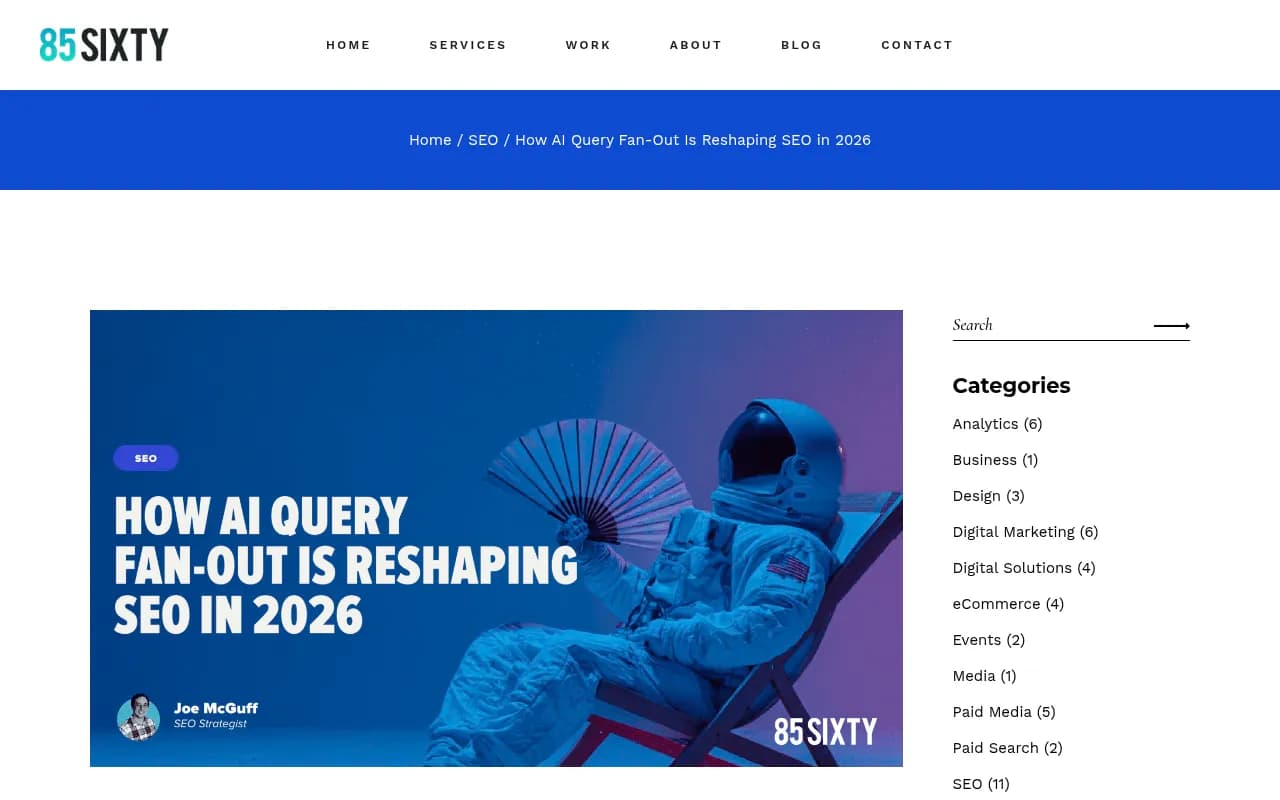
Notice that last category. The 85SIXTY analysis of fan-out patterns found that "free", "pricing", and "cost" appear in the top 5-grams of fan-out queries with surprising frequency. So does "pros and cons", "complaints", and "limitations." The AI is doing due diligence -- cross-checking, looking for consensus, trying to confirm its answer from multiple angles before committing.
If your content doesn't address the risk/concern dimension or the comparison dimension, you're invisible for those sub-queries. And that invisibility feeds directly into whether you get cited at all.
The five-stage competitive audit
Stage 1: Reconstruct the fan-out tree for your target prompt
Start with one high-value prompt -- a question your ideal customer would ask that sits at the top of your funnel. Don't try to audit everything at once.
For each target prompt, generate the fan-out tree. You can do this manually by prompting an LLM directly: ask ChatGPT or Claude to "list all the sub-queries you would search to answer [your prompt] comprehensively." You'll get a rough version of the fan-out tree. It won't be perfect, but it gives you a working structure.
A more systematic approach is to use a platform that tracks fan-out data from real AI search behavior. Promptwatch includes query fan-out data as part of its prompt intelligence -- showing how one prompt branches into sub-queries, along with volume estimates and difficulty scores for each branch.
The goal at this stage is a list of 15–30 sub-queries organized by dimension (comparison, recency, risk, pricing, social proof, etc.). This becomes your audit framework.
Stage 2: Map what your competitor ranks for across the tree
Now take your top competitor and systematically check their coverage across every sub-query in the tree.
For each sub-query, ask: does this competitor have a page, article, tool, or resource that would satisfy it? You're not just checking Google rankings -- you're checking whether the content exists and whether it's the kind of content an AI model would cite.
Go through each sub-query and note:
- Does the competitor have a dedicated page for this sub-query?
- Does that page appear in Google results for the sub-query?
- Does the competitor get cited when you ask an AI model this sub-query directly?
- What format is the content (article, comparison table, calculator, FAQ, video)?
This is tedious done manually, but it's the most revealing part of the audit. You'll often find that a competitor dominates the comparison and pricing sub-queries while being weak on risk/concern content -- or vice versa. That asymmetry tells you exactly where to attack.
For the AI citation check, you can test sub-queries directly in ChatGPT, Perplexity, and Google AI Overviews. Or use a monitoring tool to pull citation data at scale. Tools like Peec AI and Otterly.AI can show you which domains are getting cited for specific queries.
Stage 3: Map your own coverage
Do the same exercise for your own site. For each sub-query in the fan-out tree, document:
- What content you have (if any)
- Whether it appears in AI citations
- Whether it's getting traffic
- The format and depth of the content
Be honest here. A 200-word section buried in a longer article doesn't really "cover" a sub-query. AI models are looking for content that directly and comprehensively addresses the specific question. Thin coverage doesn't count.
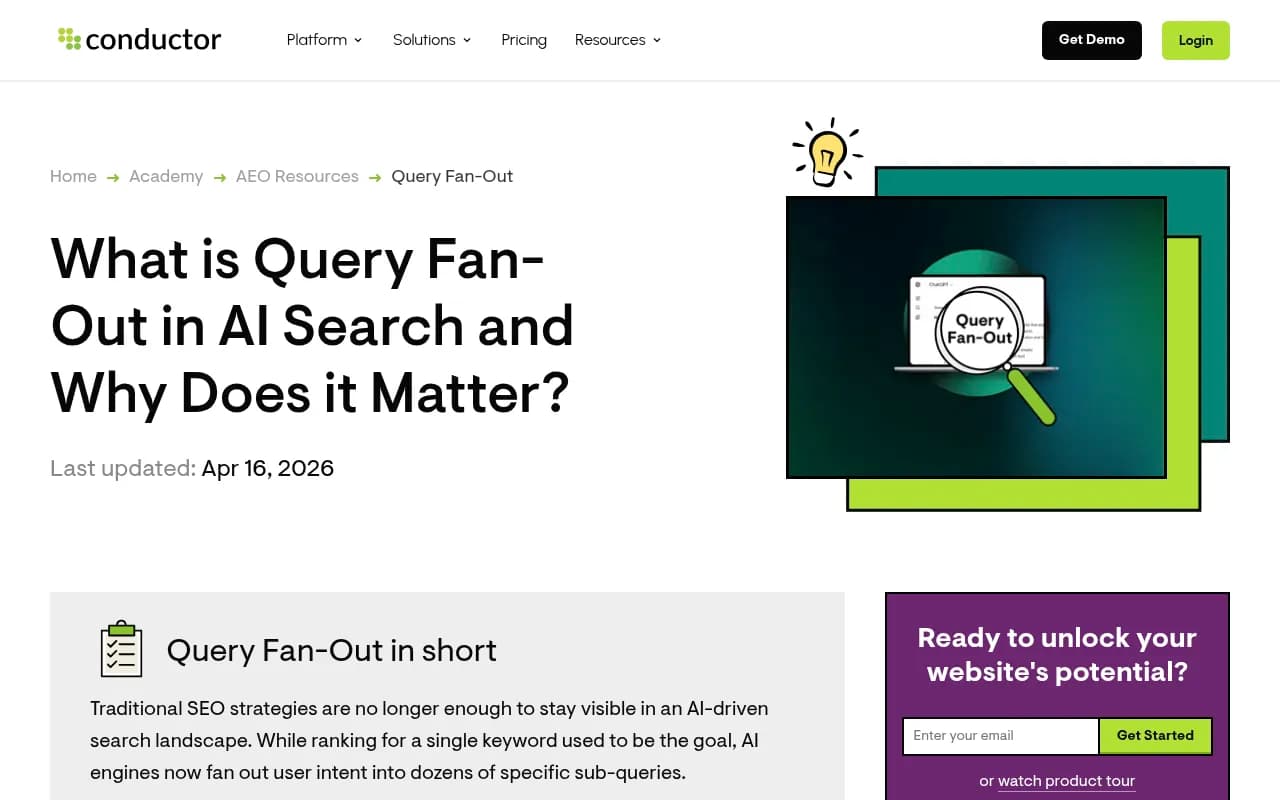
Stage 4: Build the gap matrix
Now you have two coverage maps. Put them side by side.
| Sub-query | Competitor coverage | Your coverage | Gap type |
|---|---|---|---|
| "[tool] vs [competitor] comparison" | Dedicated comparison page, cited in Perplexity | No comparison page | Missing page |
| "[tool] pricing 2025" | Pricing page + blog post | Pricing page only | Thin coverage |
| "[tool] complaints and limitations" | Forum posts + review responses | Nothing | Missing entirely |
| "[tool] for [specific use case]" | Use case landing page | Mentioned in one blog post | Thin coverage |
| "[tool] free trial" | Dedicated free trial page | Homepage CTA only | Missing page |
| "[category] best practices 2025" | Comprehensive guide, cited in ChatGPT | Outdated 2023 guide | Stale content |
The gap types matter because they require different responses:
- Missing page: You need to create net-new content
- Thin coverage: You need to expand or restructure existing content
- Stale content: You need to update and re-optimize
- Wrong format: You have the information but in a format AI models don't cite (e.g., buried in a PDF instead of a web page)
Stage 5: Prioritize and create
Not all gaps are equal. A sub-query that appears in 80% of fan-outs for your target prompt is worth more than one that appears in 20%. A gap in the comparison dimension is often more damaging than a gap in the recency dimension, because comparison sub-queries tend to be where AI models form their final recommendations.
Prioritize gaps by:
- Frequency -- how often does this sub-query appear in the fan-out tree?
- Competitor advantage -- how strong is their coverage vs. yours?
- Citation potential -- is this the kind of sub-query that produces AI citations?
- Difficulty -- how hard would it be to create competitive content?
Once you have a prioritized list, you're creating content briefs, not just keyword targets. Each brief should specify the sub-query it's targeting, the format that works best for that sub-query type, the competitor content it needs to outperform, and any recency or specificity requirements (dates, data, specific use cases).
The formats that win sub-queries
Different sub-query types favor different content formats. This matters because AI models don't just look for information -- they look for information in forms they can easily extract and cite.
| Sub-query type | Formats that get cited | What to avoid |
|---|---|---|
| Comparison ("X vs Y") | Dedicated comparison pages, tables | Comparisons buried in long articles |
| Pricing/cost | Transparent pricing pages, cost breakdowns | Vague "contact us for pricing" pages |
| Risk/concern ("complaints", "limitations") | Honest pros/cons sections, FAQ pages | Purely promotional content |
| Recency ("2025", "latest") | Dated articles with clear publish dates | Undated or old content |
| Social proof | Review roundups, case studies | Self-promotional testimonials |
| How-to/process | Step-by-step guides, numbered lists | Dense narrative prose |
| Definition/concept | Clear definitional sections, glossary entries | Assumed knowledge |
One thing that comes up consistently in fan-out research: AI models actively look for content that acknowledges limitations and risks. The 85SIXTY analysis found "pros and cons", "complaints", and "limitations" appearing regularly in fan-out sub-queries. If your content is purely promotional, you're invisible for this entire dimension -- and that's a signal to the AI that your content isn't trustworthy enough to cite.
Beyond your website: the offsite fan-out problem
Here's where most competitive audits stop short. They focus on website content and miss the fact that AI models pull citations from Reddit, YouTube, industry publications, and third-party review sites.
When an AI model runs a sub-query like "[your brand] reviews" or "[category] recommendations Reddit", it's not looking at your website at all. It's looking at what other people are saying about you. If your competitor has a strong presence in Reddit discussions, YouTube comparison videos, and industry listicles -- and you don't -- you're losing sub-queries that no amount of on-site content can fix.
The offsite audit is a separate exercise, but it follows the same logic: for each sub-query in your fan-out tree, check what's actually getting cited, whether it's your domain or someone else's. Tools like Promptwatch track offsite citations, including Reddit threads and YouTube videos that are driving AI visibility, which gives you a clearer picture of where the battle is actually being fought.
Tools that help at each stage
Running this audit manually is possible but slow. Here's a practical toolkit:
For mapping fan-out trees and tracking sub-query data:
Promptwatch includes native query fan-out data with volume estimates and difficulty scores. It's the most direct way to see how prompts branch and which branches matter most.
For checking competitor AI citations at scale:
For content gap analysis:

For tracking which sub-queries you're winning vs. losing:
A realistic timeline
This audit isn't a one-afternoon project. A realistic timeline for a single target prompt looks like this:
- Day 1: Build the fan-out tree (manual + tool-assisted), 20–30 sub-queries
- Day 2–3: Map competitor coverage across all sub-queries
- Day 4: Map your own coverage
- Day 5: Build the gap matrix and prioritize
- Week 2–4: Create content for the top 5–10 gaps
- Month 2: Track citation changes as AI models crawl and index new content
The tracking phase is where most teams give up too early. AI models don't instantly cite new content -- there's a lag between publishing, crawling, and citation that can take weeks. Platforms with AI crawler logs (Promptwatch shows exactly when AI crawlers hit your pages and when those pages move from crawl to citation) make this phase less of a guessing game.
The competitive reality in 2026
Most brands are still optimizing for single keywords. They're tracking rankings in Google Search Console and calling it an AI strategy. Meanwhile, their competitors are winning 8–10 sub-queries per prompt while they win one or two.
The query fan-out competitive audit is how you find out exactly where you're losing -- not in aggregate, not as a visibility score, but sub-query by sub-query. That specificity is what makes it actionable. You're not trying to "improve AI visibility" in the abstract. You're trying to create a comparison page that answers the "[your brand] vs [competitor]" sub-query better than anyone else, and a limitations page that makes the AI confident enough to cite you when users ask about risks.
That's a content brief. That's a task. That's something you can actually do.
The brands that figure this out in 2026 will have a structural advantage that compounds over time -- because every new piece of fan-out-targeted content makes the AI more confident in citing them across the full prompt tree, not just for one keyword.