Key takeaways
- Ecommerce SEO is different from blog SEO. You have thousands of product and collection pages, schema, faceted URLs, duplicate variants and out-of-stock pages. Pick tools that handle those.
- You now need two layers: a classic SEO suite (Semrush, SE Ranking, Ahrefs, Search Atlas) and an AI visibility layer that shows whether ChatGPT, Gemini and Perplexity recommend your products.
- Product pages and landing pages together are about 39% of ChatGPT citations, according to Promptwatch Data (Sep 28 to Oct 4, 2026), so product data quality is now an SEO task.
- Monitoring-only tools tell you what's wrong. Prefer tools that also help you fix it, whether that's content, schema or internal links.
- A sensible small-store stack costs well under $300 a month. Verify every price on the vendor's page, because they change often.
What makes an AI SEO tool good for ecommerce
Most "best AI SEO tools" lists are written for bloggers. They rank article writers and keyword clusterers. That's fine if you publish ten posts a month. It's not much help if you run 3,000 SKUs on Shopify and your real problems are thin category pages, missing Product schema and a crawl budget swallowed by filter URLs.
When I evaluate a tool for a store, I ask four questions:
- Does it handle scale? Can it audit or optimize thousands of product pages, not just a few articles?
- Does it understand product data, meaning schema, prices, availability and variants?
- Does it cover AI search? Shoppers increasingly ask ChatGPT "best running shoes for flat feet" instead of Googling.
- Does it fix things, or only report them? A 4,000-row audit spreadsheet is a to-do list nobody finishes.
A word on sources. Several of the "best ecommerce SEO tool" roundups online rank the vendor's own product first. One of them scores its own tool 9.2/10 and puts Semrush at 8.3. Another declares its own product "the best SEO tool for ecommerce" on its own domain. Treat those as vendor pages, not neutral tests, and check prices yourself.
Why AI search changes the ecommerce playbook
Promptwatch Data tracked what ChatGPT cites. For the week of Sep 28 to Oct 4, 2026, product pages were the most cited content type at 22.4%, landing pages followed at 16.8%, and listicles at 13.6%. For commercial prompts like "best X for...", product pages hit 26.0% and landing pages 20.6%. Branded prompts push reviews up to 5.6%, more than three times their overall share.
Two practical conclusions. First, your product pages are a citation surface, so specs, prices and positioning need to be complete and factual. Second, you want to be in the "best of" roundups ChatGPT cites, and you want your own comparison pages.
Shopping features are a smaller part of the picture. Promptwatch's ChatGPT shopping data shows product cards appear in only a low single-digit percentage of web-search responses, and the rate moves in steps, which suggests OpenAI keeps tuning it. Complete Product schema, accurate prices and availability, and a clean merchant feed are the sensible hedge.
Paid placement is also arriving. In Promptwatch's ChatGPT ads data, ads appeared in 20.1% of web-search responses on average between May 20 and Aug 17, 2026, with the last 7 days averaging 32.4%. Most of those were on organic-style prompts. If you sell products, expect competitors to show up next to your organic citations.
One more thing worth knowing: how long pages stay cited differs by type. News pages lose half their citations in about 36 days, while landing pages and docs keep most of theirs for months. For a store, that argues for evergreen category and buying-guide pages over news-style posts.
Quick comparison of the tools
| Tool | Layer | Best for | Starting price (verify) |
|---|---|---|---|
| Semrush | Classic SEO + AI visibility | All-in-one research for serious stores | Around $139/mo and up |
| SE Ranking | Classic SEO + AI visibility | Smaller budgets | Around $65 to $129/mo |
| Ahrefs | Classic SEO | Backlinks and competitor research | Free tier, paid plans from about $29/mo |
| Search Atlas | Classic SEO + on-page automation | Deploying on-page fixes at scale | Around $79/mo and up |
| Promptwatch | AI visibility + optimization | Finding and fixing AI citation gaps | Free tier, paid from $95/mo |
| Yotpo Discover | AI visibility for catalogs | Stores with lots of reviews | Demo-based |
| Ranketta | Product-level AI tracking | Per-SKU AI visibility | Check vendor |
| Alhena AI | AI visibility for catalogs | Catalog-wide tracking | Check vendor |
| InLinks | Internal links and schema | Entity-based linking | Check vendor |
| Surfer SEO | Content optimization | Collection and guide pages | Check vendor |
Prices in the table come from third-party roundups or vendor positioning and were not all independently verified. Confirm on each vendor's pricing page before buying.
Layer 1: the classic SEO suite
You still need keyword research, rank tracking, backlinks and technical audits. Google remains the biggest source of store traffic for most merchants.
Semrush
Semrush is the default recommendation in most of the roundups I read, and I mostly agree. Product keyword research, competitor content analysis, backlink tools and rank tracking segmented by country and device cover what a store needs. It has also added AI visibility tracking, so one bill covers both layers.
The downside is cost and sprawl. It's a big dashboard, and a 20-product store will use maybe a fifth of it. The AI-specific add-on is a separate product line, listed in our catalog as the Semrush AI Visibility Toolkit.
SE Ranking
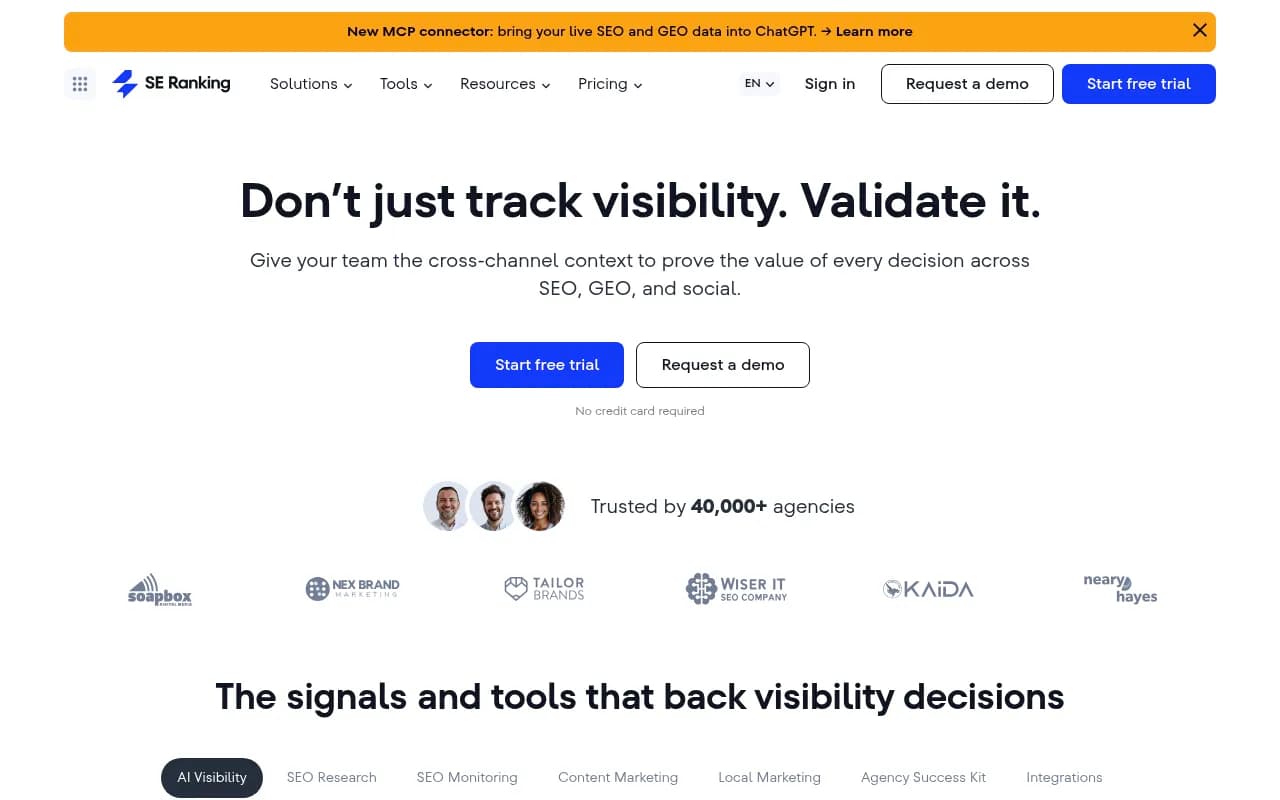
SE Ranking is the one I'd point budget-conscious stores toward. It covers rank tracking, audits and research at a lower entry price, and has an AI visibility product too.
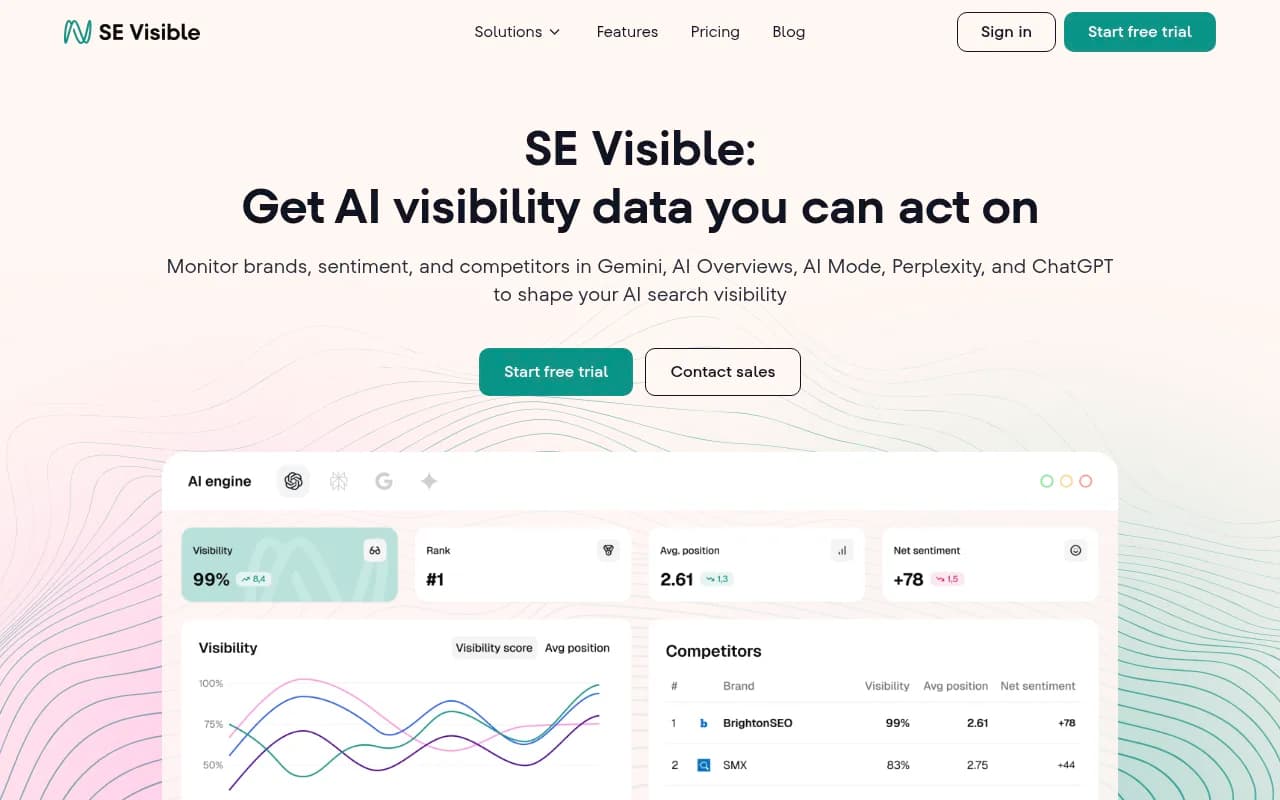
The AI side is sold separately as SE Ranking Visible.
Ahrefs
Ahrefs is strongest on backlinks and competitor research. If your growth plan leans on digital PR and links to category pages, it earns its place. Its Brand Radar feature tracks brand mentions across AI engines.

Search Atlas
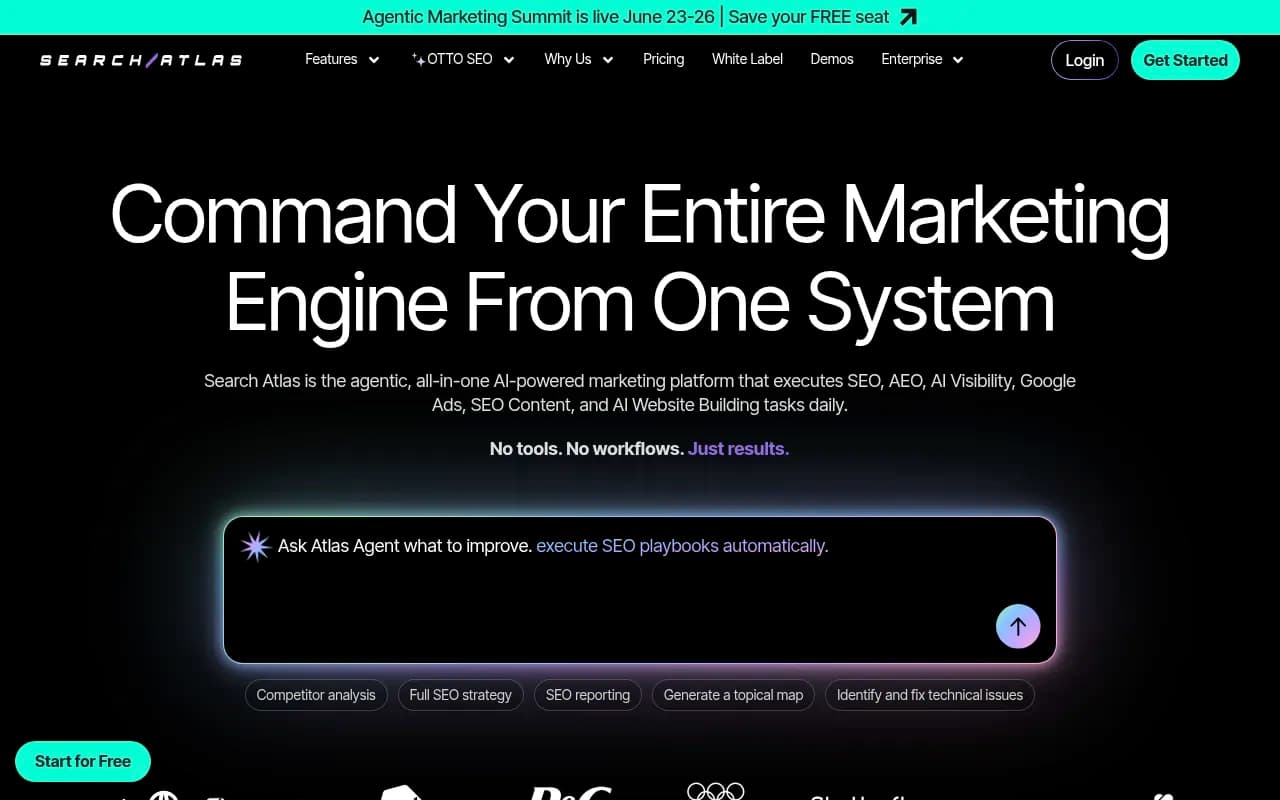
Search Atlas combines traditional and AI SEO and is known for deploying on-page changes through its OTTO feature rather than leaving them in a report. For a store with hundreds of pages needing title and meta cleanup, that kind of automation saves real time. Check how changes get applied to your platform (Shopify, WooCommerce) and whether you can roll them back.
Layer 2: AI visibility and optimization
This is the newer category. These tools query ChatGPT, Gemini, Perplexity and others with the prompts your buyers use, then report whether your brand and products show up.
Promptwatch
Full disclosure: 1001 SEO Media, which publishes this site, uses Promptwatch for its own GEO work. That said, it earns the slot on its features. Promptwatch goes past tracking: it shows which prompts you're missing, which pages AI cites, and whether AI crawlers can actually read your site (via IP-verified crawler logs). Then its Content Agent can draft and publish pages to Shopify-adjacent CMSs like Webflow, Framer or WordPress, and track whether those pages get cited. It also covers ChatGPT shopping carousels and Amazon Alexa product results, and you can upload a product catalog to track your own products, which matters for stores.

Pricing starts with a free Explore tier (10 prompts, ChatGPT only), then Essential at $95/month for 50 prompts across all models. Confirm current numbers at promptwatch.com/pricing. The AI-optimized content writing and the automated Content Agent sit on higher tiers, so smaller stores may only use the tracking and crawler-log side at first.
Ecommerce-specific trackers
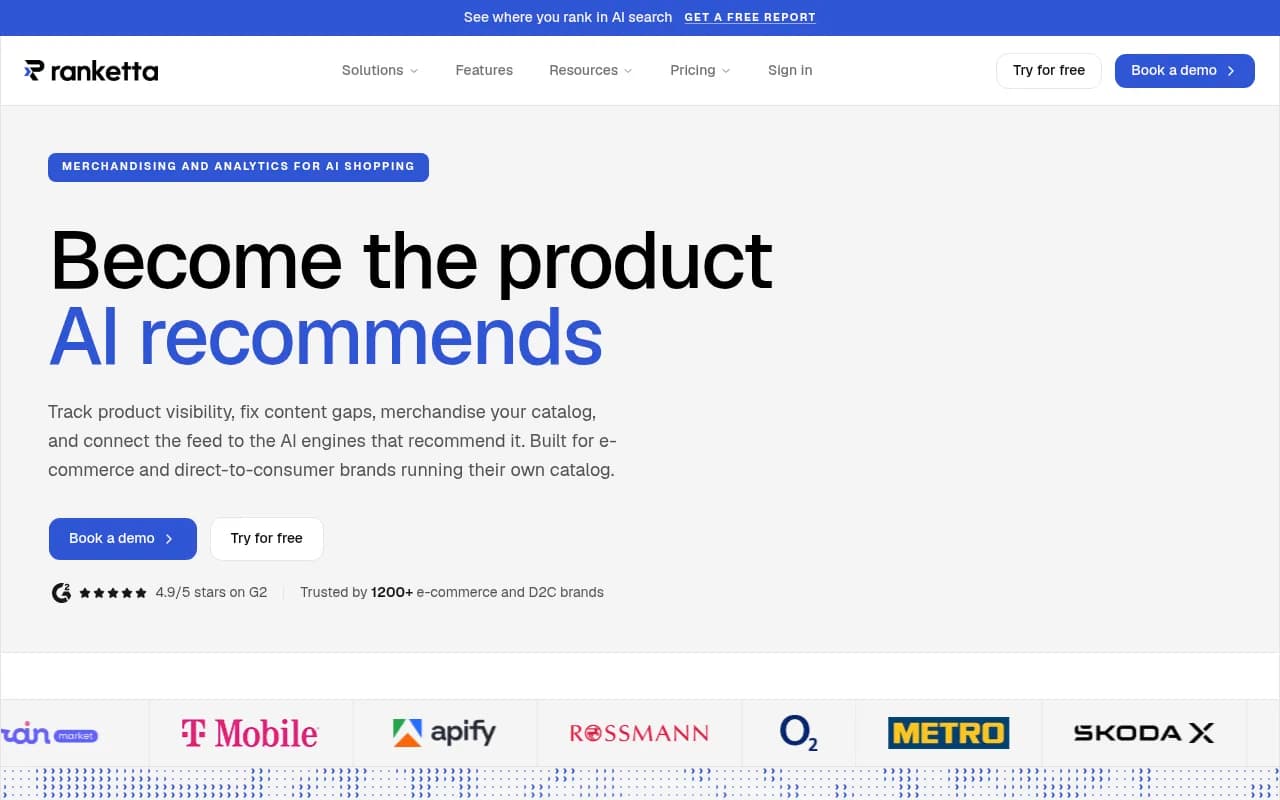
A few tools target catalogs directly. Ranketta tracks AI visibility at the product level, which is useful when you want to know whether a specific SKU gets recommended.
Alhena AI and Yotpo Discover both build AI visibility around catalogs, and Yotpo leans on review data.
Yotpo Discover
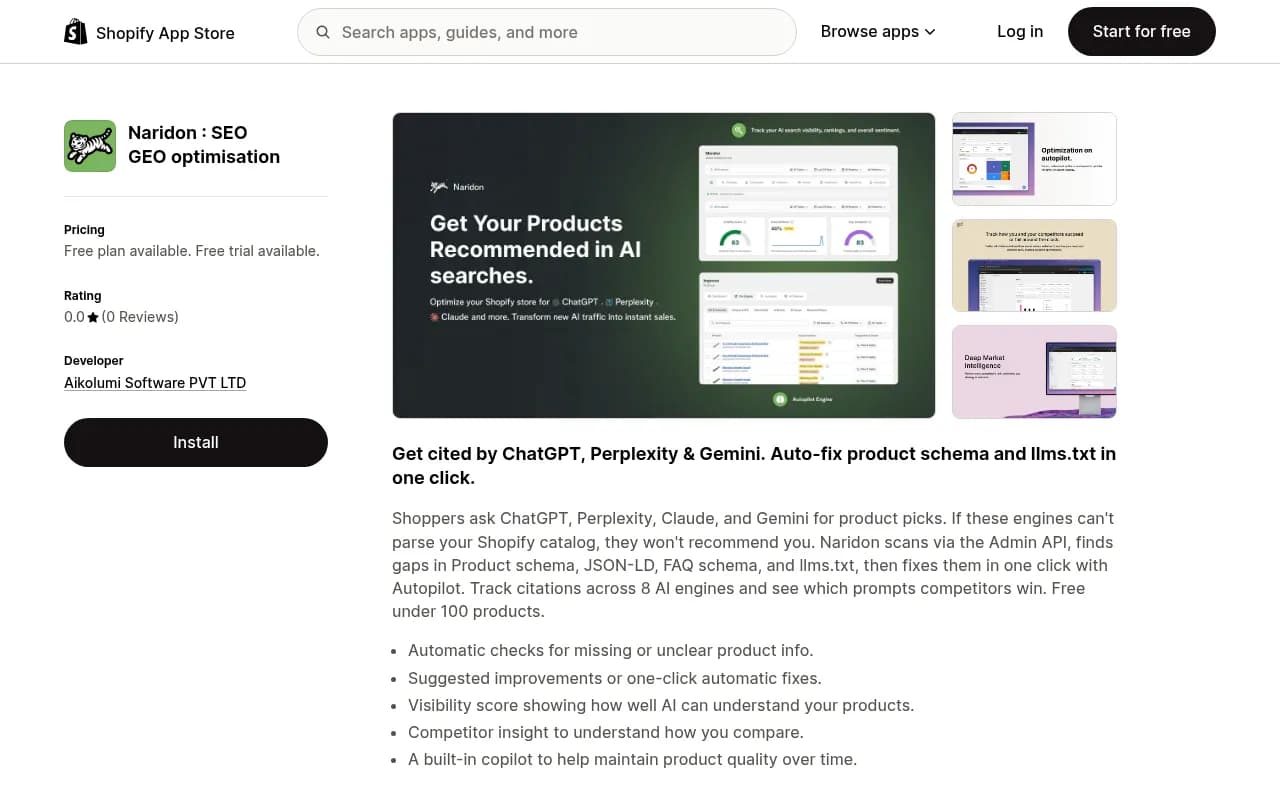
Naridon is a Shopify-native option for GEO monitoring.

I can't vouch for these in depth from the research I have, so treat them as shortlist candidates and run a trial against your own top 20 products.
Generalist trackers worth a look
If you want pure monitoring at a lower price, Otterly.AI and Peec AI are popular, though both stop at reporting. Profound is the enterprise pick.



For a wider view, the GEO software directory lists dozens more.
Layer 3: content, schema and internal links
Content optimization
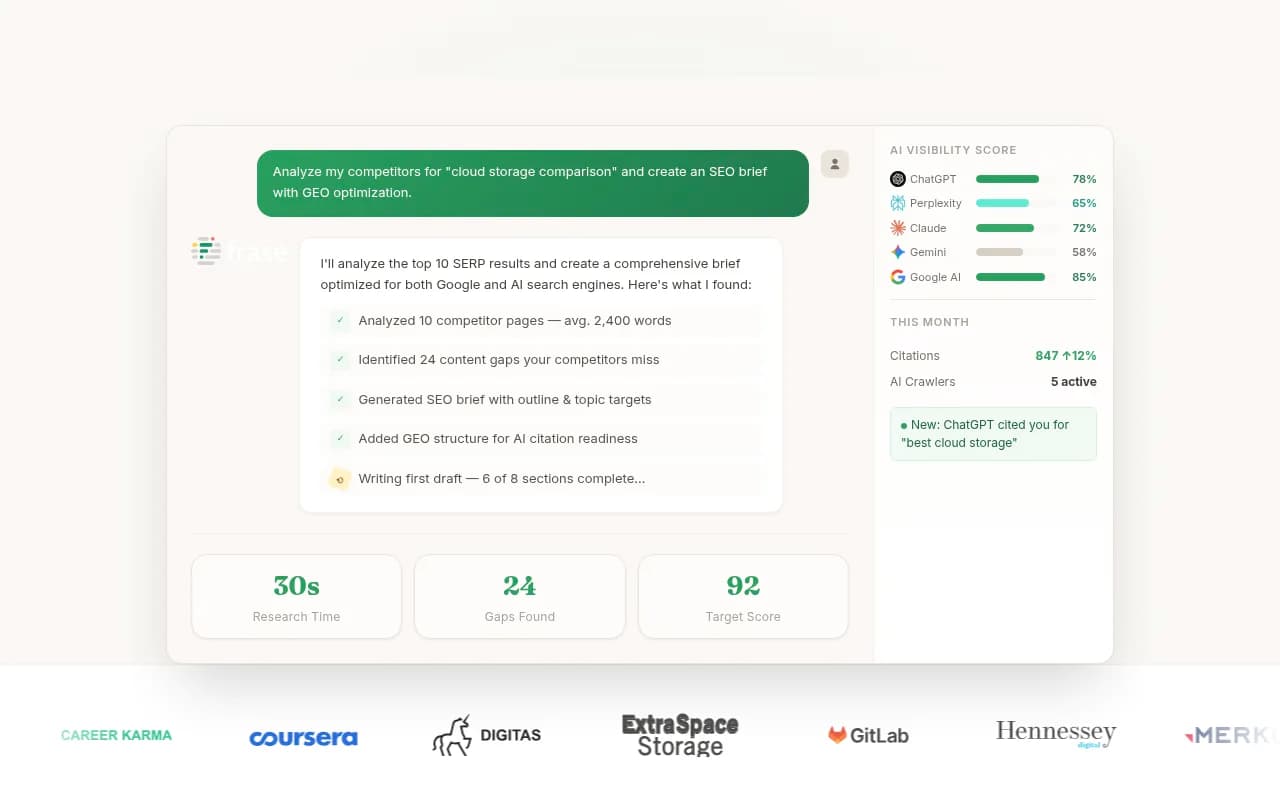
Collection pages and buying guides still need decent copy. Surfer SEO and Frase score drafts against what ranks.
For product descriptions at scale, Hypotenuse AI is built for ecommerce and handles catalog-sized batches.
Hypotenuse AI
Be careful with bulk generation. Thin, near-duplicate product descriptions are an old way to get a store demoted, and AI makes it easier to do at scale.
Schema and internal linking
InLinks automates entity-based internal links and schema, which is a decent fit for large category trees where manual linking breaks down.
Indexing
New stores or big catalogs sometimes wait weeks for discovery. Indexly focuses on faster indexing and pairs that with AI visibility checks.

The vendor pages I looked at
Here's the ranking page from Ryze AI, which positions itself as an ecommerce tool that applies fixes rather than only reporting them. It's a vendor page, so read the scores accordingly, but the framing (does the tool fix or only report?) is a useful one.
The OneLittleWeb list is more of an agency view, built on tools they use on client accounts, and it evaluates accuracy, pricing and integrations with GSC and GA4.
Suggested stacks by store size
| Store type | Suggested stack | Why |
|---|---|---|
| Small Shopify store (under 100 products) | SE Ranking + Promptwatch free tier or Essential | Cheap research plus a look at AI visibility |
| Growing store (hundreds of SKUs) | Semrush or Search Atlas + Promptwatch Essential/Professional | Research, on-page automation, and AI citation work |
| Large catalog (thousands of SKUs) | Semrush + InLinks + an AI visibility platform with crawler logs | Scale, internal linking, and diagnosis of what AI can read |
| Review-heavy brand | Add Yotpo Discover | Reviews influence branded AI prompts |
A practical workflow
- Audit first. Run your suite's site audit and fix faceted URL bloat, duplicate variants and missing schema before anything else.
- Fix Product schema. Make sure price, availability, brand, GTIN and review data are accurate and consistent with your feed.
- Build your prompt list. Write 30 to 50 questions shoppers ask, such as "best [product] for [use case]" and "[your brand] vs [competitor]". Track them weekly in an AI visibility tool.
- Check crawler access. If AI bots are blocked or erroring on your product pages, nothing else matters. Server logs or a tool with crawler logs will show it.
- Publish comparison and buying-guide pages. These feed the listicle and comparison share that AI cites.
- Earn third-party mentions. Roundups and review sites are cited heavily for commercial prompts.
- Re-measure monthly. AI results shift. Promptwatch Data has shown sudden swings in how ChatGPT searches and what it cites, so one snapshot isn't enough.
What to skip
- Auto-publishing generic blog posts. Frizerly-style weekly blog automation may help some stores, but it won't fix product pages, which are the main AI citation surface.
- Tools with no way to verify results. If you can't see which pages were crawled and cited, you can't tell if the work paid off.
- Paying for three overlapping suites. Pick one primary suite and one AI visibility tool.
For broader tool browsing, Surferstack has reviews and alternatives across categories, and AI Rank Tools covers rank trackers.
Bottom line
For most stores, start with one classic suite (Semrush if budget allows, SE Ranking if not), add one AI visibility tool that can also tell you what to fix, and spend the saved time on product page quality. The data says product and landing pages are what AI cites most, so that's where the effort pays back. Re-check all pricing on vendor pages before committing, since several figures in public roundups are unverified.