Key takeaways
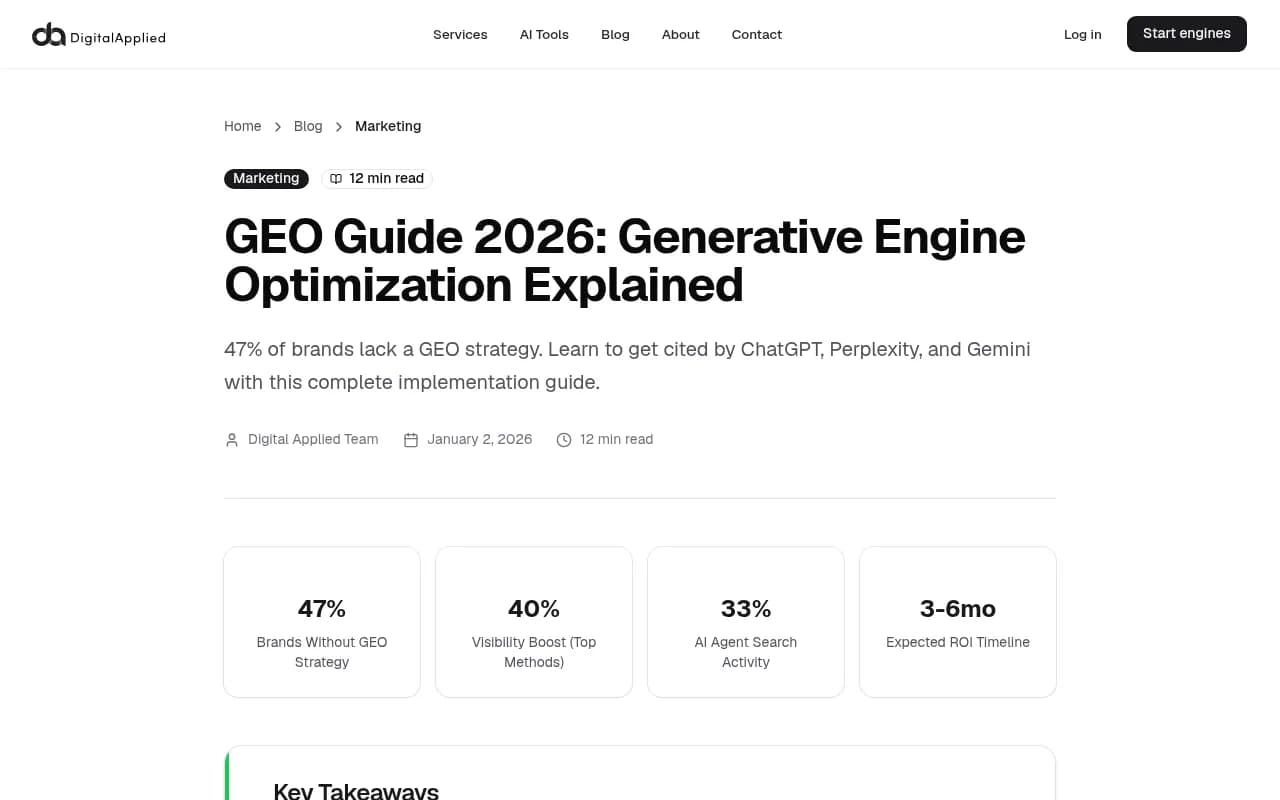
- GEO (Generative Engine Optimization) is the practice of making your content get cited by AI search engines like ChatGPT, Perplexity, Gemini, and Claude -- not just ranked on Google.
- It's different from traditional SEO: AI engines synthesize answers from multiple sources rather than listing links, so the goal is to be the source they pull from.
- Princeton researchers found that citing sources, adding statistics, and including quotations can improve AI visibility by 30-40%.
- About 47% of brands still have no GEO strategy, which means early movers have a real window right now.
- Measuring GEO requires new metrics -- "Share of Model" (how often your brand appears in AI responses vs. competitors) rather than just keyword rankings.
What GEO actually is
If someone at your company has recently asked "are we showing up in ChatGPT?" -- that question is about GEO.
Generative Engine Optimization is the practice of optimizing your website and content so that AI systems cite, reference, or summarize your brand when generating answers to user queries. When someone types "what's the best project management tool for remote teams?" into Perplexity or ChatGPT, GEO determines whether your product gets mentioned or whether a competitor does.
The term was coined by Princeton researchers in 2023. By 2026, it's moved from academic curiosity to genuine marketing discipline. According to data from Digital Applied, roughly 47% of brands still have no GEO strategy -- which is either alarming or an opportunity, depending on where you sit.
The core idea is simple: AI search engines don't rank pages. They read content, synthesize it, and generate an answer. Your job is to be the content they choose to synthesize.
How AI search engines actually work
To understand GEO, you need to understand what's changed about search.
Traditional search engines (Google, Bing) crawl the web, index pages, and return a ranked list of links. The user clicks one and reads it. Your goal as a publisher was to rank high enough that people clicked your link.
AI search engines work differently. When a user asks a question, the engine retrieves relevant content from across the web, then uses a large language model to synthesize a single coherent answer. It might pull from five different pages, blend their information together, and present it as one response -- with citations at the bottom, or sometimes without any at all.
This changes the game in two ways:
- There's no "page 1" to rank on. Either your content gets cited or it doesn't.
- The AI is making editorial decisions about which sources to trust, quote, and reference.
Google's own developer documentation now covers what it calls "AI optimization" -- acknowledging that optimizing for AI-generated features like AI Overviews requires a different approach than traditional SEO.
GEO vs. SEO: what's actually different
These two disciplines overlap more than people think, but they're not the same thing.
| Dimension | Traditional SEO | GEO |
|---|---|---|
| Goal | Rank high in search results | Get cited in AI-generated answers |
| Output | A link in a results list | A mention or quote inside an answer |
| User behavior | User clicks a link | User reads the AI's answer |
| Content format | Keyword-optimized pages | Authoritative, citable, structured content |
| Measurement | Rankings, organic traffic | Share of Model, citation frequency |
| Key signals | Backlinks, on-page SEO | Expertise, data, citations, clarity |
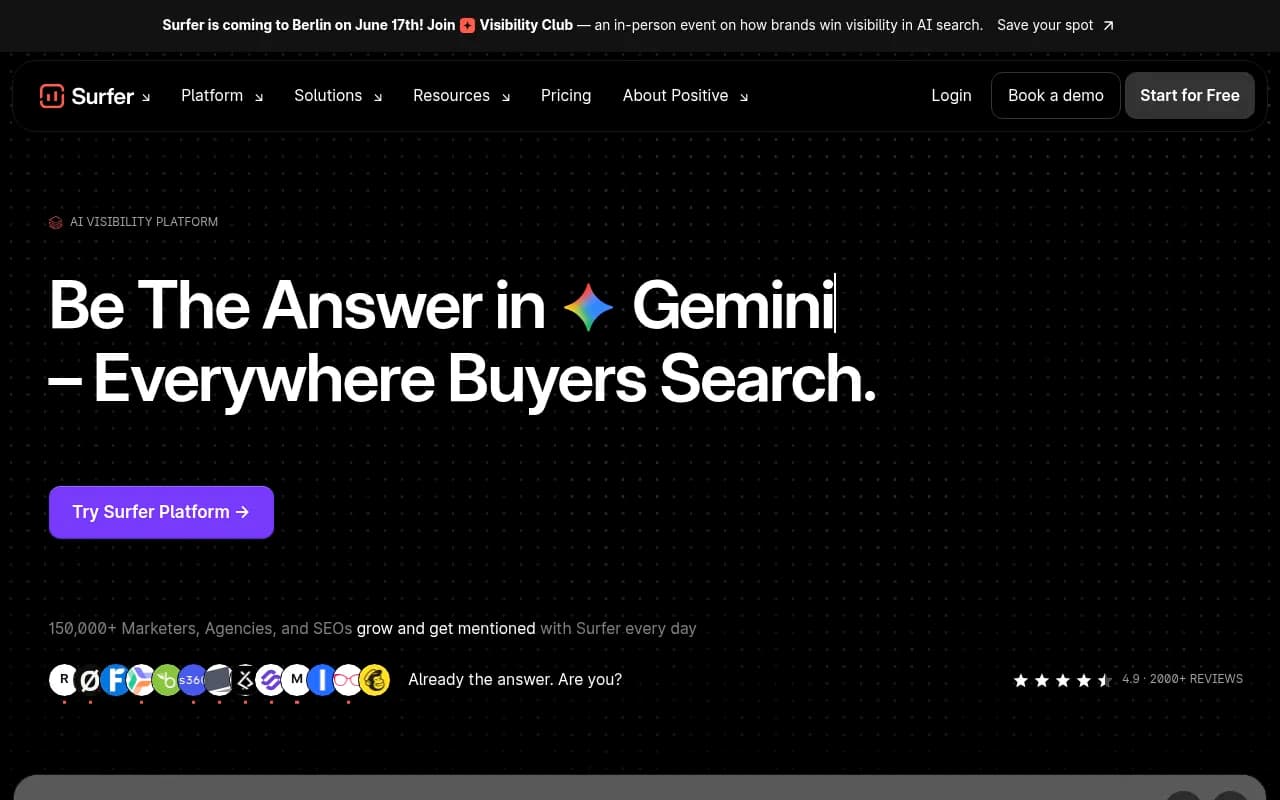
| Tools | Semrush, Ahrefs, Surfer | Promptwatch, Peec AI, Otterly.AI |
The good news: GEO builds on SEO. AI engines tend to pull from content that already ranks well in traditional search. If your SEO foundation is weak, GEO will be harder. But strong SEO alone won't get you cited -- you also need content that reads as authoritative and citation-worthy to an AI.
Think of it this way: SEO gets you in the room. GEO gets you quoted.
GEO vs. AEO: is there a difference?
You'll see both terms used. "AEO" stands for Answer Engine Optimization, and it refers to the same basic idea -- optimizing for AI systems that generate answers rather than lists of links.
Google's developer documentation treats them as essentially synonymous. In practice, most practitioners use "GEO" when talking about generative AI systems (ChatGPT, Perplexity, Gemini) and "AEO" when talking specifically about voice search or featured snippets -- but the line is blurry and getting blurrier. Don't get too hung up on the terminology.
Why GEO matters right now
A few things are happening simultaneously that make 2026 a critical moment:
AI search is growing fast. Perplexity reported over 100 million monthly active users in early 2026. ChatGPT's search feature is now used by hundreds of millions of people. Google's AI Overviews appear on a significant portion of all searches. These aren't niche products anymore.
Traffic patterns are shifting. When users get a complete answer from an AI engine, they often don't click through to any website at all. This is the "zero-click" problem -- but with a twist. Brands that get cited still benefit from the mention, the brand association, and the occasional click. Brands that don't get cited get nothing.
The window for early movers is real. With nearly half of brands still having no GEO strategy, there's genuine competitive advantage available to companies that move now. That window will close.
What makes content citation-worthy
Princeton researchers ran experiments testing which content modifications most improved AI citation rates. The results are worth knowing:
- Citing sources in your content: +40% visibility improvement
- Adding statistics and data: +37%
- Including direct quotations from experts: +30%
- Using technical terminology appropriately: +28%
This isn't surprising when you think about it. AI engines are trying to generate trustworthy answers. They prefer content that itself demonstrates trustworthiness -- through data, citations, and clear expertise.
Practical content principles for GEO
Write for humans first, but structure for machines. AI engines parse content to extract answers. Clear headings, direct answers to specific questions, and well-organized information all help.
Be specific. Vague, hedging content doesn't get cited. If you're writing about "the best CRM for small businesses," give an actual recommendation with reasons, not a list of considerations.
Include original data. If you have proprietary research, survey results, or unique data, publish it. AI engines love citing original data because it makes their answers more credible.
Answer questions directly. The format "Question: [X]. Answer: [Y]." is almost too obvious, but it works. AI engines are looking for content that directly answers the queries users are asking.
Build topical authority. Covering a topic deeply across multiple pages signals expertise. An AI engine is more likely to cite a site that has 20 well-researched articles about supply chain logistics than one that has a single generic overview.
The technical side of GEO
Content quality matters most, but technical factors play a role too.
Schema markup helps AI engines understand what your content is about. FAQ schema, HowTo schema, and Article schema all give structured signals about your content's purpose and format.
Page speed and crawlability matter because AI engines need to be able to access your content. If your pages are slow, blocked by robots.txt, or behind login walls, they can't be cited.
Structured data in general -- clear author information, publication dates, organization markup -- signals credibility. AI engines are trying to assess trustworthiness, and these signals help.
One thing that's become more important in 2026: AI crawler logs. Tools like Promptwatch now track when AI crawlers (from ChatGPT, Perplexity, Claude, etc.) actually visit your pages -- which pages they read, how often they return, and whether those visits eventually lead to citations. This is genuinely new information that didn't exist a couple of years ago.

Off-site GEO: it's not just your website
One thing that surprises people when they first get into GEO: AI engines don't only cite your own website. They cite Reddit threads, YouTube videos, review sites, industry publications, and third-party listicles.
This means GEO has an off-site dimension that traditional SEO also has, but it works differently. Getting your brand mentioned in a Reddit thread that AI engines frequently cite can drive visibility just as much as optimizing your own pages. Same with being included in "best of" listicles on authoritative sites.
The practical implication: GEO strategy should include PR, community engagement, and third-party content -- not just your own website optimization.
How to measure GEO success
This is where a lot of teams get stuck. Traditional SEO metrics (rankings, organic traffic) don't capture AI visibility. You need different measurements.
"Share of Model" (SoM) is the primary GEO metric. It measures how often your brand appears in AI responses to relevant queries, compared to competitors. If you ask 100 relevant questions to ChatGPT and your brand appears in 23 of the answers while your main competitor appears in 41, your SoM is 23%.
Citation frequency tracks how often specific pages on your site get cited across different AI engines and different query types.
Prompt coverage measures how many of the relevant queries in your space your brand has any visibility for at all -- useful for finding gaps.
AI-attributed traffic is harder to measure but increasingly trackable. Some platforms can now connect AI citations to actual website visits and conversions.
Manually checking these metrics is tedious and doesn't scale. Most teams doing GEO seriously use a dedicated tracking tool.
Tools for GEO in 2026
The GEO tool landscape has grown quickly. Here's a practical breakdown:
For tracking and monitoring
These tools show you where you're visible (and where you're not) across AI engines:





For content optimization
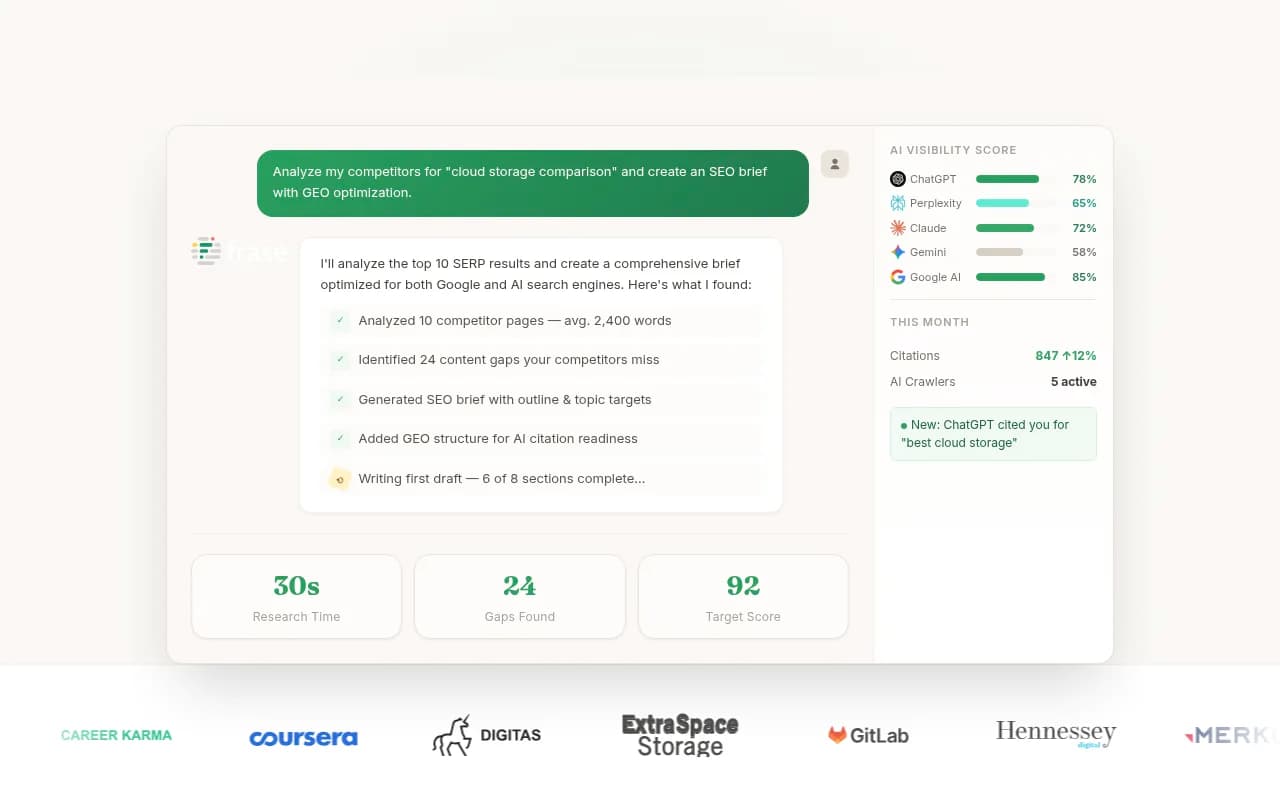
These help you create content that's more likely to get cited:

For full-cycle GEO (tracking + optimization)
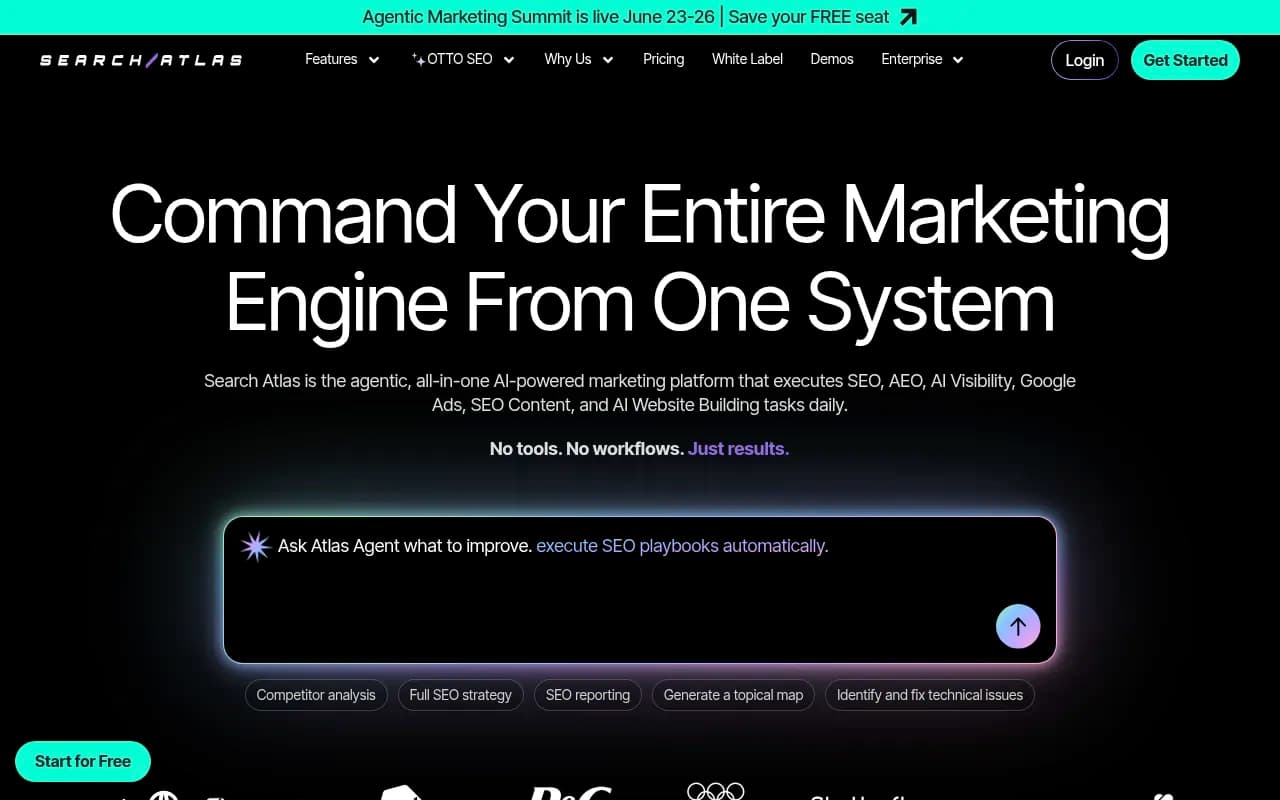
A few platforms try to close the loop between finding gaps and fixing them:
Promptwatch is worth calling out here because it goes beyond monitoring. Most tools tell you where you're not visible. Promptwatch also shows you which specific content gaps are causing that invisibility, then helps you generate content to fill them -- with AI crawler logs, prompt volume data, and page-level citation tracking built in.

A practical GEO starting point
If you're new to this and want to start somewhere concrete:
- Pick 20-30 questions your target customers ask that your product or service answers. These are your seed prompts.
- Run those prompts through ChatGPT, Perplexity, and Gemini manually. Note which competitors appear and whether you do.
- For prompts where you don't appear, look at what content exists on your site (or doesn't) that would answer that question well.
- Prioritize creating or improving content for the highest-value gaps -- the questions with the most commercial intent where you're currently invisible.
- Set up a tracking tool to monitor your Share of Model over time so you can see whether your changes are working.
That's the basic loop. Find gaps, create content, track results, repeat.
The relationship between GEO and traditional SEO
Worth saying clearly: GEO doesn't replace SEO. Google still processes billions of searches per day, and traditional organic rankings still drive enormous amounts of traffic. The brands winning in 2026 are doing both.
But the weight is shifting. AI-generated answers are appearing on more and more searches. The users who are most valuable to many businesses -- researchers, decision-makers, high-intent buyers -- are increasingly using AI search tools as their primary research method.
The content investments you make for GEO (authoritative, data-rich, well-structured content) also tend to perform well in traditional search. They're complementary disciplines, not competing ones.
What GEO looks like in practice
A concrete example: a B2B software company selling expense management tools wants to appear when finance teams ask "what's the best expense management software for mid-sized companies?"
Their GEO strategy might include:
- Publishing a detailed comparison page that cites industry data, includes specific pricing, and directly answers common objections
- Getting reviewed on G2, Capterra, and similar platforms that AI engines frequently cite
- Creating content around adjacent questions ("how to reduce expense report processing time", "expense management best practices") to build topical authority
- Monitoring which AI engines cite them and which cite competitors, then analyzing the content differences
- Tracking AI crawler visits to understand which pages are being read and which aren't
This isn't radically different from good content marketing. It's content marketing with a clearer understanding of who the audience actually is -- and in 2026, part of that audience is an AI engine deciding what to recommend.
Where GEO is headed
The honest answer is that no one knows exactly how AI search will evolve. The models change, the interfaces change, and the signals that drive citations will change too.
What's unlikely to change: AI engines will keep trying to generate trustworthy, accurate, useful answers. Content that is genuinely authoritative, well-sourced, and directly helpful will keep performing well. The fundamentals of good content -- expertise, clarity, specificity -- aren't going anywhere.
The brands that will struggle are those that treat GEO as a technical trick to game. The ones that will win are those that use GEO as a framework for creating content that actually deserves to be cited.
That's a higher bar than keyword stuffing. It's also a more defensible position once you get there.